
There is something undeniably appealing about the liveaboard lifestyle. You wake up anchored in a remote bay, dive some of the most spectacular reefs on the planet, and spend your surface intervals watching the ocean stretch endlessly in every direction. When the sun goes down, the group gathers on deck, the stars come out, and someone inevitably suggests opening a cold beer.
It sounds harmless. After all, you are on holiday. But drinking and diving is one of the most underestimated risk combinations in recreational scuba, and on a liveaboard, where you may be doing three or four dives a day for a week straight, the stakes are even higher.
This article breaks down exactly what happens when alcohol enters the equation, why the risks are greater than most divers realize, and how to enjoy your Komodo liveaboard trip without putting yourself or your dive buddies in danger.
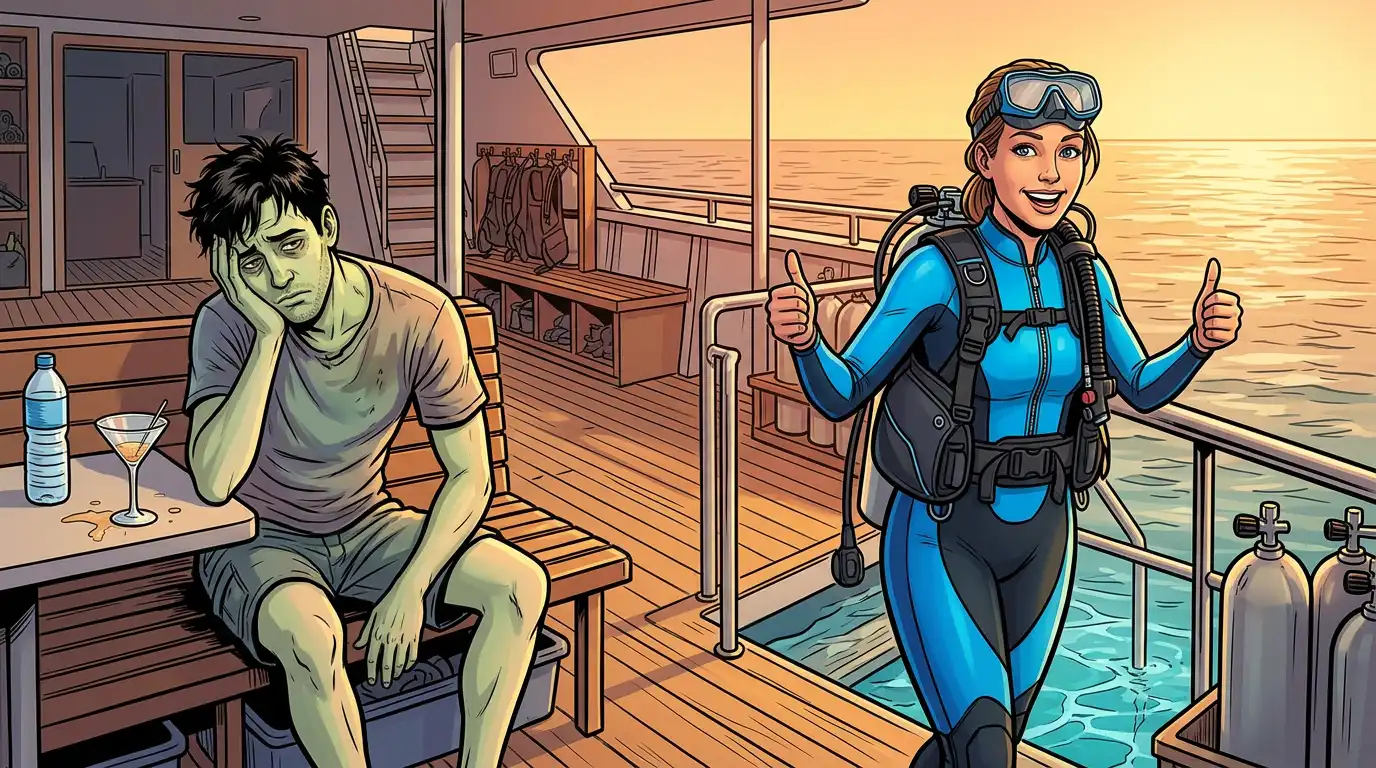
Drinking and Diving: How Alcohol Affects the Body Underwater
To understand why drinking and diving is dangerous, you first need to understand how alcohol interacts with the specific physiological demands of scuba diving. On the surface, the effects of a few drinks are familiar — relaxation, lowered inhibitions, slower reaction times. Underwater, every one of these effects becomes amplified and potentially life-threatening.
Impaired Judgment and Reaction Time
Scuba diving requires continuous decision-making to avoid increased risk or diving accidents. Consuming alcohol will block this decision making for scuba divers. You monitor your depth, air supply, ascent rate, and buddy position simultaneously while managing buoyancy and responding to changing conditions. Alcohol slows cognitive processing and reduces the ability to react quickly to unexpected situations such as a free-flowing regulator, a sudden current, or a buddy in distress.
Research consistently shows that even blood alcohol concentrations well below the legal driving limit can measurably impair the kind of divided-attention tasks that diving demands. The problem is compounded at depth, where increased partial pressures of nitrogen already challenge mental clarity.
Accelerated Heat Loss
Alcohol causes peripheral vasodilation — your blood vessels widen, sending warm blood to the skin's surface. On land, this creates the familiar flushed feeling. Underwater, it accelerates heat loss to the surrounding water. Core body temperature drops faster, increasing the risk of hypothermia even in tropical waters, and cold stress further degrades cognitive and motor function.
On a liveaboard in warm water, many divers already push the limits of thermal comfort across multiple daily dives. Alcohol removes whatever margin they had.
Dehydration
Alcohol is a diuretic. It inhibits the release of antidiuretic hormone (ADH), causing the kidneys to produce more urine and the body to lose fluid faster than it can replenish. For divers, dehydration is not just uncomfortable — it is directly linked to one of the most serious diving injuries. This is why drinking and diving is really a bad idea.
Dehydrated blood is thicker and circulates less efficiently, reducing the body's ability to transport and eliminate dissolved nitrogen from tissues during and after ascent. This sets the stage for decompression sickness.
Drinking and Diving: The Decompression Sickness Connection
Decompression sickness, commonly known as the bends, occurs when dissolved nitrogen forms bubbles in the blood and tissues during or after ascent. Under normal conditions, the body eliminates this nitrogen gradually and safely during ascent and surface intervals. But when the system is compromised, bubble formation becomes more likely.
Drinking alcohol compromises the system in multiple ways simultaneously, a high risk for drinking and diving that sometimes causes symptoms we can't even predict and in the worst of the cases, unfortunately, scuba fatalities.
Dehydration Reduces Off-Gassing Efficiency
As discussed, alcohol induced dehydration thickens the blood and impairs circulation. With reduced blood flow, nitrogen is transported away from tissues more slowly which in simple terms means a high nitrogen retention which in return turns into what? decompression sickness DCS! The standard dive tables and computer algorithms assume a normally hydrated diver. When you are dehydrated, you are effectively diving outside the parameters your computer is calculating for, so drink plenty of water and avoid alcohol consumption on diving trips... better enjoy your scuba vacation, your night dives, than drinking alcohol and dealing with nitrogen narcosis or worse.
Alcohol Alters Blood Flow Patterns
Beyond simple dehydration, alcohol changes how blood is distributed throughout the body. Peripheral vasodilation redirects blood away from deep tissues and toward the skin. This means nitrogen-saturated tissues in the core receive less blood flow for off-gassing, while the skin — now flushed with blood — may absorb more nitrogen than usual.
This redistribution creates an off-gassing imbalance that standard decompression models do not account for.
Impaired Recognition of Symptoms
One of the most insidious dangers of mixing alcohol and diving is that the early symptoms of decompression sickness — fatigue, dizziness, mild confusion, joint aches — overlap significantly with the symptoms of a hangover. Divers who have been drinking may dismiss or fail to recognize DCS symptoms, delaying treatment during the critical window when it is most effective.
On a liveaboard far from a hyperbaric chamber, delayed recognition can turn a treatable incident into a medical emergency. Yet another reason why drinking and diving should be avoided.
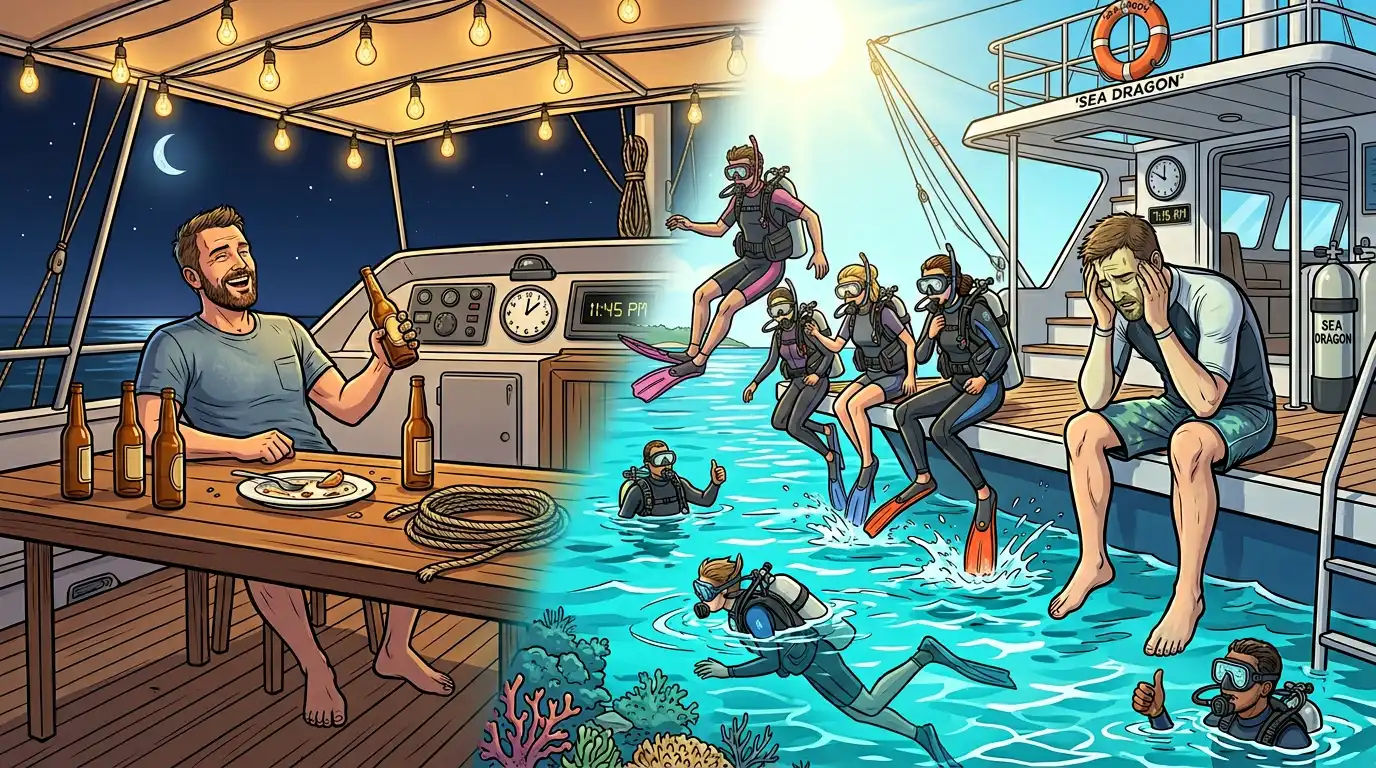
Nitrogen Narcosis and Alcohol: A Dangerous Amplifier
Nitrogen narcosis is the intoxicating effect of breathing nitrogen at elevated partial pressures, typically becoming noticeable around 30 meters. It affects judgment, coordination, and emotional regulation in ways that are often compared to alcohol intoxication. In fact, the old rule of thumb — Martini's Law — estimates that every 10 meters of depth is equivalent to drinking one martini on an empty stomach.
Now consider what happens when you add actual alcohol to the equation.
A diver who has been drinking is already starting from a baseline of impaired function. Add nitrogen narcosis on top of that, and the combined effect is not additive — it is synergistic. A diver at 30 meters who drank the night before may experience narcosis equivalent to a much deeper dive. Decision-making capacity that might have been adequate at that depth is now severely compromised.
On liveaboard trips that frequently include deeper dives on walls, wrecks, or pinnacles, this combination represents a genuine threat that is entirely preventable.
The Liveaboard Factor: Why the Risk Is Greater
A liveaboard diving trip amplifies every risk associated with drinking and diving for reasons that are specific to the format.
Multiple Dives Per Day Over Multiple Days
Liveaboard itineraries typically include three to four dives per day for five to ten days. This means your body is continuously loading and off-gassing nitrogen with relatively short surface intervals. There is very little margin for error in this schedule, and any factor that impairs off-gassing — such as dehydration from alcohol — has a cumulative effect over the course of the trip.
A diver who drinks moderately every evening may feel fine on day one or two but enter a state of chronic mild dehydration by mid-trip that significantly increases DCS risk on later dives.
Limited Medical Access
Liveaboards operate in remote locations same like many dive resorts. That is a large part of their appeal — pristine, uncrowded dive sites far from shore. But it also means that in the event of a diving emergency, medical facilities may be hours away. Hyperbaric chambers are often located on the mainland or on specific islands, and evacuation in rough seas or at night adds further delay.
When you are two days from the nearest hospital, prevention is not just preferable — it is essential.
Social Pressure and Holiday Mentality
Liveaboards create a close-knit social environment. Evening meals are shared, stories from the day's dives are exchanged, and the atmosphere is relaxed and convivial. In this setting, it can feel awkward to decline a drink, especially when others are indulging.
The holiday mentality also works against caution. Divers may rationalize that one or two drinks will not make a difference, particularly if they have done it before without incident. But the absence of a negative outcome in the past does not equal safety — it means you were fortunate.
Compounding Environmental Stressors
Liveaboard divers are exposed to continuous sun, wind, salt water, and physical exertion. All of these contribute to fluid loss. When alcohol is added to an already dehydrating environment, the total fluid deficit can become substantial without the diver fully realizing it.
Additionally, sleep quality on a boat is often less than ideal — motion, noise, shared cabins, and early wake-up calls all contribute. Alcohol disrupts REM sleep further, meaning a diver who drinks in the evening is less rested, less sharp, and less physiologically prepared for the demands of the next morning's dive.
What the Dive Industry and Medical Organizations Say
The position of every major dive training agency and diving medical organization is clear and consistent.
PADI's guidelines state that divers should be in good physical and mental condition and should not dive under the influence of alcohol or drugs. SSI, NAUI, and BSAC hold similar positions. The Divers Alert Network, widely regarded as the leading authority on dive medicine, has published extensively on the risks of alcohol consumption in relation to diving and recommends avoiding alcohol for at least 8 hours before any dive, with 24 hours being the safer standard after heavy consumption.
DAN's research has identified alcohol as a contributing factor in a significant percentage of dive fatalities and near-miss incidents. Their annual diving incident reports consistently highlight impaired judgment — often linked to alcohol or fatigue — as a root cause of preventable accidents.
These recommendations are not arbitrary. They are based on decades of incident data and physiological research. So trust us when we say, drinking and diving should not mix.
How Long Should You Wait After Drinking Before Diving?
There is no single definitive answer because individual metabolism varies based on body weight, tolerance, liver function, hydration status, food intake, and the amount consumed. However, the following guidelines represent the consensus of dive medicine professionals.
After one standard drink, wait a minimum of 8 hours. This is the absolute floor and assumes you are otherwise well-hydrated and well-rested.
After moderate drinking — two to three drinks — wait at least 12 hours and focus on aggressive rehydration before diving.
After heavy drinking — four or more drinks — wait a full 24 hours. Even at 24 hours, you may still be experiencing some degree of dehydration and sleep deficit, so conservative dive profiles are advisable.
On a liveaboard with an early morning first dive, even a single drink after dinner can cut into the recommended minimum window. This is why many experienced liveaboard divers simply choose to abstain entirely during the trip.

Practical Tips for Managing Alcohol on a Liveaboard
Choosing not to drink on a liveaboard does not mean sacrificing the social experience. Here are practical approaches that experienced divers use.
Prioritize hydration throughout the day. Carry a water bottle and drink consistently between dives. Coconut water and electrolyte drinks are excellent choices. By the time you feel thirsty, you are already mildly dehydrated.
Eat well and rest when you can. Proper nutrition and adequate sleep do more for your diving performance and enjoyment than any drink can. Take advantage of surface intervals for naps when possible.
Choose non-alcoholic alternatives in the evening. Most liveaboards stock a range of soft drinks, juices, teas, and coffee. Some now carry non-alcoholic beers and mocktails. You can participate fully in the social atmosphere without alcohol.
If you do choose to drink, keep it minimal. One drink on a night when the next morning's dive is later in the schedule, combined with extra water intake, is a far lower risk than multiple drinks on an early-dive morning.
Be honest about how you feel. If you wake up feeling less than optimal — whether from alcohol, poor sleep, or any other reason — communicate with your dive guide. Skipping one dive is always preferable to pushing through when your body is telling you something is wrong.
Set the tone for your group. If you are an experienced diver, your choices influence those around you. Choosing water sends a signal that safety is a priority, and it gives others permission to make the same choice without feeling they are missing out.
The Bigger Picture: Risk Management in Diving
Scuba diving is a remarkably safe activity when conducted within established guidelines. The training, equipment, and procedural standards that exist today are the product of decades of refinement. But diving safety ultimately rests on individual decisions, and those decisions are only as good as the condition of the person making them.
Drinking and diving introduces a variable that degrades every aspect of a diver's capacity — physical, cognitive, and physiological. It does so in ways that are difficult to self-assess in the moment and that interact dangerously with the unique stresses of the underwater environment.
On a liveaboard, where the diving is intensive, the environment is remote, and the social setting encourages relaxation, the temptation to treat alcohol as a normal part of the experience is understandable. But the best liveaboard trips are defined by extraordinary diving, not by what you drank on deck. And the best way to ensure you are in peak condition for every dive — especially the ones that take your breath away — is to keep alcohol out of the equation entirely.
Your dive buddy, your dive guide, and your body will thank you.