
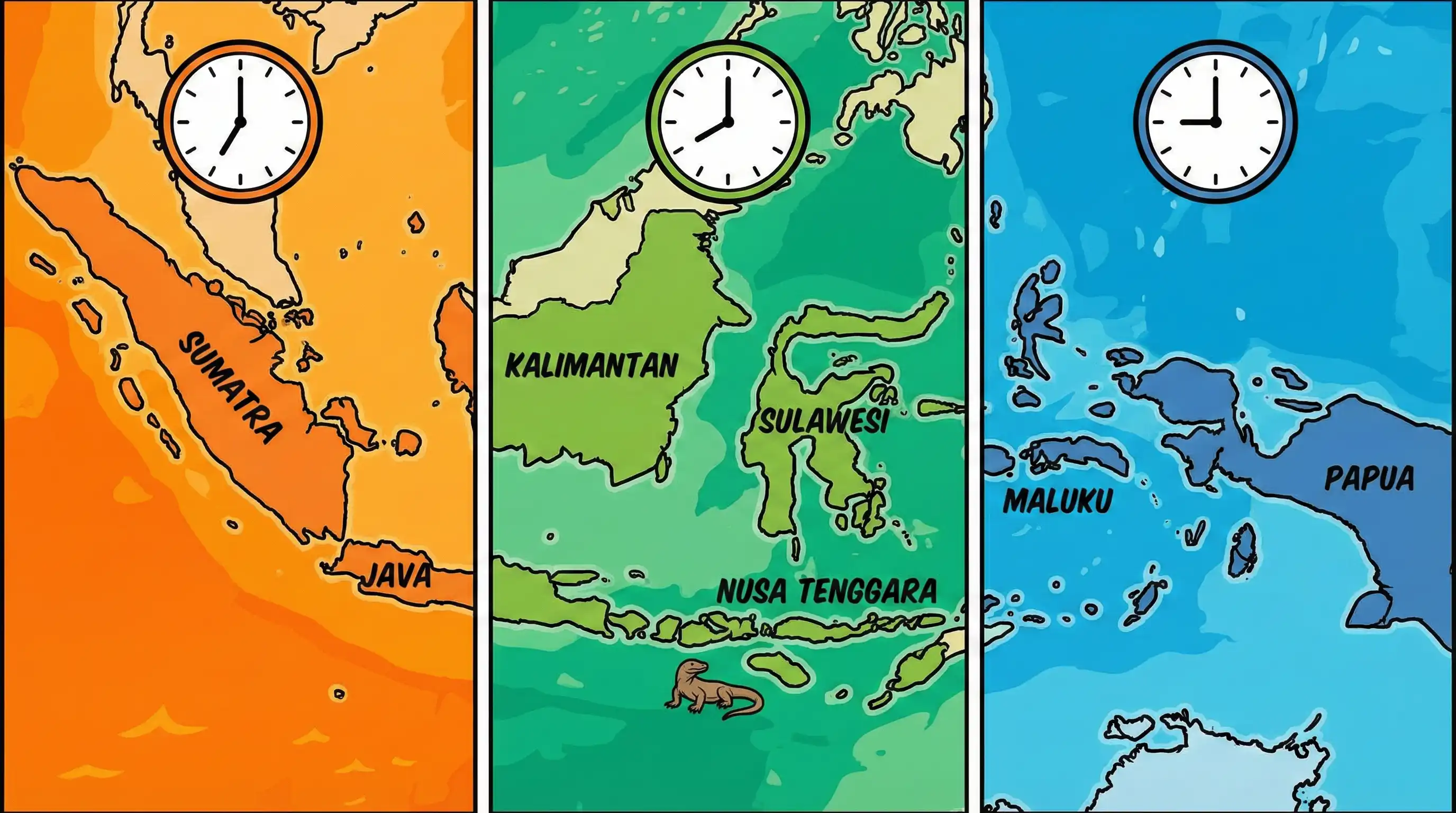
Indonesia time zones consist of three: Western Indonesia Time (WIB) at UTC+7, Central Indonesia Time (WITA) at UTC+8, and Eastern Indonesia Time (WIT) at UTC+9. This three-part approach works well for the country's huge 5,120-kilometer east-west spread spanning more than 17,000 islands.
This article talks about the current Indonesia time zone boundaries, regional coverage, and how these things affect business when you need to plan activities across different parts of Indonesia. Changes that happened before 1964 are not covered in this content. If you want to plan inter-island flights, cross-regional meetings, or multi-property reservations, you need to know about Indonesia time zone variances.
Keep in mind that Bali is one hour ahead of Jakarta and Papua is two hours ahead when you are organizing anything across Indonesia. Indonesia doesn't use daylight saving time, therefore these time discrepancies stay the same all year.
Let's learn more together about the Indonesia time zones :
- Identify which regions use WIB, WITA, or WIT time zones
- Calculate time differences between Indonesian cities and international locations
- Avoid costly scheduling conflicts in business and travel
- Optimize communication timing for guests and partners across zones
- Implement practical solutions for multi-zone operations

Understanding Indonesia’s Time Zone System
Indonesia's archipelago runs from Sumatra in the west to Papua in the east. If strict solar time were used, the longitudes would need even more time zones. The three time zones are a good balance between what is actually happening in the world and what is best for running the government.
On January 1, 1964, the president signed a law that set up the current system. It replaced older Dutch colonial systems that used fractional offsets. This framework has stayed the same, with the most recent change happening in 1988 when Bali went from WIB to WITA.
Three Time Zone Structure
There is a predetermined difference between Coordinated Universal Time (UTC) and each Indonesian time zone. WIB is UTC+7, WITA is UTC+8, and WIT is UTC+9. Indonesia does not observe daylight saving time like Australia or many European nations do. This is because it is located near the equator, where the durations of day and night stay almost the same all year round, with dawn and sunset only changing by around 30 minutes between seasons.
About 80% of Indonesia's more than 270 million people live in the WIB zone, which makes western Indonesia the country's political, economic, and demographic hub. Because of this emphasis, WIB is the country's official time for government functions, stock exchanges, and national broadcasting.
Geographic Coverage Principles
In Indonesia, time zone boundaries usually follow province lines and main island groups instead than exact longitudinal divisions. This method makes administration easier and, when possible, keeps the inhabitants of each island in the same time zone.
Jakarta in WIB is the capital and financial center, Bali in WITA is the core of the tourism industry, and Papua in WIT is home to major mining and resource extraction operations. When planning operations that traverse regions, it is very important to understand these geographic distributions.
Detailed Breakdown of Each Time Zone
Knowing exactly which areas are in which time zone eliminates scheduling mistakes and makes sure that you can talk to local partners, guests, and operational teams accurately. The following breakdown gives you all the information you need about coverage in different regions for business and travel planning.
Western Indonesia Time (WIB, UTC+7)
Western Indonesia Time covers the most densely populated and economically significant regions of Indonesia. The zone encompasses:
Sumatra: All provinces including Aceh, North Sumatra (Medan), West Sumatra (Padang), Riau, Jambi, South Sumatra (Palembang), Bengkulu, Lampung, Riau Islands, and Bangka Belitung Islands.
Java: Complete coverage including Banten, Jakarta (the capital), West Java (Bandung), Central Java (Semarang), Special Region of Yogyakarta, and East Java (Surabaya).
Kalimantan (partial): West Kalimantan and Central Kalimantan.
Jakarta, the capital of Indonesia and the largest city in the country, is what makes this zone so important. Most multinational firms, government agencies, and banks have their main offices in the city. When overseas partners say "Indonesia time" without being precise, they usually imply WIB.
Central Indonesia Time (WITA, UTC+8)
Central Indonesia Time is one hour ahead of WIB and covers areas that are becoming more important for both tourism and the economy:
Bali: The island province that draws millions of international visitors annually. Understanding the one-hour time difference from Jakarta is essential for travelers booking connecting flights—a 7 AM WIB departure from Jakarta arrives at 8 AM WITA local time in Denpasar.
Kalimantan (partial): South Kalimantan, East Kalimantan, and North Kalimantan. Notably, this zone includes Nusantara, Indonesia’s emerging new capital city currently under construction in East Kalimantan.
Sulawesi: All provinces including North Sulawesi (Manado), Gorontalo, Central Sulawesi, West Sulawesi, South Sulawesi (Makassar), and Southeast Sulawesi.
Lesser Sunda Islands: West Nusa Tenggara (Lombok) and East Nusa Tenggara (including Flores and Komodo).
Tourism is very important to the WITA zone, and Bali alone brings in a lot of money for Indonesia in foreign exchange. When Jakarta-based offices work with Bali-based hospitality businesses, they may need to change the times of their meetings.
Eastern Indonesia Time (WIT, UTC+9)
Eastern Indonesia Time runs two hours ahead of WIB and covers Indonesia’s easternmost territories:
Maluku Islands: Maluku (Ambon) and North Maluku provinces.
Papua region: Central Papua, Highland Papua, Papua (Jayapura), South Papua, Southwest Papua, and West Papua (Manokwari).
These areas are hard to work in because they are far away and have a big time difference from the Java-based headquarters. Mining and resource extraction make up most of the economy. Operations need to be carefully coordinated with Jakarta offices, which are two hours behind.
In some WIT areas, there are problems with communication infrastructure that make time zone issues worse. This makes it even more vital to plan ahead and be clear about times.
Practical Applications for Business and Travel
In Indonesia, you always need to know about time zones in real life. A hotel group that maintains hotels in Java and Bali, a worldwide firm that has mining operations in Papua and Jakarta, or a tour operator that schedules journeys to several islands all need to be able to appropriately deal with these time zones.
Time Conversion Procedures
Time conversions become necessary whenever activities cross zone boundaries or involve international partners. The following process ensures accuracy:
- Identify source and destination zones: Confirm which time zone each party operates in using regional information above.
- Apply the offset: Add one hour when moving east from WIB to WITA, add two hours from WIB to WIT. Subtract when moving west.
- Verify with current time tools: Use reliable time zone converters or the IANA time zone database references (Asia/Jakarta, Asia/Makassar, Asia/Jayapura) for technical implementations.
- Document in communications: Always specify the time zone when scheduling—“9 AM WIB” rather than simply “9 AM Indonesia.”
To convert between time zones around the world, start with UTC. Jakarta (WIB) is UTC+7, thus when London shows 12:00 PM GMT, Jakarta shows 7:00 PM WIB. Singapore and WITA are both in the UTC+8 time zone, which makes it easy for business partners in that city-state to work together on Bali.
International Time Comparisons
| City (Time Zone) | When Jakarta (WIB) shows 9 AM | When Bali (WITA) shows 9 AM | When Jayapura (WIT) shows 9 AM |
|---|---|---|---|
| New York (EST/UTC-5) | 9 PM previous day | 8 PM previous day | 7 PM previous day |
| London (GMT/UTC+0) | 2 AM same day | 1 AM same day | 12 AM same day |
| Singapore (SGT/UTC+8) | 10 AM same day | 9 AM same day | 8 AM same day |
| Sydney (AEDT/UTC+11)* | 1 PM same day | 12 PM same day | 11 AM same day |
| Tokyo (JST/UTC+9) | 11 AM same day | 10 AM same day | 9 AM same day |
*Note: Sydney has daylight saving time, therefore these hours are for summer. Australia's DST period changes the time difference with Indonesia, which doesn't observe daylight savings time.
The best times to talk to Western markets are in the afternoon in Indonesia. Late morning WIB (about 10–11 AM) is a good time for European partners because it falls during early European business hours. The optimal time for American East Coast cooperation is early evening WIB, when New York offices open.

Common Time Zone Challenges and Solutions
Traveling and doing business across Indonesia's three time zones brings up problems that are easy to forecast. Proactive solutions keep service quality high and minimize problems.
Multi-Property Hotel Operations
Standardized procedures are needed to make sure that check-in and check-out timings are the same across properties in different zones. Set up centralized reservation systems that show times in each property's local zone while keeping a consistent backend reference (usually WIB). Staff training should stress confirming guest-facing timings in local zone format, and internal communications should make it clear what zones are.
Guest Communication Timing
Most of the time, automated messaging systems use server time instead of the time at the recipient's location. Set up confirmation emails, information before arrival, and marketing messages to go out based on the time zones of the properties where guests will be staying. At 2 PM WITA, not 2 PM WIB, a guest who is coming to Bali should get their check-in reminder. This is an hour earlier than planned.
Staff Scheduling Across Regions
There is a two-hour time difference between Jakarta and Papua, which makes it hard for teams in Jakarta and Papua to have virtual meetings and training sessions. Pick meeting times that work for everyone throughout normal business hours. For example, mid-morning Jakarta time works well for both zones. Clearly state the time zones in all scheduling systems and calendar invites.
Conclusion and Next Steps
Anyone who works across Indonesia's huge archipelago needs to pay attention to the country's three time zones: WIB (UTC+7), WITA (UTC+8), and WIT (UTC+9). Not having daylight saving time makes preparing for the whole year easier, but the east-west span makes it necessary to have organized ways to schedule and talk to each other.
Immediate actions:
- Verify current local times for all relevant Indonesian locations using reliable time zone tools
- Update scheduling and reservation systems to handle multi-zone operations correctly
- Train staff on time zone awareness, emphasizing explicit zone specification in all communications
- Establish standard operating procedures for cross-zone coordination
Other interesting subjects to look at are Indonesian business hours and cultural factors that determine when meetings should be held, seasonal tourism patterns that affect operational needs, and the effects of moving Indonesia's capital to Nusantara in the WITA zone.
Additional Resources
IANA time zone database identifiers for technical implementations:
- Asia/Jakarta (WIB: Sumatra, Java)
- Asia/Pontianak (WIB: West/Central Kalimantan)
- Asia/Makassar (WITA: East/South Kalimantan, Sulawesi, Bali, Nusa Tenggara)
- Asia/Jayapura (WIT: Maluku, Papua)
Recommended tools:
- Time.Global for real-time conversions and meeting planners
- World Clock mobile applications for quick reference across locations
- Calendar applications with multi-zone display capabilities
The Indonesian government's time standards are still in line with the 1988 framework. There are no plans to change them right now, even though the capital relocation project is still continuing on.