
There is something about arriving at a dive site on a traditional wooden sailing vessel that a fibreglass catamaran or a steel-hulled motor yacht will never replicate. The creak of teak, the warmth of hand-carved timber, the low profile against a volcanic island backdrop. In Komodo National Park, that vessel is a phinisi boat, and it has become the defining way to experience one of the world's greatest marine and terrestrial wilderness areas.
A phinisi liveaboard Komodo trip combines centuries of Indonesian maritime heritage with modern diving logistics, luxury accommodation, and multi-day access to dive sites, snorkeling reefs, pink sand beaches, and Komodo dragon trekking that no single day trip from Labuan Bajo can match. Whether you are a certified diver chasing manta rays at Manta Alley, a snorkeler floating over coral gardens, or a couple looking for a phinisi boat Labuan Bajo honeymoonunlike anything available in Bali or the Maldives, the phinisi format delivers an experience rooted in place, history, and craftsmanship.
This guide covers everything you need to know about phinisi boats, their history, how they are built, why they dominate the Komodo liveaboard scene, and why the Komodo Sea Dragon has earned its reputation as the most luxurious phinisi operating year-round trips in Komodo National Park.

What Is a Phinisi Boat?
A phinisi boat (also spelled pinisi) is a type of Indonesian sailing vessel defined by its distinctive rigging system rather than a specific hull shape. The classic phinisi carries seven to eight sails arranged across two masts in a configuration similar to a gaff-ketch. Unlike Western square-rigged ships, a phinisi's sails pull out like curtains along fixed gaffs, a design that allows a relatively small crew to handle large amounts of canvas efficiently in the variable winds of the Indonesian archipelago.
The term kapal phinisi (phinisi ship) has become shorthand for any large traditional wooden boat built in the Bugis-Makassarese style, even when the vessel is motor-powered rather than sail-driven. Today, the word phinisi evokes a specific aesthetic: a long, graceful wooden hull, a high bow, a sweeping stern, and the unmistakable silhouette of twin masts against the sky.
What makes a phinisi boat Indonesia vessel unique is not simply its appearance but the philosophy behind it. Every phinisi is hand-built using techniques passed down through generations. There are no factory moulds, no computer-aided designs in the traditional process. Each boat is a one-off creation shaped by the knowledge, intuition, and cultural memory of its builders.
The History of Phinisi Boats: From Spice Trade Cargo Vessels to UNESCO Heritage
Origins in South Sulawesi
The phinisi tradition originates with the Konjo-speaking people of the Ara and Tana Beru villages in Bulukumba regency, South Sulawesi. While phinisi boats are often associated broadly with the Bugis seafarers, four distinct cultural groups contributed to their development: the Konjo, Mandar, Bugis, and Makassarese. Of these, the Konjo played the most influential role in shaping the construction techniques and rigging systems that define a phinisi.
Historians estimate that the earliest forms of the phinisi emerged between the 14th and 17th centuries, evolving from earlier vessel types like the Padewakang and Lepa-Lepa. The design absorbed influences from multiple maritime traditions. Arab dhows contributed elements of hull shaping. Chinese junks influenced structural reinforcement. Dutch colonial ships introduced aspects of the fore-and-aft rig. Yet the result was something distinctly Indonesian, a synthesis adapted to the winds, currents, and island geography of the archipelago.
The Spice Trade Era
For centuries, phinisi boats were the workhorses of inter-island trade across what is now Indonesia. They carried sandalwood from Timor, textiles from Java, spices from the Moluccas, and rice from Sulawesi, moving goods across thousands of kilometres of open sea without engines, GPS, or satellite communications. The sailors who crewed these vessels navigated by stars, currents, wind patterns, and accumulated knowledge passed orally from one generation to the next.
Bulukumba, the heartland of phinisi construction, became known as Butta Panritta Lopi, meaning "the land of the phinisi boat experts." The title was not honorary. It reflected a region whose economy, identity, and spiritual life revolved around the construction and sailing of these vessels.
The Transition to Motor Power
Before the 1970s and 1980s, phinisi boats were the largest Indonesian sailing ships in regular commercial use. The introduction of diesel engines gradually transformed the fleet from sail-powered traders to motorised cargo carriers, though many retained their masts and rigging as auxiliary power or simply as cultural markers. By the late 20th century, the commercial cargo role of phinisi boats was declining as steel-hulled freighters and container shipping took over major trade routes.
What might have been the end of the phinisi tradition instead became its reinvention. As the cargo role diminished, a new purpose emerged: luxury tourism, diving expeditions, and private charters. The same qualities that made phinisi boats exceptional for inter-island trade, their seaworthiness, their spacious wooden hulls, their ability to navigate shallow reefs and anchor in remote bays, made them ideal platforms for exploring the Indonesian archipelago as a destination rather than a trade network.
UNESCO Recognition
In 2017, UNESCO inscribed "The Art of Boatbuilding in South Sulawesi" as Intangible Cultural Heritage of Humanity, formally recognising the phinisi tradition as a living cultural practice of global significance. The inscription acknowledged not just the technical skill involved in building these vessels but the entire cultural ecosystem surrounding them, the rituals, the knowledge transmission, the relationship between communities and the sea.
A powerful demonstration of phinisi seaworthiness came in 1986, when a traditionally built national phinisi sailed from Indonesia to Vancouver, Canada, and onward to the United States, proving that these wooden vessels could handle open ocean crossings that would challenge modern yachts.
How Phinisi Boats Are Built: The Craft Behind the Vessel
Tana Beru and Ara: The Boatbuilding Villages
The primary centre of traditional phinisi boat construction remains Tana Beru, a coastal village in Bontobahari District, roughly 24 kilometres from Bulukumba city in South Sulawesi. Nearby Ara village is equally important to the tradition. Together, these communities have produced phinisi boats for generations and continue to build them today, both for domestic use and for the growing fleet of luxury charter and liveaboard vessels operating across Indonesia.
Construction Without Blueprints
What distinguishes phinisi construction from modern shipbuilding is the absence of written plans. Master builders, known locally as punggawa, carry the design specifications in their memory, learned through years of apprenticeship and hands-on practice. The shape of the hull, the curve of the bow, the angle of the stern, all of this is determined by eye, experience, and an understanding of how wood behaves in water that cannot be reduced to engineering drawings.
The primary timber used is traditionally ironwood (ulin) and teak, chosen for their durability, resistance to marine borers, and strength under load. The keel is laid first, and the hull is built up plank by plank using wooden pegs and joints rather than metal fasteners in the most traditional examples. Construction takes anywhere from three to six months depending on the vessel's size, the availability of materials, and seasonal conditions.
Ritual and Ceremony
Phinisi construction is not purely a technical exercise. It is embedded in cultural and spiritual practices. The laying of the keel, the first plank, and the launch of the completed vessel are all accompanied by ceremonies, prayers, and offerings. These rituals reflect the deep connection between the Bugis-Makassarese maritime communities and the sea, a relationship in which the boat is not merely a tool but an extension of the community that built it.
Phinisi Boats Today: The Rise of the Luxury Phinisi Liveaboard
From Cargo Holds to Luxury Cabins
The transformation of the phinisi from a cargo vessel to a luxury liveaboard is one of the most successful examples of cultural adaptation in Indonesian tourism. Where hulls once held sacks of rice and bales of textiles, they now contain air-conditioned cabins with en-suite bathrooms, king-size beds, and private balconies. Where crews once navigated by the stars to deliver goods, they now chart courses through marine parks to deliver guests to world-class dive sites.
This evolution preserved the external character of the vessel, the wooden hull, the twin masts, the hand-carved details, while completely reimagining the interior for comfort, safety, and hospitality. A modern luxury phinisi boat operating in Indonesian waters is equipped with radar, GPS, AIS transponders, satellite communications, EPIRB distress systems, fire suppression, life rafts, and every other piece of safety equipment required by maritime regulations. The result is a vessel that looks timeless from the outside and functions as a floating boutique hotel from the inside.
Why Phinisi Boats Dominate the Komodo Charter Scene
Labuan Bajo, the gateway town to Komodo National Park on the western tip of Flores, has become the phinisi capital of Indonesia. Dozens of phinisi boats operate from Labuan Bajo's harbour, offering everything from budget day trips to multi-week luxury charters. The reasons are straightforward.
First, the geography suits them. Komodo National Park consists of multiple islands, channels, bays, and reef systems spread across a wide area. A vessel that can anchor in shallow bays, navigate narrow channels, and sail comfortably between islands is more practical than a large steel yacht that needs deep water and port infrastructure.
Second, the aesthetic matches the destination. Komodo National Park is a UNESCO World Heritage Site of volcanic islands, turquoise water, and prehistoric dragons. Arriving at Pink Beach or Padar Island on a handcrafted wooden sailing vessel feels coherent with the landscape in a way that a modern motor cruiser does not.
Third, the liveaboard format solves a fundamental problem. Komodo's best dive sites, snorkeling spots, and trekking viewpoints are scattered across the park. Reaching them all from a land base in Labuan Bajo requires hours of daily boat travel each way, eating into dive time and energy. A phinisi liveaboard puts you at the dive site when you wake up, eliminates transit fatigue, and allows multi-day itineraries that cover both the northern and southern zones of the park.
Komodo Sea Dragon: The Most Luxurious Phinisi Liveaboard in Komodo
Among the fleet of phinisi boats operating in Komodo National Park, the Komodo Sea Dragon stands apart. Built in 2009, last renovated in 2025, and operated by Komodo Resort and Neptune Liveaboards, the Sea Dragon is a 35-metre (114-foot) luxury phinisi liveaboard that blends the traditional exterior character of a hand-built wooden vessel with an interior designed for genuine comfort and service.
Vessel Specifications and Design
The Komodo Sea Dragon carries a maximum of 12 guests in six spacious, air-conditioned cabins, with flexibility for up to 16 passengers when sofas convert to extra beds for families or triple occupancy. Cabin options include double cabins with king-size beds (23 square metres) and twin cabins (15 to 18 square metres), each with en-suite bathrooms, writing desks, reading lights, sea views, and in the double cabins, private balconies with seating areas.
Public spaces include an air-conditioned dining salon, an outdoor lounge, a sun deck with loungers, and a bar. The vessel provides free unlimited 4G internet, audio and video entertainment, warm water showers, and the kind of thoughtful details, separate camera rinsing stations for underwater photographers, dedicated diving towels, all-day coffee and snacks, that distinguish a genuinely luxury operation from a boat that merely claims the label.
The Dedicated Dive Boat Concept
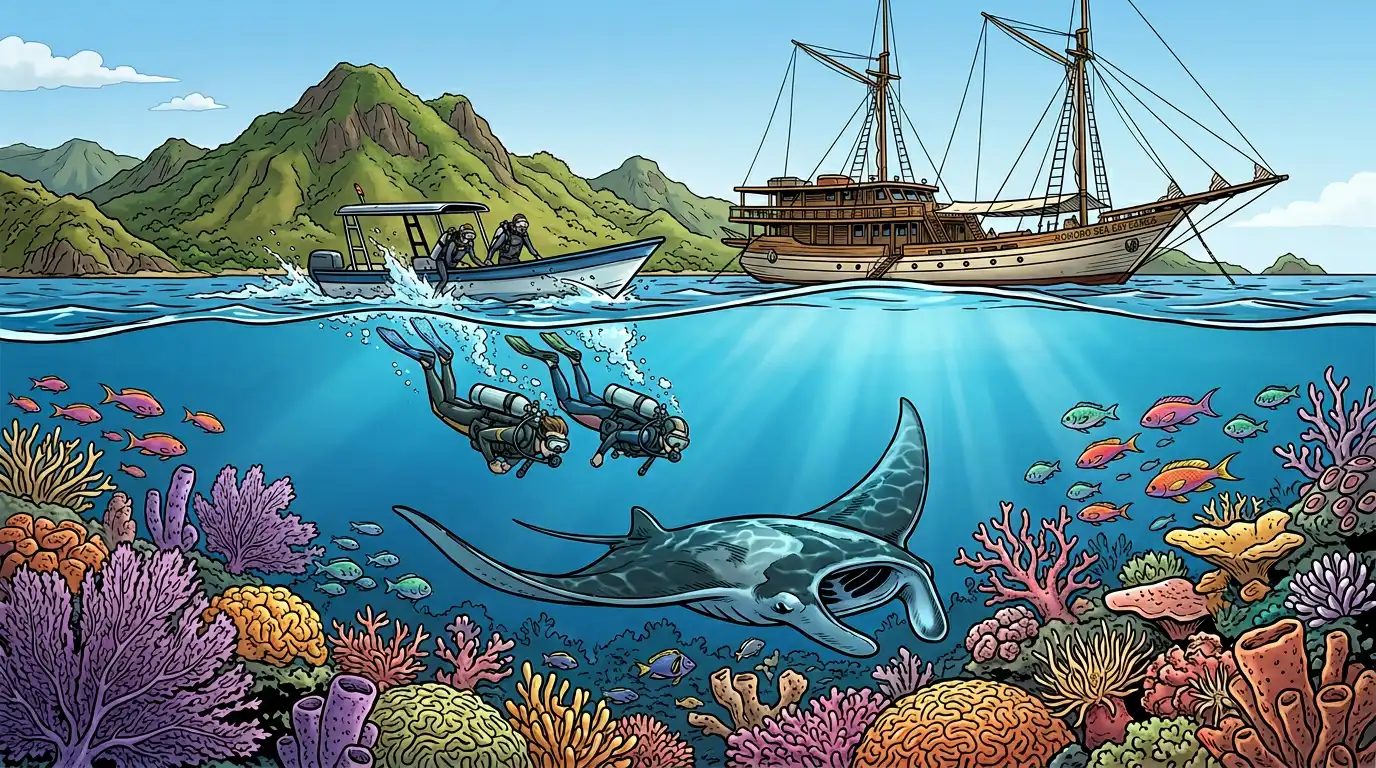
One of the features that sets the Komodo Sea Dragon apart from other phinisi diving liveaboard Komodo options is its dedicated dive boat. An 18-metre support vessel, the Putra Sebayur, accompanies the main ship on every trip. All diving equipment, tanks (12-litre and 15-litre, both yoke and DIN), compressors, and gear storage are housed on this separate boat.
The practical advantages are significant. The main vessel stays clean, quiet, and comfortable because there is no compressor noise, no wet equipment dripping through common areas, and no tanks cluttering the deck. Divers kit up and enter the water from the dive boat, which positions itself directly at the dive site while the main vessel anchors nearby. After the dive, you return to the Sea Dragon for meals, rest, and relaxation in a space that feels like a hotel rather than a working dive platform.
Dive groups are maintained at a strict ratio of four divers to one guide, ensuring safety and personalised attention on every dive, whether you are drifting along the walls of Batu Bolong or hovering above the cleaning stations at Manta Point.
Year-Round Operations from Labuan Bajo
The Komodo Sea Dragon operates phinisi boat tour Komodo itineraries throughout the year, departing from and returning to Labuan Bajo. Trip lengths range from six-day/five-night itineraries to eight-day/seven-night expeditions, covering both the northern and southern zones of Komodo National Park.
Weather conditions in Komodo are generally good year-round, with the peak monsoon months of January and February bringing rougher seas but, counterintuitively, some of the best manta ray encounters of the year. The Komodo high season runs from April through December, with warm water temperatures, strong currents that feed the park's marine diversity, and excellent visibility on many sites.
Every trip includes full-board meals (buffet-style Western and Asian cuisine), drinking water, tea, coffee, snacks, and a complete diving package. National Park fees are additional, and NITROX, rental gear, and alcoholic beverages are available as optional extras. For direct bookings, Komodo Resort offers complimentary diving accident insurance through DiveAssure, a meaningful safety net for a diving-focused trip.
Safety Standards
The Komodo Sea Dragon carries comprehensive safety equipment including radar, GPS, Class B AIS transponder, EPIRB distress system, emergency life rafts for 32 persons, fire extinguishers and hoses, smoke detectors, oxygen kits, first aid kits, life vests, satellite and mobile phones, search lights, emergency flares, and Nautilus Lifeline marine rescue GPS units for each diver. The crew conducts regular training and drill sessions for scenarios including man overboard, fire, and emergency oxygen provision.
Dive Sites Accessible by Phinisi Liveaboard in Komodo
A liveaboard komodo diving itinerary on a phinisi opens access to dive sites that day boats from Labuan Bajo struggle to reach, particularly in the central and southern zones of the park. Here are the Komodo dive sites that define a Komodo diving trip.
Batu Bolong
An iconic submerged pinnacle rising from deep water, Batu Bolong is widely considered one of the best dive sites in Komodo National Park. Strong currents sweep nutrients across the rock, attracting reef sharks, giant trevally, dogtooth tuna, Napoleon wrasse, and dense schools of fusiliers and surgeonfish. The coral coverage is extraordinary, with hard and soft corals encrusting every surface. This is an advanced dive site where current management and good buoyancy control are essential.
Manta Point (Karang Makassar)
A shallow sandy channel where reef manta rays gather at cleaning stations, Manta Point offers encounters that range from one or two mantas on a quiet day to dozens during peak season. The dive is relatively shallow and accessible to less experienced divers, making it a highlight for both certified divers and snorkelers.
Castle Rock
A submerged seamount in the northern zone, Castle Rock attracts large schools of fusiliers, sweetlips, and batfish, along with grey reef sharks, whitetip reef sharks, and occasional eagle rays. The currents can be strong, and the site rewards patient positioning in the blue where pelagic action unfolds.
Crystal Rock
Near Castle Rock, Crystal Rock is another current-swept pinnacle with vibrant soft coral growth, schooling fish, reef sharks, and green turtles. The site often offers excellent visibility and is a favourite among underwater photographers.
Cannibal Rock
In the southern zone, Cannibal Rock is Komodo's premier muck and macro dive site. The rock is carpeted with sea apples, crinoids, and soft corals that shelter pygmy seahorses, ghost pipefish, flamboyant cuttlefish, rare nudibranchs, and other critters that macro photographers travel thousands of kilometres to find.
Manta Alley
Located in the south, Manta Alley is a channel where oceanic manta rays cruise through nutrient-rich upwellings. The mantas here tend to be larger than the reef mantas at Manta Point, and encounters can include dramatic feeding chains where multiple mantas swim in formation.
Shotgun
A thrilling drift dive through a narrow channel, Shotgun launches divers through a gap in the reef at speed, with reef sharks, turtles, and dense coral walls flashing past. The name is accurate. This is not a gentle float.
Pink Beach
While primarily known as a snorkeling and beach excursion stop, the reef off Pink Beach offers easy, colourful diving suitable for all levels. The combination of the pink-sand beach (coloured by red coral fragments) and the adjacent reef makes this a complete above-and-below-water experience.
Phinisi Boat Tour Komodo: What a Typical Itinerary Looks Like
A phinisi boat tour Komodo on the Sea Dragon follows a rhythm designed to maximise time in the water and on the islands without feeling rushed.
Morning
Wake to coffee and breakfast as the boat sits at anchor near the first dive site. Briefing with the dive guides covers the site, current conditions, marine life expectations, and group assignments. Transfer to the dive boat, gear up, and complete the first dive of the day. Return to the main vessel for a second breakfast or snack.
Midday
A second dive or snorkeling session, followed by a full lunch aboard the Sea Dragon. Afternoon rest, reading on deck, or exploring an island on foot. Komodo dragon trekking on Rinca or Komodo Island, viewpoint hikes on Padar, or beach time at Pink Beach are woven into the itinerary between dives.
Afternoon and Evening
A third dive or sunset snorkel, depending on conditions and the group's energy. On some evenings, a night dive is offered for those who want to explore the reef after dark, when different creatures emerge, torpedo rays, Spanish dancers, sleeping turtles, hunting lionfish. Dinner is served on the main vessel, followed by the briefing for the next day's itinerary.
Multi-Day Coverage
The advantage of a multi-day phinisi trip is that the vessel moves overnight, covering distance while guests sleep. A five-night itinerary can cover the northern sites (Castle Rock, Crystal Rock, Batu Bolong), the central zone (Manta Point, Siaba), and the southern sites (Cannibal Rock, Manta Alley, Horseshoe Bay) without the exhausting daily boat commutes that day-trip divers endure from Labuan Bajo.
Phinisi Boat Charter Komodo: Private Groups and Special Occasions
The Komodo Sea Dragon is available for phinisi boat charter arrangements, making it an exceptional option for private groups, families, dive clubs, corporate retreats, and special celebrations.
Why Charter a Phinisi?
A private charter gives your group exclusive use of the vessel, crew, dive guides, and itinerary. You set the pace. You choose the dive sites. You decide whether to extend a morning at Padar Island or add an extra dive at Batu Bolong. There are no compromises with other passengers' preferences, and the crew tailors every meal, activity, and schedule to your group's needs.
Phinisi Boat Labuan Bajo Honeymoon
A phinisi boat Labuan Bajo honeymoon on a vessel like the Komodo Sea Dragon is an alternative to the typical Bali beach resort honeymoon that offers something genuinely different: waking up at a different island each morning, diving or snorkeling together in water most couples only see in photographs, watching the sunset from a private balcony on a handcrafted wooden boat, and having an entire crew dedicated to making the trip extraordinary.
Komodo is not the obvious honeymoon destination, and that is precisely the point. Couples who choose a phinisi honeymoon are looking for adventure combined with comfort, privacy combined with discovery. The double cabins on the Komodo Sea Dragon, with their king-size beds, en-suite bathrooms, and private balconies overlooking the water, provide the intimacy of a boutique hotel room in a setting that no hotel can match.
Corporate and Group Charters
For dive clubs, photography groups, or corporate teams, a charter on the Komodo Sea Dragon accommodates up to 16 guests in a format that combines shared experiences (diving, trekking, meals) with enough private space (individual cabins, balconies, sundeck) that the group does not feel cramped. The dedicated dive boat ensures efficient operations even for groups with mixed experience levels.
Labuan Bajo: The Gateway to Every Phinisi Liveaboard Komodo Trip
Every phinisi boat Labuan Bajo departure begins in this small but rapidly developing town on the western tip of Flores. Labuan Bajo has grown from a quiet fishing village into the primary gateway for Komodo National Park, with a recently expanded airport (Komodo Airport, LBJ) receiving direct flights from Bali, Jakarta, and other Indonesian cities.
Getting to Labuan Bajo
Direct flights from Bali to Labuan Bajo take approximately one hour. From Jakarta, flights are available with one connection, typically through Bali or Surabaya. The airport is a short drive from the harbour where phinisi liveaboards, including the Komodo Sea Dragon, are berthed.
What to Do Before or After Your Trip
Labuan Bajo offers a growing selection of hotels, restaurants, and cafes for pre-boarding or post-disembarkation stays. The town's waterfront has developed considerably, and while it is not a destination in itself for most travellers, it provides a comfortable staging point with reliable infrastructure.
For guests combining a liveaboard trip with a resort stay, Komodo Resort on Sebayur Island is accessible from Labuan Bajo by boat, offering the option to extend your Komodo experience with resort-based diving, snorkeling, and relaxation before or after the liveaboard portion.

Choosing the Right Phinisi: What to Look for in a Komodo Liveaboard
The phinisi boat Komodo market ranges from basic shared-deck boats running day trips to ultra-luxury private charters costing thousands per night. When evaluating a phinisi liveaboard for a diving-focused trip, the factors that matter most are not always the ones that look best in Instagram photos.
Safety First
Check that the vessel carries modern navigation electronics (radar, GPS, AIS), EPIRB distress beacons, adequate life rafts, fire suppression systems, and emergency oxygen. Ask about crew training, drill protocols, and the vessel's maintenance schedule. A beautiful wooden boat with inadequate safety equipment is not a luxury experience, it is a liability.
Dive Operations
Look for a dedicated dive guide programme with small group ratios (four divers to one guide is the gold standard), well-maintained rental equipment, both 12-litre and 15-litre tanks, NITROX availability, and clear briefing procedures. The Komodo Sea Dragon's dedicated dive boat concept is a significant advantage because it separates diving logistics from the main vessel's comfort spaces.
Cabin Quality
Confirm cabin sizes, bed configurations, air conditioning, en-suite bathrooms, and storage space. On a multi-day trip, your cabin is where you recover between dives, and the difference between a cramped shared space and a proper private room with natural light and ventilation is the difference between a good trip and a great one.
Crew and Service
The crew makes or breaks a liveaboard trip. Read guest reviews carefully, not just for star ratings but for specific mentions of crew attentiveness, guide knowledge, food quality, and problem-solving. The Komodo Sea Dragon consistently receives outstanding reviews for crew service, with guests highlighting the warmth, professionalism, and responsiveness of both the hospitality and diving teams.
Itinerary Flexibility
A good phinisi liveaboard adapts its itinerary to conditions. Currents, weather, and marine life patterns change daily in Komodo, and a rigid schedule that ignores these realities will miss opportunities. The best operations, including the Komodo Sea Dragon, adjust dive site selections based on real-time conditions to give guests the best possible experience on any given day.
Phinisi Boat Indonesia: Beyond Komodo
While Komodo National Park is the heartland of the phinisi liveaboard scene, the phinisi boat Indonesia story extends across the entire archipelago. Phinisi vessels operate diving and expedition cruises in Raja Ampat, the Banda Sea, Alor, Wakatobi, Halmahera, Cenderawasih Bay, and along the Spice Islands route that traces the old trading paths these boats once sailed commercially.
The versatility of the phinisi design, shallow draft for reef navigation, spacious hull for comfortable accommodation, seaworthy construction for open-water crossings, makes it the ideal vessel type for exploring an archipelago of 17,000 islands where infrastructure is sparse and the most rewarding destinations are often the most remote.
For divers and travellers who fall in love with the phinisi format in Komodo, it becomes a gateway to a broader Indonesian sailing experience. The same type of vessel, the same craftsmanship, the same fusion of tradition and modern comfort, can carry you to places where you might be the only boat at the dive site for days at a time.
When to Book and What to Expect
Booking Timeline
Popular departure dates on the Komodo Sea Dragon sell out months in advance, particularly during high season from April to December and around major holiday periods. If you have specific dates in mind, booking three to six months ahead is advisable. For phinisi boat charter arrangements for private groups, even longer lead times may be necessary.
What Is Included
A standard trip on the Komodo Sea Dragon includes accommodation, all meals (buffet-style breakfast, lunch, and dinner), drinking water, tea, coffee, snacks, the diving package (tanks, weights, guide), cabin towels, and VAT. Complimentary diving accident insurance through DiveAssure is provided for direct bookings.
What Costs Extra
National Park entry fees are mandatory and charged per trip duration. Optional extras include NITROX, rental dive equipment, alcoholic beverages, and soft drinks. Gratuities for the crew are at guests' discretion but are appreciated and customary.
What to Pack
Light, breathable clothing for the tropics. A rash guard or thin wetsuit for diving (water temperatures in Komodo range from approximately 24 to 29 degrees Celsius depending on depth and season, with southern sites tending cooler due to upwellings). Reef-safe sunscreen. An underwater camera if you have one. Comfortable shoes for island trekking. Motion sickness remedies if you are prone, though phinisi boats handle swell better than smaller vessels due to their weight and hull design.
Final Thoughts
A phinisi liveaboard Komodo trip is not simply a diving holiday or a liveaboard sailing cruise in Komodo. It is an experience that connects two extraordinary Indonesian traditions: the centuries-old craft of wooden boatbuilding and the world-class marine biodiversity of Komodo National Park. You sleep aboard a vessel whose design lineage stretches back to the spice trade. You dive sites where manta rays, reef sharks, and pygmy seahorses share the same reef system. You trek volcanic islands where Komodo dragons patrol the grasslands. And you do all of it from a floating base that, in the case of the Komodo Sea Dragon, offers genuine luxury without sacrificing the character and soul of the traditional phinisi boat.
The phinisi is not a gimmick. It is the right vessel for these waters, proven by centuries of use, refined by modern safety and comfort standards, and recognised by UNESCO as a cultural treasure. When you step aboard in Labuan Bajo and watch the harbour shrink behind you as the boat heads toward the first anchorage, you are not just starting a trip. You are joining a maritime tradition that has been moving people through these islands for longer than most countries have existed.