
Introduction to Komodo Dive Sites
There is a good reason why Komodo National Park is known as one of the best places in the world to go diving. This Indonesian marine sanctuary, which was established in 1980 and named a UNESCO World Heritage Site in 1991, has world-class diving that is always ranked among the best in the world. The park covers about 1,733 square kilometers of islands, coastlines, and healthy undersea habitats where cold, nutrient-rich currents from the Indian Ocean meet milder waters from the Flores Sea.
What makes diving at Komodo so special is that it has pristine coral reefs, lots of marine life, and diving conditions that range from calm coral gardens to heart-pounding drift dives through shark-filled passages. Whether you want to hover next to reef mantas at a cleaning station or watch grey reef sharks patrol a pinnacle that is being pushed by a current, the park has experiences that keep divers coming back year after year.
This guide is organized by the park's three main areas: North Komodo (big fish, clear water, and strong currents), Central Komodo (manta rays, colorful reefs, and most day trips), and South Komodo (cooler water, great macro life, and seasonal manta aggregations). It covers the most popular and some lesser-known komodo dive sites. Depending on your interests and ability level, you'll get detailed information on which sites are must-dive priorities and which are optional.
The park's usual conditions include depths of 5 to 40 meters, water temperatures that range from 22 to 29°C depending on the region and season, and currents that can be anything from moderate glides to very strong washing-machine-like waves. When arranging your komodo diving trips, the most important thing is to be honest about your degree of experience and certification when choosing places.
How Komodo’s Three Dive Regions Work (North, Central, South)
If you want to organize your diving trip to Komodo National Park, you need to know about its geography. The park naturally splits into three separate areas, each having its own features, seasonal factors, and types of marine life. When you plan a trip smartly, you make sure that the regions you visit match your certification level, hobbies, and travel dates.
North Komodo, which is mostly around Gili Lawa Laut and Gili Lawa Darat, has the park's best dive locations for big fish action. Castle Rock, Crystal Rock, The Cauldron/Shotgun, Golden Passage, and Lighthouse are the main features of this area. The park will have the strongest currents, the water will be clean for 20–30 meters, and the temperature will be 26–29°C. The best time to go to these places is during the dry season (April to October). During the wet season, the waters are rougher, which makes getting to them more difficult.
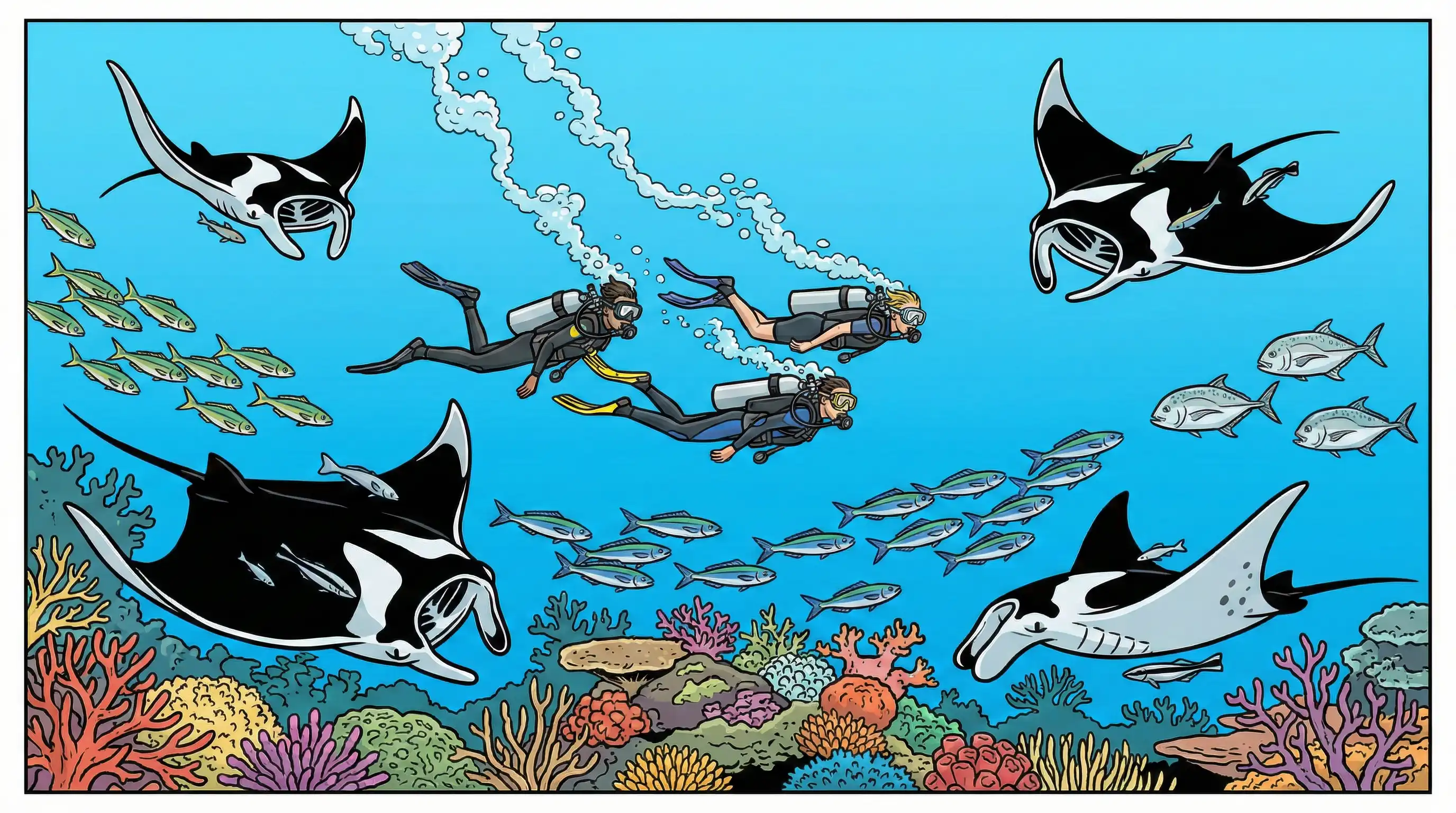
Central Komodo is the park's most accessible and varied diving area. You can get to the sights all year round from Labuan Bajo by day boat. Batu Bolong, Karang Makassar (Manta Point), Mawan, Tatawa Besar and Tatawa Kecil, Siaba Besar and Siaba Kecil, Pengah, Sebayur, and Wainilu all have something for everyone, no matter how experienced they are. This area is home to the famed manta encounters, beautiful coral reefs, turtle-filled coves, and great macro chances, all within 1 to 3 hours of the harbor.
South Komodo and Nusa Kode have quite diverse underwater environments. When you dive in the south, you'll notice that the water is cooler (22–26°C), visibility is lower (10–20 meters), and there are a lot of invertebrates. From September to January, macro photographers and divers come to Cannibal Rock, Yellow Wall, German Flag, Manta Alley, Langkoi Rock, Boulders, and Crinoid Corner to view seasonal manta aggregations.
Seasonal patterns have a big effect on the schedules of liveaboards. In the dry season, boats usually stay in the North and Central zones, where the waters are calmer and the weather is best. When the northern swells get too strong, the wet season moves the focus to Central and South Komodo, where the southern locations stay safe.
Central Komodo Dive Sites (Heart of the Park)
Central Komodo is the busiest dive zone for practical reasons. These sights are the closest to Labuan Bajo, so you may visit them on regular day trips without having to pay for gas and travel time like you would for visits to the North or South. More crucially, Central Komodo has many of Komodo's most famous locations, which are on bucket lists all over the world and offer great diving for a wide variety of certification levels.
Most Popular Central Komodo Dive Sites (Must-Dive):
- Batu Bolong
- Karang Makassar (Manta Point)
- Mawan
- Tatawa Besar
- Siaba Kecil
- Siaba Besar
Central destinations have manta cleaning stations where you can spend whole dives watching reef mantas fly overhead, exciting drift dives through orange soft coral gardens, bays that are great for beginners to assess their dives, and world-class macro hunting areas like Wainilu. Because there is so much to see and do, a single day in Central Komodo can please photographers, people looking for huge animals, and coral lovers all at the same time.
Most day trips follow a 3-dive schedule, and spots are often paired up based on the tides. A typical combo would start at Batu Bolong when the tide is just right, then go to Manta Point when the drift window is open, and finally end at Siaba Kecil or Tatawa Besar when the currents calm down. To get the most out of each site, experienced dive operators plan their schedules around these patterns.
Batu Bolong (Central – Iconic “Fish Soup” Pinnacle)
Batu Bolong is always in the top 30 dives in the world, and every dive center we talked to for this book said it was the best dive site in Komodo. The name means "rock with a hole," which describes the small island that can be seen at the surface with a hole in the middle. This small peak is located between Komodo Island and Tatawa. It has a lot of fish life and is a great place to dive.
The underwater topography shows a reef formation that looks like a pyramid and dips more than 50 meters on its steepest sides. Every surface is covered in hard coral terraces, colorful sponges, and big gorgonian sea fans. Divers usually swim in zig-zag patterns along the protected walls, stopping at each level to take in the incredible amount of life around them.
Marine life at Batu Bolong is like a list of the best Komodo animals: clouds of anthias swarm every coral head, white tip reef sharks and black-tip reef sharks patrol the blue, Napoleon wrasse cruise past with their usual curiosity, and schools of fusiliers and giant trevally make walls of silver in the current. Hawksbill turtles eat sponges, and people who love macro photography can spot nudibranchs, pygmy seahorses, and orangutan crabs hiding in the reef.
Respect is important when diving. Most of the time, the usual working depth is 15 to 20 meters, although those that go deeper can reach depths of up to 30 meters. Batu Bolong is known for having strong up- and down-currents on its exposed sides, thus it's very important to dive at low tide for safety and fun. The best beauty frequently happens in shallow water, when crystal-clear water brings out the colors of millions of reef fish.
It's easy to understand the degree of experience needed: you should have an Advanced Open Water certification (or something similar) and be able to control your buoyancy well. Sometimes, beginner dives can only dive the shallow, sheltered lee side with close supervision from a guide. But this famous dive location is best for those who know how to completely explore it.
Karang Makassar (Manta Point, Central – Long Drift with Mantas)
Karang Makassar, also known as Manta Point, is a long rubble reef that runs between Komodo and Tatawa islands and is 1.5 to 2 kilometers long. This is Komodo's official manta cleaning station. The site is known for having manta rays all year round, which makes it one of the park's most popular diving spots. The most manta rays are usually seen between December to February.
First-time visitors are surprised by the bottom composition. Instead of thick coral gardens, you'll discover low-relief rubble and sand with coral bommies sprinkled around that act as cleaning stations. At first, the lunar-like scenery doesn't appear that interesting, but then the mantas show up, which they typically do. On good days, divers see 10 to 30 reef mantas. On great days, they see 50 or more mantas swimming about the cleaning stations.
In addition to mantas, the site is home to black-tip and white-tip sharks, spotted eagle rays, bumphead parrotfish, and hawksbill turtles. Dugongs have been seen here from time to time, and macro hunters locate blue-ringed octopuses and other small animals hidden in the wreckage between manta passes.
Diving usually starts with a negative or standard entry, depending on the current strength. Then, the diver drifts at a depth of 8 to 16 meters, stopping at designated cleaning stations. When the weather is good, snorkelers can often see mantas in the shallow water. The currents here are moderate to strong, and the average depth is about 12 meters. This makes the location good for confident Open Water divers who follow their guides diligently.
It is important to follow manta etiquette: stay low to the substrate, keep a respectful distance from mantas, and never chase them.
Mawan / Mauan (Central – Secondary Manta Cleaning Station)
Mawan, which is often written Mauan, is a small island near Manta Point. It has longer and frequently closer manta sightings away from the crowds that sometimes gather at Karang Makassar. This spot has sandy slopes and coral ridges that make it a more private option for photographers and divers who want to see spectacular manta rays without having to fight for space.
The arrangement includes a surrounding reef that drops down to 18–20 meters and two primary manta cleaning stations where the rays circle in a predictable way. Between manta passes, gentle coral gardens with pastel soft corals and bright sponges make a nice background.
Marine life includes more than just mantas. It also includes hawksbill turtles, cuttlefish, bamboo sharks, leaf scorpionfish, and mantis shrimp. Strong macro life rewards careful study. For example, hairy shrimp and ornate ghost pipefish show up sometimes for divers with sharp eyes who are prepared to look closely at the coral structure.
In general, the weather in Mawan is milder than at Manta Point. However, the currents can get a lot stronger during the new and full moon phases. Most qualified divers can handle an average dive depth of 10 to 18 meters with a guide. When Manta Point is too busy or when they want to have more relaxed interactions with mantas, dive operators typically select Mawan. This is especially true for tourists who want to take pictures instead of just checking things off their list.
Tatawa Besar (Central – Classic Orange Soft-Coral Drift)
Tatawa Besar is one of Central Komodo's most famous drift dives. It has large fields of orange soft corals and staghorn corals that go from 3 to 14 meters deep. This colorful dive is always on "best of Komodo" lists since it is easy to get to and has a lot of marine life.
The best way to drift dive is to start up-current at 8–12 meters and allow the current carry you along a reef that slopes gently and is full of coral bommies, sea fans, and schooling fish. Speed changes a lot depending on the tide phase. You could see anything from a slow glide to a quick "Superman" drift that goes a long way.
Hawksbill turtles eating sponges (here is a great place to see turtles), black-tip reef sharks swimming in the blue, schools of fusiliers and trevally making silver curtains, and batfish gathering around coral heads are all important marine species. When the current and plankton conditions are just right, manta rays sometimes swim through.
The typical depth here is about 15 meters, and even though the currents can be powerful, the sloping reef gives you alternatives for controlling depth and speed. Most of the time, Open Water divers can dive here when the currents aren't too strong. However, the greatest times to see the beautiful coral life and manageable flow are when the tide is falling and the slack period is rising.
The contrast between the orange soft corals and the turquoise sea at Tatawa Besar makes it a great place for wide-angle photography. Divers with cameras should bring extra batteries and storage space for this site.
Tatawa Kecil (Central – High-Energy Boulders & Swim-Throughs)
Tatawa Kecil is a smaller island that is more exposed than its bigger neighbor. It has stronger currents and more interesting underwater structures. Tatawa Besar is beautiful and easy to get to, but Tatawa Kecil is harder to get to and gives you more.
There are large boulders, valleys, caves, and tunnels in the landscape that have been formed by the flow of water over thousands of years. Colorful gorgonian fans attach to corners that are whisked by currents, and schools of fish gather when water speeds up through gaps in the structure. The terrain makes you want to explore, but you need to always be mindful of where you are and how strong the current is.
The structure is home to groupers, snappers, jacks, and sweetlips, which patrol the area, and reef sharks, which cruise the deeper borders. There are chances of seeing manta rays and perhaps dugongs on lucky dives. If you look closely, you'll find lots of anthias and macro subjects hiding in cracks and crevices.
Conditions necessitate an honest evaluation: the typical operating depth is from 15 to 25 meters, and during spring tides, currents can be intense, featuring substantial up-currents and down-currents. The site is best for diving when the tide is low to rising, and many operators ignore Tatawa Kecil altogether during strong moon phases.
When the tide is running, this is clearly a place for intermediate to advanced divers. Experienced divers love the stunning landscape and fish life, while less experienced divers should go to Tatawa Besar instead.
Siaba Kecil (Central – Fast Drift & Fishy Overhangs)
Siaba Kecil is known for being one of Komodo's quickest drifts. To get to the coral face before the current sweeps divers past the best viewing spots, divers typically have to do negative entrances and speedy descents.
The structure is a steep slope reef with ledges and caves that turns into a flat plateau in the shallow water. Instead than fighting the water all the time, divers often hook around rocks or tuck into eddies to watch schools of fish in the blue.
Marine life rewards those who can get in the right place: enormous trevally, white-tip reef sharks, batfish, sea snakes, and harlequin sweetlips patrol the walls. Turtles relax on the plateau, and lucky groups get to see dugongs from time to time.
The main wall is 15 to 22 meters deep on average, and the conditions are very sensitive to changes in the current. When the tide is low, circumstances can be calm enough for expert divers who are quite buoyant. Only experienced divers should try this place when the current is strong.
It's important to put safety first: avoiding negative entrances, remaining low to the reef, and paying close attention to dive site briefings are all important. It is standard for every diver here to have a surface marker buoy (SMB), a dive computer, and a device that makes noise to signal.
Siaba Besar (Central – “Turtle Bay” Training & Macro Site)
Siaba Besar is a nice change from its fast-flowing neighbor. It has a protected harbor with a sandy bottom that is 10 to 12 meters deep, and an outlying reef that goes a little deeper. This is the best place in Komodo for beginner divers, check dives, and night dives.
Some of the main attractions include the many resident green and hawksbill turtles that don't mind divers, the tranquil circumstances that are wonderful for practicing skills, the healthy hard coral gardens, and the nursery fish life, which includes young bumphead parrotfish and young Napoleon wrasse.
Macro life thrives in this safe place. Frogfish, seahorses, ghost pipefish, flamboyant cuttlefish, and many nudibranchs reward photographers who are patient. The place is great for people who want to find critters and are ready to take their time and look closely at the reef.
Conditions make Siaba Besar easy for almost everyone to get to. The currents are usually weak, the water is usually 5 to 15 meters deep, and the visibility is usually good. Snorkelers like the shallow water, training dives go smoothly without any problems with the current, and experienced divers like the macro potential of slow, meticulous explorations.
On three-dive days, dive operators commonly couple Siaba Besar with harder locations. This lets groups of people with different levels of experience explore Komodo together. One diver can go to Siaba Kecil while another works on their confidence at Siaba Besar. After that, both groups can meet up at a moderate site.
Pengah / Pengah Kecil (Central – Steep Slope & Pinnacle)
Pengah, also known as Pengah Kecil, is a small island with a steep slope and a mini-pinnacle structure. It is easy to get to from the main Central Komodo roads. It works well as a warm-up dive, a farewell dive, or just a good place to dive when the tides don't allow for more difficult options.
The reef has big whip corals, beautiful table corals, and a combination of hard and soft coral that is in fantastic shape. Depending on the current, divers can either go around the island or zig-zag along one side. The little pinnacle is a good place for fish to gather.
Wildlife follows the usual Komodo patterns, including schools of bluefin trevally, fusiliers, batfish, white-tip reef sharks, and a wide range of nudibranchs. When you look closely at the bigger coral formations, you can see macro topics like whip coral shrimp.
Most divers can handle the conditions: the average depth is 12 to 20 meters, there are moderate to strong currents on the points, and the water is calmer on the lee side. If you prepare ahead based on the direction of the current, people of all skill levels can safely enjoy this place.
Sabayur / Sebayur Kecil & Mini Wall (Central – Easy Reefs Near Labuan Bajo)
Sebayur Kecil and the nearby Mini Wall are two of the best places to dive around Labuan Bajo harbor that are like National Parks. When operators don't have time to travel to faraway places, they often employ these sites on the first or last day of diving.
There are shallow coral bommies at Sebayur Kecil that lead to a thick coral wall. You may often see blue spotted stingrays, turtles, eagle rays, and reef sharks there. Most of the site is safe from strong currents, save along the canal, thus it's a good place to relax when diving.
The Mini Wall is a sandy slope that goes from around 5 to 30 meters up to a vertical wall. Hard corals in good condition host anthias clouds and lionfish, while crocodile fish rest on sandy patches and eagle rays occasionally pass in the blue.
The conditions are good for younger divers and lazy afternoons. The average depth is 12 to 18 meters, and the currents are usually light. This is a great place for training, check dives, and guests who want to combine diving with a hotel stay. It's also a good alternative for people who want to dive without the intensity of sites that are farther away.
Siaba Shark Point / Shark Point (Central – Turtles & Reef Sharks)
Shark Point at Siaba Besar lives up to its name by consistently showing white-tip and black-tip reef sharks in an easy-to-reach way. The site has wide sandy areas mixed with hard coral gardens, which is why it is known as "Turtle Town" because of the many green and hawksbill turtles that live there with the sharks.
This dive is usually peaceful and goes 10 to 20 meters deep, with mild to moderate current. In addition to the famous turtle and shark sightings, there are also big schools of reef fish. Shark Point is a good option for those who want to see sharks but don't want to deal with heavy drift diving conditions.
Wainilu / Wae Nilu (Central – Komodo’s Muck & Macro Heaven)
Wainilu (sometimes spelled Wae Nilu) is Komodo's version of the famous Lembeh Strait. It has a gently sandy slope with broken coral that is home to some of Indonesia's most sought-after critters for macro photographers who are patient.
Mandarin fish showing off at dusk, dragonets hovering over sand, frogfish in different colors, ribbon eels, ghost pipefish, rhinopia scorpionfish when they are there, fire urchins hosting Coleman shrimp, and many nudibranch species are all examples of iconic macro life. This is where pygmy seahorses and other small things need macro lenses and sharp eyesight to find them.
Diving style is very different from Komodo's drift sites. For example, muck diving at 8 to 20 meters is slow and careful, and you need to be able to manage your buoyancy very well so you don't disturb the silt. Photographers often finish whole dives within 50 meters, discovering more things to shoot than they can.
Visibility is usually between 5 and 15 meters, depending on the tide. Light currents make the site safe for most trained divers who can hover without contacting the bottom. Many tour companies offer a Rinca Island dragon-trek trip along with a Wainilu trip to show off both the legendary komodo dragons and the best macro diving in Komodo in one day.
North Komodo Dive Sites (Big Fish, Clear Water, Strong Currents)
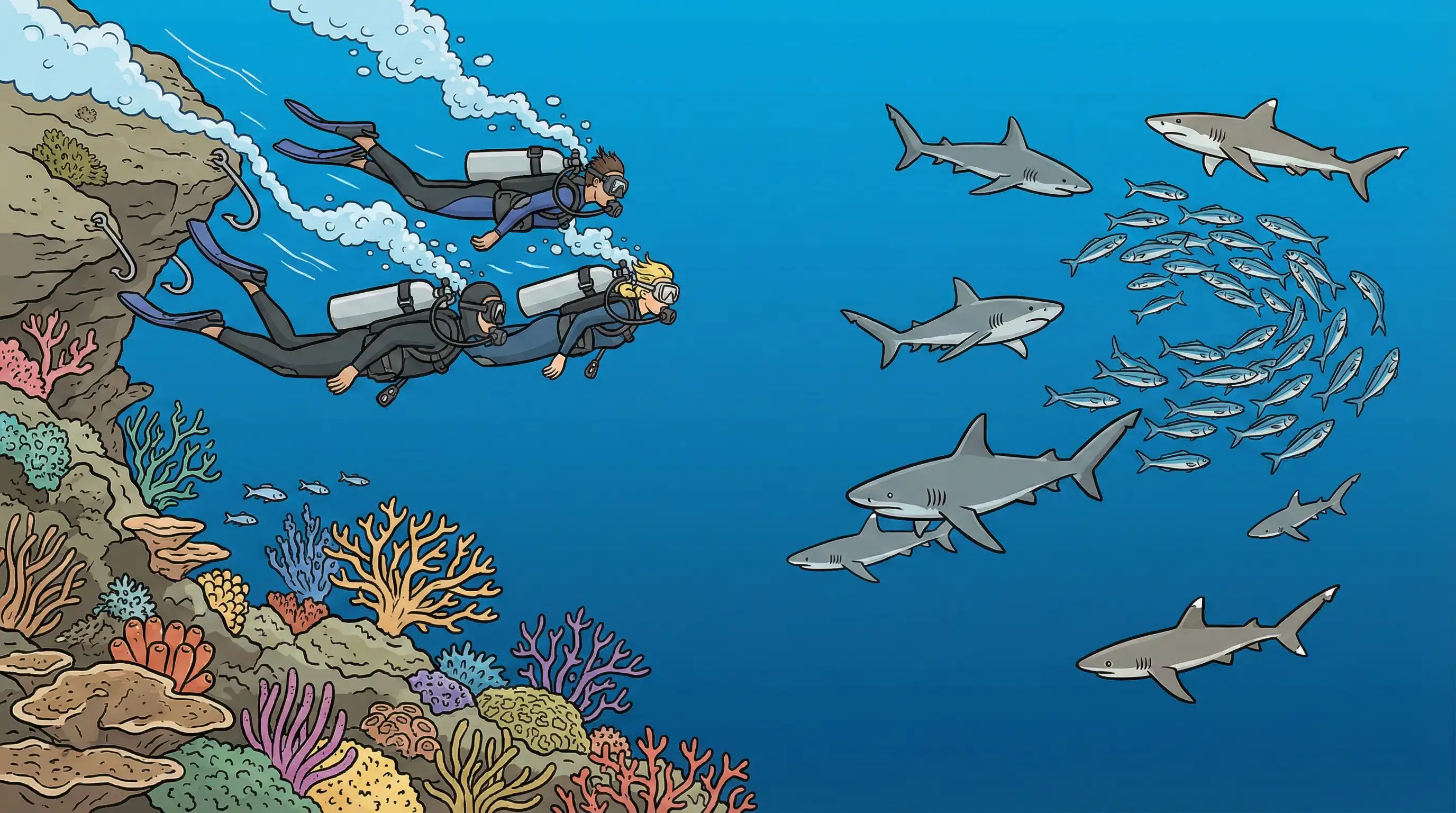
North Komodo, which is located around Gili Lawa Laut and Gili Lawa Darat, has the most exciting diving for advanced divers who want to see enormous pelagic fish. This area has everything that experienced divers dream about: strong currents that bring marine life close to impressive underwater structures, visibility that is typically more than 25 meters, and guaranteed sightings of sharks, tuna, and huge schools of predatory fish.
Most Popular North Komodo Dive Sites (Must-Dive):
- Castle Rock
- Crystal Rock
- The Cauldron/Shotgun
- Lighthouse
- Golden Passage
- Batu Tiga
The best time to get to North Komodo is from May to October, when the weather is dry and the winds and waves are calm enough for boats to safely cross. Liveaboards often spend the night in the Gili Lawa anchorage area, which lets them dive at Castle Rock or Crystal Rock early in the morning before day boats come from Labuan Bajo.
You should set your expectations right: most of the dives in North Komodo are good for intermediate to advanced divers who are okay with negative entrances, reef hooks for longer viewing in current, and sometimes short bottom durations since they are using a lot of energy to fight or manage currents.
For hotels and dive centers that cater to advanced divers, good coordination between the two is quite important. Guests who are going on multi-day liveaboard cruises or early-morning visits to North Komodo need to eat breakfast early, have reliable transportation, and be able to talk to each other clearly about their schedules.
Castle Rock (North – Classic Seamount of Sharks & Trevally)
Castle Rock is one of Komodo's most famous advanced sites. It is a big seamount that rises from around 75 meters to within 3–4 meters of the surface and is north of Gili Lawa Laut. This amazing dive site is on almost every "best of Komodo" list and offers the big-fish action that makes North Komodo diving so great.
Normal dive etiquette calls for a negative entry against the current, a short drop to 20–30 meters, and then hanging onto rocks to watch the spectacle unfold in the blue water around you. The way the seamount is built makes the current stronger, which in turn makes marine life more abundant, frequently in a big way.
The marine life is better than expected. White tip reef sharks and grey reef sharks monitor the area on a daily basis, and big trevally, dogtooth tuna, and mackerel seek through the water column. Barracuda swim in schools and make silver walls, and dolphins often swim by. The structure is covered in soft corals, enormous sea fans, and spectacular gorgonians. If you look attentively, you can see pygmy seahorses lurking.
Conditions necessitate candid self-evaluation: this location features robust, consistent currents, with an average operational depth of 20-25 meters and visibility generally exceeding 20-30 meters during the season. This is definitely a place for advanced divers who are comfortable with managing currents and dealing with negative entrances.
The top of Castle Rock, which is 5 to 10 meters high, may be unexpectedly serene and quite colorful. It's a great place to stop and relax while off-gassing, with anthias clouds and macro objects to look at.
Crystal Rock (North – Colorful Pinnacle in Clear Water)
Crystal Rock is a rocky peak that rises above the ocean at low tide. The water is very clear, and the currents are as strong as those at Castle Rock. The huge rock is the center of the site, and there are also nearby ridges and lesser pinnacles that make the diving area bigger.
Divers usually go down river and swim around the rock at a depth of 15 to 25 meters, where they can watch the action and take pictures of marine life without having to fight the current all the time. The platform gives awards to people who organize their dive based on the direction of the current.
The wildlife is like the North Komodo pattern: reef sharks, eagle rays, Napoleon wrasse, big schools of sweetlips and anthias, and tuna and mackerel swimming above. There are beautiful views between big-animal passes thanks to the great coverage of hard and soft coral.
Conditions call for respect: you typically have to enter negatively, and currents can get very strong on spring tides. The average depth is between 15 and 25 meters, although only highly advanced groups that are comfortable with strong current at depth can go deeper. Divers who are not as experienced may only dive on the lee side, where the current is much less.
The Cauldron / Shotgun (North – Legendary High-Speed Channel)
The Cauldron, which is also called Shotgun, is one of Komodo's most famous dives. It is a tiny channel between Gili Lawa Laut and Gili Lawa Darat that makes a "washing machine" bowl and acceleration zone, which is why it is called "Shotgun." This is the drift dive that makes Komodo known for its thrilling current-driven adventures.
The path goes like this: you start on a coral garden at 5–10 meters, then drop softly into a sandy basin (the "cauldron") at 20–22 meters, which is home to soft corals and gorgonians. From there, you ride the current through the channel to a shallow reef exit. When the currents are strong, divers are literally pushed through, which is where the name comes from.
Reef sharks, manta rays during the season, large jacks, schools of snapper, and schooling batfish are all types of wildlife. If you can stop and look, there are big chances with pygmy seahorses on sea fans.
This is one of Komodo's most current-intense dives because of the conditions. It is very important to know exactly when the tide will change, and you need to have expert guides. The average depth of the diving profile is between 12 and 22 meters.
You should have at least an Advanced certification and a lot of drift dive experience. Divers need to be able to quickly swim up over shallow coral while keeping their buoyancy in check. This dive isn't for people who are still learning the basics.
Lighthouse (North – Slope with Pinnacles & Seasonal Spawning)
Lighthouse is a slope reef off Gili Lawa Laut with two peaks. People usually dive there as a medium-speed drift, which is great for diving without the severe intensity of Castle Rock or The Cauldron.
There are big table corals, whip corals, soft corals, and sandy areas in the reef. At certain periods of the year, the pinnacles are home to leaf scorpionfish, frogfish, batfish, and breeding groups of Indonesian groupers. Photographers come to watch this behavior and take pictures of it.
Other marine life that can be seen near the reef includes white-tip reef sharks, bumphead parrotfish, and sometimes manta rays or dolphins.
Conditions are better than those at surrounding sites, with an average depth of 15 to 25 meters and currents that change but are normally easy to handle. Open Water divers who are confident and have Advanced certification find Lighthouse to be a rewarding place to dive without the stress that comes with more intense North Komodo spots.
Golden Passage (North – Scenic Strait Drift)
Golden Passage is the short strait that separates Gili Lawa Darat from Komodo Island. It has steady drift dives along walls and slopes with lots of marine life and beautiful underwater scenery.
Most dive trails start on the eastern side of the harbor, where you go down 20 to 25 meters toward the point. As the currents slow down, you go back up over a coral-rich reef.
Coral trout, anchovies, small tuna, trevally, and sleeping white tip sharks hiding in cracks are some of the wildlife. There are also a lot of turtles in the shallows. The site has a steady flow of activity, but not as much as Castle Rock or Crystal Rock.
Conditions are moderate to strong, and the optimum time to dive is when the tide is low to mid-tide. Experienced divers who are used to strong currents can dive in depths of 10 to 25 meters. When the weather is good, snorkelers like the tip of the peninsula for turtles and fish in shallow corals.
Batu Tiga & GPS Point (North/Central Border – Big Fish & Strong Currents)
Batu Tiga, which means "three rocks," is in the Linta Strait between Komodo and Rinca. It is a big-fish spot that is easy to get to by liveaboard and well-equipped day boats. GPS Point is a historically famous place that is offshore. It has been damaged by blast fishing, although it still has shark encounters.
Batu Tiga has a gorge of big rocks where strong currents bring marine life together. Barracuda, gigantic trevally, batfish, fusiliers, bumphead parrotfish, and pelagic visitors that are drawn to the nutrient-rich flow are common sights.
In September, GPS Point attracted divers looking for different types of sharks and schools hammerheads. Even if the coral is damaged, grey reef sharks and Spanish mackerel still swim in the area.
Conditions make both places advanced-only because of strong currents and being in the open ocean. To lower the risk, dives are carefully organized around tides and take place at depths of 15 to 25 meters.
South Komodo & Nusa Kode Dive Sites (Cool Water, Macro & Mantas)
South Komodo, which includes Nusa Kode and Langkoi, offers a very distinct diving experience. This area gets cooler, nutrient-rich water from the Indian Ocean, which supports a lot of invertebrate life and seasonal manta aggregations that are among of the best in Indonesia. The underwater scenery changes from the clear blue of the north to greener, more atmospheric conditions full of filter-feeding species.
South Komodo dive sites are not easily accessible due to distance and sea conditions. Dive centers and normal day tour boats do not operate in this area. So to dive the south Komodo dive sites, you typically must book a large liveaboard such as Komodo Sea Dragon or King Neptune.
Most Popular South Komodo Dive Sites (Must-Dive):
- Cannibal Rock
- Yellow Wall
- Manta Alley
- German Flag
- Langkoi Rock (for advanced divers)
- Nusa Kode macro sites (Crinoid Corner, Boulders)
Access to seasonal areas is different from North Komodo. From June to August, southern swells can make the seas boisterous at exposed spots. From September to January, when the surge dies down and the manta rays gather in large groups, many liveaboard tours focus on South Komodo.
When the temperature is between 22 and 25 degrees Celsius, divers need to wear the right protection. Many divers wear 5mm wetsuits or semi-drysuits when they work on South Komodo locations a lot. Visibility is usually 10 to 20 meters with a greenish tint instead of the blue clarity of northern sites. However, this means that there is a lot of marine life.
Most people get to these places by either a liveaboard cruise or a longer speedboat excursion from Labuan Bajo. Hotel guests usually work with operators that organize multi-day trips, so it's especially helpful when accommodation and dive logistics are combined.
Cannibal Rock (Nusa Kode, South – Invertebrate Showcase)
Cannibal Rock is probably Indonesia's best macro diving site. It's a small seamount in Loh Dasami Bay that has more different types of invertebrates per square meter than practically any other place divers can go.
The landscape has a peak that rises from 35 to 40 meters to about 5 to 6 meters at its highest point. Every surface is covered in ledges, overhangs, and a combination of rocks and soft coral gardens. There are a lot of small habitats for the animals that make this place famous.
Marine life is so amazing that even experienced macro photographers are amazed. There are pygmy seahorses, frogfish of many kinds, ornate ghost pipefish, sea apples, colorful nudibranchs that are too many to count, fire urchins with Coleman shrimp, various scorpionfish, and bohar snappers and surgeonfish that are bigger subjects. The list of possible sightings seems like a list of things to see while hunting for critters.
Conditions are good for photographers because the water is usually calm and the typical dive depth is 15 to 25 meters. The spot is good for people who dive slowly with macro lenses and are patient.
Every serious macro diver should want to go to Cannibal Rock. Photographers often say it's one of the nicest dives they've ever done.
Yellow Wall of Texas (Loh Dasami, South – Bright Soft-Coral Wall)
Yellow Wall is in the southeast corner of Loh Dasami Bay. It gets its name from the thick yellow soft corals that cover its vertical face. The spot offers wall-diving beauty that is unlike anything else in North or Central Komodo.
The dive usually starts at about 25 meters and slowly goes up the wall, going past fields of sponges, crinoids, and tunicates. The site is great for both day and night dives, and other animals come out after dark.
There are sleeping slipper lobsters, cleaner shrimp, decorator crabs, sea cucumbers, Spanish dancers (during night dives), reef fish like coral trout, turtles, and bamboo sharks or cat sharks resting in crevices.
Conditions make Yellow Wall easy for intermediate divers to get there: there is usually little current and the average depth is 15 to 22 meters. Macro photographers and aficionados can discover plenty of subjects without having to deal with excessive flow.
Night diving here shows you hunting cuttlefish, prowling crustaceans, and sleeping reef fish that are easy to photograph. This is a great addition to any South Komodo program.
Manta Alley (South Komodo – Manta Aggregation Hotspot)
Manta Alley is a group of small rocky islands on South Komodo's exposed coast that draws a lot of reef mantas, especially from September to January when the nutrients rise to the surface.
There are shallow cleaning stations around the rocks at depths of 5 to 15 meters. Deeper sandy channels go down to about 25 meters, where mantas cruise and eat concentrated plankton.
Wildlife emphasizes on mantas but also includes gigantic trevally, reef sharks, mobula rays that come and go, and good hard coral cover in sheltered areas between the rocks. On busy days, dozens of mantas swim around the cleaning stations in patterns that are hard to look away from.
Conditions necessitate an honest evaluation: this exposed spot is characterized by chilly water, fluctuating visibility, and frequently robust surges and currents. Under rigorous guide control, all levels can dive here only when the weather is moderate. Otherwise, this is intermediate-plus terrain.
Here, manta etiquette is very important: stay low, don't block cleaning stations, don't chase or contact, and stay neutral buoyant over coral. The mantas come back because they feel safe at their cleaning stations. Keeping them comfortable will make sure that all divers have more chances to see them.
German Flag (South Komodo – Cool-Water Manta Site)
From September to January, colder Indian Ocean water rich in plankton rises up from the bottom of the German Flag reef on South Komodo's shore. This attracts filter feeders and the mantas that follow them.
There are shallow rocky places with patchy reefs where malabar grouper, potato grouper, Napoleon wrasse, schools of surgeonfish, and sweetlips live. The upwelling's high productivity supports a lot of fish life all across the site.
When there are a lot of plankton here, manta behavior is mostly about eating and cleaning. When operators plan trips, they typically combine German Flag with Manta Alley, allowing divers more chances to see the animals on the same day.
Conditions usually include current and depths of 10 to 20 meters. The water may look greenish, but it is full of life. Photographers who are willing to deal with the conditions often come back with amazing pictures of mantas in atmospheric water.
Nusa Kode Macro Circuit: Crinoid Corner, Boulders & Invertebrate Walls
Nusa Kode, which is south of Rinca, is a protected bay system with colorful cliffs and enormous boulders. It has a special macro-focused itinerary for divers who like to look at small things instead than pelagics.
Crinoid Corner is a morning wall dive that starts at around 25 meters and goes up slowly. It is full of small crustaceans, nudibranchs, shrimps, and the critters that live with crinoids (shrimp, squat lobsters, clingfish) and hide in their fluffy arms.
Boulders has a lot of big boulders, from 8 to 30 meters, with a sandy base and a soft coral forest developing on top. Coleman shrimp on fire urchins show up a lot, and mobula rays sometimes swim by overhead. The spot is good for diving during the day and at night.
Walls with a lot of invertebrates (often called "unnamed" or "locally designated") have a lot of tunicates, sponges, and sea fans that house a lot of macro subjects.
Inside the sheltered bays, the current is normally light, and the average depth is between 15 and 25 meters. Nusa Kode is a great place for intermediate divers who like to explore slowly and in detail.
Langkoi Rock / TNC Rock & Loh Sera (South – For Hardcore Shark & Pelagic Fans)
Langkoi Rock (off Langkoi Island) and Loh Sera pinnacles are South Komodo's best places to catch big fish. They are open to the Indian Ocean and need a lot of planning to dive safely.
Langkoi Rock is a pinnacle that is scoured by currents and has stunted corals, but it is quite exciting. Grey reef sharks, white-tips, and sometimes hammerheads and bronze whalers come to the area from July to September. Experienced divers who are ready to work for their encounters are drawn to these animals.
Loh Sera has walls and pinnacles with precipitous drop-offs where dogtooth tuna, big trevally, large groupers, and manta rays live. Even experienced divers have a hard time with surge and high currents.
Both sites are only good for expeditions because they are quite exposed to currents and have a lot of surge. You need to plan carefully around tides and swell forecasts. People who live on boats usually do these things when the weather is calm, not while they are on day boats.
Komodo Dive Seasons, Conditions & Planning Your Itinerary
Komodo's dive calendar shows that you can dive all year round, but knowing how the seasons change makes organizing your trip much easier. April through November is usually the ideal time for all regions, but each one has its own special needs.
Monthly trends by region:
- North Komodo: Best May through October when seas are calm; often inaccessible November through March
- Central Komodo: Diveable year-round; peak conditions April through November
- South Komodo: Best September through January for manta aggregations; rough June through August
Water temperatures and thermoclines:
- North and Central: 27-29°C during dry season
- South and occasionally Central: 22-26°C during rainy season and upwelling periods
- Thermoclines can drop temperatures 5-8°C in seconds on certain sites
Visibility patterns:
- North dry season: 20-30 meters, often crystal blue
- Central year-round: 15-25 meters depending on plankton
- South with upwelling: 10-20 meters with green, productive tones
Sample 3-5 day itineraries:
Batu Bolong, Manta Point, Mawan, Tatawa Besar, Siaba Besar, Siaba Kecil, and Wainilu are all central places for groups with different levels of experience. You can get there from Labuan Bajo on day boats, and it's good for Open Water to Advanced dives.
Castle Rock, Crystal Rock, The Cauldron, Batu Bolong, and Siaba Kecil are all good places for advanced divers in the North and Central regions. During the dry season, you need to stay on a boat or start your day early. You need to have advanced qualification and current experience.
Central and South liveaboard loop: Batu Bolong, Manta Point, then go to Cannibal Rock, Yellow Wall, and Manta Alley when the sea is calm. Best time to go is from September to January, and the best way to do it is on a liveaboard for 4 to 7 days.
Safety, Certification Levels & Choosing the Right Dive Operator
Komodo is known for strong, unpredictable currents, and the first step to staying safe is being honest about your talents. The amazing diving here rewards being prepared and punishes being too sure of yourself. If you pick the right places for your level, you'll always want to go back for more.
Recommended certification levels by region:
| Region | Minimum Certification | Notes |
|---|---|---|
| Central | Open Water | Some sites better with Advanced; guide closely |
| North | Advanced Open Water | Drift experience essential; reef hooks useful |
| South | Varies by site | Mix of intermediate and advanced depending on exposure |
Essential safety gear:
- SMB (surface marker buoy) per diver—mandatory
- Audible signaling device (whistle, air horn)
- Dive computer with current no-deco limits
- Reef hook for extended viewing at North sites
- GPS beacon consideration for remote liveaboard trips
- Appropriate exposure protection for South Komodo temperatures
What to look for in a dive operator:
- Experienced local guides who know site-specific conditions
- Clear dive briefing with tide/current plans before every dive
- Proper boat safety equipment and oxygen onboard
- Sensible group sizes (maximum 4-6 divers per guide in current)
- Contingency plans for changing conditions
- Professional attitude toward diver skill assessment
Conclusion: Experience the Best of Komodo Dive Sites
Diving in Komodo National Park is a wonderful experience for divers of all levels of experience. Komodo really does have something for everyone. There are the exciting drift dives in the north, the colorful coral gardens and lots of marine life in the center, and the unusual macro and manta ray encounters in the south. The park's underwater sceneries and coral life are so beautiful that you'll be amazed whether you choose to dive at well-known sites like Batu Bolong, Manta Point, or Castle Rock or at less well-known places like Wainilu or Cannibal Rock.
To get the most out of your diving trips, schedule them at the optimum times of year, use reliable dive operators, and always put safety first by following dive briefings and being aware of strong currents. Komodo is still one of the best places in the world to go scuba diving. It has UNESCO World Heritage designation, beautiful coral reefs, and lots of marine life, like manta rays, reef sharks, turtles, and colorful reef fish.
Komodo promises amazing diving experiences that will blow your mind and leave you with memories that will last a lifetime, whether you are going on a liveaboard tour or a day trip from Labuan Bajo. Explore the depths of this underwater wonderland and find out why divers from all over the world love Komodo dive spots.