The Komodo dragon is the closest thing this planet has to a living dinosaur. It's the largest lizard alive today, a three-metre apex predator that can bring down a water buffalo, and it exists in the wild on just a handful of Indonesian islands and nowhere else on Earth. Meeting one on a guided Komodo dragon tour is the kind of encounter that rearranges your idea of what a reptile can be.
But the animal is far stranger than the "giant lizard with deadly bacteria" story most people grew up with. Real Komodo dragons have venom glands, iron-tipped teeth, a coat of bone armour under their skin, and females that can reproduce without a single male involved. Before you visit the park on a Komodo National Park tour, it helps to know what you're actually looking at. Here's the full picture, backed by current science.
This guide runs through the facts that matter most: how big they get, where they live, whether they're really venomous, how they hunt, why their childhood is so brutal, how many are left, and how to see them safely and responsibly.
Komodo Dragon Facts at a Glance
If you only remember a handful of things about this animal, make it these:
- Species name: Varanus komodoensis, a monitor lizard. Locals call it ora.
- Size: up to about 3 metres (10 feet) long.
- Weight: roughly 70–90 kg on average; the heaviest verified individual hit 166 kg with a full stomach.
- Range: only Komodo, Rinca, Gili Motang, Nusa Kode, and parts of Flores.
- Wild population: around 3,000–3,500 individuals.
- Status: Endangered on the IUCN Red List since 2021.
- Lifespan: up to about 30 years in the wild.
- Top speed: roughly 20 km/h in a short sprint.
How Big Do Komodo Dragons Get?
Size is the headline, and it deserves to be. A large male stretches to about three metres from snout to tail tip and weighs as much as a grown man, sometimes more. That makes the Komodo dragon the heaviest lizard on the planet by a comfortable margin.
Two numbers tend to surprise people. First, the famous 166 kg record belonged to a dragon that had just gorged itself, so part of that mass was the meal. A healthy unfed adult is usually in the 70–90 kg range. Second, males are noticeably bigger than females, which top out closer to two metres and around 50–70 kg. Hatchlings, by contrast, are tiny: barely 20 centimetres and light enough to sit in your palm. The growth from a palm-sized lizard to a deer-killing giant is one of the most extreme size journeys in the animal kingdom.
Their tails are about as long as their bodies, muscular and heavy, and a dragon can swing one hard enough to knock prey off its feet. That tail isn't decoration. It's a weapon.
Why Are Komodo Dragons So Big?
The obvious explanation is "island gigantism", the tendency for some island animals to evolve to unusual sizes when there's little competition. It's a tidy theory, and for years it was the standard answer. The fossil record, though, tells a more interesting story.
Komodo dragons didn't get big because they ended up on small islands. Fossils show that giant monitor lizards of this size were roaming Australia and the surrounding region hundreds of thousands of years ago, alongside the even larger extinct Megalania. The ancestors of today's Komodo dragons were already huge before they arrived in what is now Indonesia. In other words, they were giants that found a refuge, not small lizards that grew into the role. As the megafauna they once hunted disappeared elsewhere, this corner of Indonesia became their last stronghold.
That deep evolutionary history is part of what makes standing near one feel so primal. You're not looking at an oversized lizard. You're looking at a survivor from an age of giants.
Where Do Komodo Dragons Live?
This is the fact that makes the whole trip worth it: Komodo dragons are found in the wild in exactly one place on Earth, the islands of Komodo National Park and a sliver of neighbouring Flores. The core populations live on Komodo Island and Rinca Island, with smaller groups on Gili Motang and Nusa Kode.
Of the two main islands, Rinca is often the better bet for a sighting because the dragons there tend to gather around the ranger station and the savanna is more open. Our guide to seeing Komodo dragons on Rinca Island covers exactly what that visit looks like. Komodo Island itself is larger and wilder, and many trips combine a dragon trek with a climb up the famous viewpoint on nearby Padar Island and a stop at one of the park's pink-sand beaches.
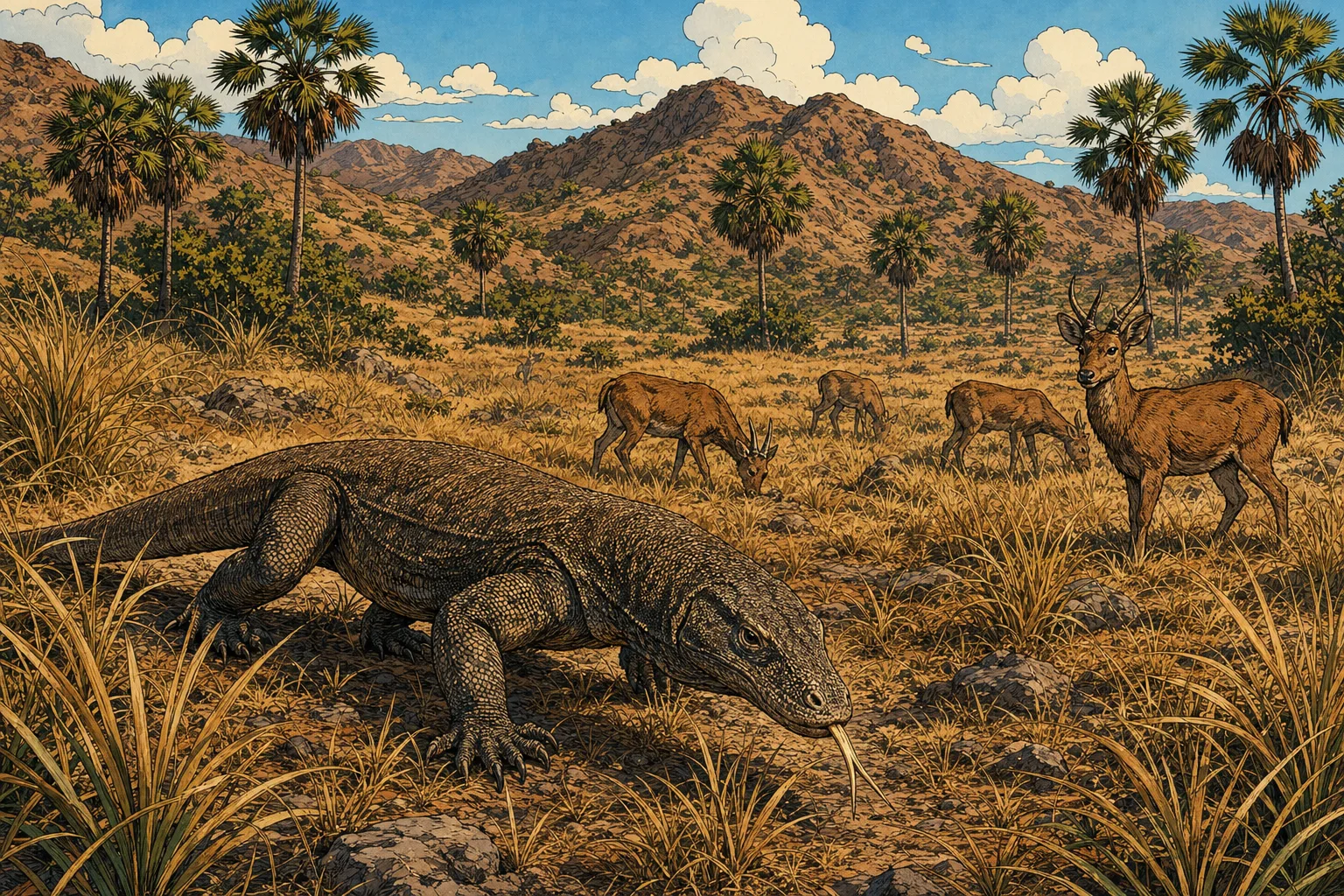
The habitat is not the steamy jungle people expect. These islands are hot, dry, and surprisingly harsh, with golden savanna grassland, scattered lontar palms, and tropical dry forest on the hillsides. Daytime temperatures regularly push past 35°C. The dragons are perfectly built for it, spending the hottest hours resting in shade and burrows, then moving out to hunt and patrol when the heat eases.
Are Komodo Dragons Venomous? The Truth About the Bite
For decades the story went like this: a Komodo dragon's mouth is so full of toxic bacteria that a single bite infects its prey with deadly sepsis, and the dragon simply follows the dying animal until it drops. It's a great story. It's also mostly wrong.
In 2009, a research team led by Bryan Fry at the University of Queensland showed that Komodo dragons have genuine venom glands in their lower jaw. The venom is an anticoagulant: it stops blood from clotting and drops the victim's blood pressure, which causes massive bleeding, shock, and rapid weakening. Combined with the dragon's serrated teeth, which open deep, ragged wounds, the venom means prey bleeds out far faster than infection alone could ever manage.
So what about the bacteria? The "deadly mouth" idea has been largely overturned. A 2013 study found the bacteria in a wild dragon's mouth were no more dangerous than what you'd find in other carnivores, and the dragons are fastidious about cleaning their mouths after eating. The real one-two punch is the wound plus the venom, not a soup of germs.
Worth saying plainly: this is why you keep a respectful distance and listen to your ranger. A dragon bite is a genuine medical emergency. It's not common, but it's serious, which is one reason organised tours exist in the first place.
How Komodo Dragons Hunt and Eat
Komodo dragons are ambush predators. They'll lie still and camouflaged beside a game trail for hours, then explode forward with a short, shockingly fast sprint to grab prey by the leg or throat. They hunt Timor deer, wild boar, smaller dragons, monkeys, and even young water buffalo, and they'll happily scavenge a carcass when the chance comes.
Their sense of smell does the heavy lifting. A dragon "smells" by flicking out its long, forked yellow tongue, collecting scent particles, and pressing them against the Jacobson's organ on the roof of its mouth. The forked shape lets it tell which side a smell is stronger on, like a chemical compass. On a good day, with the wind right, a dragon can detect a rotting carcass from up to 9–11 kilometres away.
Then there's the appetite. A Komodo dragon can eat up to 80% of its own body weight in a single meal. It swallows huge chunks, sometimes whole smaller animals, helped by a flexible jaw, an expandable stomach, and a throat that does most of the work. After a feast that big, it may not need to eat again for weeks. They've even been seen ramming carcasses against trees to force them down, and regurgitating a stomach pellet of horns, hair, and teeth afterwards.
Built Like a Tank: Skin, Teeth, and Senses
Recent research has revealed just how heavily armed and armoured these animals really are.
Iron-tipped teeth
In 2024, scientists at King's College London discovered that Komodo dragons coat the serrated edges and tips of their teeth in a concentrated layer of iron. You can actually see it as a faint orange staining along the cutting edges. The iron hardens the teeth and keeps them razor-sharp, which helps explain how they slice through hide and bone so efficiently. A dragon carries around 60 curved, serrated teeth, and like sharks, it replaces them throughout its life.
A coat of bone armour
Adult Komodo dragons have osteoderms, tiny bones embedded in their skin that form a kind of natural chain mail. A 2019 study using CT scans found that older, larger dragons are almost completely encased in this bony armour, while hatchlings have none. The leading theory is that the armour protects adult dragons from the only thing big enough to hurt them: other adult Komodo dragons.
Senses and movement
Their eyesight is decent in daylight and they can spot movement at around 300 metres, but they see poorly in low light and have a narrow field of focus. Hearing is limited; smell is everything. On land they're faster than they look, hitting roughly 20 km/h over short distances, and they're strong swimmers that can cross channels between islands. Young dragons are also excellent climbers, which matters more than you'd think.
Virgin Births: How Komodo Dragons Reproduce
Here's the fact that stops people in their tracks. Female Komodo dragons can reproduce without a male, through a process called parthenogenesis. The most famous case happened in 2006 at Chester Zoo in England, where a female named Flora laid fertile eggs despite never having lived with a male. Several zoos have since recorded the same thing.
It works because of how reptile sex chromosomes are arranged, and there's a twist: parthenogenetic offspring are always male. In evolutionary terms it's a clever insurance policy. A single female washed up alone on a new island could, in theory, lay eggs, hatch sons, and then breed with them to found an entire population. For an animal scattered across isolated islands, that's a serious survival advantage.
In the normal course of things, dragons mate around the dry season. Females lay clutches of roughly 20 eggs, often in abandoned megapode (scrubfowl) mounds or in burrows they dig themselves, then guard the nest for months. The eggs incubate for seven to eight months before hatching, usually around the start of the wet season when small prey is abundant.
A Brutal Childhood
Being a baby Komodo dragon is dangerous, and the biggest danger is adult Komodo dragons. Cannibalism is a normal part of dragon life, and roughly one in ten of an adult's diet can be smaller dragons.
Hatchlings have a remarkable survival strategy: they head straight up into the trees. For the first few years of life, young dragons are largely arboreal, living in the branches where the heavy adults can't follow. Up there they feed on insects, geckos, small birds, and eggs. Newly hatched dragons have even been observed rolling in faeces, and adults sometimes avoid eating the youngsters that smell that way, an unglamorous but effective defence.
Only once a young dragon is big enough to have a fighting chance does it come down and start living on the ground full-time. It's a hard, high-stakes start to life, and it's part of why the species reproduces slowly and recovers slowly from any population dip.
A Day in the Life of a Komodo Dragon
For all their menace, Komodo dragons spend most of their time doing very little, and understanding that rhythm explains a lot about what you'll actually see on a trek. They're ectotherms, so the sun runs their schedule. Early morning is for warming up: a dragon will haul itself into a sunny patch and bask until its body is warm enough to move efficiently.
Once it's up to temperature, the dragon patrols. It walks slowly along well-worn trails, tongue flicking, covering a territory it often holds for years. The middle of the day, when the savanna bakes, is downtime. Dragons retreat into shade or into burrows they dig with those powerful claws, which keeps them cool and conserves energy. This is why midday treks often turn up dragons lying motionless under a tree rather than charging across the grass.
They aren't especially social. Adults are largely solitary and tolerate each other mainly around a carcass, where a strict pecking order plays out: the biggest dragons eat first, and smaller ones wait, or risk becoming the next meal. They communicate less through sound than through body language and scent. A dragon standing tall on stiff legs with its back arched is making itself look big, and it's a signal worth respecting.
How Many Komodo Dragons Are Left?
Somewhere between 3,000 and 3,500 Komodo dragons survive in the wild. In 2021, the IUCN moved the species from Vulnerable to Endangered, and the reason is sobering: climate change and rising sea levels are projected to shrink the dragon's already tiny island habitat over the coming decades.
Other pressures include habitat loss on Flores, a decline in the deer the dragons depend on (partly from poaching), and the simple fragility of a species that lives in just a few places. The good news is that the core populations inside Komodo National Park are stable and well protected. The park is a UNESCO World Heritage Site, and the entry fees you pay fund conservation and ranger patrols, which is exactly why those fees exist. Our breakdown of Komodo National Park entrance fees explains where that money goes.
Visiting responsibly genuinely helps. Tourism gives these islands an economic reason to stay wild, and it funds the rangers who keep both the dragons and the visitors safe.
Komodo Dragons and Humans
The wider world only learned about Komodo dragons surprisingly recently. Western science first documented them in 1910, when a Dutch officer heard rumours of a "land crocodile" and brought back a specimen; the species was formally described in 1912. Within a couple of decades the animal had captured the public imagination so completely that it helped inspire the 1933 film King Kong. An American expedition in the 1920s brought live dragons to New York, and the "lost world of giant lizards" idea took root in popular culture.
Attacks on people are rare but real, which is why the park takes safety seriously. Dragons are wild apex predators, not props, and they can move fast when motivated. Stick with your ranger, keep your distance, and you'll be fine. For the full rundown on risk and how the park manages it, see our honest guide on whether Komodo Island is safe. Families travelling with children should also read our Komodo with kids guide, which covers the age rules and practicalities of dragon treks.
Where and How to See Komodo Dragons
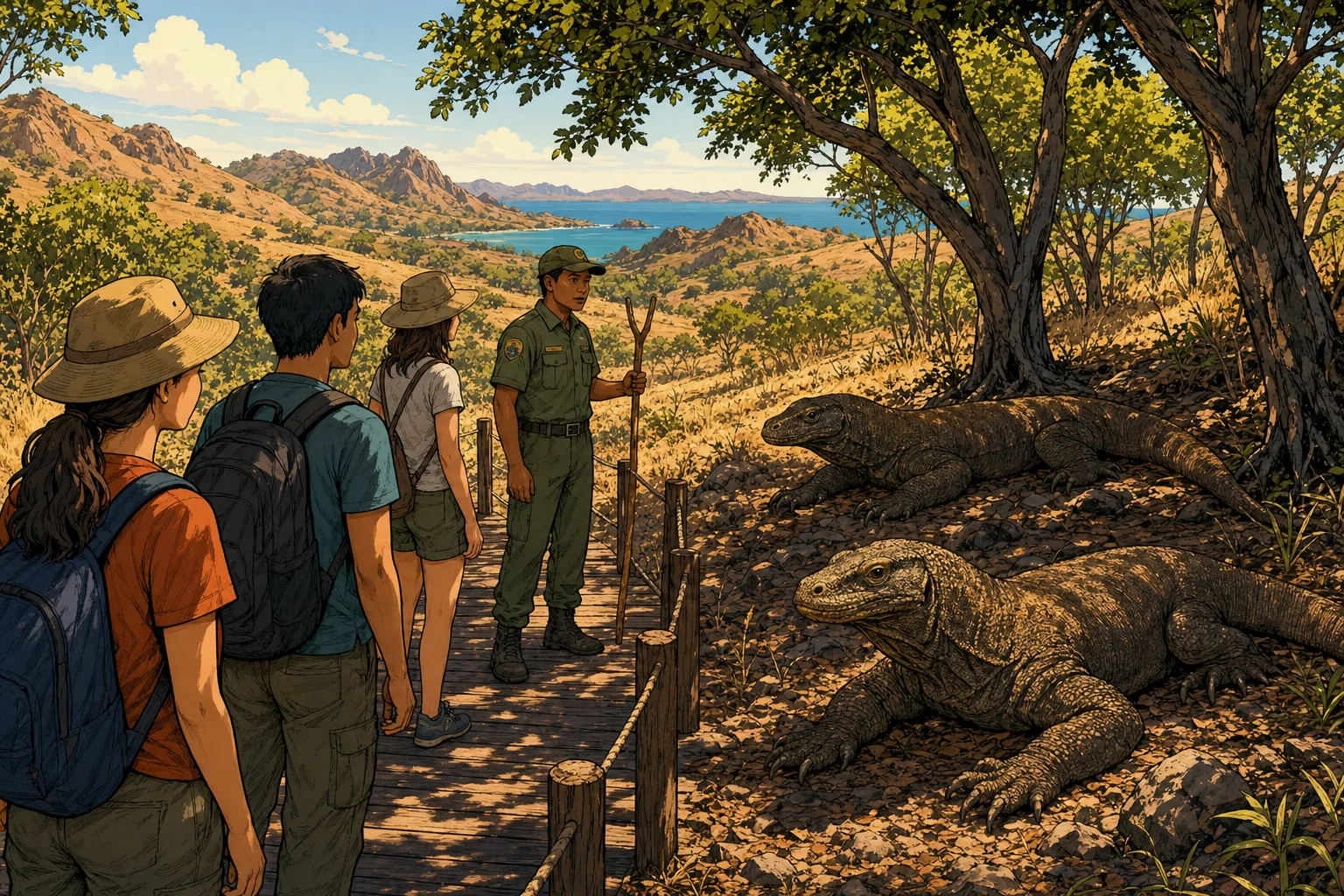
You can only see wild Komodo dragons inside Komodo National Park, reached through the town of Labuan Bajo on the western tip of Flores. Most visitors fly into Labuan Bajo and join a boat trip out to Komodo or Rinca; our Labuan Bajo travel guide covers the gateway town in detail.
A few practical pointers for the dragon encounter itself:
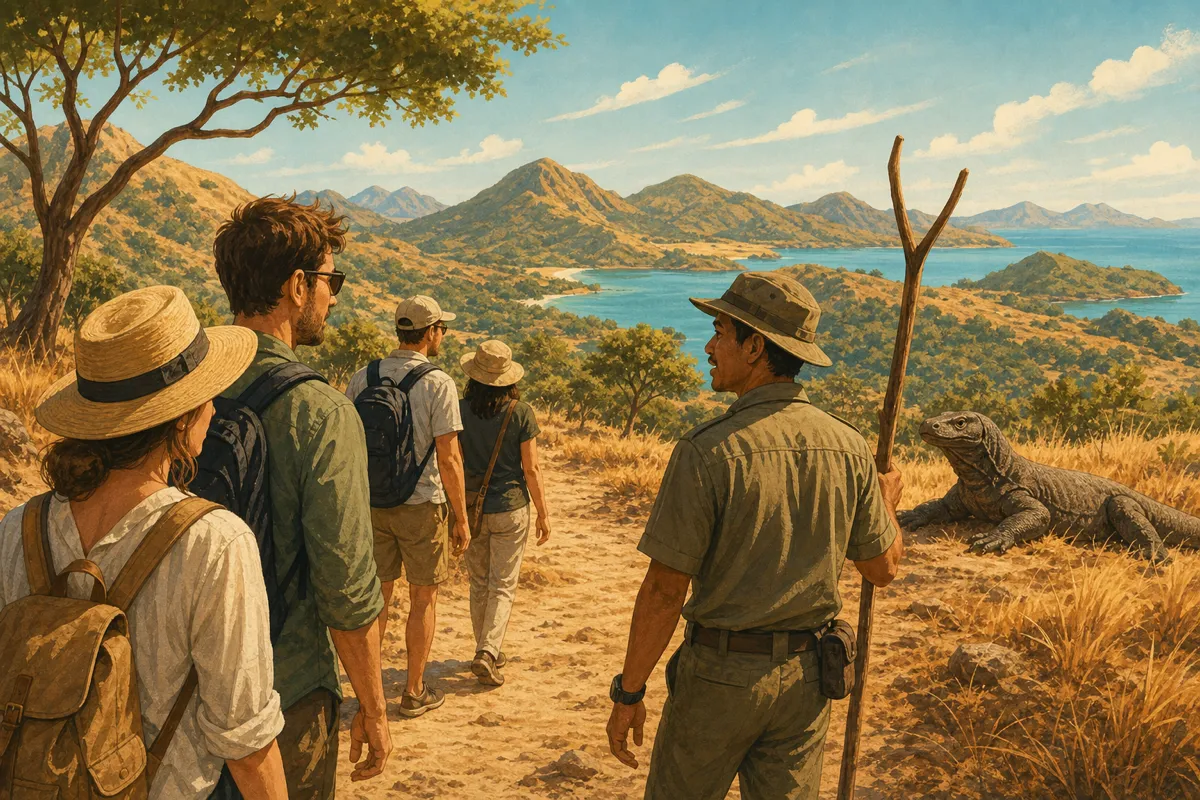
- Always go with a ranger. Independent walking among the dragons isn't allowed, and for good reason. Rangers carry a long forked stick and know how to read the animals' body language.
- Keep your distance and stay with the group. Don't crouch, don't run, and never get between a dragon and where it wants to go.
- Mornings are best. Dragons are more active in the cooler early hours and tend to retreat to shade by midday.
- Pick the right season. The mating and nesting calendar and the weather both shift through the year; our best time to visit Komodo guide breaks it down month by month.
- A note for women: rangers ask visitors who are menstruating to let them know, as dragons have an extraordinary sense of smell for blood. It's a simple precaution, not a reason to skip the trek.
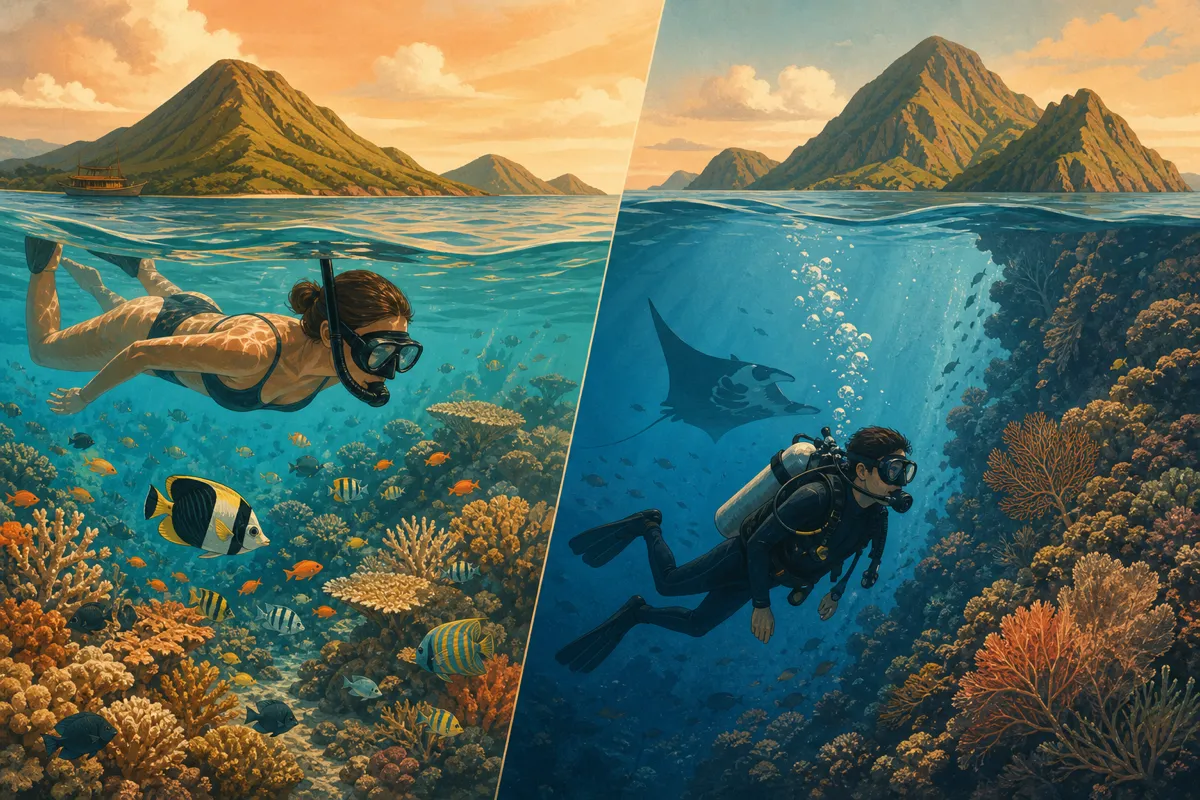
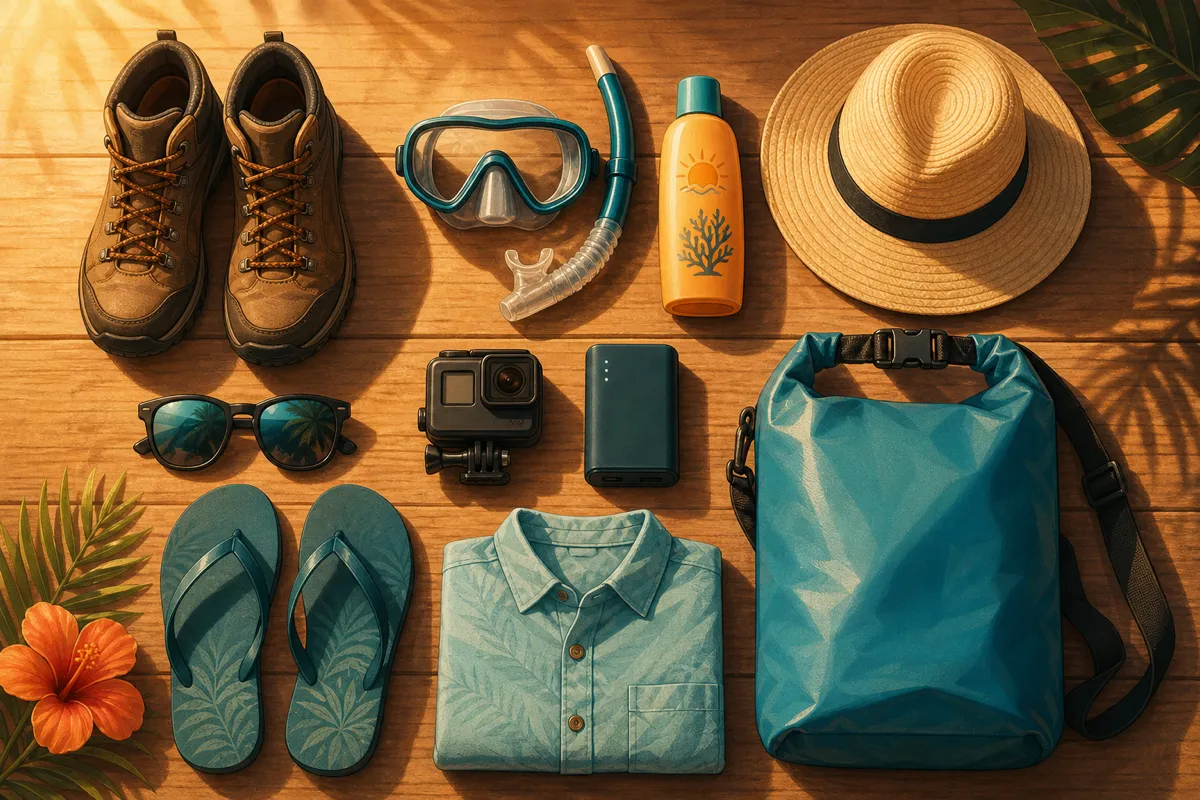
A dragon trek pairs naturally with the rest of the park's highlights. If you're building a full trip, our list of the best things to do in Komodo and our ready-made Komodo itineraries will help you slot the dragons in alongside diving, snorkelling, and island hopping. And before you fly out, run through our Komodo packing list, sturdy closed shoes and sun cover matter more on a hot savanna trek than people expect.
Komodo Dragon Myths, Busted
A handful of "facts" about Komodo dragons get repeated everywhere and most of them are shaky. Here's the reality:
- Myth: they kill with dirty, bacteria-filled mouths. Largely false. Venom and slicing wounds do the work, and the dragons keep their mouths fairly clean.
- Myth: they're slow and clumsy. Wrong over short distances. A dragon can sprint at around 20 km/h, faster than most people expect from something that size.
- Myth: they're basically dinosaurs. Not quite. They're monitor lizards, a modern reptile group, though their lineage of giant monitors is genuinely ancient.
- Myth: a bite is always fatal to humans. No. Bites are serious and need urgent treatment, but they're survivable and, crucially, rare.
- Myth: they can't swim. They're capable swimmers and cross open water between islands.
Quick-Fire Komodo Dragon Facts
A few more that didn't fit neatly above, perfect for impressing your boat-mates:
- Their name in Indonesian is sometimes buaya darat, literally "land crocodile".
- They can go through 4–5 sets of teeth in a lifetime, much like sharks.
- A dragon's bite force is modest; the damage comes from the slicing teeth and venom, not crushing power.
- They have a relatively small home range and often patrol the same territory for years.
- Despite the bulk, they're capable swimmers and have been seen crossing open water between islands.
- Baby dragons can climb; fully grown adults are too heavy and stay on the ground.
- A big meal can sustain an adult for weeks, so they don't need to hunt every day.
The Last Dragons
There's a reason people travel from the other side of the world to walk a dusty trail and watch a lizard sleep under a tree. The Komodo dragon is a genuine evolutionary marvel, a venomous, iron-toothed, armour-plated giant clinging on in one small corner of Indonesia. Seeing one in the wild is a privilege, and a reminder of how strange and fragile the natural world can be. Come with curiosity, keep your distance, follow your ranger, and you'll leave with the kind of story that doesn't need exaggerating.