
It is usually the first question people ask when they start planning a trip to Komodo National Park: are Komodo dragons actually dangerous? The short answer is yes, Komodo dragons are apex predators capable of killing prey much larger than a human, and they deserve serious respect. The longer and more reassuring answer is that attacks on people are extremely rare, and visiting the dragons with a ranger is one of the safest wildlife encounters of its kind anywhere in the world.
This article separates the myths from the biology: how the Komodo dragon actually hunts and kills, whether it is truly venomous, what the attack statistics and famous incidents really tell us, what happens medically when a dragon bites, and the simple rules that have kept millions of park visitors safe.
How Dangerous Is a Komodo Dragon, Really?
On paper, the Komodo dragon is a formidable predator. Adults reach up to 3 meters in length and around 70 to 90 kilograms, making them the largest lizards on Earth. They can sprint at nearly 20 kilometers per hour in short bursts, swim confidently between islands, and take down water buffalo several times their own weight. Their mouths hold about 60 serrated, shark-like teeth that are replaced continuously throughout their lives, and their bite is driven by powerful neck muscles that pull backward in a slashing motion designed to open large wounds.
Dragons are ambush hunters. Rather than chasing prey over distance, they wait motionless beside game trails, camouflaged against the dry savanna, and strike with explosive speed. For smaller prey like deer, the first strike is often decisive. For larger animals like buffalo, the dragon frequently delivers a deep bite and then retreats, tracking the weakening animal, sometimes for days, using a sense of smell that can detect carrion from as far as 9 kilometers away.
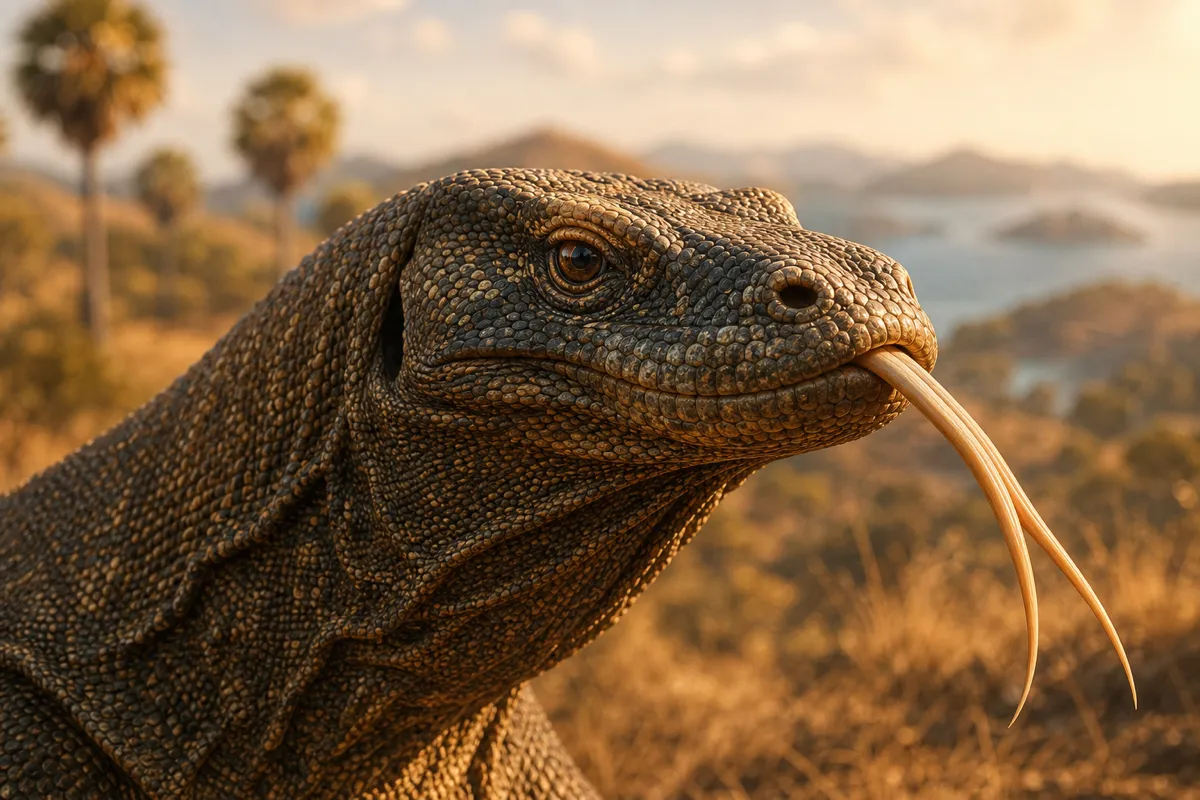
That sense of smell deserves its own mention. Like snakes, dragons taste the air with a long forked tongue, transferring scent particles to the Jacobson's organ in the roof of the mouth. Each fork samples a slightly different point in space, letting the animal follow a scent gradient with eerie precision. It is why park rules about food and blood are taken so seriously: a dragon's nose is its primary weapon, and it works at extraordinary range.
So yes: a wild Komodo dragon is dangerous in the way a crocodile, a big cat, or a bear is dangerous. What matters for travelers is context, and the context is overwhelmingly reassuring.
Venom, Bacteria, or Both? The Science of the Bite
For decades, the popular story was that Komodo dragons killed with dirty mouths: bacteria in their saliva supposedly caused fatal infections in bitten prey, which the dragon would then track until it collapsed. The theory appeared in textbooks, documentaries, and a generation of nature writing. Modern research has largely overturned it.
In 2009, a team led by Dr. Bryan Fry of the University of Melbourne used MRI scans and biochemical analysis to show that Komodo dragons possess true venom glands in their lower jaws, with ducts opening between the teeth. The venom is a complex cocktail containing toxins that prevent blood clotting, dilate blood vessels, lower blood pressure, and induce shock. Combined with the mechanical trauma of their serrated teeth, the venom means that prey wounded by a dragon weakens rapidly from blood loss and plunging blood pressure rather than from slow infection.
Follow-up research also found that dragon mouths are no dirtier than those of other carnivores; the famous toxic bacteria were largely environmental contamination from drinking stagnant water and feeding on carrion. In other words, the Komodo dragon is the largest venomous land animal in the world, a title far more remarkable than the myth it replaced.
Either way, the practical takeaway for humans is identical: a bite is a serious medical emergency involving deep lacerations, significant blood loss, and envenomation, and the entire safety system of the park is built around making sure bites never happen.
What Actually Happens If a Dragon Bites?
It is worth being clear-eyed about this, because it explains the park's caution. A Komodo dragon bite combines three problems at once: deep, ragged wounds from the serrated teeth; anticoagulant venom that keeps those wounds bleeding; and the physical power of an animal that can pull prey off its feet. Victims of serious bites need rapid evacuation, wound repair, and in severe cases transfusion and antibiotics.
Labuan Bajo, the gateway town to the park, has a hospital, and serious cases are evacuated onward to Bali. But the honest medical reality is that the nearest advanced trauma care is hours away, which is exactly why the ranger system exists and why the rules are non-negotiable. In the entire modern era of managed tourism, serious bites to visitors on guided treks have been vanishingly rare, precisely because the system works.
Do Komodo Dragons Attack Humans?
Rarely, and far less often than their reputation suggests. Komodo National Park receives hundreds of thousands of visitors per year, and confirmed attacks number a handful per decade. Park records and local reporting document roughly 30 attacks over the past 50 years across the park and surrounding villages, with around five fatalities, most involving villagers going about daily life rather than tourists on guided treks.
A few incidents have become well known. In 1974, an elderly European visitor vanished on Komodo Island after separating from his group to rest; only his camera and a few belongings were found, and he is presumed to have been taken by dragons. In 2009, a local fruit picker who entered a restricted area died of blood loss after an attack. In 2017, a foreign tourist who approached feeding dragons alone, before the rangers' morning shift, survived a severe bite to his leg. Even in zoos, the rare bites recorded have almost all followed a keeper or visitor entering an enclosure at close range.
Notice the pattern: nearly every incident involves someone alone, someone surprising a dragon at close range, someone near feeding animals, or someone inside an enclosure. Guided tourist groups following ranger instructions have an outstanding safety record stretching back decades. Statistically, the boat ride to the island carries more everyday risk than the dragons do.
It is also worth remembering that dragons do not see humans as preferred prey. Their diet is Timor deer, wild boar, buffalo, smaller dragons, and carrion. Attacks on people are defensive or opportunistic exceptions, not hunting behavior directed at visitors.
Surprising Abilities: Swimming, Climbing, and Cannibal Youth
Part of respecting the dragon is knowing what it can actually do, and some of its abilities surprise visitors:
- They swim. Dragons cross the channels between islands and have been seen swimming well offshore. The populations on Komodo, Rinca, and the smaller islands exchange individuals this way. A dragon resting on a beach is entirely normal, and boat crews know to keep tenders clear of swimming animals.
- Young dragons climb. Juveniles spend their first years living almost entirely in trees. The reason is grim and fascinating: adult dragons are cannibals, and juveniles make up a meaningful share of some adults' diets. Life in the canopy, feeding on insects, geckos, and birds, is the safest option until they are too large to be worth an adult's effort.
- Females can reproduce alone. Komodo dragons are among the few large vertebrates capable of parthenogenesis: females isolated from males have produced viable offspring in captivity. In the wild this may help dragons colonize new islands, a single stranded female theoretically founding a population.
- They are smarter than they look. Dragons distinguish individual rangers, learn feeding routines, and show play-like behavior in captivity. That intelligence is another reason rangers, who know each resident animal by sight, are so effective at reading a dragon's mood before it becomes a problem.
How Dragon Encounters Actually Work in the Park
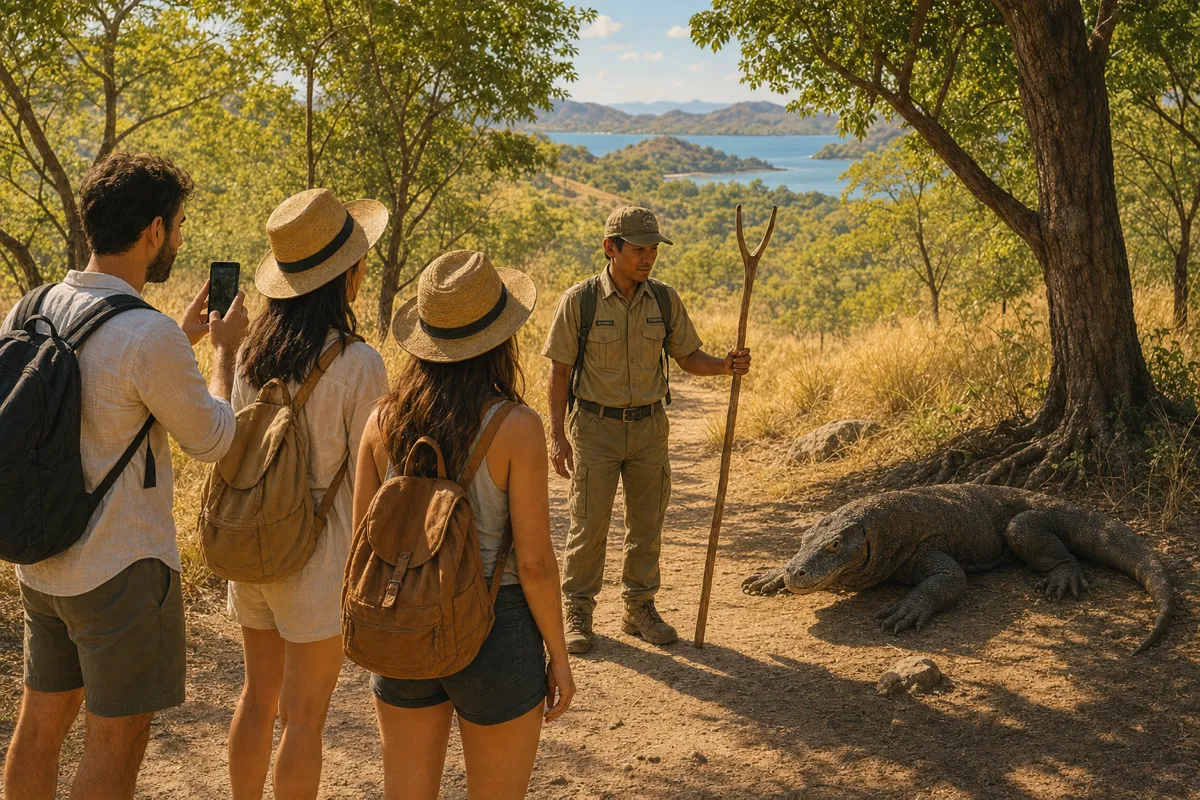
All dragon viewing in Komodo National Park happens on guided treks on Rinca Island and Komodo Island, the two main strongholds of the species' natural habitat. Here is what keeps those encounters safe:
- Mandatory ranger escort. You cannot walk the islands alone. Every group is accompanied by trained rangers who read dragon behavior and know the resident animals individually.
- The forked stick. Rangers carry a long wooden staff with a forked end, a simple but remarkably effective tool for redirecting a curious dragon's head at a safe distance. It works because a dragon's strength is in forward lunges and tail swipes, and the fork controls the head without harming the animal.
- Distance rules. Visitors keep at least 5 meters from any dragon, and more from females guarding nests during the breeding season, roughly July to September, when extra caution applies.
- Group discipline. Stay with the group, no sudden movements, no flash photography at close range, and absolutely no food on the trail.
- Route choice. Rangers pick short, medium, or long trek routes based on conditions and where the animals are that day, keeping groups away from feeding sites and nesting females.
Within those rules, encounters are calm and surprisingly relaxed. Dragons spend most of the day conserving energy, basking in the morning sun or resting in the shade during the heat, and rangers position groups for excellent photographs without stress to animal or visitor. Our guide to Komodo dragon tours covers the trekking options in detail.
Best Time and Places for a Safe Encounter
Timing shapes both your chances of seeing dragons and the conditions around them. The dry season from April to November is the main visiting window, with the clearest weather and the easiest boat access; our best time to visit guide breaks the year down month by month. Early morning is the golden window for treks, when dragons are active and gathering warmth before the midday heat sends them into the shade.
Rinca Island is often the better choice for reliable sightings, with a high density of dragons around the Loh Buaya ranger station, and it is closer to Labuan Bajo than Komodo Island. Komodo Island itself offers longer treks and the chance to combine your visit with nearby Pink Beach. During the July to September breeding and nesting season, males may be more active and females fiercely protective of their mounded nests, so rangers apply extra distance; it is a fascinating time to visit but one where following instructions matters even more.
Safety Rules for Visiting Komodo Dragons
The park's rules are few and easy to follow:
- Never explore alone; always stay with your ranger and group.
- Keep the minimum 5-meter distance, even from dragons that appear asleep. They are faster than they look and can lunge from a standstill.
- Do not bring food onto the trails, and tell your ranger if you have open wounds. Dragons' sense of smell is extraordinary, and blood or food odors attract attention from a great distance.
- Women who are menstruating should quietly inform the ranger; this is a standard park guideline, and rangers discreetly assign such visitors a position in the middle of the group as a precaution.
- Move calmly and never run. Running triggers a chase reflex in many predators, dragons included.
- Do not use flash photography up close, and never try to bait or provoke an animal for a better shot.
- Follow instructions immediately and without debate; rangers know the individual animals and their moods.
Follow those rules and the risk to a park visitor is vanishingly small. For a broader look at health and safety across the destination, from currents to sun exposure to what to pack, see our guide on whether Komodo Island is safe and our Komodo packing list.
Are Komodo Dragons Dangerous to Children?
Families visit the park regularly, and children are welcome on the treks, but the guidelines are stricter for good reason. Smaller visitors are asked to stay in the center of the group and to hold an adult's hand at all times, and rangers keep a close eye on younger children throughout. Very active toddlers who cannot reliably stay calm and still are better suited to boat-based sightseeing than the walking treks. Our Komodo with kids guide covers how to plan a family trip around the dragons and the diving.
Conservation: A Dangerous Animal Worth Protecting
The Komodo dragon has survived for millions of years and exists nowhere else on Earth in the wild. Around 3,400 individuals remain across the islands of the park and pockets of western Flores, and the species is classified as endangered, threatened by habitat loss, a limited range, and the pressures of climate change and rising seas on its low-lying island home.
The healthy fear the dragons inspire is part of what protects them. The park exists, and the strict rules are enforced, because the world decided these animals were worth preserving, dangerous or not. Tourist revenue funds rangers, anti-poaching patrols, and the prey-species management that keeps the ecosystem intact. Visiting responsibly is not in tension with conservation; it is one of the main things paying for it.
So, Should You Visit?
Seeing a Komodo dragon in the wild, low-slung and unhurried, tongue tasting the air, is one of the great wildlife experiences on the planet, made safe by rangers who have managed these encounters for decades. Learn more remarkable details about the species in our 25 Komodo dragon facts, or start planning the trip itself with our Komodo itinerary guide. Many visitors combine dragon trekking with diving or snorkeling, staying at an island resort inside the park or exploring further aboard a Komodo liveaboard.
So, are Komodo dragons dangerous? Absolutely. Should that stop you from visiting? Absolutely not. Treat them with the respect an apex predator deserves, follow your ranger, and you will come home with photographs, stories, and every finger you left with.