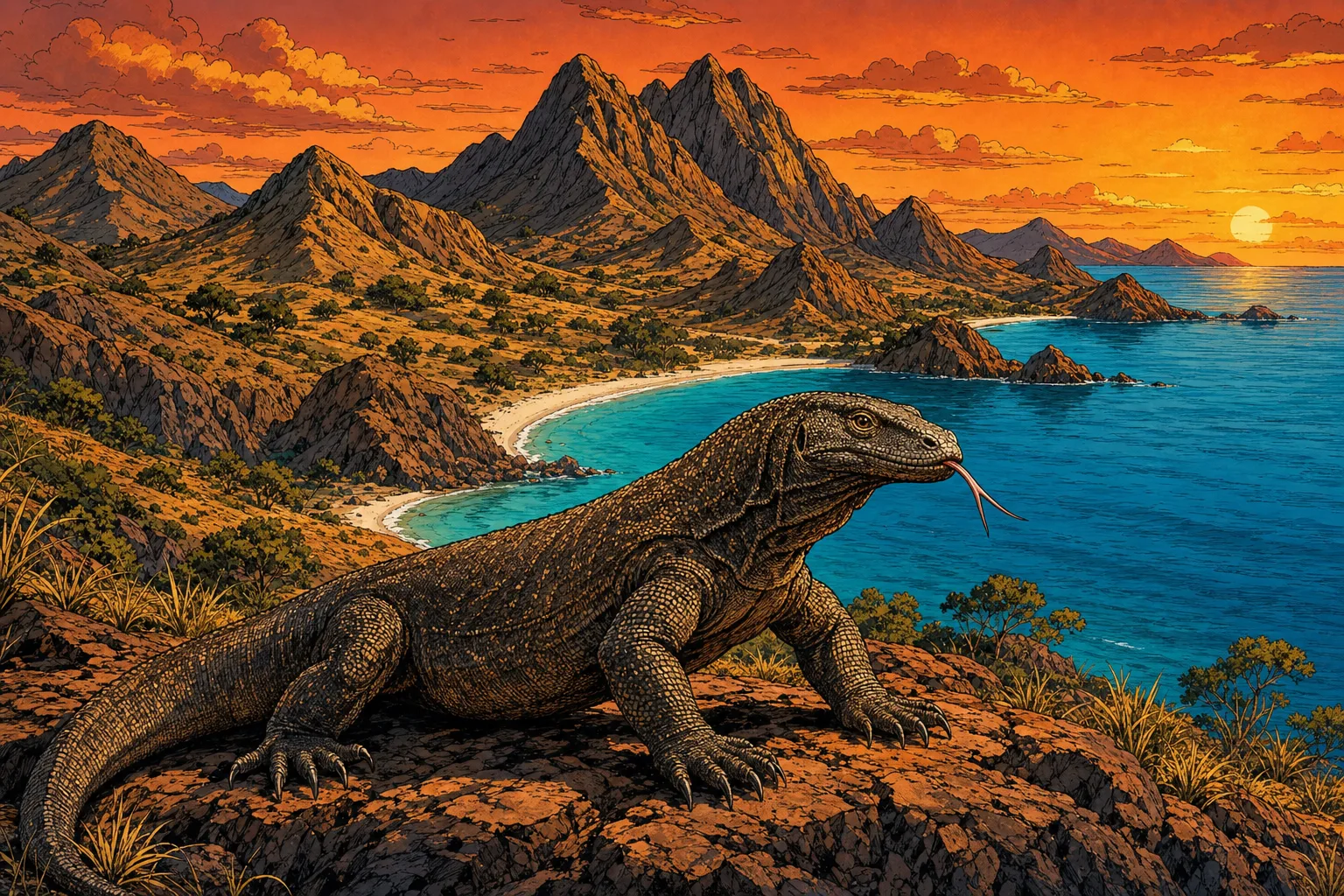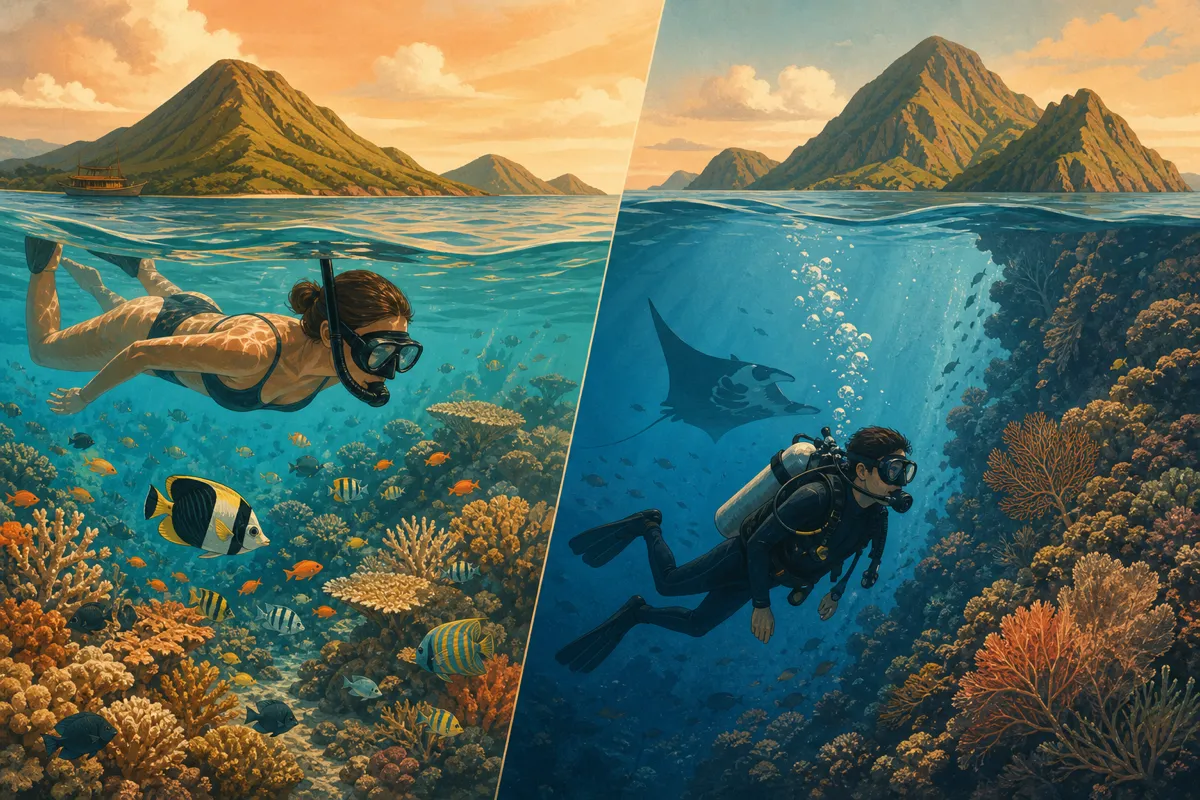
Almost everyone arrives in Komodo for one animal. The Komodo dragon is the headline act, the reason the park exists on most travel bucket lists, and it deserves the attention. But spend a few days here on a Komodo National Park tour and you start to notice something: this place is teeming with life, above and below the water, and the dragon is only the beginning.
From clouds of flying foxes that darken the sunset sky to manta rays gliding over coral gardens, from shy deer in the savanna to one of the richest reef systems on Earth, Komodo is a full-blown wildlife destination. The dragons share these islands with deer, wild boar, macaques, dozens of bird species, sea turtles, reef sharks, and an underwater cast that draws divers from around the planet. If the giant lizards are what bring you in on a Komodo dragon tour, the rest of the wildlife is what makes you want to stay.
This guide is a complete tour of Komodo's animal life beyond the dragon: the land mammals, the birds, the other reptiles, and the extraordinary marine world, plus where and when to see it all and how to watch responsibly.
The Dragon's Neighbours: A Quick Overview
Komodo National Park covers both land and sea across three main islands, Komodo, Rinca, and Padar, plus dozens of smaller ones and the channels between them. That mix of dry savanna, tropical forest, mangroves, and coral reef packs an unusual variety of habitats into a small area, which is why the wildlife list is so long.
On land, the ecosystem is shaped by the dragon at the top of the food chain. Below it sit the animals it hunts and the scavengers and survivors that share its territory. Offshore, the park sits in the heart of the Coral Triangle, the most biodiverse marine region on the planet. Put simply, Komodo is two great wildlife destinations stacked on top of each other.
How Komodo's Wildlife Survives a Harsh Land
The first thing that surprises people is how dry Komodo is. This isn't lush rainforest. For much of the year the islands are parched gold, with cracked earth, brittle grass, and temperatures that push well past 35°C. Rain falls in a short window, then the land bakes. Any animal that lives here has to be tough.
That harshness shapes everything. Animals cluster around the few permanent water holes in the dry months, which is part of why wildlife can actually be easier to find then; the deer, buffalo, and the dragons that follow them all gravitate to the same shrinking pools. Many animals are most active at dawn and dusk to avoid the worst heat, lying low through the searing middle of the day. The vegetation is built for drought too, from the fan-leaved lontar palms that dot the hillsides to the tangled dry forest in the valleys and the mangroves that fringe the coast. Each of those habitats supports a different slice of the park's wildlife, and a single trek can take you through several of them in an hour.
Land Mammals of Komodo
The savanna and forest support a surprising number of mammals, most of which exist in a tense relationship with the resident dragons.
Timor deer
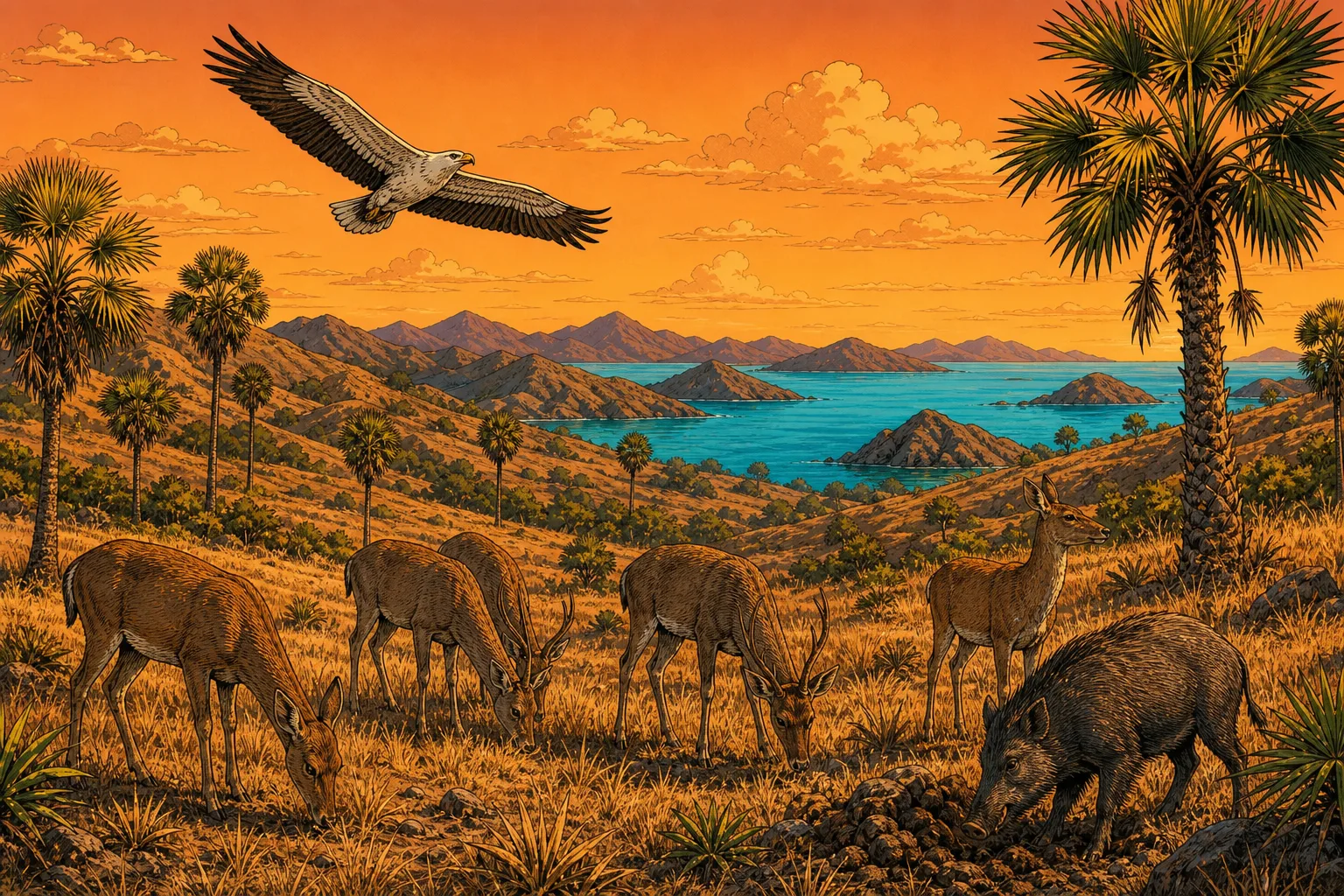
The Timor deer is the single most important animal in the park's land ecosystem, because it's the dragon's main prey. Herds graze the open grassland at dawn and dusk, always alert, and watching them is part of the rhythm of any savanna trek. Where there are deer, there are usually dragons not far away.
Wild boar
Wild boar root through the undergrowth and grassland, another key food source for adult dragons. They're shy and quick, so you'll often see the churned earth where they've been feeding before you spot the animals themselves.
Water buffalo
Introduced long ago, wild water buffalo wallow in muddy pools across Rinca and Komodo. They're huge, and a healthy adult buffalo is one of the few land animals a dragon will struggle to take down, though dragons do prey on weakened or injured individuals over time.
Long-tailed macaques
Troops of long-tailed macaques live along the forest edges, especially on Rinca. They're clever and bold, raiding for food and keeping a wary eye on the dragons below. Keep your distance and don't feed them; habituated monkeys can be a nuisance and occasionally aggressive.
Smaller mammals
Rounding out the list are wild horses on some islands, palm civets, rats endemic to the region, and several bat species. The bats, though, deserve a section of their own.
The Flying Foxes of Kalong Island
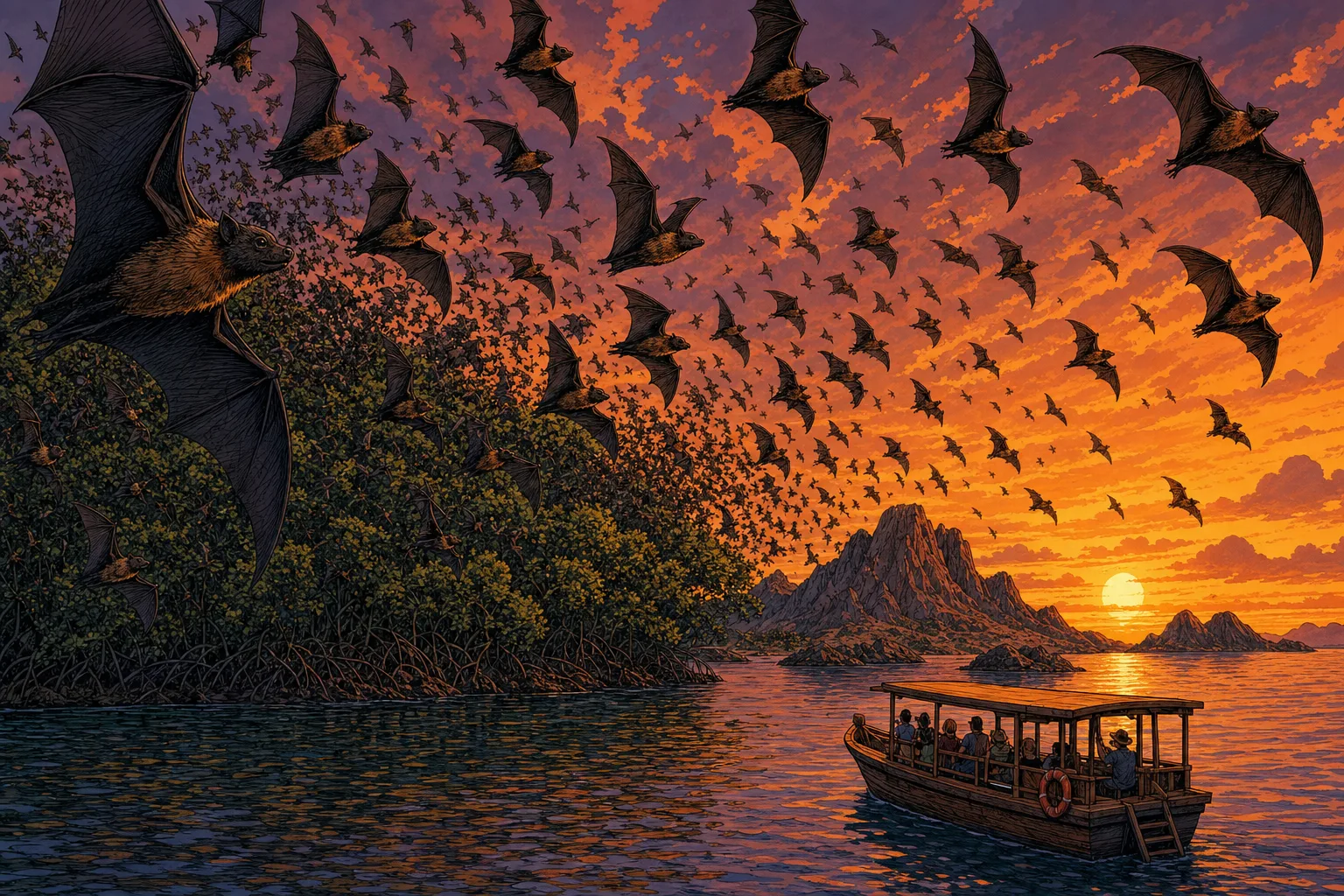
If you see one piece of non-dragon wildlife in Komodo, make it this. Kalong Island is a small, mangrove-covered island that serves as a daytime roost for tens of thousands of large fruit bats, known locally as kalong, or flying foxes. By day they hang in the trees in vast numbers. At sunset, they pour off the island in an endless ribbon of dark wings, crossing the water to feed on Flores through the night.
Most overnight boat trips time their first evening to anchor near Kalong for the spectacle, and it ranks among the most memorable sights in the whole park. Our dedicated guide to Kalong Island explains the best way to experience it. These bats are not predators or pests; they're crucial pollinators and seed dispersers that keep the surrounding forests alive.
Birds of Komodo National Park
Komodo is quietly excellent for birdwatching, with around 80 species recorded across the islands. You don't need to be a birder to enjoy them, but anyone who pays attention is rewarded.
- Orange-footed scrubfowl: a ground-dwelling megapode that builds enormous mounds of soil and leaf litter to incubate its eggs with natural heat. These same mounds are sometimes used by female dragons to lay their own eggs, a neat overlap of two very different animals.
- Yellow-crested cockatoo: a striking, critically endangered white parrot with a lemon crest. Komodo is one of its last strongholds, and hearing a flock screech across the savanna is a real treat.
- Green junglefowl: the wild ancestor-relative of the domestic chicken, often seen scratching along trails.
- White-bellied sea eagle and Brahminy kite: large raptors that patrol the coastlines and put on aerial displays over the bays.
- Friarbirds, sunbirds, and the Flores green pigeon: smaller residents of the forest edges and flowering trees.
Early morning, before the heat builds, is by far the best time for birdlife, which conveniently lines up with the early starts most treks involve anyway.
Other Reptiles: Snakes, Geckos, and Monitors
The dragon is the giant of Komodo's reptile world, but it's far from the only one. The islands are home to a range of other reptiles, some harmless and some best admired from a distance.
- Snakes: the park has several species, including the venomous Russell's viper, the white-lipped pit viper (a vivid green tree snake), and cobras. Bites are very rare, and snakes generally avoid people, but it's another good reason to wear closed shoes and stay on the trail with your ranger.
- Geckos and skinks: abundant and harmless, these little lizards are everywhere, and they're an important food source for young dragons in their tree-dwelling years.
- Water monitors: a smaller relative of the Komodo dragon, often seen near water and around the ranger stations. People sometimes mistake juveniles for baby dragons.
- Sea turtles and sea snakes: green and hawksbill turtles are common on the reefs, and banded sea kraits turn up on dives, more on the marine world below.
To understand the apex predator that shapes all of this, our guide to Komodo dragon facts digs into the biology, venom, and behaviour of the islands' most famous resident. Rinca is often the most reliable place to see dragons in the wild; our Rinca Island guide covers that trek in detail.
The Underwater World: Komodo's Marine Wildlife
Here's the part that surprises first-time visitors. As impressive as the land animals are, Komodo's marine life is arguably the bigger draw. The park sits in the Coral Triangle and protects over 1,000 species of fish, around 260 species of coral, and a roll call of large marine animals that reads like a wishlist. Whether you snorkel or dive, this is world-class.
Manta rays
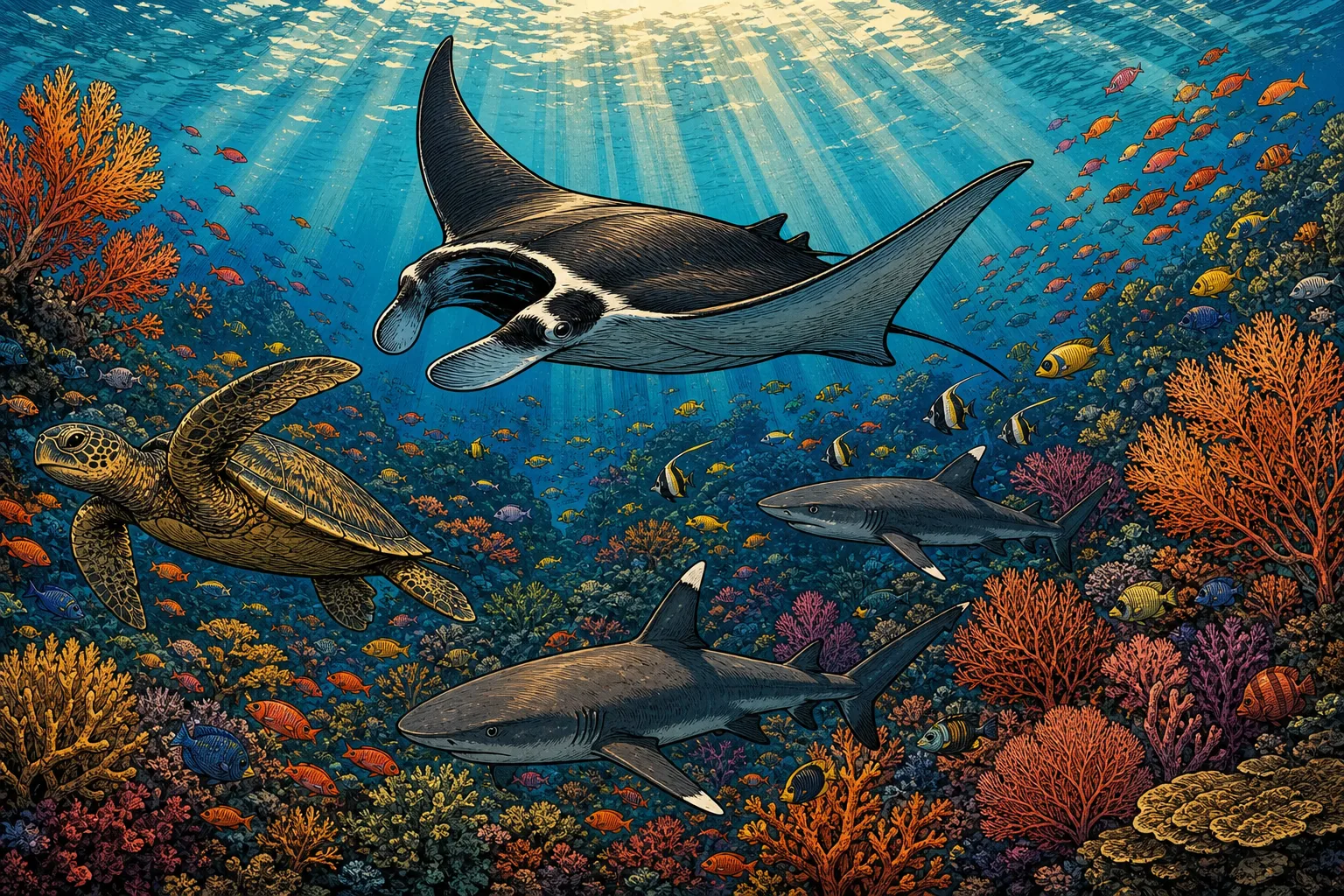
The undisputed stars of the reef. Reef mantas gather at cleaning stations and feeding zones like Manta Point and Mawan, where they glide in slow circles just below the surface, often within reach of snorkellers. Encounters are possible year-round and peak during the plankton-rich months. Our guide to swimming with manta rays in Komodo covers the seasons and the etiquette that keeps these encounters going.
Sharks and turtles
White-tip and black-tip reef sharks are a common, harmless sight patrolling the drop-offs, and grey reef sharks appear at the busier pinnacles. Green and hawksbill turtles are almost guaranteed on the reefs, grazing on coral and sponges and often completely unbothered by divers and snorkellers.
Big schools and big animals
Komodo's currents feed enormous schools of fusiliers, snapper, surgeonfish, and trevally that move across the reef like living walls. Bumphead parrotfish, Napoleon wrasse, and the occasional eagle ray cruise the edges. Lucky visitors spot dolphins from the boat, and the park's deeper waters are visited by dugongs and, on rare occasions, whales and whale sharks passing through.
Macro life
For those who like the small stuff, Komodo's reefs are a treasure trove: nudibranchs in every colour, frogfish, seahorses, ghost pipefish, and anemonefish tucked into their hosts. The southern sites in particular are famous for cold-water-fed macro diversity. Our guides to Komodo snorkelling and the best Komodo dive sites break down where to find what.
How It All Connects: The Komodo Food Web
What makes Komodo's wildlife so compelling isn't just the species list, it's how tightly the pieces fit together. On land, the whole system pivots on the dragon. Deer and boar graze the savanna; dragons hunt the deer and boar; scrubfowl build incubation mounds that dragons borrow for their own eggs; and when anything dies, the dragons clean up the carcass, recycling nutrients back into the dry earth. Remove the deer and the dragons starve, which is exactly why poaching of prey animals is treated as a serious threat.
The same interdependence runs underwater. The park's ferocious currents, the very thing that makes diving here challenging, are what feed everything. They sweep nutrients and plankton through the channels, which feeds the coral and the small fish, which feed the bigger fish, which draw in the sharks and the mantas. The flying foxes, meanwhile, pollinate and seed the forests that hold the islands together. Pull one thread and the whole web loosens. Seeing the park this way, as a single connected system rather than a checklist of animals, is what turns a good wildlife trip into a memorable one.
Where to See Komodo's Wildlife
Different animals live in different corners of the park. Here's a quick map of who is where:
- Rinca Island: the most reliable dragons, plus deer, buffalo, macaques, and birds around the savanna and ranger station.
- Komodo Island: dragons, deer, wild boar, and excellent birdlife in a wilder, larger setting.
- Kalong Island: the flying-fox sunset exodus.
- Padar Island: fewer large animals (and no dragons today), but superb savanna scenery and birds; see our Padar Island guide.
- The reefs and channels: mantas, sharks, turtles, and the full marine cast, reached by snorkel or dive boat.
A standard multi-day trip naturally strings several of these together, which is why even a short visit can deliver dragons, bats, birds, and mantas in the same few days. For the bigger picture of how it all fits together, see our roundup of the best things to do in Komodo.
Can You See Komodo's Wildlife Without Diving?
Absolutely, and this is reassuring news for travellers who don't dive. A huge share of Komodo's wildlife is visible from land or the surface. The dragons, deer, boar, macaques, and birds are all land sightings on a ranger-led trek. The flying foxes are watched from the deck of a boat at sunset. And the marine showstoppers, mantas and turtles especially, are regularly seen by snorkellers floating at the surface, since both often cruise in shallow water.
Diving simply unlocks more: the sharks at depth, the macro critters, the big schools that gather on the deeper pinnacles, and longer, calmer time with each animal. But if you've never put your face in the water, a snorkel-focused trip still delivers dragons, bats, birds, and mantas. Komodo rewards everyone, from non-swimmers to seasoned divers.
Best Time to See Wildlife in Komodo
Komodo is a year-round wildlife destination, but timing tweaks what you'll see and how comfortably.
- Dry season (April–October): the best all-round window. Calm seas make reef trips reliable, and animals concentrate around the remaining water sources on land, which can make land wildlife easier to find.
- Manta season: mantas are present all year but aggregate in larger numbers during the cooler, plankton-rich months.
- Wet season (December–February): the savanna turns green, birdlife is active, and the islands are quieter, though rougher seas can disrupt boat plans.
For a full month-by-month breakdown of weather, water, and crowds, see our guide to the best time to visit Komodo Island.
Wildlife Watching Tips and Safety
Seeing animals well, and safely, comes down to a few simple habits:
- Go early. Dawn and dusk are when land animals are most active and the light is best. Midday is quiet, hot, and harder for sightings.
- Always trek with a ranger. It's required, and rangers know where the animals are and how to keep you safe around dragons and snakes. Our guide on whether Komodo is safe covers the practicalities.
- Keep your distance and stay quiet. Don't chase, corner, or feed any animal, on land or in the water. The best sightings come to those who hang back.
- In the water, look but don't touch. Maintain good buoyancy, never touch coral or marine life, and let mantas and turtles set the pace.
- Wear the right gear. Closed shoes and sun cover for treks; reef-safe sunscreen for the water. Our Komodo packing list has the full rundown.
Endemic Species: Found Nowhere Else
The Komodo dragon gets all the "found nowhere else on Earth" headlines, and it earns them, but it isn't the park's only special resident. Komodo and the surrounding Lesser Sunda islands sit in a unique biogeographic zone, a transition between Asian and Australasian wildlife, which has produced species and subspecies you won't see elsewhere.
Several small mammals, including endemic rats, are unique to these islands. The yellow-crested cockatoo, while not exclusive to Komodo, survives here in one of its last meaningful populations after being wiped out across much of its former range. Even the marine life carries this signature: the meeting of Pacific and Indian Ocean waters, funnelled through the park's channels, creates conditions that support an unusually dense concentration of species. It's this combination of isolation, harsh conditions, and rich surrounding seas that makes Komodo a genuine evolutionary hotspot rather than just a pretty place to see a big lizard.
Wildlife Photography in Komodo
Few destinations offer this much variety for a camera in such a compact area. In a single trip you can shoot savanna mammals at golden hour, raptors in flight, a sky full of bats, and manta rays underwater, all within a few days. A few pointers help you make the most of it:
- Shoot early and late. The soft light at dawn and dusk is kinder than the harsh midday sun, and the animals are far more active.
- Bring a zoom for land wildlife. You'll be kept at a respectful distance from dragons and deer, so reach matters.
- Protect your gear. Salt spray, dust, and heat are hard on cameras; a dry bag and a cleaning cloth are essential.
- For the reef, a wide-angle setup and natural light work best for mantas and reefscapes. Our dedicated underwater photography guide for Komodo covers camera, settings, and the best sites in detail.
- Respect the subject. Never bait, crowd, or use flash on wildlife to get a shot. The welfare of the animal always comes first.
Conservation: Why Komodo's Wildlife Is So Special
Komodo National Park is a UNESCO World Heritage Site, and that status protects far more than the dragons. The park safeguards endemic species found nowhere else, critically endangered birds like the yellow-crested cockatoo, globally important manta and shark populations, and some of the healthiest coral reefs left in Indonesia.
That protection isn't free. The entrance and conservation fees visitors pay fund ranger patrols, anti-poaching work, and reef monitoring, which is exactly why those fees exist; our breakdown of Komodo National Park entrance fees explains where the money goes. The biggest threats today are climate change, illegal fishing, poaching of the deer the dragons rely on, and the pressure of rising tourist numbers. Visiting responsibly, choosing operators who follow wildlife guidelines, keeping your distance, and never buying wildlife products, genuinely helps keep this ecosystem intact.
A Quick Komodo Wildlife Checklist
Hoping to tick off as much as possible? Here's a realistic wish list for a multi-day trip, roughly in order of how likely you are to see each:
- Very likely: Komodo dragons (on a ranger trek), Timor deer, long-tailed macaques, reef fish, green turtles, flying foxes at Kalong.
- Likely: white-tip and black-tip reef sharks, manta rays (especially in season), sea eagles and kites, wild boar signs.
- Possible with luck: water buffalo, yellow-crested cockatoo, dolphins from the boat, eagle rays, octopus and macro critters on the reef.
- Rare treats: dugongs, whale sharks, and passing whales in the deeper channels.
No single trip guarantees all of it, and that unpredictability is part of the appeal. Wildlife watching rewards patience, early starts, and a bit of luck.
More Than a Dragon Park
The Komodo dragon will always be the reason most people come, and rightly so. But the travellers who leave most impressed are usually the ones who looked beyond it: who stayed for the flying foxes at dusk, drifted alongside a manta at dawn, watched deer melt into the savanna, and realised they'd stumbled into one of the great wildlife destinations on Earth. Come for the dragon. Stay for everything else.