It is one of the most common questions we hear from guests: should I snorkel or dive in Komodo? The honest answer is that both are world-class here, and neither feels like a compromise. But that does not help much when you are trying to plan your trip, set a budget, and decide whether to spend three months getting certified before you fly out.
Komodo National Park sits at the meeting point of the Indian and Pacific Oceans. Cold, nutrient-dense water surges through narrow channels between volcanic islands, feeding one of the richest marine ecosystems on the planet. The result is reef life so dense and varied that even experienced underwater photographers struggle to capture it all in a single trip. That richness extends from the surface all the way down to 40 metres, which means snorkelers and divers share the same waters but experience them in very different ways.
This guide breaks down the differences honestly so you can decide what works for your trip.
What You Will Actually See
This is what most people really want to know, so let us start here.
Snorkeling: The View from the Surface
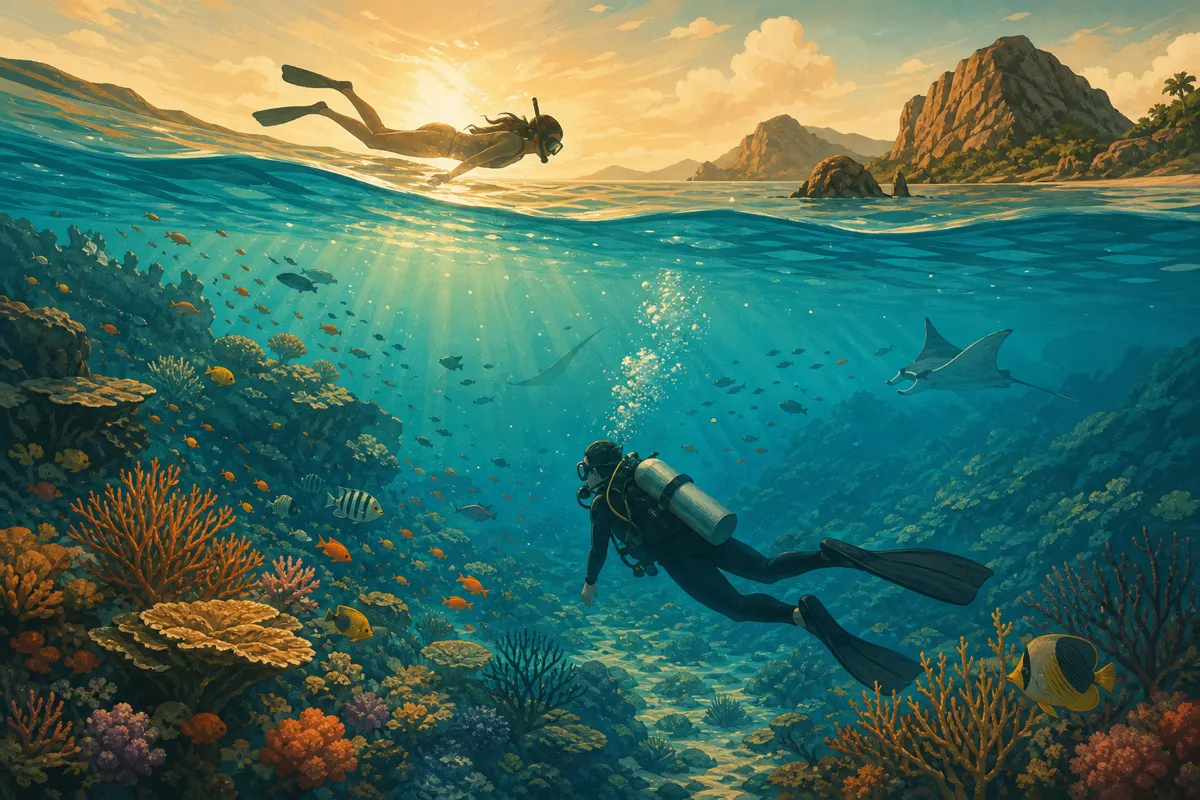
Komodo's reefs start shallow. At many sites, healthy hard coral begins in waist-deep water and extends outward in dense gardens that drop off into blue. Floating on the surface with a mask, you are looking down at an aquarium that happens to be real.
On a typical snorkeling day in Komodo, you can expect to see:
- Sea turtles grazing on coral, often within a few metres of the surface
- Schools of fusiliers, surgeonfish, and butterflyfish so thick they look like moving walls
- Giant trevally hunting on the reef edge
- Clownfish in their anemones, parrotfish crunching on coral, moray eels peering from crevices
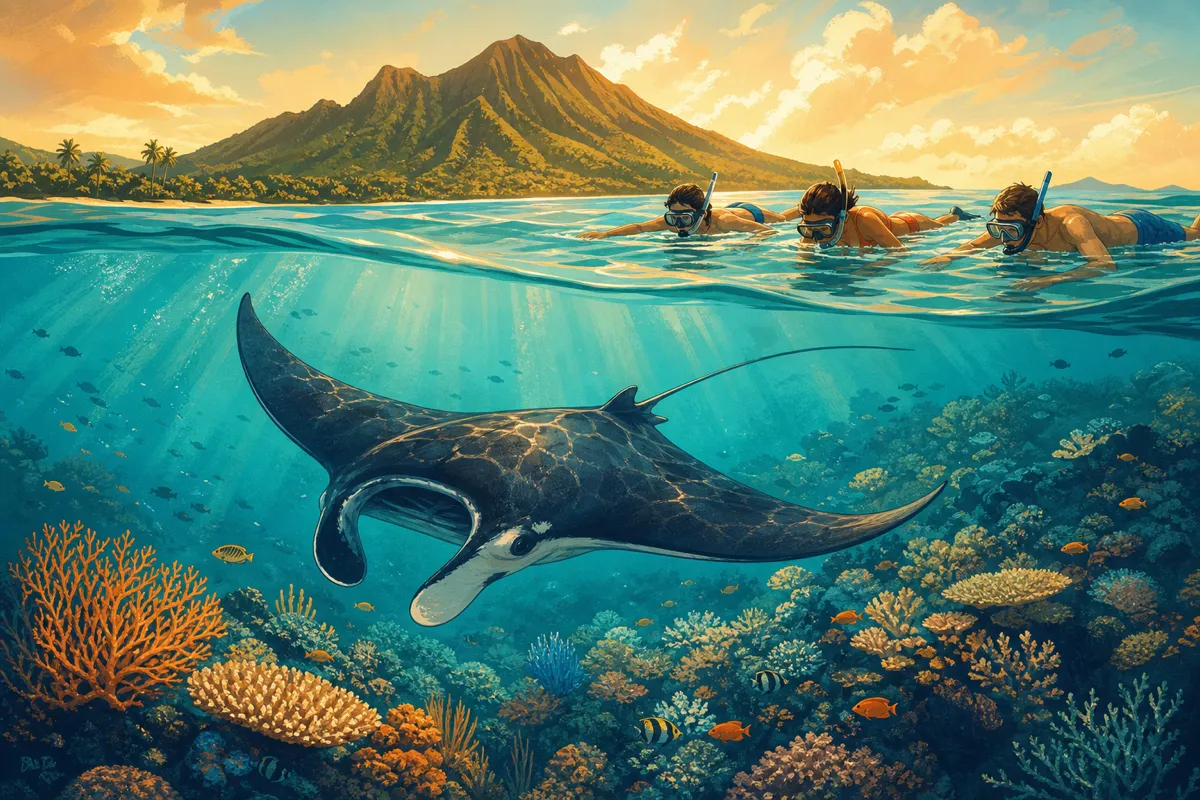
- Manta rays at Manta Point and Mawan, gliding beneath you at 5 to 10 metres depth
- Reef sharks patrolling the shallows at certain sites
The quality of snorkeling in Komodo surprises a lot of people. At destinations like Thailand or Bali, snorkeling often feels like a watered-down version of the dive experience. In Komodo, the shallow reef is genuinely spectacular on its own terms. The nutrient-rich currents that make this park famous also feed the reef from the top down, so the surface layer is packed with life.
Diving: What Opens Up at Depth
Everything a snorkeler sees, a diver sees too, but closer, longer, and from different angles. Diving also unlocks an entirely separate category of marine life that lives below snorkel depth:
- Walls covered in soft coral, sea fans, and sponges in colours that only appear under torchlight
- Cleaning stations where manta rays hover motionless while small fish pick parasites from their gills
- White-tip reef sharks resting in sandy channels and under ledges
- Napoleon wrasse, barracuda schools, and eagle rays cruising the blue
- Macro life: pygmy seahorses, nudibranchs, frogfish, blue-ringed octopus, ornate ghost pipefish
- The dramatic landscape of south Komodo: volcanic walls dropping into cold, dark water at sites like Cannibal Rock and Torpedo Alley
Diving in Komodo also has a sensory dimension that snorkeling cannot replicate. You feel the current pushing you along a wall. You hear the crackling of a healthy reef (yes, reefs make noise). You watch a manta ray bank directly toward you, pass overhead, and disappear into the blue. Those moments are hard to explain to someone who has not been underwater on scuba, and they are a big part of why people come back to Komodo year after year.
Difficulty and Requirements
This is where the practical differences really matter.
| Factor | Snorkeling | Diving |
|---|---|---|
| Certification needed | None | Yes (Open Water minimum, Advanced recommended) |
| Swimming ability | Basic. Life jackets provided | Comfortable in water. Must pass a swim test |
| Fitness level | Low to moderate | Moderate. Must be able to carry gear and handle currents |
| Equipment | Mask, snorkel, fins (usually provided) | Full scuba kit (usually provided, personal mask recommended) |
| Training time | 15 minutes of instruction | 3 to 4 days for Open Water certification |
| Age minimum | No strict minimum with life jacket | 10 years old (Junior Open Water), 12 for some sites |
| Medical restrictions | Very few | Cannot dive with certain heart, lung, or ear conditions |
The certification barrier is the single biggest factor in this decision for most people. If you are not already a certified diver and your trip is less than a week, getting certified on arrival eats into your park time. A Discover Scuba Diving experience lets you try diving in a single day without full certification, but it limits you to shallow, calm sites with an instructor holding your hand the entire time.
If you have never snorkeled before, do not worry. Most first-timers are comfortable within 15 to 20 minutes at a calm site like Pink Beach or Kanawa Island. Guides are patient, life jackets are standard, and the water is warm enough (27 to 29 degrees C) that you can stay in for hours.
Best Sites for Snorkeling vs Diving
Not every site in Komodo works equally well for both activities. Some are snorkeling paradise but dangerous for divers (too shallow, boat traffic). Others are world-class dives but have nothing interesting at the surface. And a few are genuinely excellent for both.
| Site | Snorkeling | Diving | Notes |
|---|---|---|---|
| Pink Beach | Excellent | Good | Shallow reef starts from shore. Perfect for beginners. Calm water most of the year |
| Kanawa Island | Excellent | Good | Protected bay with minimal current. Great for first-timers and families |
| Siaba Besar | Very good | Excellent | Turtle city. Gentle currents. Works for both at the same time |
| Manta Point | Very good | Excellent | Mantas cruise at 5 to 15m. Snorkelers see them from above; divers get eye-level encounters |
| Taka Makassar | Very good | Moderate | Sandbar with shallow reef. Great snorkeling, limited dive depth |
| Batu Bolong | Possible (calm days) | World-class | Strong currents. Arguably Komodo's best dive site. Snorkeling only safe on slack tide |
| Castle Rock | Not recommended | World-class | Submerged pinnacle with strong currents. Advanced divers only. No snorkeling |
| Cannibal Rock | Not possible | World-class | Deep site (18 to 30m), cold water, macro paradise. Divers only |
| Crystal Rock | Not recommended | Excellent | Current-exposed pinnacle. Pelagic action. Advanced divers |
| Tatawa Besar | Good | Very good | Drift dive/snorkel along coral wall. Moderate current |
The pattern is clear: the north and central Komodo sites with the strongest currents are diving territory. The calmer, shallower sites in the south and around the smaller islands are where snorkeling shines. And a handful of sites in between work beautifully for both.
Cost Comparison
Budget is a real factor for many travellers, and diving is significantly more expensive than snorkeling. Here is a rough breakdown of what each costs in Komodo in 2026:
| Activity | Typical Cost (USD) | What Is Included |
|---|---|---|
| Day trip with snorkeling (group) | 50 to 120 | Boat, guide, lunch, snorkel gear, 3 to 5 sites |
| Day trip with 2 dives (group) | 150 to 250 | Boat, dive guide, tanks, weights, 2 dive sites + 1 snorkel site |
| Liveaboard with snorkeling (3 nights) | 400 to 900 | Cabin, meals, guide, gear, 8 to 12 snorkel sites |
| Liveaboard with diving (3 nights) | 800 to 1,800 | Cabin, meals, dive guide, tanks, gear, 8 to 12 dives |
| Open Water certification | 350 to 500 | 3 to 4 day course, materials, confined water + open water dives |
| Discover Scuba Diving | 100 to 150 | Half-day intro, 1 to 2 shallow dives with instructor |
| Personal snorkel gear (own) | 40 to 80 (one-time) | Mask, snorkel, fins. Better fit than rental |
For a non-diver on a moderate budget, a snorkeling-focused trip to Komodo delivers extraordinary value. You see manta rays, turtles, and pristine coral reefs for a fraction of the diving cost. If you are already certified and own your own gear, the cost gap narrows, but diving still adds equipment rental, tank fees, and higher liveaboard rates.
For a detailed breakdown of all trip costs, see our Komodo Island trip cost guide.
The Current Factor
Currents are the defining feature of Komodo's underwater world, and they affect snorkelers and divers very differently.
For divers, currents are a feature. Drift diving along a wall with the current carrying you past schools of fish is one of the great thrills of Komodo diving. Experienced divers learn to use the current, not fight it. But even for divers, certain Komodo currents demand respect. Downcurrents at Shotgun and upcurrents at Crystal Rock can catch even experienced divers off guard. For more on diving conditions, see our Komodo diving conditions guide.
For snorkelers, currents are more of a concern. You cannot descend to escape a surface current, and strong water movement can push you away from the reef and into open water. This is why guide supervision matters so much for snorkeling in Komodo. A good guide reads the current before you enter the water, positions the boat correctly, and stays with the group throughout. At current-prone sites, snorkelers should always wear fins and be prepared to swim back to the boat if conditions change.
The takeaway: snorkeling in Komodo is safe and rewarding at the right sites with the right guide. But it is not the kind of destination where you can just jump off any boat and float around. Site selection and timing matter.
Who Should Snorkel
Snorkeling is the better choice if:
- You are not a certified diver and do not want to spend 3 to 4 days of your trip getting certified
- You are travelling with children under 10 or family members who are not confident swimmers
- You are on a tighter budget and want to maximise your time in the park
- You get anxious at the idea of breathing underwater or being at depth
- Your trip is short (1 to 3 days) and you want to see as many sites as possible
- You are already a confident snorkeler and want to experience Komodo's shallow reefs on their own terms
Read more in our full Komodo snorkeling guide.
Who Should Dive
Diving is the better choice if:
- You are already certified (Open Water or above) and comfortable in the water
- You want to see the famous current-swept sites: Batu Bolong, Castle Rock, Shotgun
- You are specifically interested in macro photography, soft corals, or deep wall diving
- You want eye-level manta ray encounters rather than viewing from above
- You are on a longer trip (5+ days) and have time to explore both north and south Komodo
- You are considering a diving liveaboard that visits remote sites inaccessible to day boats
For a full overview of Komodo's dive sites, see our Komodo dive sites guide.
Why Not Both?
Many of our guests do both, and this is honestly the best way to experience Komodo's underwater world. A typical mixed itinerary might look like this:
- Morning: two dives at current-swept sites when conditions are optimal (early tidal windows)
- Midday: lunch break on the boat, relax on a beach
- Afternoon: snorkel at a calmer, shallower site as the light softens and the fish come up to feed
On a liveaboard, this rhythm works perfectly because the boat moves between sites while you eat and rest. Divers get their deep water fix in the morning, and non-diving travel companions snorkel the same sites from the surface or visit nearby shallow reefs. Nobody feels left out.
If you are travelling as a couple or group where some people dive and others do not, Komodo is one of the few destinations where both sides of that equation are genuinely happy. The snorkelers are not sitting on the boat waiting. They are in the water having their own extraordinary experience.
For trip planning, see our 3, 5, and 7-day Komodo itineraries.
The Verdict
There is no wrong answer here. Komodo is one of a handful of destinations in the world where snorkeling is not a consolation prize. The marine life is abundant, accessible, and genuinely thrilling at the surface. If you are not a diver, do not let that stop you from visiting. You will see manta rays, turtles, sharks, and coral reefs that rival anything in the Maldives or Great Barrier Reef.
If you are a diver, Komodo belongs on your list regardless. The combination of big animals, strong currents, dramatic topography, and macro diversity puts it in the top tier of dive destinations globally.
And if you have the time and budget, do both. Spend the mornings at depth and the afternoons on the surface. You will come home with two completely different sets of memories from the same extraordinary park.