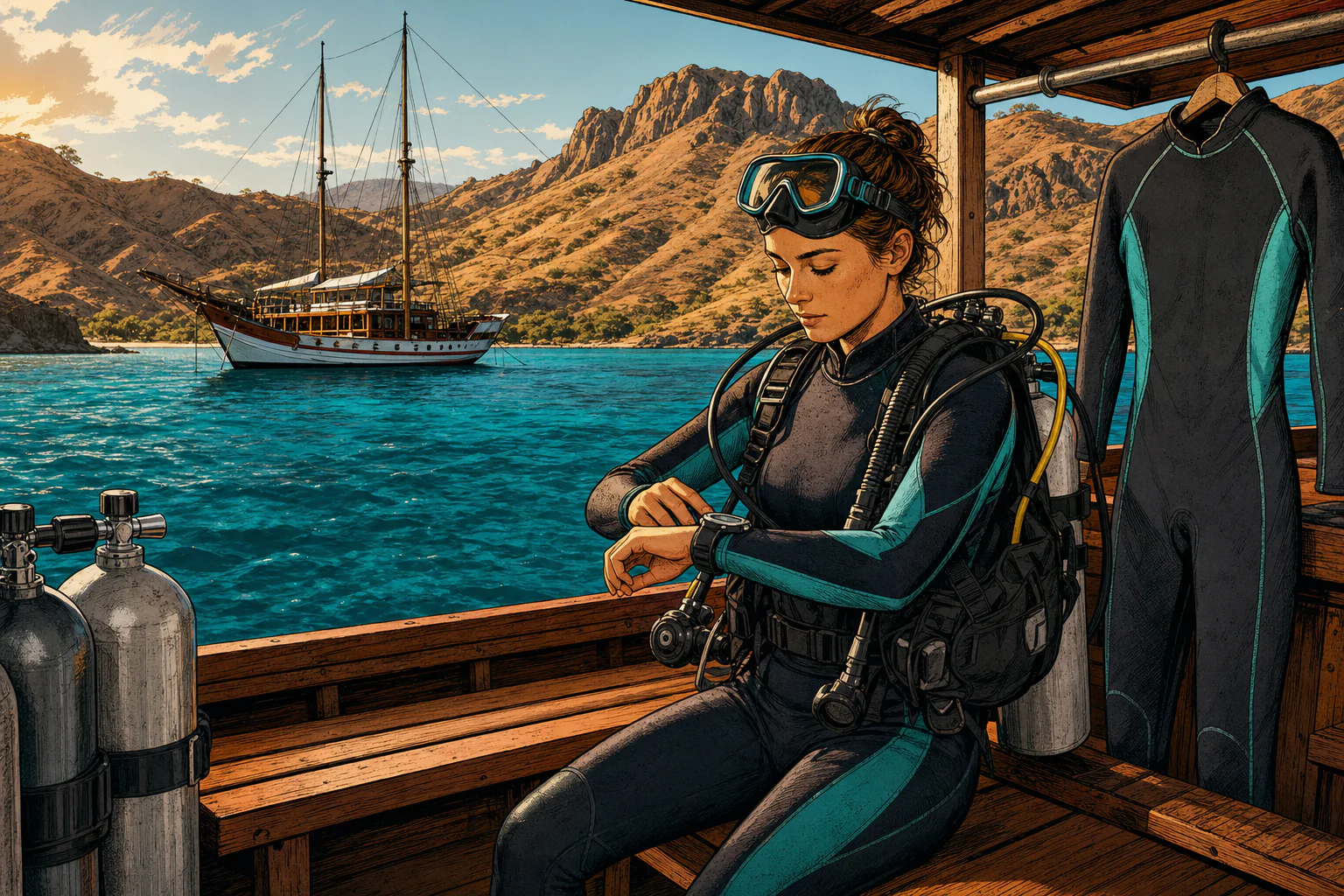
There is a particular kind of person who arrives in Komodo as a snorkeler and leaves as a diver. Maybe that is you. You came for the dragons, the pink sand, the postcard sunsets, and then somewhere out on the reef you looked down through the surface at a turtle the size of a coffee table and thought, I want to be down there. The good news is that learning to dive here is not only possible, it is one of the smartest places on the planet to do it. The Komodo Dive Center at the resort is a PADI 5-Star operation that has been turning nervous first-timers into confident divers for years, in some of the most alive water you will ever float in.
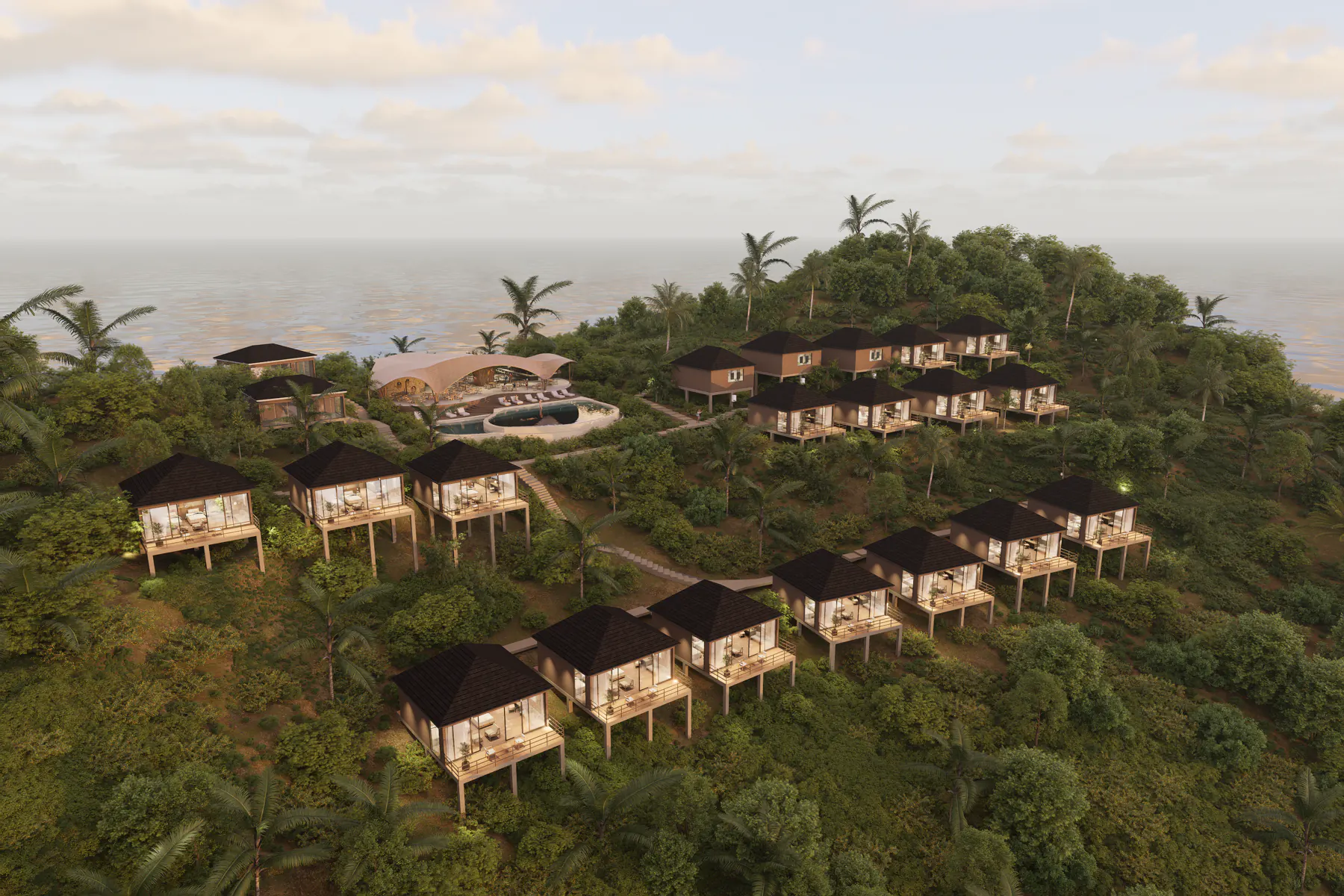
This guide is the honest, no-fluff version of how to get certified in Komodo: what the courses actually involve, how much they cost in 2026, how long they take, where you will train, and what it feels like day by day. We will also cover the bits people quietly worry about, like the famous currents and whether you are fit enough. If you are thinking about combining your course with a few nights on the water, basing yourself in one of the resort's beachfront rooms a short boat ride from the dive sites makes the whole thing slower, calmer, and a lot more fun than commuting from town.
Why Learn to Dive in Komodo Instead of Anywhere Else?
Let's be honest. Plenty of places will certify you. Bali will. Thailand will. The Red Sea will. So why here?
Because the thing nobody tells you about your first dives is that they are usually a little boring. You spend them in a pool or a sandy bay practising skills, and the "reward" reefs are often tired, grey, and picked-over. Komodo flips that. Even the gentle, shallow training sites here are stacked with life. Your very first proper dive as a student might include a turtle grazing on coral two metres away, a cloud of glassfish parting around you, and a reef shark cruising the edge of the slope, completely indifferent to the new diver hyperventilating slightly into a regulator.
Komodo National Park sits in the Coral Triangle, the most biodiverse stretch of ocean on Earth. Cold, nutrient-rich water funnels up through the channels between the islands and feeds everything. That is why the diving is world-class, and it is also why the marine life crowds into the shallows where students actually train. You do not have to be good yet to see incredible things. You just have to get in.
A few other reasons it works so well for beginners:
- Warm water. Northern sites sit around 27 to 29 degrees Celsius for most of the year, so you train in a thin wetsuit and your brain is not busy being cold.
- Sites for every nerve level. There are calm, protected coral gardens five minutes from the resort, and serious adrenaline dives further out. You learn on the gentle ones and graduate toward the rest.
- Small groups. The resort dive center runs a strict four-to-one ratio, four divers of similar level to one guide, which matters enormously when you are learning.
- Instruction in your language. Courses run in English, Chinese, Italian, and Indonesian, and that makes a real difference when someone is explaining how not to drown.
If you want the wider picture of what the underwater terrain is like before you commit, our overview of diving in Komodo is a good companion read to this one.
First Things First: Are You Actually Cut Out for This?
Short answer: almost certainly yes. People dramatically overestimate how athletic you need to be. You are not swimming hard against anything during a course. You move slowly, you breathe slowly, and the gear does most of the work. I have watched genuinely unfit people, anxious people, and people who swore they "weren't water people" finish an Open Water course grinning like kids.
That said, there are a few honest requirements:
- You need to be reasonably comfortable in water. Not an athlete, but able to relax with your face wet. The Open Water course includes a gentle swim and a float, which sound scary and are not.
- You need to be in basic good health. You will fill in a standard medical questionnaire. A few conditions (certain heart, lung, or ear issues, and pregnancy) need a doctor's clearance first. If anything is flagged, sort it before you travel so you are not stuck on day one.
- Minimum age is 10 for the Junior Open Water certification, with depth limits, and 15 for the full adult Open Water. Komodo is a wonderful place to certify as a family.
- You cannot dive hungover or drinking. This is not a buzzkill rule, it is physiology, and it genuinely matters. Our piece on why alcohol and diving do not mix explains exactly what goes wrong.
If you are still on the fence about whether the whole thing is for you, you do not have to commit to a full course on faith. Which brings us to the smartest first step.
Try Before You Commit: Discover Scuba Diving
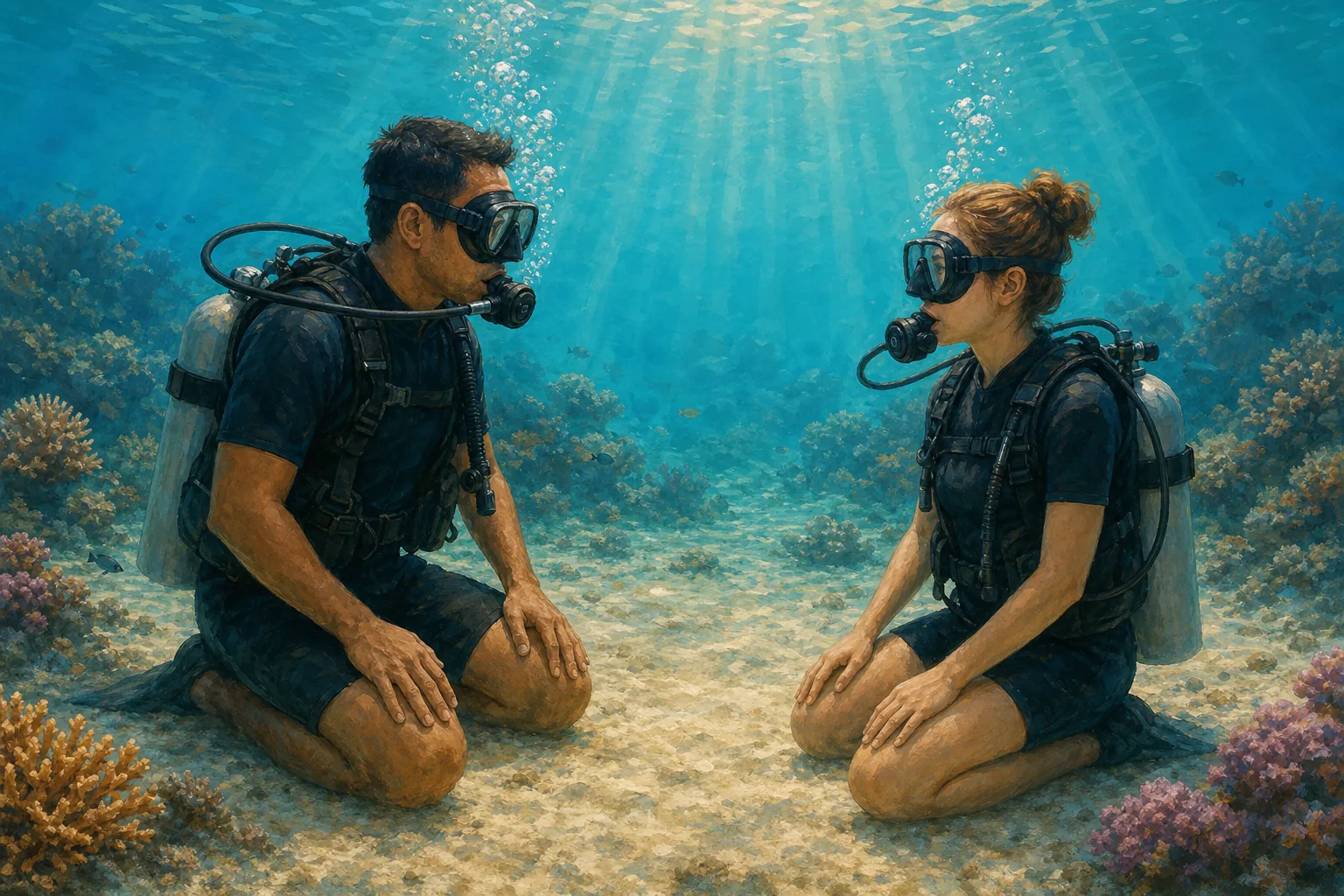
If you have never breathed underwater, do not sign up for three days of certification cold. Do a Discover Scuba Diving session first. It is a guided, single-day taster: a bit of theory, some skills in shallow water, and then a real (shallow, supervised) dive on a reef with an instructor basically holding your hand the entire time. Most people surface from it slightly stunned and immediately ask how to do the proper course.
Discover Scuba is not a certification, it is a test drive. We have written a whole guide to trying scuba diving in Komodo if you want to know exactly what that first taster day feels like. The best part: if you then go on to do your Open Water course, the experience you gained usually counts toward it. You lose nothing.
For anyone weighing diving against simply staying on the surface, our comparison of snorkeling versus diving in Komodo lays out what each one actually gets you. Spoiler: snorkeling is lovely, but the cleaning stations, the walls, and the close shark encounters belong to divers.
The PADI Course Ladder, Explained Without Jargon
Diving certifications stack like rungs on a ladder. You do not have to climb all of them, but it helps to know what each one is for. Here is the path, in plain English.
1. PADI Scuba Diver (the half step)
A shorter, lighter version of the full course. It certifies you to dive to 12 metres under the direct supervision of a professional. It is a good option if you are short on time, and you can upgrade to full Open Water later. The resort runs exactly that Scuba Diver to Open Water upgrade when you are ready to finish the job.
2. PADI Open Water Diver (the one everyone means)
This is the big one. The Open Water Diver certification is the most recognised diving qualification in the world, and it is your actual licence to dive. Once you have it, you can dive to 18 metres, anywhere in the world, with a buddy and without an instructor hovering. It never expires. This is the rung that changes your travel for the rest of your life, because suddenly half the planet's best experiences are open to you.
3. PADI Advanced Open Water Diver (the unlock)
Despite the name, "Advanced" is not for experts, it is the natural next step and a lot of people roll straight into it. You extend your depth limit to 30 metres and complete five "adventure" dives, usually including deep and underwater navigation, plus fun specialties like drift or fish identification. In Komodo this is where things get exciting, because the deeper, current-swept sites that make this place legendary open up to you. If you only have a week, Open Water plus Advanced back to back is a brilliant use of it.
4. Specialties: Nitrox, Deep, Drift
Once you are certified you can bolt on specialties. The one most Komodo divers grab first is Enriched Air (Nitrox), which lets you stay down longer with more safety margin, a real advantage when you are doing several dives a day. Drift and deep specialties are also tailor-made for this park's conditions.
5. Rescue Diver and going pro
Further up the ladder are Rescue Diver (widely described as the course that makes you a genuinely good diver rather than just a certified one) and the professional ranks, Divemaster and Instructor. Most holidaymakers stop at Advanced, but plenty of people catch the bug in Komodo and come back to go pro.
What the Open Water Course Actually Looks Like, Day by Day
Theory aside, here is the part people really want: what are you signing up for? An Open Water course in Komodo usually runs over three to four days and breaks down something like this.
Before you arrive: the theory
Most of the dry, classroom part is now done online through PADI eLearning before your trip. That is genuinely good news. It means you spend your actual days in Komodo in the water, not staring at a whiteboard while the sun blazes outside. Do the eLearning at home, on the plane, wherever. Show up with the boring bit finished.
Day one: confined water skills
Your first in-water day happens somewhere calm and shallow, a sheltered bay with a sandy bottom and no current. This is where you learn the fundamentals: clearing water from your mask, recovering your regulator, controlling your buoyancy, and the famous skill everyone dreads and then finds easy, taking your mask off underwater and putting it back on. It feels awkward for about twenty minutes and then it clicks. Your instructor is right there the whole time.
Days two and three: open water dives
Now you take those skills out to real reefs. Over four training dives you repeat the skills in open water, but mostly you just dive, and this is when the magic happens. You will likely visit gentle, life-rich sites like Siaba Besar with its resident turtles, or the protected slopes near the resort. Between skill demonstrations you are cruising over coral, watching reef fish go about their day, getting your first proper sense of weightlessness. By the last dive, the skills feel like an afterthought and the diving feels like the point.
The moment it clicks
Somewhere around dive three, most students stop fighting the water. The breathing slows, the hands go still, and they just... hover. That is the moment instructors live for. You are no longer a person doing scuba, you are a diver. After your final dive, you are a certified Open Water Diver, licensed for life.
How Much Does It Cost to Get Certified in Komodo? (2026)
Prices vary by operator, season, and exactly what is bundled in, but here are realistic 2026 ballparks for Komodo. The park is remote, so courses here tend to sit a little above the rock-bottom rates you might see in busier Bali dive towns. You are paying for small groups, pristine sites, and quality instruction, and it shows.
- Discover Scuba Diving: roughly USD 100 to 160 for a guided taster session.
- PADI Scuba Diver: roughly USD 400 to 500.
- PADI Open Water Diver: roughly USD 550 to 800, typically over three to four days.
- PADI Advanced Open Water: roughly USD 400 to 550.
- Enriched Air (Nitrox) specialty: roughly USD 150 to 250.
Always check what is included. A good package covers your instructor, eLearning and certification fees, tanks, weights, and full equipment rental. What is usually extra: national park fees, marine park and port charges, nitrox fills, and any private guiding. Speaking of which, do read up on the Komodo National Park entrance fees, because they changed recently and they are mandatory on top of any diving cost.
If you are building a wider budget for the whole trip, not just the diving, our Komodo trip cost breakdown covers flights, accommodation, food, and everything else.
How Long Does It Take to Learn?
Be realistic with your calendar and you will enjoy it far more.
- Discover Scuba Diving: half a day to a full day.
- Open Water Diver: three to four days in Komodo, plus the eLearning beforehand.
- Open Water and Advanced together: around five to six days. This is the sweet spot for a one-week diving holiday.
One firm rule that catches people out: do not dive within 18 to 24 hours of flying. Plan a buffer day at the end of your trip, ideally a lazy one on a beach or a dragon trek. The good news is there is no shortage of things to do in Komodo that keep you out of the water on that final day.
When Is the Best Time to Do Your Course?
Komodo is a year-round destination, but conditions shift through the year and that affects your learning experience. The calmest seas and best visibility come in the dry season, roughly April to October, which is the easiest and most reliable window for a course. Flat water and clear blue make everything less intimidating for a nervous beginner.
The wet season, December to February, brings warmer, sometimes greener water and rougher surface conditions at exposed sites, though sheltered training bays usually stay fine and the reefs are quieter. For a full month-by-month rundown, see our guide to the best time to visit Komodo Island. If seeing manta rays during your course is high on your list, time it for the cooler, plankton-rich months and read our guide to swimming with manta rays in Komodo before you go.
Resort-Based Course or Liveaboard Course?
You can learn to dive in Komodo two ways, and they suit different people.
Resort-based means you sleep on land and head out by boat each day. This is the right choice for most beginners. You get solid sleep in a real bed, hot showers, proper meals, and the psychological comfort of solid ground after an intense day of learning. You are also never far from help. Staying at a resort inside the park means short boat transfers and first-in-the-water mornings before the day boats arrive from town.
Liveaboard means you live on the boat for several days. It is fantastic, but it is better once you are already certified, when you can rack up dive after dive at remote sites. If that is your eventual goal, our guides to choosing the best Komodo liveaboard and to Komodo liveaboard diving will help. For a first course, though, learn on land and graduate to the liveaboard life afterwards.
What You Will See as a Brand-New Diver
This is the bit that keeps you motivated through the skills practice. Even shallow training sites in Komodo are absurdly rich. Within the limits of an Open Water diver, comfortably above 18 metres, you can reasonably expect to meet:
- Green and hawksbill turtles, often unbothered and within arm's reach (no touching, of course)
- White-tip and black-tip reef sharks patrolling the slopes, far more scared of you than you are of them
- Schooling fusiliers, snapper, and surgeonfish in numbers that blot out the sun
- Healthy hard and soft coral gardens in colours that look unreal
- Clownfish, nudibranchs, moray eels, and other macro life tucked into the reef
- With a bit of luck and the right site, manta rays gliding over cleaning stations
For the full menu of sites and what lives where, our guide to Komodo dive sites goes region by region, from the calm north to the wild south.
About Those Currents: Should Beginners Worry?
Komodo's currents have a reputation, and it is earned. The same flow that feeds all that marine life can rip through the channels with real force. So let's be straight about it: yes, Komodo can have serious current, and no, you will not be thrown into it as a student.
This is exactly why where you learn matters. A good operation keeps beginners on the calm, protected sites and reads the tides obsessively, choosing what to dive and when based on the day's conditions. The dramatic drift dives and the famous high-voltage pinnacles like Batu Bolong and Castle Rock are not student sites, they are rewards you earn later, with experience and an Advanced certification, under a guide who knows the water cold.
The single most important safety decision you make is not a skill, it is choosing a professional, conservative operator. For the wider safety picture, from boats to health to the dragons themselves, our guide on whether Komodo Island is safe is worth ten minutes of your time.
What to Pack for a Diving Course in Komodo
The dive center provides all the technical gear, tanks, regulators, BCD, wetsuit, weights, so you do not need to arrive owning a kit. But a few personal items make a course far more comfortable:
- A well-fitting mask, if you own one. A leaky rental mask is the number one thing that frustrates students, and your own face knows your own mask.
- Reef-safe sunscreen and a rash guard. The sun between dives is fierce.
- Seasickness tablets if you are at all prone, taken before you feel sick, not after.
- A refillable water bottle. Diving is dehydrating and hydration genuinely affects how you feel.
- A light layer for the boat and a dry change of clothes.
For the complete rundown covering treks, boats, and beach days too, see our Komodo Island packing list.
Small Tips That Make a Big Difference
Having watched a lot of people learn, the students who have the best time tend to do a handful of simple things:
- Breathe slow and deep. The instinct when nervous is to suck short, fast breaths. Resist it. Long, calm breaths steady your heart and stretch your air.
- Equalise early and often. Gently clear your ears every metre on the way down, before you feel pressure, never after.
- Relax your body. Tension wastes air and ruins buoyancy. The goal of diving is to do almost nothing.
- Don't compare yourself to the group. Everyone clicks at a different dive. Yours is coming.
- Ask the dumb question. There are no dumb questions when there is water above your head. Good instructors love them.
And one more, the day before you start: sleep, hydrate, and skip the Bintang. You want to walk onto that boat clear-headed.
You're Certified. Now What?
The moment you have that Open Water card, the park opens up. You can join the daily fun dives at sites that were off-limits to you as a student, and you will improve fast simply by logging dives. Many new divers stay on for a few extra days of guided diving to consolidate everything, and it is the best thing you can do for your confidence.
From there, the obvious next moves are Advanced Open Water to reach those deeper, current-fed signature sites, the Nitrox specialty so you can dive more each day, and eventually a liveaboard to reach the remote corners of the park. If you fall hard for the underwater world, and people do fall hard for it here, you might even start thinking about underwater photography in Komodo to bring the encounters home with you. For the bigger philosophy of why this particular patch of ocean grabs people, our overview of scuba diving in Komodo National Park says it better than a course brochure ever could.
How to Plan Your Komodo Diving Course
Logistically, almost everyone reaches the park through Labuan Bajo, the small harbour town on the western tip of Flores. There are flights from Bali, Jakarta, and beyond, and our guide on how to get to Komodo walks through every route. From Labuan Bajo, you transfer by boat to the resort and dive sites inside the park.
Here is the practical advice that will save your trip: build in a buffer. Flights to Labuan Bajo can be delayed or cancelled, so do not schedule your course to start the morning you land, and do not schedule it to finish the morning you fly home. Give yourself a settling day on each end. Use the first to relax and do your gear fitting, and the last to stay out of the water and explore dry land, maybe a dragon trek on Rinca or a sunrise hike up Padar.
Booking your accommodation, your course, and your park entry together through one operator removes an enormous amount of friction. Staying inside the park rather than commuting daily from town means calmer mornings, shorter boat rides, and more time actually diving, which, when you are learning, is the whole point.
Learning to dive is one of those rare skills that genuinely changes how you travel for the rest of your life, and there are very few better classrooms than this one. Come as a snorkeler, leave as a diver. Komodo has a way of making that happen.