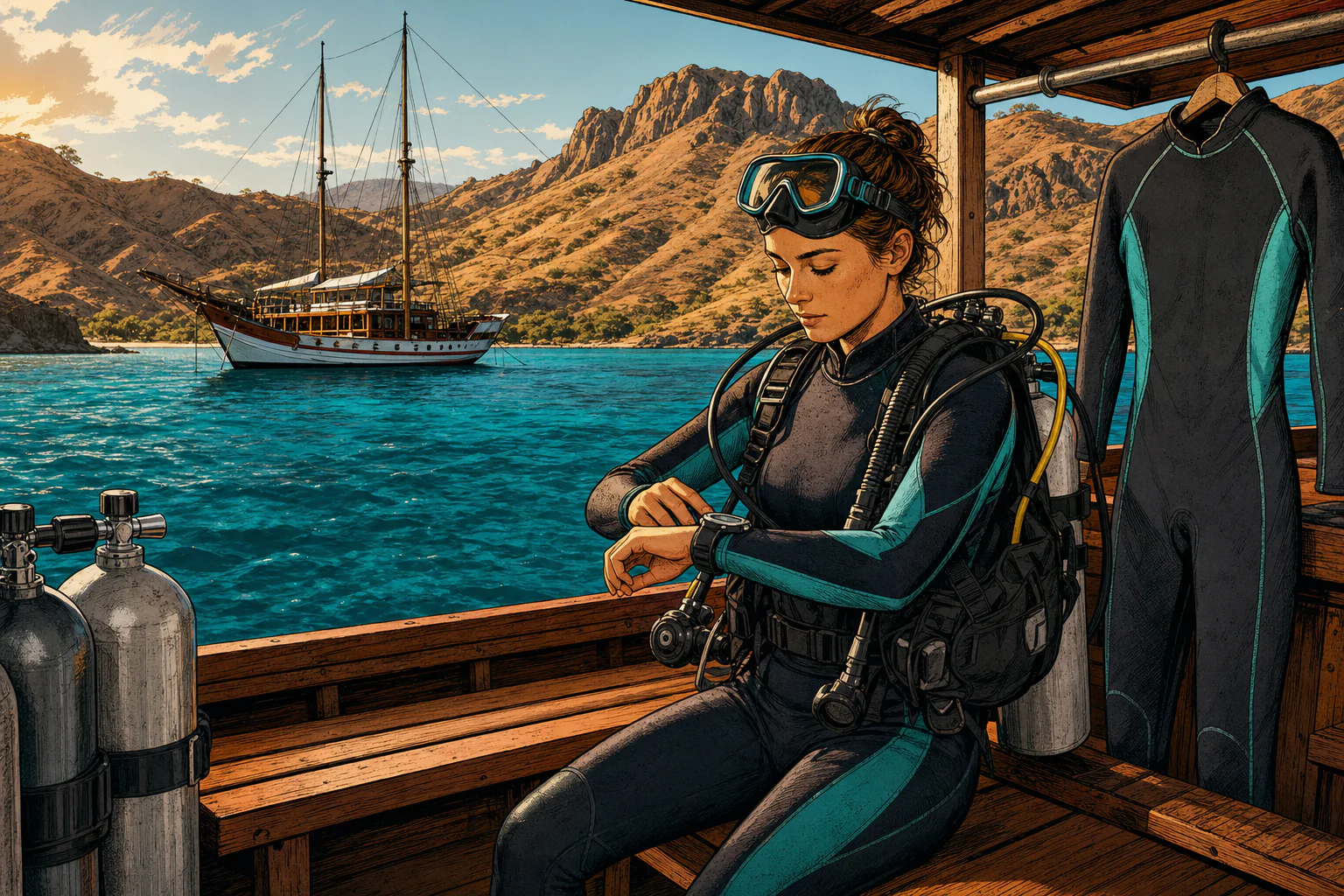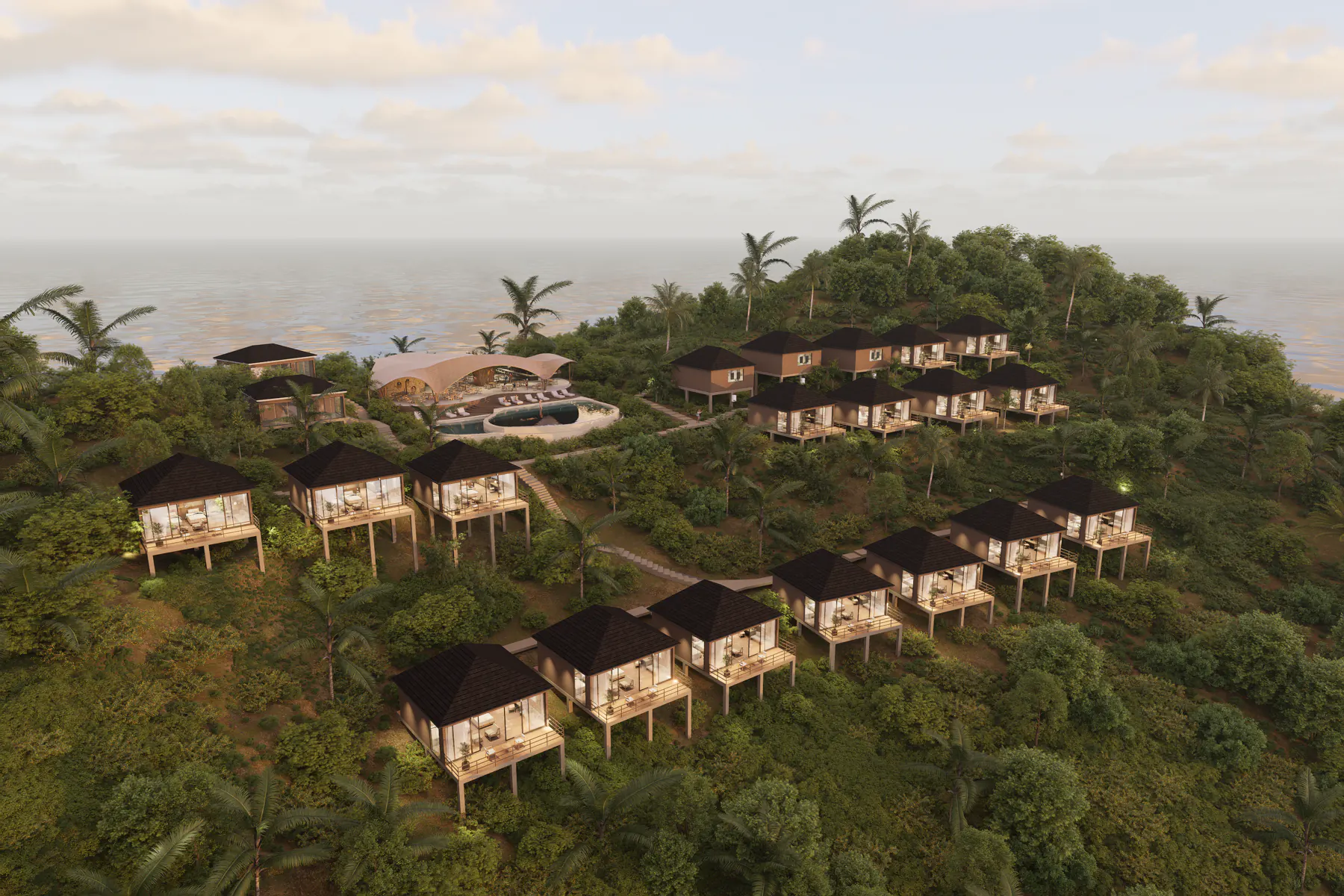
Every dive trip ends the same way: at some point you have to get on a plane. And that simple fact creates one of the most common questions we hear at our dive center: how long do I need to wait after my last dive before I can fly? The short answer is 12 to 24 hours depending on how much diving you have done. The longer answer is worth understanding properly, because getting it wrong is one of the few genuinely avoidable causes of decompression sickness, and getting it right is easy once you know how to plan your trip around it.
This matters more in Komodo than in most destinations. Nearly everyone who dives here flies in and out through Labuan Bajo, and many guests combine a resort stay with a Komodo liveaboard, stacking three or four dives a day for several days in a row. That kind of repetitive, multi-day diving is exactly the scenario where the no-fly window stretches to its longest. Plan your last dive day carelessly and you either lose dives or take a risk that no dive is worth.
In this guide we explain exactly why flying too soon after diving is dangerous, what the official DAN and PADI guidelines say, how to read the no-fly time on your dive computer, and how to build your Komodo itinerary so the waiting period costs you nothing. We will also cover the special cases people rarely think about: overland travel across the Flores highlands, snorkeling and freediving on your last day, and what to do if you develop symptoms after boarding.
Why You Cannot Fly Straight After Diving
The problem is nitrogen. Every minute you spend breathing compressed air underwater, your body absorbs nitrogen from the gas in your tank. The deeper and longer you dive, the more nitrogen dissolves into your blood and tissues. This is completely normal, it is the reason dive tables and dive computers exist, and your body releases that nitrogen gradually and harmlessly in the hours after you surface.
The key word is gradually. Nitrogen leaves your tissues at a rate controlled by the pressure around you. At sea level, that release happens slowly and safely. But if you climb to altitude while your tissues are still loaded, the ambient pressure drops, and the dissolved nitrogen can come out of solution too fast. Instead of leaving quietly through your lungs, it forms bubbles in your blood and tissues. That is decompression sickness, the same condition divers call the bends, and altitude is what triggers it in this scenario.
A commercial airliner cruising at 11,000 metres keeps its cabin pressurised, but not to sea level. Cabin pressure is typically equivalent to an altitude of 1,800 to 2,400 metres. For a rested traveller that is nothing. For a diver who surfaced from a fourth dive three hours ago, it can be enough to turn a safe nitrogen load into bubbles. It does not matter that the flight from Labuan Bajo to Bali only takes 75 minutes. The cabin altitude is the same as on a long-haul flight, and decompression sickness at 11,000 metres, an hour from the nearest hyperbaric chamber, is a genuinely serious situation.
The Official Guidelines: How Long to Wait
The most widely accepted recommendations come from the Divers Alert Network (DAN), based on their Flying After Diving workshop research, and they are echoed by PADI, SSI, and virtually every training agency. They apply to flights with cabin altitudes between 600 and 2,400 metres, which covers every commercial flight you are likely to take.
- After a single no-decompression dive: wait a minimum of 12 hours before flying.
- After multiple dives in a day, or multiple days of diving: wait a minimum of 18 hours.
- After any dive that required decompression stops: wait substantially longer than 18 hours. Most professionals treat this as 24 hours or more.
Two things are worth stressing about these numbers. First, they are minimums, not targets. The research behind them found that longer surface intervals kept reducing risk, which is why almost every liveaboard operator and dive resort in the world, ours included, works on a simple 24-hour rule of thumb for guests who have been diving repetitively. Second, no guideline reduces the risk to zero. Decompression sickness has occurred in divers who respected the recommended intervals, though it is rare. The intervals represent the point where the risk becomes very small, not where it disappears.
If you have been diving with us for a week, here is what that means in practice: your nitrogen load after several days of three or four dives per day puts you firmly in the 18-hour minimum category, and we will always recommend you give it a full 24. A last dive at 3 PM followed by a 10 AM flight two days later is a comfortable, zero-stress margin. A last dive at 5 PM followed by a 7 AM flight the next morning is not, and we will tell you so when you book your schedule.
What Your Dive Computer Says, and What It Does Not
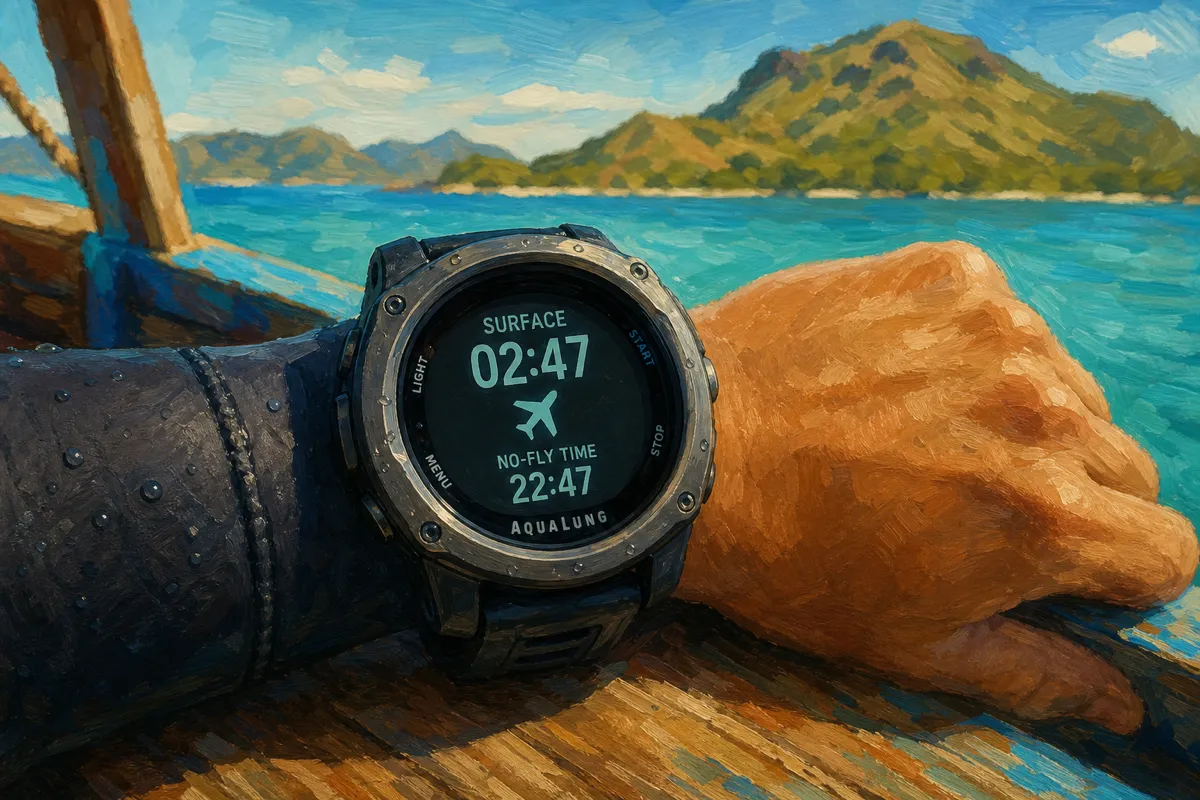
Every modern dive computer tracks your nitrogen loading across repetitive dives and displays a no-fly time after you surface, usually shown as a small aeroplane icon with a countdown. This number is useful, but you should understand what it actually is.
Different manufacturers calculate no-fly time differently. Some run a fixed 24-hour countdown from your last dive regardless of what you did. Others model your actual tissue loading and count down until the model says a cabin altitude of 2,400 metres is tolerable. That is why two divers who did identical dives can surface with different no-fly times on their wrists.
Our advice is simple: treat the computer's no-fly time as a hard minimum, and the DAN guidelines as the floor beneath it. If your computer still shows a no-fly countdown, do not board a plane, full stop. If your computer has cleared but you have done four days of repetitive diving and your flight is 16 hours after your last dive, wait anyway. The computer models an average body under average conditions. It does not know that you are dehydrated from a week in the tropics, slept five hours, and had two beers with dinner, all of which are factors that increase bubble formation. If you want to understand how alcohol specifically interacts with diving, we wrote a full guide on drinking and diving.
Planning Your Last Dive Day in Komodo
Here is the good news: in Komodo, the no-fly window is easy to plan around, because the flight schedule out of Labuan Bajo works in your favour. Most departures to Bali and Jakarta leave in the morning or around midday. That means the practical rule is simply: your last dive day should be the day before your last full day. Dive in the morning, surface by early afternoon, and by the time your flight boards the next day you have comfortably cleared 18 to 24 hours.
When guests book their stay with us, we structure the schedule automatically so this happens without anyone losing dives. A typical final stretch of a week at the resort looks like this:
- Day 6: full diving day, two or three dives, last dive surfacing around 2 PM.
- Day 7: no-fly day at the resort. Trekking, snorkeling from the beach is fine at the surface, spa, pool, sunset at the viewpoint.
- Day 8: morning shuttle boat to Labuan Bajo and your flight out, roughly 44 hours after your last dive.
If your schedule is tighter than that, you still have room. A last dive finishing at noon followed by a flight at 11 AM the next day gives you 23 hours, which respects every guideline for repetitive diving. What we ask guests to avoid is the pattern we occasionally see with tightly packed itineraries booked elsewhere: a late afternoon dive followed by the first flight out the next morning. That gap can shrink to 14 or 15 hours after multi-day diving, and that is inside the window where DAN's data says the risk is still elevated. If you are still building your trip, our Komodo itinerary guide shows how to sequence diving, trekking, and travel days properly, and our guide to flights to Komodo covers the current routes and schedules out of Labuan Bajo.
How Liveaboards Handle the No-Fly Window
On a liveaboard, the no-fly planning is built into the itinerary, and this is something worth checking whenever you compare boats. On our trips, the final day of diving always ends by early afternoon, and the boat uses the remaining hours for the land-based highlights that do not load nitrogen: the ranger-guided dragon trek, the Padar sunrise hike, Pink Beach. By the time guests disembark in Labuan Bajo the following morning, they are 18 to 20 hours past their last dive, and anyone flying that same afternoon is beyond 24.
If you are new to liveaboard diving, our first liveaboard guide walks through how a typical day on board is structured, and our overview of liveaboard diving in Komodo explains the different itinerary lengths. The pattern to look for in any itinerary is simple: the last diving day should never be the disembarkation day if guests are flying. When you see a boat advertising dives on the morning of departure, ask how they square that with an afternoon flight, because the honest answer is that they cannot.
One more liveaboard-specific point: longer trips mean deeper nitrogen loading. After six days of four dives a day in the Banda Sea or on a long Komodo crossing, your slow tissues are carrying far more nitrogen than after a weekend of diving. The 18-hour minimum still technically applies, but this is exactly the situation where stretching to 24 hours or more is cheap insurance. Good boats build that margin in; good divers do not try to negotiate it away.

The Best Part: a No-Fly Day in Komodo Is Not a Wasted Day
In some destinations, the no-fly day means sitting in an airport hotel. In Komodo, it might end up being the day you remember most. Everything on this list is altitude-safe and nitrogen-free:
- See the dragons. A guided visit to Komodo or Rinca Island is a land activity, perfectly suited to your last full day. Book it as part of a Komodo National Park tour and combine it with Pink Beach.
- Hike Padar at sunrise. The most famous viewpoint in the park involves a 30 to 40 minute climb to roughly 200 metres above sea level, far below any altitude that matters for decompression. Our Padar Island guide covers the details.
- Snorkel from the surface. Gentle snorkeling, staying on the surface without breath-hold descents, adds no meaningful nitrogen. The house reef snorkeling in front of the resort is some of the best in the park.
- Spa, pool, and beach. A massage at the Sebayur Spa, an afternoon at our new beachfront pool, and a sunset trek to the island peak make a genuinely good final day. Our list of things to do in Komodo has plenty more.
- Explore Labuan Bajo. If you overnight in town before an early flight, the harbour, the night market, and the sunset viewpoints are all worth your time. See our Labuan Bajo travel guide.
One caution hides in that list: snorkeling is fine, but freediving is not. Repeated breath-hold descents after scuba diving can contribute to bubble formation, and serious freediving on top of a week of scuba is a known risk factor. If you spent the week doing both, treat your freediving day like a diving day when you count your no-fly hours.
Overland Travel: the Rule Nobody Thinks About
Flying is not the only way to reach altitude after diving. The DAN guidelines apply to any ascent above roughly 600 metres, and that includes roads. This rarely matters on a standard Komodo trip, because Labuan Bajo, the airport, and the harbour all sit at sea level. But it matters a great deal if you are planning to travel overland across Flores after your diving.
The Trans-Flores highway climbs quickly once you leave the coast. Ruteng, the first major town east of Labuan Bajo and the gateway to the spiderweb rice fields, sits at around 1,200 metres. The road to Bajawa and the Kelimutu crater lakes goes higher still. Driving that route the morning after your last dive exposes you to a cabin-altitude-equivalent pressure drop without any of the planning you would apply to a flight. If your itinerary continues east across Flores, apply exactly the same waiting periods before you head into the highlands: 12 hours after a single dive, 18 or more after repetitive diving.
The reverse direction is completely fine, by the way. Arriving at altitude and then descending to sea level to dive poses no decompression problem. You can watch the sunrise at Kelimutu on Monday and dive Batu Bolong on Wednesday without a second thought.
What About Flying In and Diving the Same Day?
This direction gets asked almost as often, and the answer is much more relaxed: there is no decompression reason you cannot dive shortly after flying. Your body arrives with a normal nitrogen load, and descending to sea level pressure only helps. Plenty of our guests land in Labuan Bajo in the morning and are on the house reef by mid-afternoon.
The reasons to take it easy on arrival day are practical rather than physiological. Long-haul travel leaves you dehydrated, and dehydration is one of the most consistently cited contributing factors in decompression sickness cases. Jet lag dulls your attention, and your first dives in a new destination deserve a sharp head. Our usual recommendation for guests arriving from Europe or the Americas is to spend the first afternoon settling in, drink far more water than feels necessary, sleep properly, and start diving fresh the next morning. The park will still be there, and if you have planned your trip around the right season, as covered in our guide to the best time to visit Komodo, one settling-in day costs you nothing.
If You Have Symptoms After Flying Anyway
Decompression sickness does not always announce itself immediately. Symptoms can appear hours after surfacing, and a pressure drop in a cabin can bring on symptoms that were not present on the ground. The classic signs are deep joint pain that does not change when you move the joint, unusual fatigue far beyond normal travel tiredness, skin tingling or numbness, a blotchy skin rash, dizziness, and in serious cases weakness or difficulty walking.
If any of that appears during or after a flight that followed diving, take it seriously. Tell the cabin crew if you are still in the air; most airlines can arrange oxygen, and supplemental oxygen is the correct first aid for suspected decompression sickness. Once on the ground, contact DAN's emergency hotline, which operates 24 hours worldwide, and get evaluated. Do not talk yourself out of symptoms because the trip is over and a chamber visit is inconvenient. Untreated decompression sickness can leave permanent damage, and treated promptly, the outcomes are overwhelmingly good.
Two pieces of preparation make this scenario dramatically less stressful. First, carry dive insurance that covers hyperbaric treatment and evacuation. DAN membership is the standard choice and costs less than a single dive day. Second, know your geography: the nearest recompression chamber is at Siloam Hospitals in Labuan Bajo rather than in Bali, and our guide to the hyperbaric chamber in Labuan Bajo covers the whole chain from first symptom to treatment. A chamber close by is no reason to shorten the wait, though, because the flight itself is the hazard the no-fly time exists to remove. That is why every operator here stays conservative, and why you should be too.
Does Nitrox Change the No-Fly Time?
Divers who use enriched air ask this constantly, and the honest answer is: not officially, and you should not treat it as a shortcut. Nitrox contains less nitrogen than air, so diving nitrox on air tables genuinely does reduce the nitrogen your body absorbs over a week of diving. Your dive computer will reflect that with shorter no-fly countdowns, and physiologically you are better off after a multi-day trip on nitrox than the same trip on air.
But the DAN pre-flight guidelines do not publish a separate, shorter waiting period for nitrox divers, and there is a practical reason for that. Most divers on liveaboards use the advantage of nitrox to dive more, not to load less: longer bottom times, shorter surface intervals, an extra dive squeezed into the afternoon. Dive that way and your total nitrogen load at the end of the trip lands roughly where an air diver's would, sometimes higher. So treat nitrox as what it is, a tool that buys you more time underwater and a wider safety margin during the dives themselves, and apply the same 18 to 24 hour pre-flight interval you would on air. If you are curious about diving nitrox in Komodo, our dive center fills enriched air for certified divers, and the crew will happily walk you through how it changes your dive planning.
Rules of Thumb Worth Keeping
Guidelines with numbers are precise but easy to forget on holiday. These simpler rules cover almost every situation you will meet on a Komodo trip:
- Give it a full day. After any multi-day dive trip, 24 hours between your last dive and your flight is the margin that ends every debate.
- Dive in the morning, fly the day after tomorrow. The natural rhythm of Komodo schedules gives you generous margins if your last dive day ends by mid-afternoon.
- The aeroplane icon is a red light, not a suggestion. If your computer shows remaining no-fly time, you do not fly, whatever the guidelines say.
- Altitude is altitude. A mountain road across Flores counts the same as a cabin at cruising altitude.
- Hydrate like it is your job. Dehydration is the quiet contributor in a large share of DCS cases. This is doubly true in the tropics and triply true if you had drinks the night before.
- When in doubt, ask your dive team. Any professional crew would rather reshuffle your schedule than wave you onto a risky flight. Ours certainly would.
Putting It All Together
Flying after diving is one of those topics that sounds complicated and turns out to be wonderfully simple once you plan for it. Wait 12 hours after a single dive, 18 or more after repetitive diving, give it a full 24 after a serious multi-day trip, and treat your dive computer's no-fly countdown as law. Build your Komodo itinerary so the last day belongs to the dragons, the viewpoints, the spa, or the pool rather than the tanks, and the no-fly window stops being a restriction and becomes the perfect excuse for the land side of the park.
When you book your stay or your liveaboard with us, tell us your flight times and we will structure your dive schedule around them, with margins that let you board without a moment's worry. The reefs of Komodo deserve your full attention while you are down there. Your flight home deserves a body that has had time to let the nitrogen go.