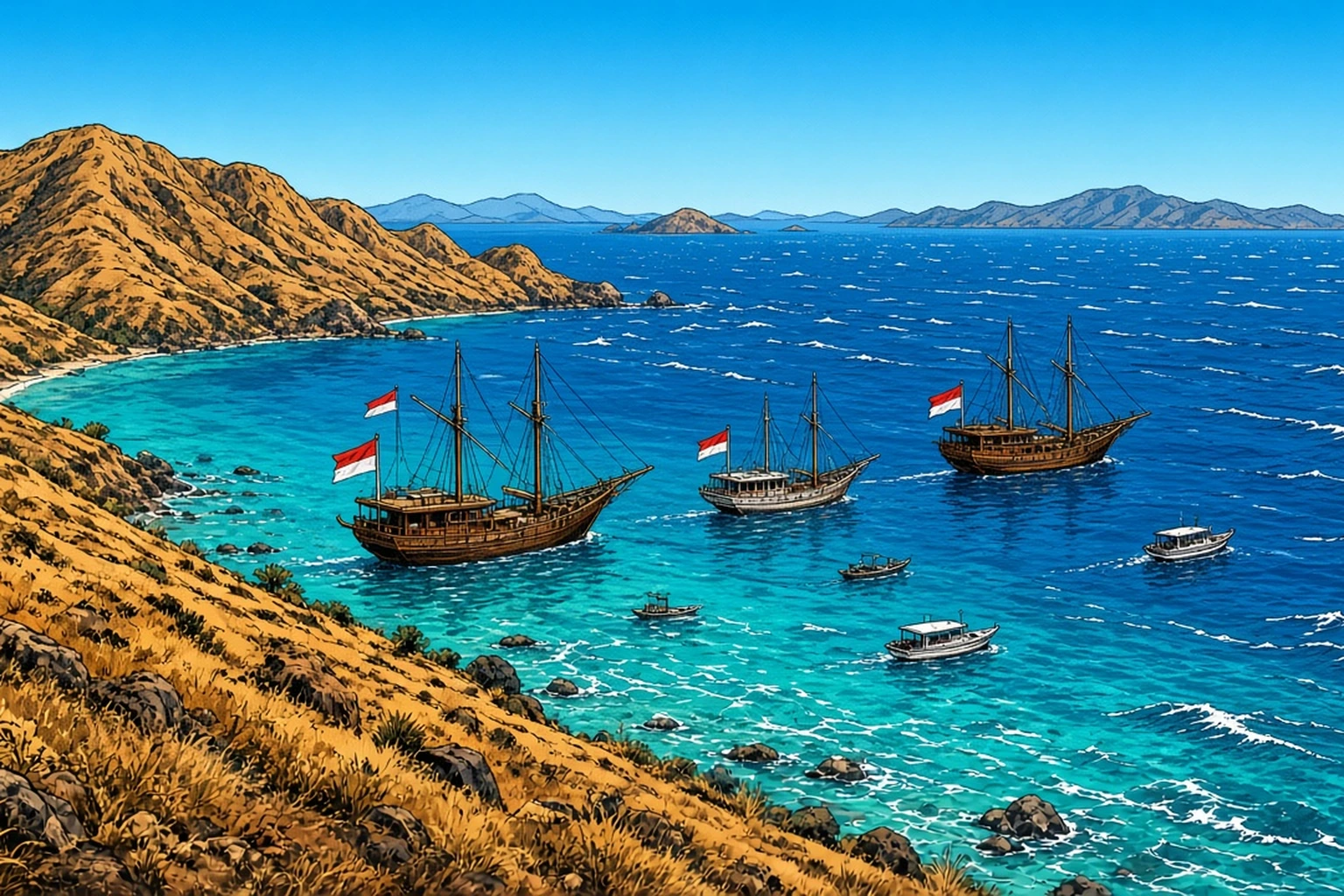
Money is the least glamorous part of planning a Komodo trip, and the part most likely to go wrong. Travelers research dragons and dive sites for weeks, then land in Labuan Bajo assuming it works like Bali, tap a card anywhere, find an ATM on every corner, and they're fine until the moment they're not: standing at a harbor warung that takes cash only, holding a foreign card the machine just rejected, with a boat leaving in twenty minutes. This guide covers everything about money in Labuan Bajo and Komodo National Park: the rupiah and its intimidating zeros, which ATMs actually work with foreign cards, how much cash to carry onto the islands, and what to tip the guides and crew who make a Komodo vacation run smoothly.
A quick note on perspective. We run a resort and dive operation out here, which means we watch guests handle these questions every single week, the ones who arrive prepared and the ones frantically asking whether the boat tour crew can break a two-million-rupiah withdrawal into something a fruit vendor will accept. Everything below comes from that daily reality, with 2026 numbers, not from a guidebook written three exchange-rate cycles ago.
The Rupiah: Making Peace with All Those Zeros
Indonesia's currency is the rupiah (IDR), and in mid-2026 one US dollar buys roughly 16,000 to 16,500 of them, one euro around 17,500 to 18,000. The zeros rattle first-time visitors: a decent dinner costs 150,000, a dive day might run 2,500,000, and suddenly you're a millionaire who can't do mental arithmetic. The trick everyone settles on within a day: knock off four zeros and think in "units" of roughly 60-ish US cents, or simpler still, remember that 100,000 rupiah is about six dollars. Prices here are commonly written with a k, "50k" on a menu means 50,000 rupiah.
Banknotes run from 1,000 to 100,000 rupiah, and the 100,000 note, red, featuring Indonesia's founding presidents, is the one every ATM dispenses and every small vendor sighs at. Getting change for big notes is a genuine daily errand in a town of small transactions, so guard your 10k, 20k, and 50k notes like the useful currency they are. Coins exist but barely matter, you'll mostly meet them as change from minimarts. One more habit worth forming immediately, and this one has saved several of our guests real money: check your zeros before confirming any transfer or card payment. Typing 1,500,000 instead of 150,000 is the classic tired-traveler error, and it's much easier to prevent than reverse.
Cash or Card? What Labuan Bajo Actually Accepts in 2026
Labuan Bajo has modernized fast, but unevenly, and the pattern is worth understanding before you decide how much cash to carry. Hotels, dive operators, the smarter restaurants on the main street, and anything bookable online take cards, usually Visa and Mastercard, frequently with a 2 to 3 percent surcharge passed on to you. Meanwhile the town's daily economy, warungs, fruit stalls, ojek motorbike taxis, small shops, harbor porters, laundry services, runs on cash and QRIS, Indonesia's ubiquitous QR-code payment system.
QRIS deserves a paragraph, because those little QR standees are on every counter in town and they're genuinely how locals pay for everything. The catch for visitors: QRIS payments pull from Indonesian bank accounts and local e-wallets, and while cross-border QR schemes have been rolling out for Southeast Asian neighbors, most Western travelers still can't use it directly. Some tourists load a local e-wallet with help from their hotel; most simply carry cash for small spending and enjoy watching a fishing town settle bills by QR code while their home city still mails paper invoices.
The honest summary: plan for cards to cover your big fixed costs, accommodation, dive packages, decent restaurants, and cash to cover everything spontaneous. In practice that means most visitors need one to two million rupiah in pocket money per person for a few town days, before excursions.
ATMs in Labuan Bajo: Where They Are and How They Behave
The good news first: Labuan Bajo has plenty of ATMs, clustered along the main street, Jalan Soekarno Hatta, near the harbor, and a row of them at Komodo Airport arrivals. The big Indonesian banks are all represented: BCA, Mandiri, BNI, and BRI, and their machines accept foreign Visa and Mastercard debit cards reliably. The less-good news is the arithmetic. Most machines cap single withdrawals at 1,250,000 to 2,500,000 rupiah, roughly $75 to $150, depending on whether the machine stocks 50k or 100k notes, machines dispensing 100k notes give you the higher ceiling. You can usually make multiple withdrawals back to back, but each one triggers whatever foreign-transaction and ATM fees your home bank charges, so five small withdrawals can quietly cost $25 in fees.
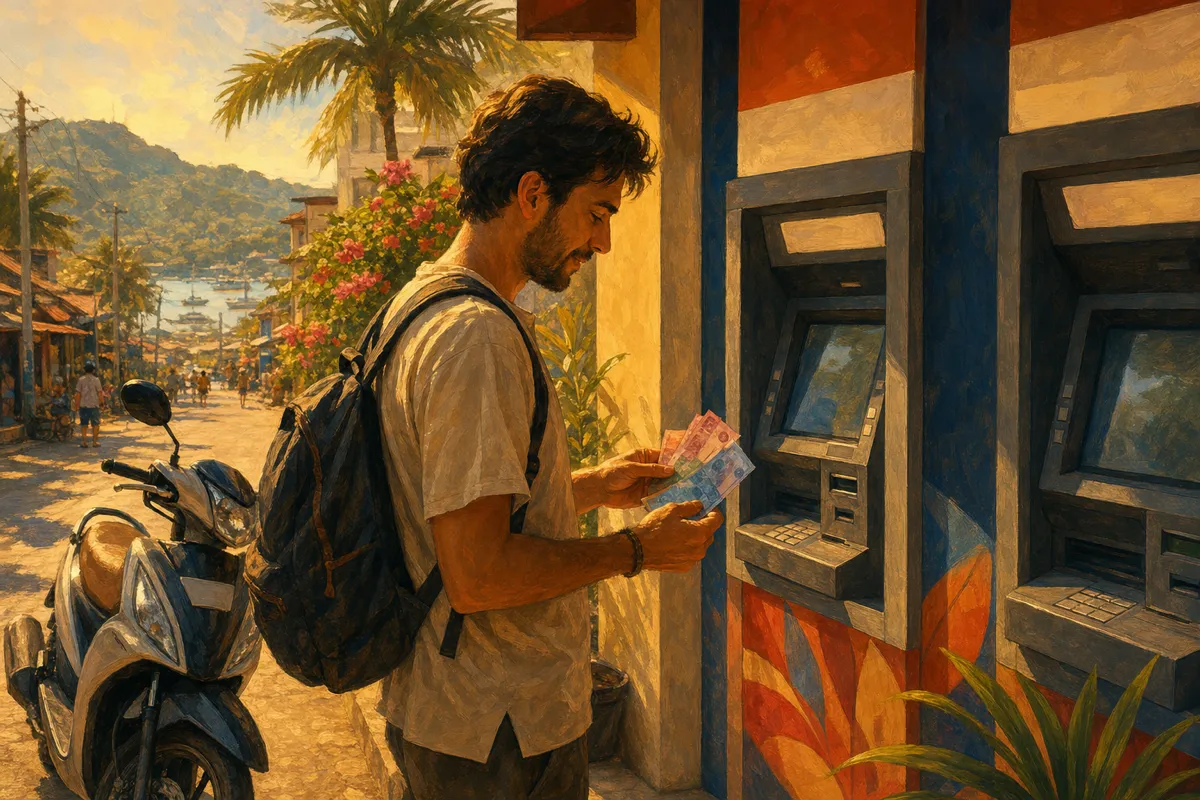
Field-tested tips from years of watching guests navigate this. Use ATMs attached to actual bank branches during daytime when possible; if a machine swallows a card, the branch staff can retrieve it, an airport or minimart machine can't. Choose machines labelled 100,000 per note for bigger withdrawals. Always decline dynamic currency conversion, if the screen offers to charge you in your home currency, refuse and take rupiah; the machine's exchange rate is invariably worse than your bank's. And never arrive counting on the last ATM working: machines here run out of cash on busy weekends and public holidays with total serenity, and the town occasionally loses connectivity during storms. Two cards from different networks, stored in different bags, is the cheap insurance policy.
One structural note for those flying in via Singapore or Bali: withdraw a working amount at Komodo Airport on arrival, but do your bulk withdrawals in town where the branch-attached machines live. Airport machines face a queue of every arriving flight and empty accordingly.
There Are No ATMs in the National Park
This is the sentence that saves trips, so it gets its own section: once your boat leaves Labuan Bajo harbor, you will not see another ATM. Not on Komodo, not on Rinca, not on Padar, not on any island in or around the park. Kampung Komodo's souvenir sellers, the drink vendors at Loh Liang, the villagers selling carved dragons and pearls, cash only, small notes preferred. The same applies to island resorts and liveaboards for incidentals, though reputable operators, ourselves included, let guests settle final bills by card and run tabs during the stay precisely because everyone knows the nearest cash machine is a sea crossing away.
How much to bring across the water? For a day trip: 300,000 to 500,000 rupiah per person covers drinks, souvenirs, snacks, and tips comfortably. For a multi-day stay at an island resort or on a liveaboard where the package covers meals and activities: one to two million per person handles tips, the odd purchase, and the unplanned, in small denominations, because nobody on a beach has change for a red note. Park entrance fees themselves are handled through the online permit system these days, usually bundled by your operator; the details live in our guide to Komodo's entrance fees.
Exchanging Money: Do It Rarely and Do It Right
Straight answer: for most travelers, ATM withdrawals beat cash exchange in Labuan Bajo. The town has a handful of authorized money changers and bank counters, but rates run noticeably worse than Jakarta or Bali, spreads of several percent are normal, and the airport counters are worse still. If you exchange physical currency anyway, know the quirks: Indonesian changers are famously fussy about foreign notes, US dollars must be recent series, crisp, unfolded, unmarked, and large denominations ($100s) get better rates than small ones. Count your rupiah at the counter, slowly, before walking away; the classic tourist-strip sleight of hand is rare here but not extinct. Use only offices displaying an authorized money changer license, and skip anyone offering a rate that looks too generous, it is.
Travelers routing through Bali often ask whether to change money there first. If you're carrying foreign cash anyway, yes, Kuta and Seminyak rates beat Labuan Bajo's. But the simpler modern answer is a travel-friendly debit card, the fintech cards with low foreign-exchange margins have made the whole money-changer ritual mostly optional, and our Indonesia visa and entry guide covers the other paperwork that pairs with arrival logistics.
Tipping in Indonesia: the Cultural Baseline
Indonesia has no aggressive tipping culture, nobody will chase you down the street, and locals themselves tip modestly if at all. But in tourism, tips are a meaningful part of real income, wages in eastern Indonesia are far lower than in Bali, and a good tip lands as genuine appreciation rather than an entitlement. The baseline habits: restaurants often add 5 to 10 percent service charge automatically, check the bill; where they don't, rounding up or leaving 5 to 10 percent for good table service is generous and welcome. Drivers and ojek riders: round up. Hotel porters: 10,000 to 20,000 per bag. Housekeeping: 20,000 to 50,000 per day, left at the end. Nobody expects precision; everyone notices kindness. Hand tips over with a smile, ideally with the right hand or both hands, the small courtesies matter here.
Tipping Dive Guides, Boat Crew, and Trekking Rangers
This is the question we're asked most, usually in a whisper on the last evening, so here are real numbers rather than diplomatic vagueness. For a day of diving, 50,000 to 100,000 rupiah per diver per day for your guide is a solid tip, more if they found you the pygmy seahorse or shepherded a nervous diver through their first current. Day-boat crews on shared open trips and private charters: 50,000 to 100,000 per guest into the communal pot covers the captain and deckhands who hauled anchors and grilled your fish. Trekking rangers on Komodo and Rinca work for the park and appreciate 50,000 to 100,000 per group for a good walk, particularly when they've patiently repositioned for everyone's dragon photos.

Liveaboards run on a different convention, closer to international dive-industry norms: 5 to 10 percent of the trip price, or roughly $10 to $20 per guest per day, given at the end into the crew box, which the whole team, captain, engineer, cooks, dive guides, splits by their own arrangement. On a good boat the crew outnumber the guests and work invisibly long hours; the tip box is where that gets acknowledged. If a single crew member transformed your trip, it's fine to tip them personally on top of the shared box, discreetly. At resorts, a shared staff box at reception is common, ours works this way, so the kitchen team and gardeners share in what the visible front-line staff receive. None of this is obligatory. All of it is remembered.
Two practical notes. Tip in rupiah when you can, crew can spend it directly, without a bank's help. And plan the cash for it before you leave town: the number of guests who've wanted to tip generously on the last morning and couldn't, because the nearest ATM was forty kilometers of ocean away, is the reason this article exists.
What Things Cost: a 2026 Reality Check
Budgeting works better with anchors, so here's what money actually buys in and around Labuan Bajo this year. A local meal at a warung: 25,000 to 50,000 rupiah. Dinner at a good tourist restaurant with a fruit juice: 100,000 to 250,000. A large water bottle: 8,000. Local beer at a bar: 45,000 to 70,000. An ojek across town: 10,000 to 20,000; a car to the airport: 50,000 to 100,000. Laundry: about 20,000 per kilo. A shared day trip to the park: 500,000 to 1,500,000 depending on boat quality; private speedboat charters start around 3,500,000 and climb steeply. Two fun dives with a reputable operator: 1,400,000 to 2,000,000. A night in a guesthouse: from 300,000; mid-range hotels: 900,000 to 2,500,000. Souvenir carved dragon in Kampung Komodo: 50,000 to 300,000 depending on size and your bargaining humor.
Bargaining, while we're here: expected at markets and with souvenir sellers, gently, with a smile, meeting somewhere in the middle; not appropriate in restaurants, shops with marked prices, or for park services. And keep perspective, the difference being argued over is usually less than a dollar, and it means more to the seller than to you.
Paying for the Big Things: Deposits, Balances, and Transfers
Trips out here involve a few large payments, dive packages, liveaboard berths, resort stays, private charters, and how you settle them is worth deciding before you travel rather than at a reception desk. Most established operators take a deposit at booking, typically 20 to 50 percent, by card through a payment link or by international bank transfer, with the balance due before arrival or on the first day. Three things to check in advance. First, the surcharge: card payments in Indonesia commonly carry that 2 to 3 percent processing fee, and on a multi-thousand-dollar liveaboard that's real money, sometimes a bank transfer, or a fintech transfer service, works out meaningfully cheaper. Second, the currency: some operators price in dollars or euros but charge your card in rupiah, which quietly adds an exchange step; ask which currency actually hits your statement. Third, the refund path: money that arrived by transfer leaves by transfer, slowly, so understand the cancellation terms before the deposit moves.
Settling balances in cash is still welcome almost everywhere and occasionally rewarded with a small discount, but do the arithmetic before committing to it: a 15-million-rupiah balance is 150 banknotes, several days of ATM limits, and a slightly absurd envelope. For anything beyond pocket-money scale, plastic and transfers exist for a reason. One genuinely useful hybrid: pay the fixed costs from home before you fly, and reserve your Indonesian cash entirely for the daily economy and tips. Guests who arrive with everything big already settled consistently have the calmest relationship with money out here.
When Money Goes Wrong: Lost Cards and Emergency Cash
It's worth knowing the recovery moves, because the failure modes here are specific. A card swallowed by a machine: if it was a branch-attached ATM during opening hours, go inside immediately, retrieval is usually same-day with your passport. A card that stops working: call your bank's international line, it's very often the fraud filter, not the card, and a five-minute call revives it. All cards dead and cash gone: international transfer services with cash pickup operate in Labuan Bajo through local agents, and money sent from home can be in your hands within hours; your hotel or operator can point you to the nearest agent. It's also entirely normal here to ask your accommodation for help, decent operators have walked dozens of guests through a money emergency and will front small amounts against a settled bill far more readily than you'd expect.
The pre-trip step that makes all of this painless: store your card numbers, bank phone lines, and passport photo somewhere accessible without your wallet, a note in your phone, an email to yourself. And carry one quiet reserve, a $50 or $100 note tucked into your luggage, exchangeable in any genuine emergency, that you'll almost certainly bring home untouched. Insurance you fold into a shoe.
Money Safety: Boring Advice That Works
Labuan Bajo is a safe, friendly town by any standard, and money problems here are almost always logistical rather than criminal. Still, the sensible habits cost nothing. Split your cash: some in your daypack, some in your luggage, some on your person, so no single soggy mishap, and this is a town of boats and rain, wipes you out. A dry bag protects phone, cards, and notes on every crossing; salt water is harder on banknotes than any pickpocket. Photograph your cards' emergency numbers and store them somewhere that isn't your wallet. Counterfeit notes are rare but real, big notes from street changers are the risk vector, another argument for bank ATMs. And tell your bank you're traveling to Indonesia before you fly; the only card fraud most visitors experience is their own bank's overzealous fraud filter at the worst possible moment.
Connectivity deserves a mention because payments depend on it: town Wi-Fi and 4G are decent, but on the islands and at sea, coverage fades to nothing fast, covered in more detail in our Labuan Bajo travel guide. Anything that requires an SMS code or a banking app, do it in town. The park runs on cash and starlight.
A One-Page Money Plan for Your Komodo Trip
Everything above, compressed into the plan we'd hand a friend.
- Before flying: notify your bank, pack two cards on different networks, and consider a low-FX-fee travel card. Skip buying rupiah at home; the rates are dreadful.
- On arrival: withdraw about 1,500,000 rupiah at the airport for the first day, then do bulk withdrawals at branch-attached ATMs in town. Always decline currency conversion at the machine.
- Cash to hold: one to two million per person for a few town days; another 300,000 to 500,000 per person per park day trip; tip money for the end of any dive package or cruise, in rupiah, in small notes.
- Before any boat leaves the harbor: final ATM stop, break your 100k notes at a minimart, and seal everything in a dry bag. There is no cash machine among the dragons.
- Tips at a glance: dive guides 50k to 100k per day; day-boat crew 50k to 100k per guest; rangers 50k to 100k per group; liveaboard crew box 5 to 10 percent of the trip; resort staff box at your discretion.
Handled this way, money fades into the background of the trip, which is exactly where it belongs. The rupiah's zeros stop being alarming by day two, the ATM routine takes ten minutes a week, and the tips land in the hands that earned them. What's left is the reason you came: dragons on a golden hillside, mantas over a cleaning station, and some of the richest reefs in the Coral Triangle, none of which take cards, and all of which are free once you're standing there. If you're still assembling the rest of the plan, our guides to when to visit and where to actually stay pick up where the wallet questions end.