September is the last full month of the Komodo dry season, and it's the month we'd pick for anyone who wants the water of July and August without quite as many boats in it. The northern and central dive sites are still at their clearest, the seas around Labuan Bajo are mostly calm, and the island landscape is at its driest and most golden. If you're planning a Komodo island vacation around diving, snorkelling and the dragons, very little in September works against you.
The catch is the south. The Indian Ocean side of the park, where Manta Alley and Cannibal Rock sit, is only just starting to settle after the southeast monsoon, and a Komodo liveaboard heading there in September is taking a chance on the swell rather than banking on it. Demand is the other catch. September still behaves like high season for boats and rooms, so the people who get the trip they wanted are the ones who booked months ahead.
Komodo in September: is it a good time to visit?
Komodo in September is the last full month of the dry season, with clear northern water, warm seas and very little rain across the national park.
- 20 to 30 metres visibility
- Water at 28 to 29C
- Dragons laying eggs
- Manta numbers starting to build
It sits between the July and August peak and the October changeover, so you get peak-season water with a little less traffic while the cold southern sites are still settling.
In September you can:
- Dive the north and centre with a Komodo dive centre
- Join Komodo snorkeling trips at the manta and turtle sites
- Walk with rangers on Komodo dragon tours to Rinca or Komodo Island
Book early, because September still fills like high season, and treat the far south as a bonus rather than the reason for the trip.
What the weather does in September
It's hot, bright and dry. Afternoons reach 32 or 33C, there are around nine hours of sunshine a day, and the UV index sits in the extreme band from mid-morning. Sea temperature around Labuan Bajo is 27 to 29C. Sunrise is a little before six and sunset a little before six in the evening, which gives you twelve hours of usable light and makes dawn starts easy.
Rain is where the published averages fall apart. One long-term dataset for Labuan Bajo shows about 45mm falling on a single day in September, and the same page, a few lines further down, gives 93mm spread across eight days. Night lows on that page range from 19C to 23C. We wouldn't plan around either figure. What we see on the ground is a month that is overwhelmingly dry, with the odd short shower that's gone before anyone has found a jacket.
The wind matters more than the rain. The southeasterly trade wind that makes the dry season what it is still blows through September. It's the reason the north is so clean, and it's also the reason open crossings can get choppy, particularly later in the day. Mornings are usually the smoothest part of the day on the water, which suits the dive schedule anyway. If boats make you queasy, our advice on seasickness on Komodo boat trips is worth reading before you fly, not on the boat.
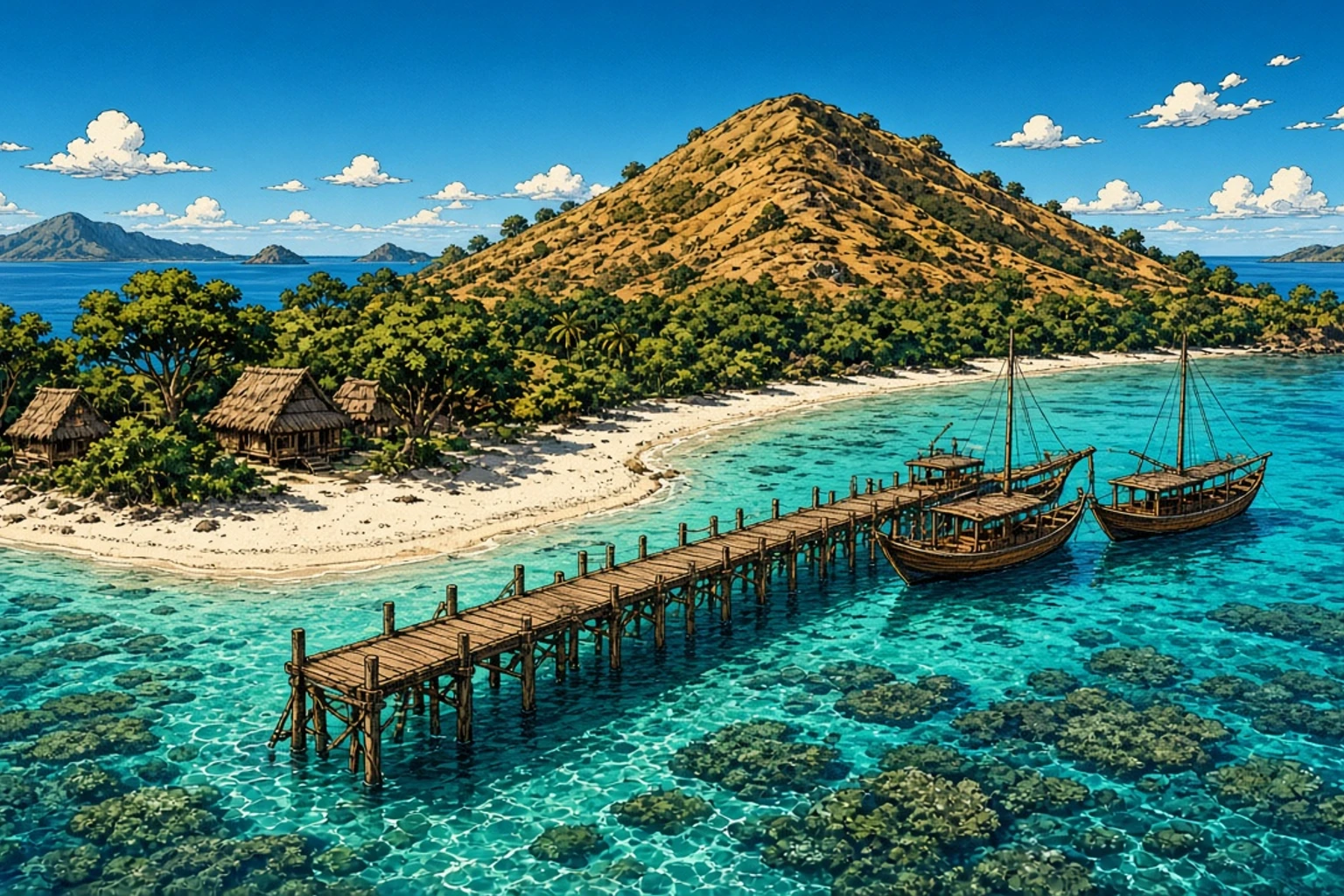
On land the dry season is at full strength. The hills of Komodo, Rinca and Padar are burnt gold and the trails are dusty. It's the landscape in the famous Padar photograph, and it's also the hottest walking of the year, so dragon treks and ridge climbs belong to the early morning.

September vs October in Komodo: what is the difference?
These are the two months people most often weigh against each other once they've decided July and August are too busy. They're closer than they look on a calendar, and the difference is mostly about one half of the park.
September
The north and centre are at full dry-season quality, with visibility often still in the 20 to 30 metre band and the calmest surface conditions of the year. The south is at the edge of its season, colder and less predictable, and some operators won't schedule it until October.
October
Northern visibility eases slightly, typically to 18 to 28 metres, while the southern sites come back into regular use and the last week can bring the first showers. It's the one month when both halves of the park tend to work at once, which we cover in our Komodo in October article.
Key distinction:
- September gives you the best of the north with a small chance at the south.
- October gives you a little less of the north with a much better chance at the south.
If your heart is set on Manta Alley or the soft coral at Cannibal Rock, go in October or later. If you mostly care about the pinnacles, the turtles and clear water on a day boat, September is the stronger month.
North, central and south Komodo in September
Komodo is really two oceans sharing one park. The northern and central sites sit on Flores Sea water, and the southern sites face the Indian Ocean. The same southeast wind that clears the north from June to September pushes swell and cold, green upwelling into the south. Here is how the three zones usually look in September.
| Zone | Water | Visibility | How you get there | Limits |
|---|---|---|---|---|
| North (Castle Rock, Crystal Rock, The Cauldron) | 28 to 29C | 20 to 30 m | Day boat or liveaboard | Strong current, advanced divers only |
| Central (Batu Bolong, Manta Point, Siaba Besar) | 28 to 29C | 20 to 30 m | Day boat, 20 to 30 minutes from Sebayur | Busiest sites in the park |
| South (Manta Alley, Cannibal Rock, Horseshoe Bay) | 21 to 23C, colder below thermoclines | 8 to 15 m | Liveaboard only, about 4 to 5 hours | Swell still settling, operators disagree |
The northern sites are famous for good reason. Castle Rock and Crystal Rock are submerged pinnacles where the current brings in grey reef and whitetip sharks, giant trevally and dogtooth tuna. They're also advanced dives by virtually every operator's policy, and September's clear water doesn't make the current any gentler. Read our Castle Rock dive site notes before you ask to go there, and be honest with yourself about your last ten dives.
The central sites are where most of a day-boat September happens. Siaba Besar and Tatawa Besar suit newer divers, with turtles that are almost guaranteed at Siaba. Batu Bolong is a narrow pinnacle with a sheltered side and an exposed one, and it rewards anyone who can hold position in a current. Manta Point, also called Karang Makassar, produces mantas through the year.
The south is where the sources split, and it's worth knowing that before you book. One long-running Komodo dive operator treats the southern window as October to April and describes September as the month it slowly settles, with 8 to 15 metres of visibility. Our sister liveaboard company counts September to November among the most reliable months for Manta Alley. Both agree it's cold, at 21 to 23C with sharper thermoclines below, and both agree it needs a liveaboard. So ask the boat directly whether a September departure includes the south, and what happens to the itinerary if the swell says no.
Mantas in September
Reef mantas live in Komodo all year, and the central cleaning stations at Karang Makassar and Mawan produce sightings in every month. What changes is the size of the groups. The trains of twenty or thirty animals at one station are most reliable from roughly September to May, with December to February the strongest stretch. September sits at the very start of that curve.
In practice, a September manta dive usually means a handful of animals in clear water rather than a crowd of them in green water. Some divers prefer that. Visibility makes the photographs cleaner, and a smaller group of mantas circling a cleaning station is easier to watch without anyone getting in the way. If a big aggregation is the whole point of your trip, our Komodo in November article explains why later months are the better bet.
The rules are the same in every month, and they matter more when boats are busy. Stay low, stay off the cleaning bommie itself, keep at least three metres back, and never chase. A manta will often come closer to a still diver and almost always leave a moving one. Our guide to swimming with manta rays in Komodo goes through the etiquette in more detail, including for snorkellers.
Longer itineraries have one more September possibility. Whale sharks gather around the fishing platforms in Saleh Bay, off Sumbawa, through roughly May to October. It's only reachable on Komodo and Sumbawa routes of eight or nine days or more, and sightings are never promised, so treat it as a reason to look at a long trip rather than a reason to book one.
Komodo dragons in September
September is nesting time. Dragons mate from around May to August, and females lay their eggs in August and September, usually 15 to 30 of them. Many use the old mound nests of the orange-footed scrubfowl rather than digging their own: one study found about 60 per cent of nests were in these mounds. Incubation takes seven to eight months, so eggs laid in September don't hatch until March or April.
What this means for a visit is that some females are digging, laying or sitting close to nest sites. They also dig decoy chambers to throw off egg-raiding rivals, and a good ranger will often point one out. A female guarding a nest is predictable about where she'll be, but she's not an animal you approach, and rangers keep groups well back from active nests. There's more on the breeding cycle in our Komodo dragon facts article.
The heat sets the timetable. Dragons are most active in the cooler early hours, and by late morning most of them are lying in shade, which makes for duller viewing and a harder walk. A Komodo dragon tour that lands on Rinca or Komodo Island first thing in the morning will see more than one that arrives at noon. Stay with your ranger, keep the distance you're told to keep, and don't crouch for a photograph. Our article on whether Komodo dragons are dangerous explains why that last rule exists.

How a September dive day works
Every dive day in Komodo is planned around the tide, not the clock. September's calm mornings help, but they don't change the basic sequence. Here's how a day out of Sebayur Island runs.
1. The plan is set the evening before
The guides look at the tide table, the moon phase and the wind forecast, then choose sites and a departure time. On a spring tide around the full or new moon the current runs harder, and the plan shifts towards sheltered sites or toward the slack water at the exposed ones. You'll get the time at dinner, not in a brochure.
2. Briefing and kit on the boat
Full rental equipment is included in our dive packages, apart from a dive computer, which costs IDR 245,000 to rent. A 3mm suit is enough for the northern and central sites in September. If you're certified for nitrox, a tank costs IDR 130,000, and it's worth it on a three-dive day.
3. The crossing
The central sites are about 20 to 30 minutes from Sebayur by boat, which is the practical advantage of staying inside the park rather than in Labuan Bajo. Northern sites take longer. Boats are not allowed to sail inside the park at night, so all of this happens in daylight.
4. Waiting your turn at busy sites
Since 2026 the park has applied what it calls the 20 Minutes Rule, which is the minimum gap between groups of divers entering the same site. It isn't a limit on how long you dive. In September, with a lot of boats about, it can mean a short wait at Batu Bolong or a switch to a quieter site, and a good guide will already have a second option ready.
5. Groups, entries and pickups
Divers go in with one guide for every four divers, matched by certification and experience. At current sites that usually means a negative entry, a planned drift and a pickup at the end, with a surface marker for the boat to follow. If any of that is new to you, our guide to diving Komodo currents covers the skills that matter.
6. Back by early afternoon
Two-dive days usually return in time for lunch at the resort. Three-dive days include lunch on board. The afternoon is for the beach, the spa, a nap or an afternoon dive, before the evening light on the island's lookout.
A worked example. Say slack water at Batu Bolong falls at about 09:00 on a calm September morning, two days after a neap tide. The boat leaves the Sebayur jetty around 08:15 and reaches the site in under half an hour. You enter on the sheltered side at slack, drop to about 18 metres, and spend 50 minutes working around the pinnacle as the current starts to build. After an hour's surface interval, the second dive is a gentler drift at Siaba Besar with turtles at 8 to 12 metres. On a three-dive day you'd add Manta Point after lunch. The two-dive package costs IDR 2,500,000 and three dives cost IDR 2,900,000, with park entrance fees charged separately. Our Batu Bolong dive site page has the layout of the pinnacle.
Crowds, prices and booking ahead
September isn't empty, and we'd be misleading you if we said it was. Operators count July to September as the busy stretch of the year, and the change in September is a matter of degree. The European summer holidays end in the first days of the month, the boats stacked on the most popular moorings thin out a little, and the Padar steps at sunrise are busy rather than a queue.
Two things can still catch out late planners. The park caps visitors at 1,000 a day and tickets are booked online through the SiOra system, so ask whoever you book your boat with whether they reserve your slot or leave it to you. And many Indonesian liveaboards treat September as one of the last months of their Komodo season before moving to other regions, so cabins on good boats go early. We'd plan four to six months ahead for September, and longer for a specific liveaboard departure.
Prices are still high-season prices. September isn't a discount month and nobody should sell it as one. The wet season, from about December to March, is when rates fall, with the weather trade-offs that come with it. If you're comparing what the whole trip costs, our Komodo Island trip cost breakdown lists the main items, and the park's charges are in the Komodo National Park entrance fees article.
It's also worth checking the current state of the park before you travel. Komodo stayed open through the August 2026 earthquake and through every September we know of, but rules and access do change. Our article asking is Komodo Island closed keeps track of what's open and how to check for yourself.
Snorkelling and non-divers in September
September is one of the easiest months of the year to enjoy Komodo without a tank. The water is warm, the surface is usually calm in the morning, and the shallow reefs are as clear as they get. Turtles at Siaba Besar, the pink sand and shallow coral at Pink Beach, and mantas at Karang Makassar feeding close enough to the surface to watch from the top are all realistic in a single day.
From Sebayur, snorkellers can join the dive boat for two snorkelling stops for IDR 2,200,000 per person, or snorkel the house reef with a guide for IDR 350,000. Our house reef has turtles, blacktip and whitetip reef sharks and rays, and snorkelling there is supervised by our staff. Diving on the house reef isn't allowed, which is a rule we put in place to protect it.
For a day that mixes the famous stops, Komodo National Park tours combine Padar, Pink Beach, the dragons and snorkelling in one trip, either on a shared boat or as a private charter. Start early in September. By ten in the morning the Padar ridge is genuinely hot, with no shade worth the name, and our guide to hiking in Komodo lists how long each trail honestly takes.
The one thing to take seriously is current. A snorkeller gets no special treatment from it, and the same tidal flow that makes the diving good can move a snorkeller off a reef quickly. Wear the flotation vest, stay with the guide, and say so before you get in if you're a nervous swimmer.
What to look for in a September dive trip
September conditions are forgiving, which is exactly when people stop asking the right questions. These are the ones we'd ask any operator, us included.
1. Whether the south is really on the itinerary
If a September liveaboard advertises Manta Alley, ask what happens when the swell is up. A good answer names the alternative sites. A vague answer usually means the south was never likely.
2. The guide-to-diver ratio
Busy sites and strong current are a bad mix with large groups. Ask how many divers each guide takes, and whether groups are split by experience. Our ratio is four divers to one guide.
3. How they handle the 20 Minutes Rule
At the priority sites, boats wait their turn. Ask what the plan is when Batu Bolong or Castle Rock is busy, because the answer tells you whether the operator plans the day or just turns up.
4. Thermal protection for colder water
A 3mm suit covers the north and centre. Anywhere further south needs 5mm with a hood at minimum, and most rental fleets in Labuan Bajo are stocked for warm water. Ask what sizes they actually have on board.
5. Experience rules for the advanced sites
Castle Rock, Crystal Rock and The Cauldron are advanced dives. Ask what certification and how many logged dives they need, and whether they run a check dive first. An operator who'll take anyone anywhere in September isn't doing you a favour.
6. Nitrox and dive computers
On repetitive three-dive days nitrox gives you more margin. Check that it's available, what it costs and whether you need your own computer.
7. The emergency plan
Ask where the oxygen is kept, who on the boat is trained to use it, and how long it would take to reach the hyperbaric chamber in Labuan Bajo from the day's sites. It's a dull question that every serious operator answers instantly.
8. Who books your park slot
With online tickets and a daily cap, make sure it's clear whether the operator reserves your park access or leaves it to you. On a busy September day that difference decides whether you visit Komodo Island or not.
How to choose a September trip for your group
Non-divers and snorkellers. September is close to ideal: calm mornings, warm water and the classic dry-season views. Base yourself somewhere that puts you near the snorkelling sites, and use our Komodo snorkeling day options to see mantas and turtles from the surface.
First-time divers. Warm, clear water and gentle sites like Siaba Besar make September a good month to learn. The learn to dive in Komodo guide compares the courses, and a PADI Open Water course with us costs IDR 8,700,000 including rental gear and e-learning.
Certified divers. This is the month for the central and northern classics from a day boat. If you want the advanced pinnacles, the PADI Advanced Open Water course costs IDR 7,400,000 for five dives, and doing it early in your stay is a sensible way to build up to Castle Rock.
Advanced and current-loving divers. The north is in prime shape. If you also want the south, go for a longer itinerary with a flexible route, or move your dates into October. Compare the options on our Komodo liveaboard trips page and read the best Komodo liveaboard guide on how to judge a boat. The King Neptune liveaboard and our other boats publish their departures online.
Families. Calm, dry weather makes September a straightforward family month, as long as dragon treks are done early and children are kept well hydrated. Our article on visiting Komodo with kids covers ages, safety and what children enjoy most.
Couples. The light is golden, the sunsets are clear and the water is warm. If you're planning a honeymoon or an anniversary, our Komodo Island for couples guide has ideas that go beyond the usual boat day.
Who Komodo Resort is for in September, and who it is not for
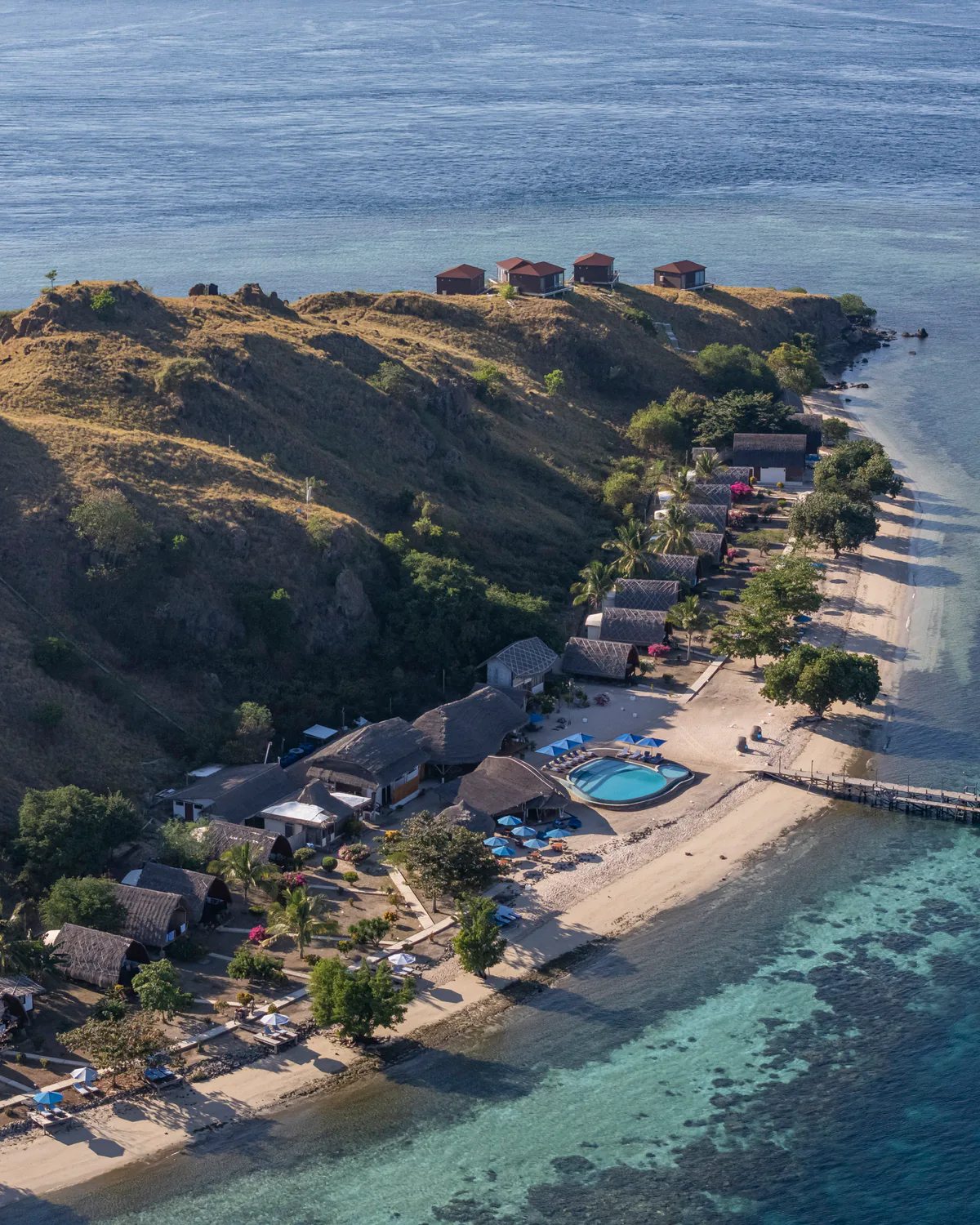
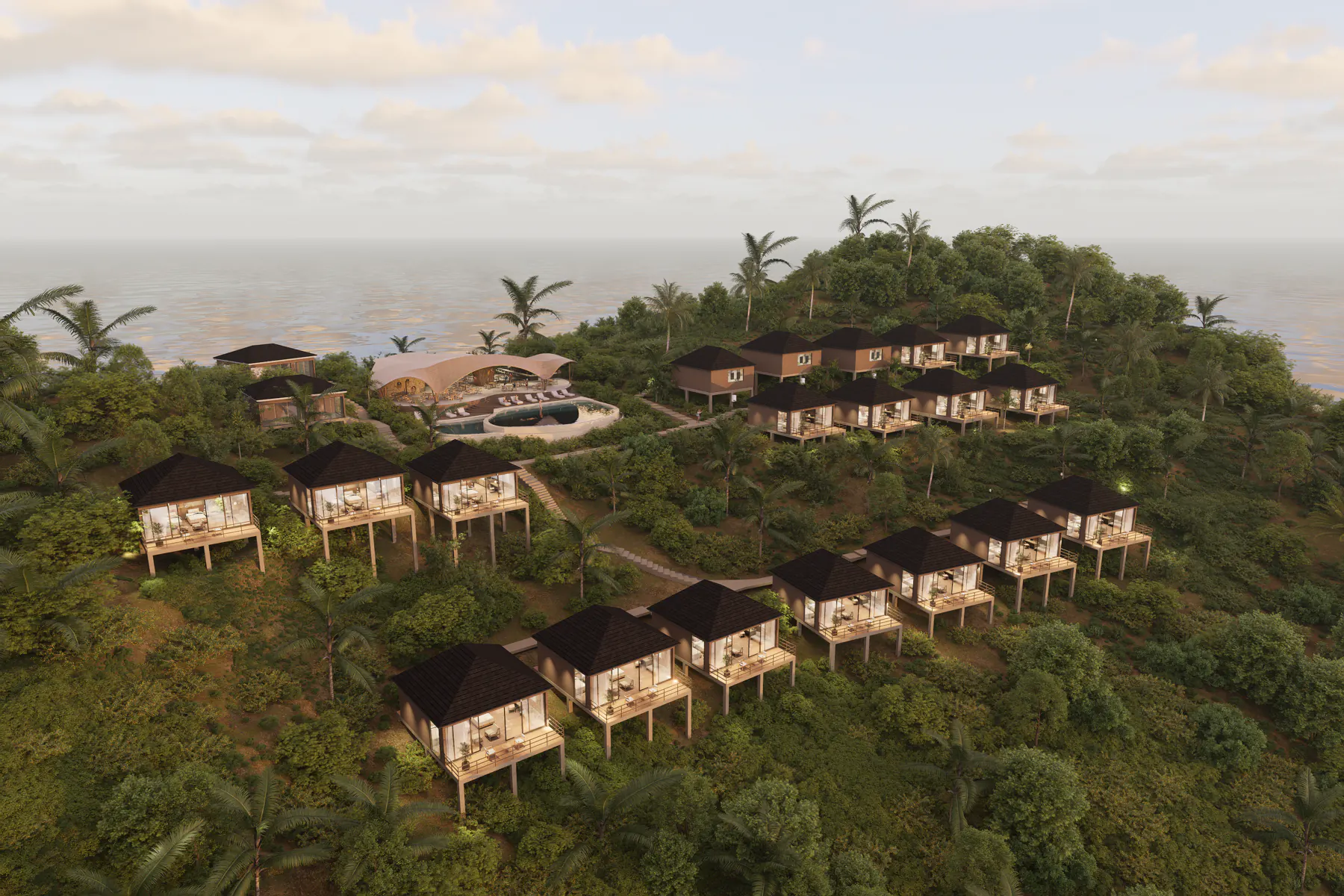
Komodo Resort is on Sebayur Island, 30 minutes from Labuan Bajo by speedboat, and it was the first resort ever built in Komodo. That position is the point of staying with us in September. The central dive sites are 20 to 30 minutes away, so you reach them early and you're back for lunch while day-trippers from town are still on their way home. Our Komodo Resort rooms are beachfront and ocean-view bungalows, and the Komodo Resort dive centre runs its boats from our own jetty with a four-to-one guide ratio. Between dives there's the beach, the pool, the spa and the restaurant, which you'll find on the Komodo Resort facilities page.
The island is private property. Apart from our guests, only visitors with an advance restaurant or bar reservation can come ashore, which keeps it quiet in a month when the rest of the park is busy.
We're the wrong choice for some September travellers, and it's better to say so now:
- Divers who want the south above all. Manta Alley and Cannibal Rock are too far for a day boat. A southern liveaboard, ideally in October or later, is the right trip.
- Anyone who wants town life between dives. There's no village on Sebayur and no nightlife. If you want bars and restaurants to walk between, stay in Labuan Bajo.
- Divers hoping to shore dive. Diving on our house reef isn't allowed, so every dive is a boat dive. Snorkelling the house reef is allowed, with supervision.
Key takeaways
- September is the end of Komodo's dry season: clear, warm northern water, little rain and calm mornings across the national park.
- The north and centre are still at peak quality, with 20 to 30 metres of visibility and water at 28 to 29C.
- The south is cold at 21 to 23C and still settling, so ask any liveaboard what happens if the swell closes it.
- Mantas are seen at the central stations, usually in small groups, and the big aggregations come later in the year.
- Female dragons are laying eggs, so visit Rinca or Komodo Island early and keep well back from nests.
- It still books like high season, so reserve rooms, boats and park slots four to six months ahead.