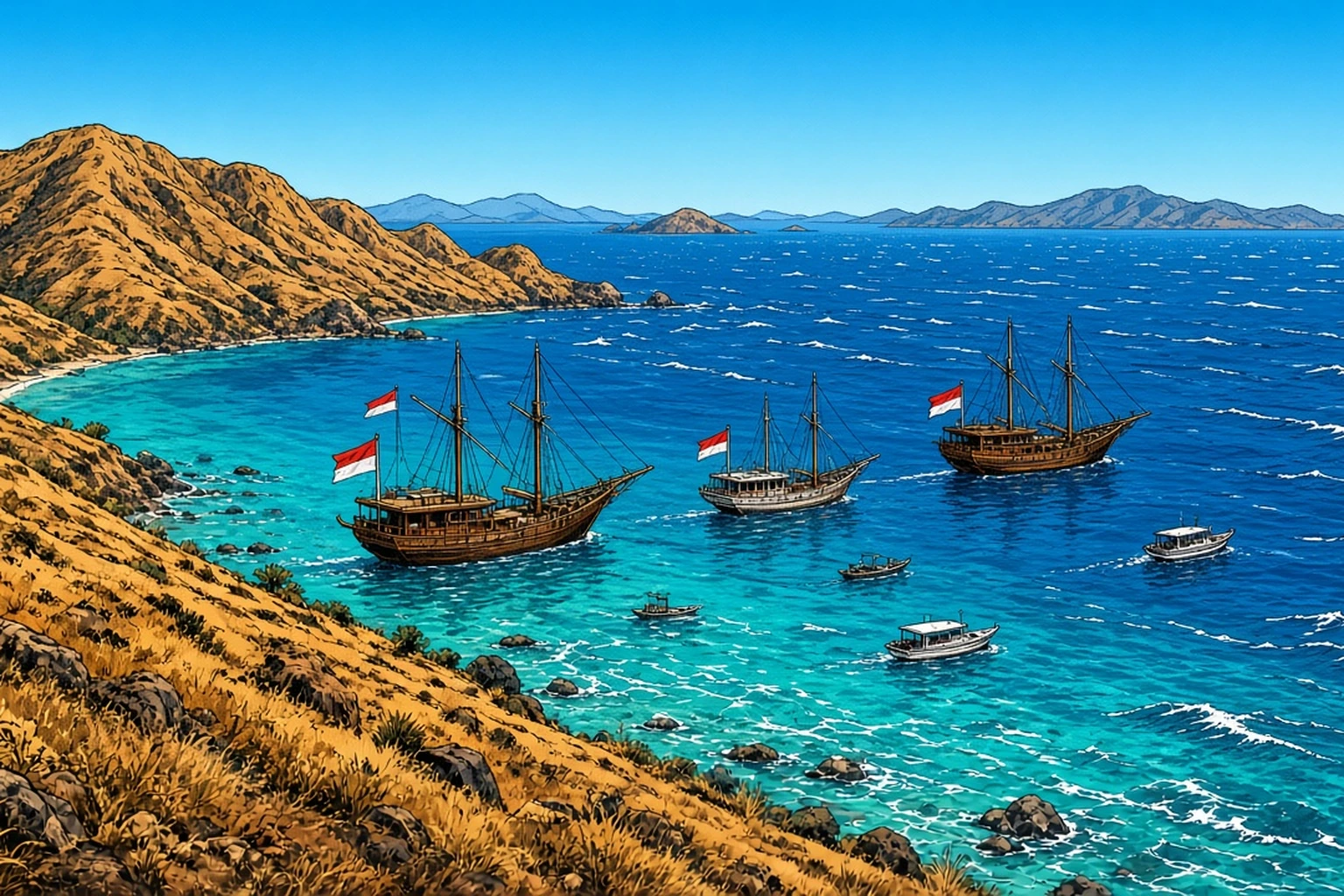
Komodo's rainy season runs from about December to March, with the heaviest rain in January and February. Diving carries on and the mantas peak, but wind can stop the boats for days, so plan spare time.
Komodo's rainy season is the stretch of the year when the hills of the national park turn green, the central manta sites get busy and the dive boats empty out. It's also when the harbourmaster in Labuan Bajo is most likely to stop boats leaving port, which is the one thing that can actually wreck a trip. For a Komodo island vacation between December and March, the rain itself matters far less than the wind and how much slack you build into your dates.
We stay open right through it, and our Komodo dive centre keeps diving whenever the sea allows. What changes is which sites work, how clear the water is and how often a day has to be rearranged. Get those three things right and the wet months are some of the quietest, best value weeks in the park.
What is the Komodo rainy season?
The Komodo rainy season is the northwest monsoon period, roughly December to March, that brings heavy showers, choppier seas and peak manta numbers to Komodo National Park.
- Afternoon and night downpours
- Northwest winds and swell
- Green hills and fewer visitors
- Occasional boat suspensions
It sits between the calm shoulder of October and November and the dry season that settles in from about April.
In the rainy season you can still:
- Join a Komodo dragon tour on Rinca or Komodo Island
- Dive the central manta sites on a Komodo liveaboard
Most days still go ahead, but the sea, not the rain, decides which ones do.
Rainy season vs dry season: what's the difference?
Komodo has two seasons, and they're set by which way the monsoon wind blows rather than by temperature, which barely moves all year.
The rainy season
From about December to March, the wind comes from the northwest and brings most of the year's rain, with Labuan Bajo getting 300 to 400 mm a month at the peak. The sea is warm everywhere, the hills are green, and the north of the park takes the swell.
The dry season
From about April to November, the southeast monsoon takes over and some months see less than 30 mm of rain. The savanna turns gold, the northern dive sites are at their clearest, and the south coast takes the swell instead.
The distinction that matters:
- The rainy season changes where the swell lands, not whether you can dive. One half of the park is usually sheltered.
- Rain rarely cancels a day. Wind does, and in the rainy season the wind is more likely to close the harbour.
The rainy season month by month
Published rainfall figures for Labuan Bajo don't agree, because they come from different stations, different periods and different definitions of a "rainy day". The ranges below span the three most quoted datasets.
| Month | Rain (mm) | Rain days | Sea and access | Best for |
|---|---|---|---|---|
| November | 190 to 320 | 12 to 25 | Mostly calm, both halves of the park open | All round value |
| December | 300 to 350 | 19 to 29 | North less reliable, Christmas fully booked | Early December quiet weeks |
| January | 355 to 405 | 21 to 25 | Wettest month, highest risk of suspensions | Central mantas, empty sites |
| February | 360 to 370 | 19 to 26 | Often the windiest weeks | Mantas, flexible travellers |
| March | 310 to 340 | 17 to 29 | Wind easing, north reopening in windows | Green hills, low prices |
| April | 155 to 255 | 11 to 20 | Dry season arriving, full access returning | Shoulder season start |
December and January have their own guides. Komodo in December explains why the month splits in two around Christmas, and Komodo in January covers the peak of the wet season in detail.
How much does it actually rain?
A lot, by the numbers. Labuan Bajo gets something like 2,300 mm a year, and roughly two thirds of it falls between December and March. January is the wettest month in most datasets at around 350 to 400 mm, against less than 30 mm in August.
The numbers make it sound worse than it feels. Rain in Komodo usually comes as heavy showers and thunderstorms, often in the afternoon or at night, rather than as days of steady drizzle. Even in January, the averages still show six to seven hours of sunshine a day, against nine in September. Mornings are often bright, which suits a diving or trekking day that starts early.
Temperatures hardly move. Days are around 27 to 30°C and nights around 24°C, with humidity in the mid to high eighties. It's sticky rather than cold, and the sea stays warm.
What you'll notice most is the colour. By January the brown hills of Padar and Rinca have turned green, the light is softer, and the views that look harsh in August look almost tropical. Photographers who know the park in the dry season are often surprised by how different it is.
The 2026/27 rainy season forecast
This year's rainy season is forecast to start late. In its 2026/27 seasonal outlook, Indonesia's meteorological agency, BMKG, puts the Pacific in a very strong El Niño phase, which pushes the start of the rains back across much of the country.
For East Nusa Tenggara, the province that includes Komodo and Flores, the regional climatology station expects 27 of its 28 season zones to start the rainy season in December 2026, most of them later than normal. The total rainfall is expected to be about normal, but the season is forecast to be shorter than usual in most zones, with the peak in January or February 2027.
For a trip, that suggests November and early December may stay drier than the long-term averages, and the heaviest weeks may be squeezed into January and February. Seasonal forecasts move, though, and BMKG updates them through the season. Treat this as a tilt in the odds, not a promise.
Boat suspensions: the real risk
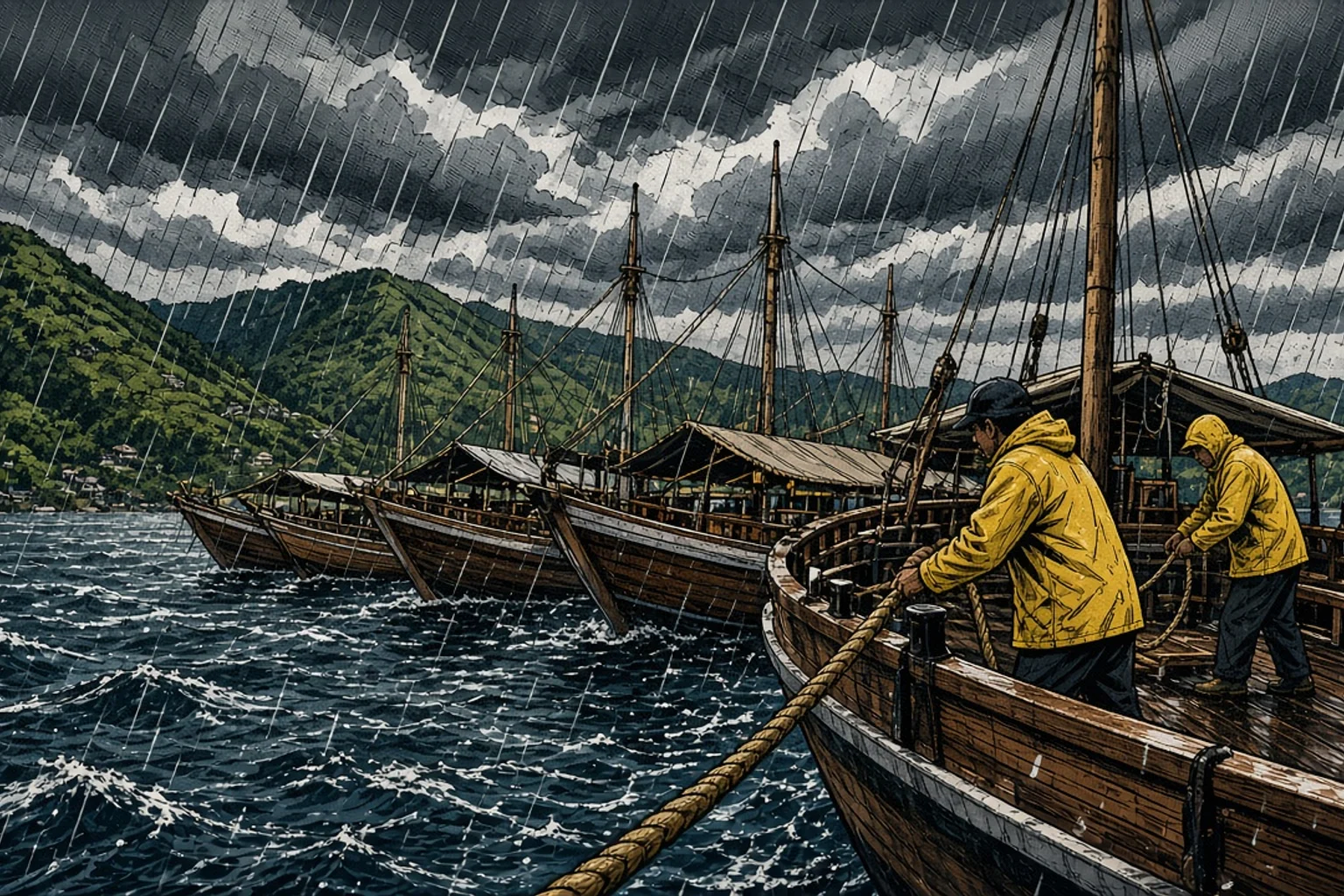
Every tourist boat leaving Labuan Bajo needs a sailing approval letter from the port authority, the KSOP. When BMKG forecasts strong wind and high waves, the harbourmaster can stop issuing those letters, and then nothing sails, however much you've paid.
Last wet season showed how long that can last. Tourist sailing was closed from 26 December 2025, reopened for three days from 9 to 11 January, closed again from 12 January and was extended to 27 January 2026. For most of that month the ban covered speedboats as well as the wooden tour boats. That was an unusually long run, but it's the scenario to plan around.
Suspensions aren't limited to the rainy season. In September 2026, sailing to Komodo Island and Padar was closed twice for a couple of days at a time, while boats were still allowed to Rinca, which sits closer to Labuan Bajo. Partial closures like that, where the exposed sites shut and the sheltered ones stay open, are more common than full ones.
Sailing inside the park at night isn't allowed at any time of year. Our guide to whether Komodo Island is closed explains the difference between weather suspensions, the visitor cap and the various closure rumours.
Diving in the rainy season
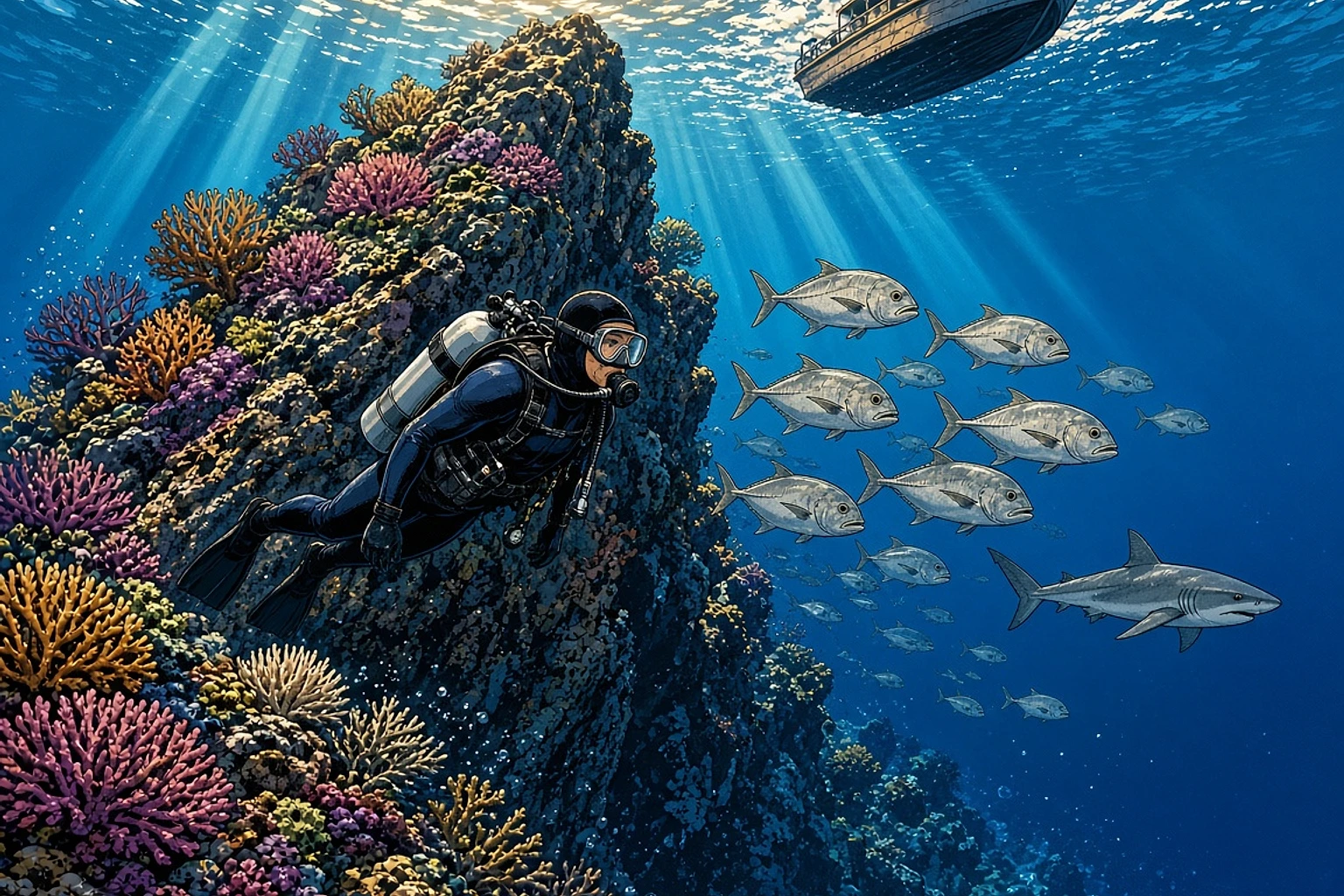
Diving doesn't stop. The main manta site in the central park, Karang Makassar, usually called Manta Point, has its biggest aggregations from about December to February, when the water is full of the plankton they feed on. On a good day it's one of the best manta dives in Indonesia, with very few other boats around. Our guide to swimming with manta rays in Komodo covers how those dives work.
The northern pinnacles, such as Castle Rock and Crystal Rock, are a different story. They're still dived in December, but in January and February the northwest swell makes the crossings uncomfortable and some days rules them out completely. By March, they start reopening in windows between bouts of wind.
Visibility is the honest weak point. Rain washes sediment into the water, and the plankton that draws the mantas also clouds it. Expect roughly 5 to 20 metres, depending on the site and on what the weather did in the previous day or two, against 20 to 30 metres on a good dry-season day in the north.
Water temperature is where sources disagree. Some operators put the whole park at about 27 to 29°C in the wet season, with the cold upwelling in the south only running from June to September. Others report 20 to 25°C in the south from December to February. A 3 mm wetsuit is fine for the central and northern sites. If your trip includes the southern sites, bring a 5 mm suit and a hood, and ask your operator what they're currently seeing.
On land: dragons, Padar and Flores in the rain
The dragons don't mind the rain. They're seen all year on Rinca and Komodo Island, and the walks go ahead with a ranger as usual. March and April are when the year's hatchlings emerge, though they head straight up into the trees and are rarely seen. Go early, when the air is coolest and the trails are driest.
The Padar viewpoint climb is steep, and after heavy rain the dirt steps get slippery. Wear shoes with real grip rather than sandals, and skip the sunrise climb if it's been pouring all night. The reward for a rainy-season climb is that famous view in green instead of brown.
On the Flores mainland, the rainy season brings more landslides and road delays inland, especially in the mountains around Ruteng and on the way to villages such as Wae Rebo. Allow extra time for overland legs, and check our Flores road trip guide before you set off.
February and March in Komodo
February gets less attention than January, but it's very similar: heavy rain, warm water, big manta days at Karang Makassar and a real chance of windy spells that close the northern sites or the harbour. Some operators find the windiest wet-season weeks land in February. It's a good month for flexible divers who want quiet sites and lower rates, and a poor one for anyone with a short, fixed trip.
March is the turning point. Rain is still frequent, but the wind usually eases through the month and the northern sites start coming back. The hills are at their greenest, the visitor numbers are still low, and prices haven't yet climbed to dry-season levels. For a lot of travellers, late March is the sweet spot of the whole wet season.

How the Komodo rainy season works
The pattern repeats every year, even if the dates drift by a few weeks.
1. The wind turns northwest
Around November or December, the dry southeasterly wind gives way to the northwest monsoon. The swell that pounded the south coast all through July and August now hits the north of the park instead.
2. The rain builds
Showers become daily through December and peak in January and February. Most come as afternoon or night storms, so mornings tend to be the most reliable time on the water.
3. BMKG issues maritime warnings
The meteorological agency's marine station in Kupang forecasts wind and wave height for the Komodo waters. When waves are expected to pass about 1.25 to 2.5 metres, the port authority issues notices to captains.
4. The harbourmaster decides each day
Based on those forecasts, the port authority either issues sailing approvals, restricts certain routes, as with Padar and Komodo in September 2026, or closes sailing completely until conditions improve.
5. Operators reroute
On open days, dive guides pick the sites in the lee of the wind. That usually means the central park, including Manta Point, rather than the exposed northern pinnacles.
6. The wind eases
Through March and April, the northwest wind fades, the rain thins out, and by May the dry season is back with full access across the park.
A worked example
A couple who dive book five nights at Komodo Resort in mid February. They land in Labuan Bajo before noon, check in at our town office and take the 12:45 boat to Sebayur. The next morning, the guide picks two central sites in the lee of the wind, Manta Point among them, at IDR 2,500,000 each for the two-dive day. On day three, the northwest wind picks up and the harbourmaster restricts the exposed routes, so they snorkel the house reef instead and rest. On day four, the wind drops and they're back out for three dives. They booked their flight home for the day after checkout, not the same afternoon, so a closed harbour on the last morning would have cost them a night, not a flight.
What to look for in a rainy season trip
The difference between a great wet-season trip and a frustrating one is mostly decided before you fly.
1. A spare day at the end
A closed harbour on your last morning is the scenario that causes the most trouble. Ask yourself: "If no boats sail on my last day, can I still make my flight?" If the answer is no, add a night in Labuan Bajo.
2. A clear weather policy
Operators handle suspensions differently. Ask: "What happens to my booking if the harbourmaster stops sailing on my dates?"
3. Insurance that covers weather disruption
Many policies cover delays caused by official port closures, and some don't. Ask your insurer: "Am I covered for extra nights and missed flights if boats are suspended by the authorities?"
4. A plan B for windy days
A good operator knows which sites stay sheltered in a northwest wind. Ask: "Where do you dive when the north is closed?"
5. Distance to the dive sites
Short crossings matter more when the sea is choppy. Ask how long the boat ride is to the central sites, and whether the boat can turn back easily if the weather changes.
6. The right wetsuit
Rental suits are usually 3 mm. Ask: "What is the water temperature at the sites we'll dive, and do you have 5 mm suits in my size?"
7. Park ticket flexibility
Park tickets are booked online in advance and the park caps visitors at 1,000 a day. Ask your operator whether they handle the tickets and what happens to them if your day is cancelled.
8. Seasickness preparation
Crossings are bumpier in the wet season. If you're prone to it, take tablets before you board, not once you feel ill.
Our Komodo packing list covers rain gear, dry bags and the rest.
How to choose the rainy season for your trip
The wet season suits some travellers very well and others not at all.
Non-divers and snorkellers
Snorkelling works in the rainy season, but visibility is lower and the water can be choppy. If snorkelling is the main goal, the dry season is the safer bet. Our Komodo snorkeling page explains what's possible at each time of year.
First-time divers
Learning to dive is fine in the rainy season, and the central sites are gentler than the northern pinnacles. Expect lower visibility than the brochures show. Our guide to learning to dive in Komodo covers the courses.
Certified divers
Divers who love mantas and quiet sites, and don't mind a rearranged day, get the most from the wet season. Divers who've come for the northern pinnacles at 30 metres of visibility should come in the dry season instead.
Families
Families with fixed school holidays are the most exposed to a closed harbour. If you're coming over Christmas or New Year, build in a spare day. Our Komodo with kids guide has more on planning with children.
Couples
Green hills, quiet beaches and lower rates make the wet season a good fit for couples who want a slower trip. See our Komodo for couples guide for ideas.
Who Komodo Resort is for in the rainy season, and who it is not for
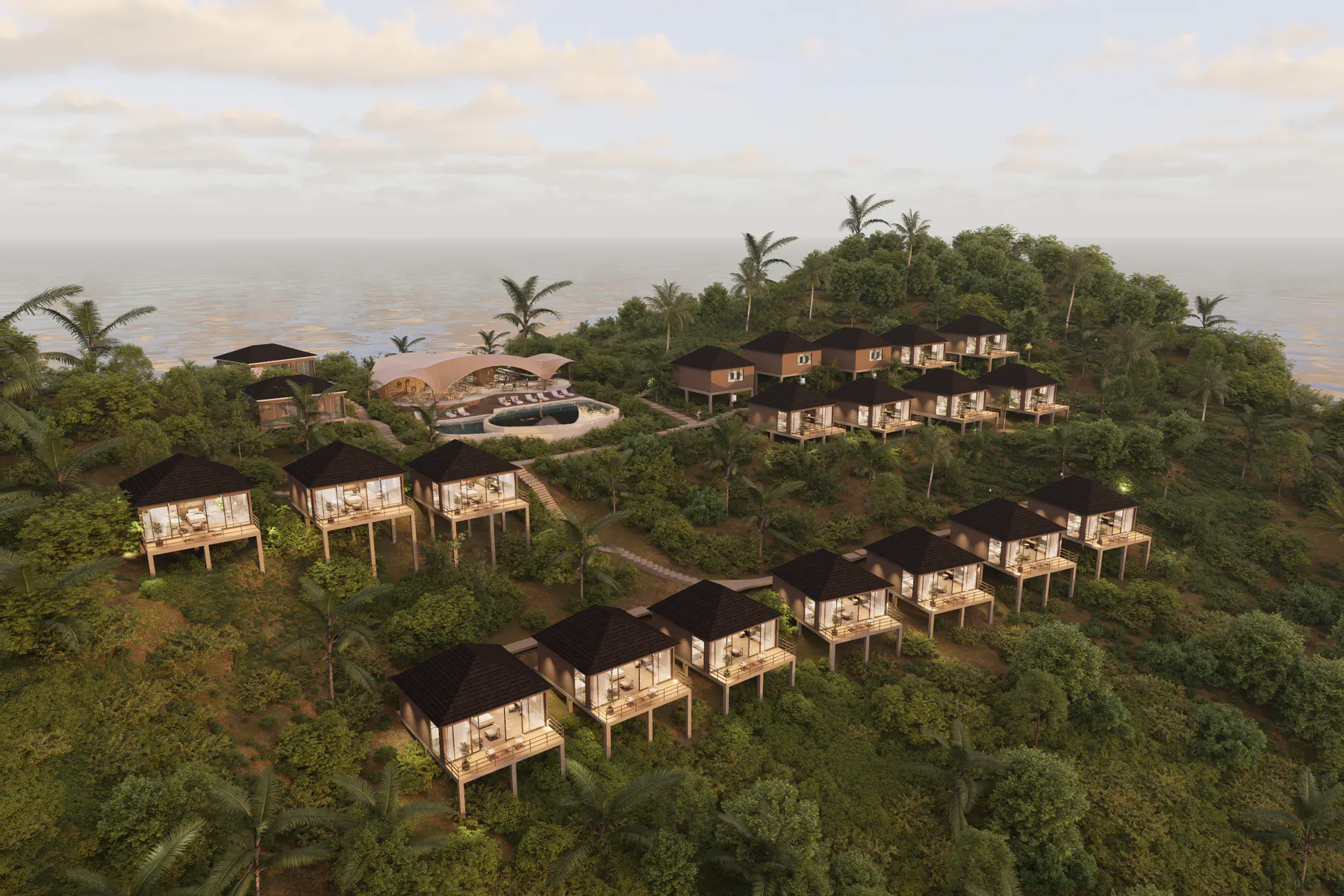
Komodo Resort is on Sebayur Island, inside the national park and about 30 minutes from Labuan Bajo by speedboat. We're open all year, and our rates are lower in the rainy season. Once you're on the island, a windy day is a beach, house reef and spa day rather than a day stuck in town. You can compare the Komodo Resort rooms before you pick dates.
For divers, the central sites are 20 to 30 minutes from our jetty, which means short crossings when the sea is choppy, and the dive centre at Komodo Resort picks sheltered sites on windy days. Diving on the house reef isn't allowed, but snorkelling it with a guide is.
We're not the right choice for everyone in the wet season. If the harbourmaster stops all sailing, our boat transfers stop too, like every other boat in the park. We handle those situations case by case and contact affected guests directly, but we can't override the port authority. If your trip is short, your dates are fixed and the northern pinnacles or Padar are the whole point, come in the dry season instead. And if you want Labuan Bajo's restaurants and bars every evening, a hotel in town will suit you better.
Key takeaways
- Komodo's rainy season is the northwest monsoon, from about December to March, with the heaviest rain in January and February.
- Rain rarely cancels a day. Wind does, and the harbourmaster can stop all boats, as from late December 2025 to late January 2026.
- Manta Point has its biggest aggregations from about December to February, while the northern pinnacles become unreliable.
- Visibility drops to roughly 5 to 20 metres, and water temperatures in the south are disputed, so pack a 5 mm suit for southern sites.
- BMKG expects the 2026/27 season to start late, in December, and to be shorter, peaking in January or February 2027.
- Keep a spare day before your flight home, and check what your operator and insurer do if boats are suspended.