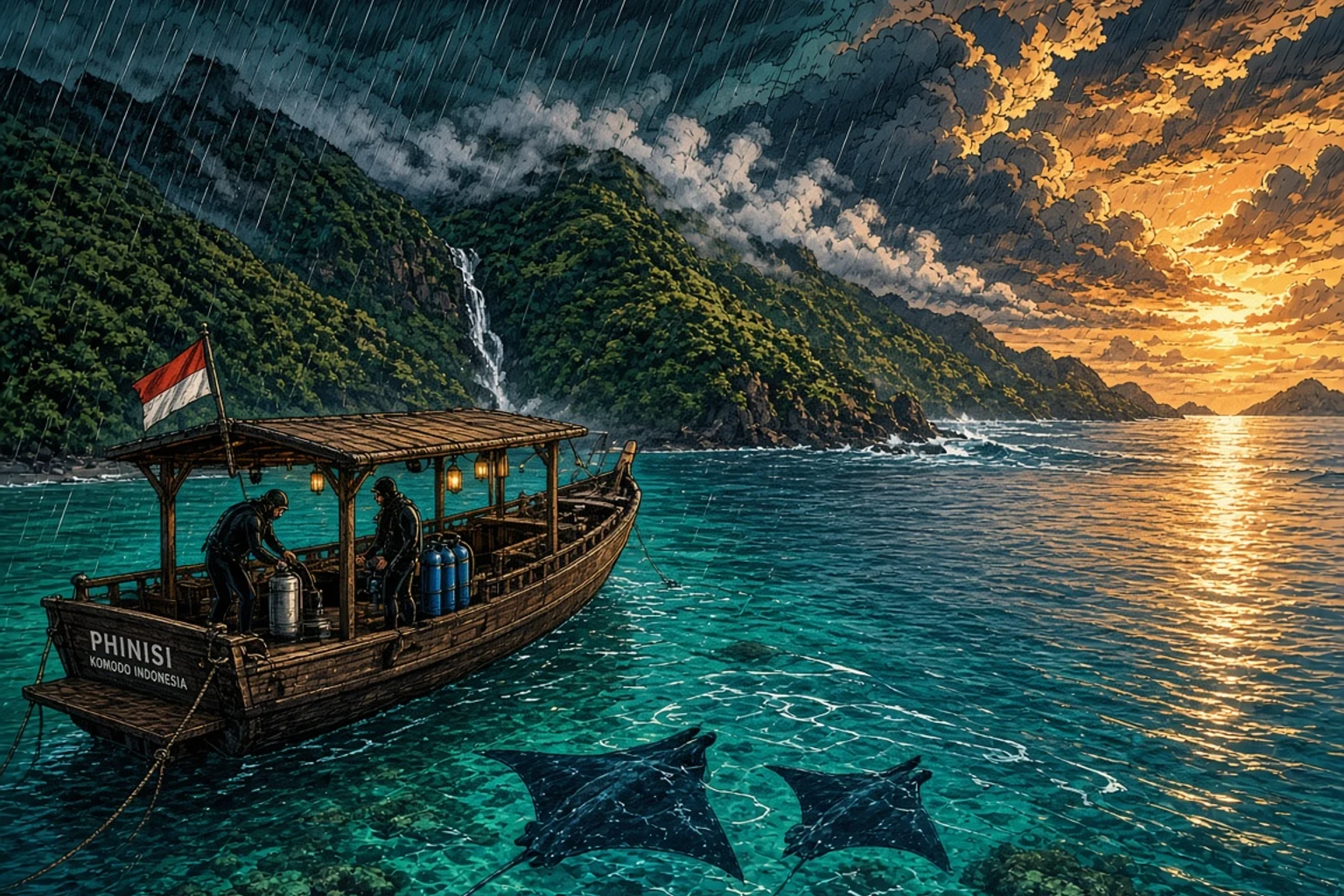
January is the wettest month of the Komodo year, and it is also the month several of us would pick for ourselves. Both of those things are true at once, which is why the advice you find online about it is such a mess. Search for it and you will be told the rainy season ruins the trip, or that it is a secret paradise, and neither is much use when you are trying to decide whether to book. What actually happens in January is more specific and more interesting than either: the wind changes direction, roughly half the famous dive sites stop working, the mantas turn up in numbers, the islands go green, and the park empties out. Plan a Komodo liveaboard around that and January is excellent. Plan the standard dry-season itinerary and expect to be disappointed.
The reason comes down to one fact that most month-by-month guides skip. Komodo sits between two weather systems and the wind flips twice a year. From roughly December to March it blows from the northwest, which is the opposite of the rest of the year. That does not decide whether you can dive, and our Komodo dive centre runs through the wet season the same as any other. It decides where you dive, and the park is compact enough that there is always a sheltered side.
This guide covers what the monsoon does to site access, why the manta answer is more precise than most sources make it, how much rain to genuinely expect and why the published figures disagree so wildly, what January costs compared with August, and the part nobody writes down: who should book a different month instead. I have tried to be straight about the trade-offs rather than sell you a season.
What January Actually Is
Labuan Bajo and the park sit in a tropical savannah climate with two clean seasons. April to November is dry, with southeast trade winds. December to March is wet, with the wind out of the northwest. January is the deepest part of that wet phase, usually alongside February.
Air temperature barely moves across the year. Expect a daytime high around 31°C and an overnight low around 24°C, with humidity up near 87 per cent. It is hot and heavy rather than cold and grim, which is the first thing people get wrong about a tropical wet season. Nobody is shivering.
The rain arrives mostly as short, heavy tropical bursts, frequently in the afternoon or overnight, with clear windows between them. That pattern matters enormously in practice: a two-hour squall that soaks the deck and moves on is a completely different holiday from eight hours of grey drizzle. Genuinely overcast stretches do happen, and late January is often when the monsoon is at its windiest, but the default rhythm is bursts and gaps rather than constant rain.
The North Closes. That Is the Real Trade-Off.
Here is the part that actually changes your trip, and it has nothing to do with getting wet.
Komodo's most famous dive sites are northern pinnacles: Castle Rock, Crystal Rock, The Cauldron. They are exposed to the north, they are dry-season sites, and in January the northwest swell makes them unreliable. Boats often skip them for weeks at a stretch. If your mental image of diving Komodo was built from photographs of grey reef sharks stacked up in blue water on a northern pinnacle, understand that January is not the month that reliably delivers it.
What opens instead is the rest of the park. Central Komodo, including the manta aggregation at Karang Makassar, works essentially all year and becomes the backbone of a January itinerary. The southern bays are sheltered from a northwesterly, so Horseshoe Bay and the sites around Cannibal Rock and Nusa Kode are reachable when the north is not, and in January they are warm rather than cold. Some operators run a central-and-south pattern for the whole month and plan around the weather windows day by day.
Be careful with what you read here, because this is one of the most frequently garbled facts about Komodo. Some published guides state that northern sites are the sheltered ones in January. That is backwards for a northwest monsoon, and it contradicts both the physics and the operators who sail it. If a source tells you to head north in January for shelter, treat everything else on that page with suspicion. Our guide to diving Komodo currents explains why the wind direction and the tide together decide what is divable on any given morning.
The Manta Question, Answered Properly
"Manta season in Komodo" has no single answer, because Komodo has two manta zones running on opposite clocks. Conflating them is the most common error in generic season guides, and it is worth getting right, because it is probably the main reason to come in January at all.
Karang Makassar is January's engine
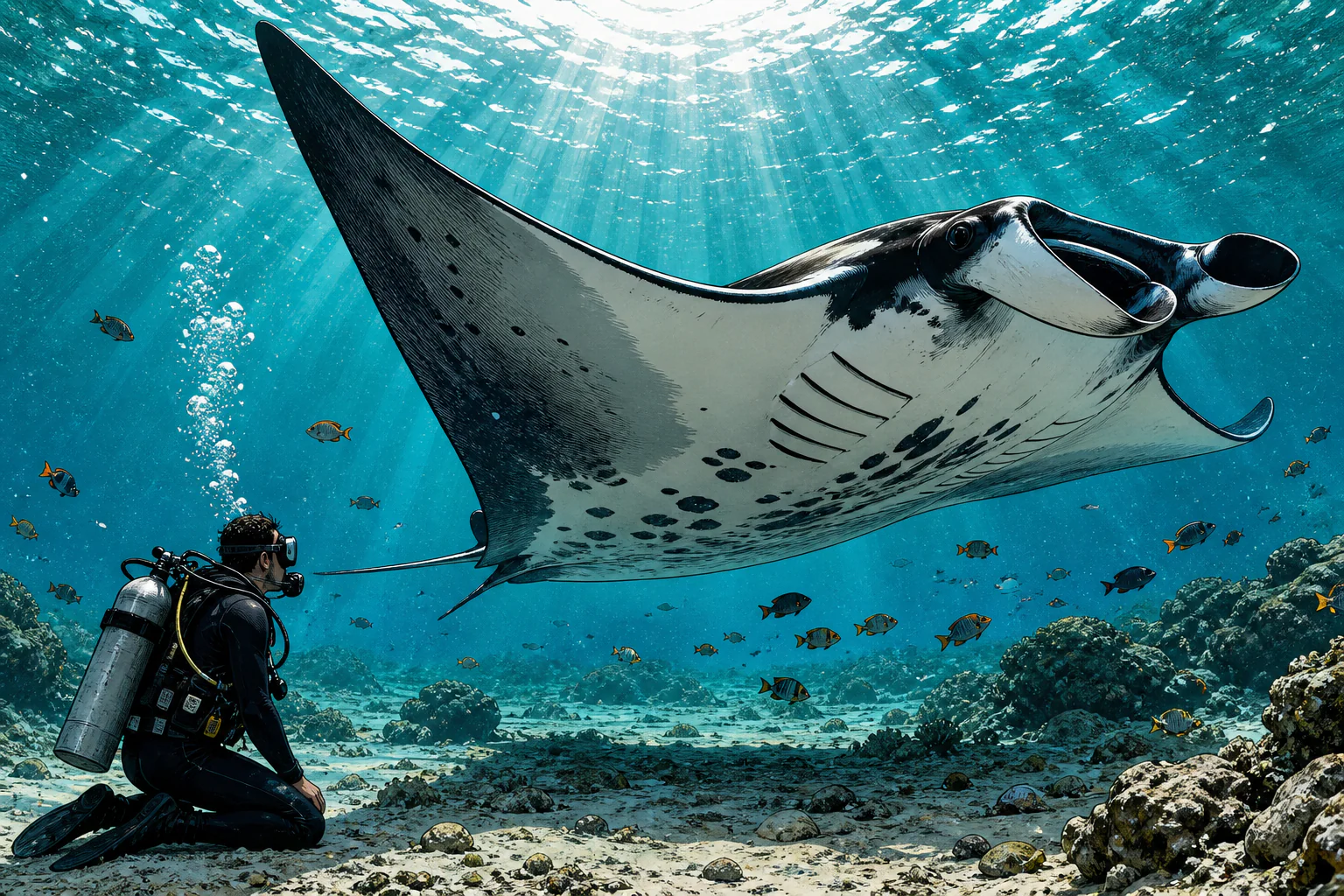
Karang Makassar in central Komodo, usually called Manta Point, is a long, shallow rubble drift where reef mantas come to be cleaned and to feed. It produces sightings essentially year-round, which is why no month is a write-off for mantas here. Its volume peaks in the wet season, roughly December to February, when the water carries more food. On a good January day this is a genuinely spectacular site: warm blue water, mantas passing in numbers over the rubble, and almost nobody else on it.
Manta Alley runs on the other clock
Manta Alley, on the south coast, works the opposite way. It is powered by the dry-season upwelling that pushes cold, green, nutrient-loaded water up the south coast from roughly June to September. That is when Manta Alley earns its reputation, and it comes with water in the low twenties and a moody green cast that underwater photographers either love or fight.
In January there is no upwelling, so the south is warm and blue and Manta Alley is reachable when the sea state allows, but it is not at its peak. If you have read that January is peak season at Manta Alley specifically, that source has merged the two zones.
The practical version: for the best odds of a big manta day in January, you want central Komodo. Our guide to swimming with manta rays in Komodo covers the etiquette, which matters more in a busy aggregation than people expect. And no operator can promise you mantas in any month. They are wild animals following food.
Water, Visibility and What to Wear
Water temperature in January runs about 27 to 29°C across the whole park. This is the one season where that sentence is simple, because the southern upwelling is switched off and the cold water that makes the south so strange in July is absent. A 3 mm wetsuit is plenty. Guests who feel the cold on repetitive days often prefer a 5 mm or a hooded vest, but nobody needs the 7 mm some people pack for a July trip to Manta Alley.
Visibility is the honest weak point. Rain puts runoff and sediment in the water and the plankton that draws the mantas is, by definition, stuff floating in your line of sight. Expect something in the range of five to twenty metres depending on the site and on what the rain did in the previous day or two, against twenty to thirty on a good dry-season day on a northern pinnacle. That is a real reduction and you should factor it in if crystalline water is the point of the trip for you.
It cuts the other way for some divers. Macro life is abundant on the reefs in the wet months, nudibranchs and juveniles especially, and a shorter viewing range pushes your attention onto the reef in front of you instead of into the blue. Photographers shooting close-focus work often prefer these conditions outright, and our guide to underwater photography in Komodo goes through the strobe and lens choices that suit plankton-heavy water.
How Much Rain, Honestly
I want to show you the actual state of the evidence here rather than pick a number that suits the argument.
Published January rainfall figures for Labuan Bajo range from around 235 mm to just over 400 mm, spread across roughly 17 to 21 rain days. Different datasets, different reference periods, different measuring points, and the gap between the highest and lowest figure is nearly double.
The useful conclusion is not a precise millimetre count. It is this: January is reliably the wettest or second-wettest month of the year, it rains on most days, and you should not plan an itinerary that depends on a specific forecast a fortnight out. "Rain on most days, usually in bursts, mostly afternoons" is the planning-grade truth. Anyone quoting you a confident single figure to the millimetre has picked one dataset and not mentioned the others.
What this means on the boat is fairly mundane. You dive wet anyway. Rain during a surface interval is an annoyance rather than a problem, dinghy rides get splashy, and the sun deck is out of action for part of the day. Bring a light rain shell and stop thinking about it.
The Park Never Closes. Your Boat Might.
Komodo National Park does not shut for the monsoon. It is open every day of the year, and no seasonal closure applies in January.
What is decided daily is whether boats leave. The harbour master in Labuan Bajo clears departures each morning based on wind and wave conditions, with captains reading the national marine forecast alongside that. A red flag means nothing sails. In the dry season that check is close to a formality; in January and February it is a real one, and it is the single highest-disruption window of the year. Boats sail happily in light and moderate rain, so a shower does not cancel anything. Wind and swell do.
What to ask before you pay
Four things, and they matter more in January than in any other month:
- Get the weather cancellation policy in writing. Postponed departures are normally rescheduled or refunded, but "normally" is not a contract. Ask specifically what happens if the harbour master stops sailings on your date.
- Build in a buffer day before. Arrive in Labuan Bajo at least a day before your boat leaves. Flights into Labuan Bajo can be delayed, and starting a liveaboard on the morning you land is a bad plan in any month and a worse one in this one.
- Build in a buffer day after. Do not book a departing flight for the evening you get back. Boats come in late for perfectly ordinary reasons, and weather adds to the list.
- Ask how flexible the itinerary is. The right answer in January is "very". An operator who insists the published route runs exactly as printed regardless of conditions is either inexperienced or not being straight with you.
Our Labuan Bajo travel guide covers what to do with those buffer days, which is more than people assume.
What January Costs, and the Two Weeks to Avoid
Green-season pricing is genuinely lower. Charter and cabin rates in the November to March window commonly sit 20 to 40 per cent below peak, and the anchorages are far emptier, which is a saving that does not show up on an invoice at all. Sites that have four boats on them in August can have none.
There is a large exception, and missing it is an expensive mistake. The Christmas to New Year fortnight is not quiet or cheap. It fills boats and Labuan Bajo hotels months ahead at high-season prices, despite falling squarely in the wet season. Chinese New Year does the same, and in 2027 it lands on 6 February, which means January is clear of it, but check the date against your own dates if you are reading this in a later year.
Two smaller things worth knowing. Indonesian domestic public holidays fill boats even in otherwise empty months, so check the national holiday calendar for your dates. And park entrance tariffs are higher on Sundays and public holidays than on ordinary weekdays, so a Tuesday entry can beat a Sunday one on price; the figures are in our guide to Komodo National Park entrance fees.
Put together, the value window in January is roughly the second week onwards, once the New Year crowd has flown home. That fortnight is about as close as Komodo gets to having the park to yourself. For a full budget picture, our breakdown of Komodo Island trip cost covers fees, gear, nitrox and gratuities alongside the headline rate.
The Islands Are Green
The topside change is the part photographs undersell in both directions.
Every famous Padar Island photograph you have seen, the one with three bays and the ridge, was taken in the dry season, when the hills are burnt amber-gold. That is the iconic look, and it is a dry-season look. In January those same hills are green, thick and soft, streaked with cloud and steam after a downpour. Waterfalls run on Flores that do not exist in August. It is a genuinely beautiful and much less photographed version of the same landscape.
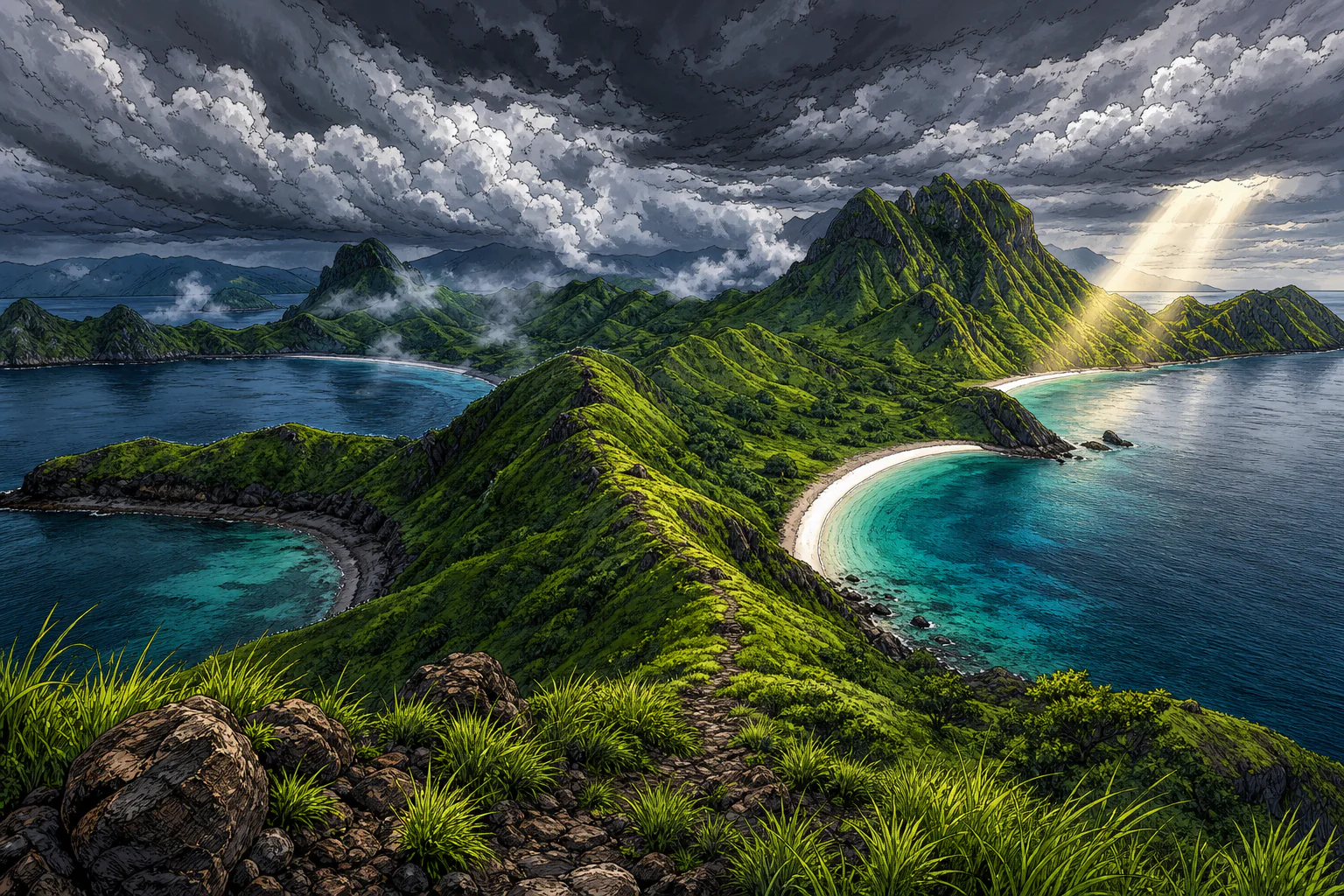
The cost is light and footing. Overcast skies mean flatter light for landscape work, sunrise on the Padar climb is less reliable, and the trail is slippery. Go up in proper shoes rather than the sandals that are fine in August, and start early to use the clearer part of the day. Our guide to hiking in Komodo covers the climbs and the realistic timings.
Dragons and Trekking in the Wet
Komodo dragons are active year-round and January does not change that. They are large ectotherms on islands that stay hot all year, and the rangers walk the trails every day of the season.
What changes is behaviour at the margins and comfort on foot. Dragons will shelter during heavy downpours rather than lie out in the open, so a walk in the middle of a squall is a poorer walk. Trails on Rinca and Komodo Island get muddy and slippery, and the humidity makes an easy hike feel harder than the distance suggests. Morning walks are better in every respect: cooler, more animal activity, and usually ahead of the afternoon rain.
Rinca is the better bet for reliable sightings in most conditions, and the ranger walks there are short. All walking in the park is guided; stay with the ranger and on the path.
Snorkelling and Non-Divers
January is a reasonable snorkelling month with one caveat. The mantas at Karang Makassar are in shallow water and are frequently snorkelled rather than dived, so the headline animal of the season is available to non-divers, and warm water makes long sessions comfortable. Reduced visibility hurts snorkellers more than divers, though, because you are looking down through the murkiest part of the column from the surface.
Pick your days rather than your week. On a clear morning after a dry night, snorkelling in January is lovely; after a night of heavy rain, the same site can be soupy. Our Komodo snorkeling page covers the sites that hold up best, and if you are weighing the two, Komodo day trip explains what a single day out actually buys you.
Seasickness Deserves a Serious Mention
Crossings are sloppier in January than in the dry season. That is the honest version. Northern crossings in particular can be uncomfortable, which is one more reason itineraries stay central and south.
If you are prone to motion sickness, this is the month to take it seriously rather than hope. Take medication the night before rather than when you already feel unwell, choose a lower and more central cabin, and eat something dry rather than nothing at all. Our guide to seasickness on Komodo boat trips goes through what actually works, and it is worth ten minutes before a wet-season booking. A larger vessel rides noticeably better than a small speedboat in a lumpy sea, and in January that difference is worth paying for.
What to Pack for January
Most of the packing list is season-independent, so this covers only what January adds or changes:
- A light rain shell. The single most useful January item. Dinghy transfers, the Padar climb, sitting on deck through a squall.
- A 3 mm wetsuit, not the thicker suit a July south-Komodo trip would justify. Add a hooded vest if you dive four times a day and feel the cold.
- Dry bags, genuinely waterproof ones, for cameras and phones on tender rides.
- Shoes with grip for muddy trails, instead of sandals.
- More dry clothes than you think. Nothing air-dries quickly at 87 per cent humidity, and a damp shirt stays damp.
- Motion sickness tablets, taken preventively.
The complete list is in what to pack for Komodo Island.
Who January Is For, and Who Should Book Another Month
This is the section I would want if I were choosing, so here it is without hedging.
January suits you if mantas are the reason for the trip; if you want warm water everywhere and no upwelling; if you would rather have empty sites than perfect visibility; if you shoot macro; if you want green islands instead of gold; if the lower price matters; or if you have enough days to absorb a weather delay without it wrecking the holiday.
Book another month if this is your first Komodo trip and you want the full classic north-to-south itinerary with the famous northern pinnacles; if visibility is what you are paying for; if you have a rigid schedule with no buffer days; if you are badly affected by motion sickness; or if you are bringing children or nervous first-time divers who will be unsettled by lumpy crossings and changed plans.
For that second group, the honest recommendation is April to June or September to November. May, June and September give the whole park with settled weather and thinner crowds than July and August. If you want the quiet-season logic without the deepest part of the monsoon, Komodo in November makes the case for the warm, calm shoulder, and our overview of the best time to visit Komodo Island compares every month side by side.
A Realistic January Week
What the trade-offs look like as an actual trip, so you can picture it.
You fly into Labuan Bajo in the second week of the month and spend a night in town, because you built the buffer day in. The boat leaves mid-morning after the harbour master clears it. The published itinerary said north on day two; the cruise director says the north is blown out and you are running central and south instead, and you agree because that is the correct call. You dive Karang Makassar twice in three days and on the second visit the mantas are there in numbers, in warm water, with one other boat in sight. Visibility is maybe twelve metres and you stop noticing after the first dive.
You dive the southern bays on a flat morning and spend an hour on black sand finding things the size of a fingernail. It rains hard for two hours on day three and you sit under cover with a coffee and it is fine. You climb Padar at dawn in cloud, get a green ridge instead of a golden one, and take a photograph almost nobody else has. A ranger walk on Rinca in the morning turns up four dragons. You pay maybe a third less than the August version of the same week, and at no point are you queueing behind another group.
That is a good January. It is not the August brochure, and it was never going to be.
The Short Version
January is the wettest month and the northwest monsoon closes the famous northern pinnacles, which is the real trade-off rather than the rain. Central Komodo carries the month and Karang Makassar peaks for mantas now, while Manta Alley in the south belongs to the dry season, whatever the generic guides say. Water is warm at 27 to 29°C park-wide and a 3 mm suit is enough. Visibility drops to somewhere between five and twenty metres. Published rainfall figures disagree by nearly double, so plan for rain on most days in bursts rather than for a number. The park never closes but the harbour master can stop your boat, so get the cancellation policy in writing and put a buffer day at each end. Skip the Christmas and New Year fortnight, and the second half of January is about as quiet and cheap as Komodo gets.
If you are weighing January against another month for a specific trip, get in touch and tell us what you are hoping to see. It is an easier conversation with your dates and priorities in front of us than any month-by-month table can be.