December in Komodo is two different trips wearing one name. Come before about the 20th and you'll pay roughly 20 to 40 per cent under peak, dive sites will be empty, and the southern reefs will be at their best. Come over Christmas and you'll pay full high-season rates in the wettest half of the month. Same destination, same water, completely different holiday. We run our Komodo dive centre right through it, and we watch that switch flip every year.
People ask about December more than any other month, and they've usually already decided. Half are convinced it's a washout. The other half have seen the green-season rates and think they've found a loophole. They're both right, for about three weeks. If you're pricing a Komodo liveaboard to reach the southern sites, know which December you're buying: the gap between the 12th and the 27th can be wider than the gap between November and August.
Below: what the rain really does, why the monsoon hands you the south and takes back some of the north, where the mantas are, what Christmas costs, how the new visitor quota changes the maths, and the one risk nobody's booking page mentions.
Komodo in December at a Glance
| What you're asking | December answer |
|---|---|
| Rainfall, Labuan Bajo | About 300 mm, roughly three quarters of January's |
| Rain days | 19 to 29, depending whose dataset you read |
| Air temperature | 29 to 30°C by day, about 25°C at night |
| Water, north and central park | 27 to 30°C. A 3 mm suit is plenty |
| Water, southern park | 20 to 25°C. You want 5 mm and a hood |
| Visibility, north | 10 to 20 m, down from 25 to 35 m in peak dry season |
| Best diving | The south: Manta Alley, Horseshoe Bay, Cannibal Rock |
| Northern pinnacles | Still diveable, less reliable than October |
| Mantas | Building into the December to February peak |
| Prices, 1 to 20 December | Roughly 20 to 40 per cent below peak |
| Prices, 20 December to 2 January | Full peak, booked months ahead |
| Park permits | Capped at 1,000 visitors a day, booked in advance |
Why December Splits in Two
From the 1st to around the 20th, Komodo is in proper green season. Boats have space. You'll surface at Batu Bolong and find you're the only group on it. Rates sit well under the July and August peak. The rain has turned up but hasn't yet settled into the grey all-day business that January does so well, and the hills have gone green while the mantas build toward their annual peak.
Then the 20th arrives and the whole thing turns over. Those half-empty boats are full, and they were full in March. Labuan Bajo hotels charge high-season rates in the middle of the wet season and fill anyway. Anchorages that held one boat now hold six. The weather, meanwhile, is at its worst point of the month.
So when somebody tells you December in Komodo is cheap and quiet, ask them which half they mean.
How Much Does It Rain in Komodo in December?
Published figures for Labuan Bajo cluster between about 295 and 310 mm. Rain days are where the datasets fall out with each other: one will tell you 19, another insists on 29. That's not sloppiness so much as different stations and different ideas of what counts as a rainy day, and it's worth knowing before you lean too hard on any single number.
What matters more is the shape of the season around it. November sits near 190 mm. December lands around 300. January jumps to roughly 396 and February to about 369. December is the wet season arriving, not the wet season at full strength, and the first week or two can still feel a lot like November.
Temperatures barely shift: 29 to 30°C in the day, about 25°C at night, humidity in the mid eighties. The sea is bath warm, close to 30°C across the north and centre.
Here's the part that surprises people. Rain almost never cancels a dive. You're underwater, and it's raining on the surface, and the two facts have very little to do with each other. Wind is what cancels dives, because wind builds swell and swell makes crossings unsafe. A grey morning with heavy rain and no wind is a fine day's diving. A bright afternoon with a hard northwesterly is the one that keeps the boat tied up.
The Monsoon Arrives and the Park Turns Over
Komodo runs two opposite calendars, and December is changeover month.
Most of the year, the southeast monsoon pushes swell onto the south coast of Komodo and Rinca. That's why Manta Alley and Cannibal Rock are rough to undiveable in July and August, and why the north is at its glassy, 30-metre best in exactly those months.
From around November to March the wind swings northwest and the whole pattern reverses. The south coast drops into the lee and flattens off. Cold, plankton-thick water rises up the southern walls out of the Indian Ocean. The north, meanwhile, starts taking wind swell from an angle it gets no shelter from, and those long runs out to the northern pinnacles turn into work.
December is the first full month of the new arrangement. It isn't the hardest month up north, that's January and February, but the direction has changed and you plan around it.
The South Is the Reason to Come
If December has a headline, this is it. The southern sites are moving into the strongest stretch of their year, and December through February is when they're at their most reliable.
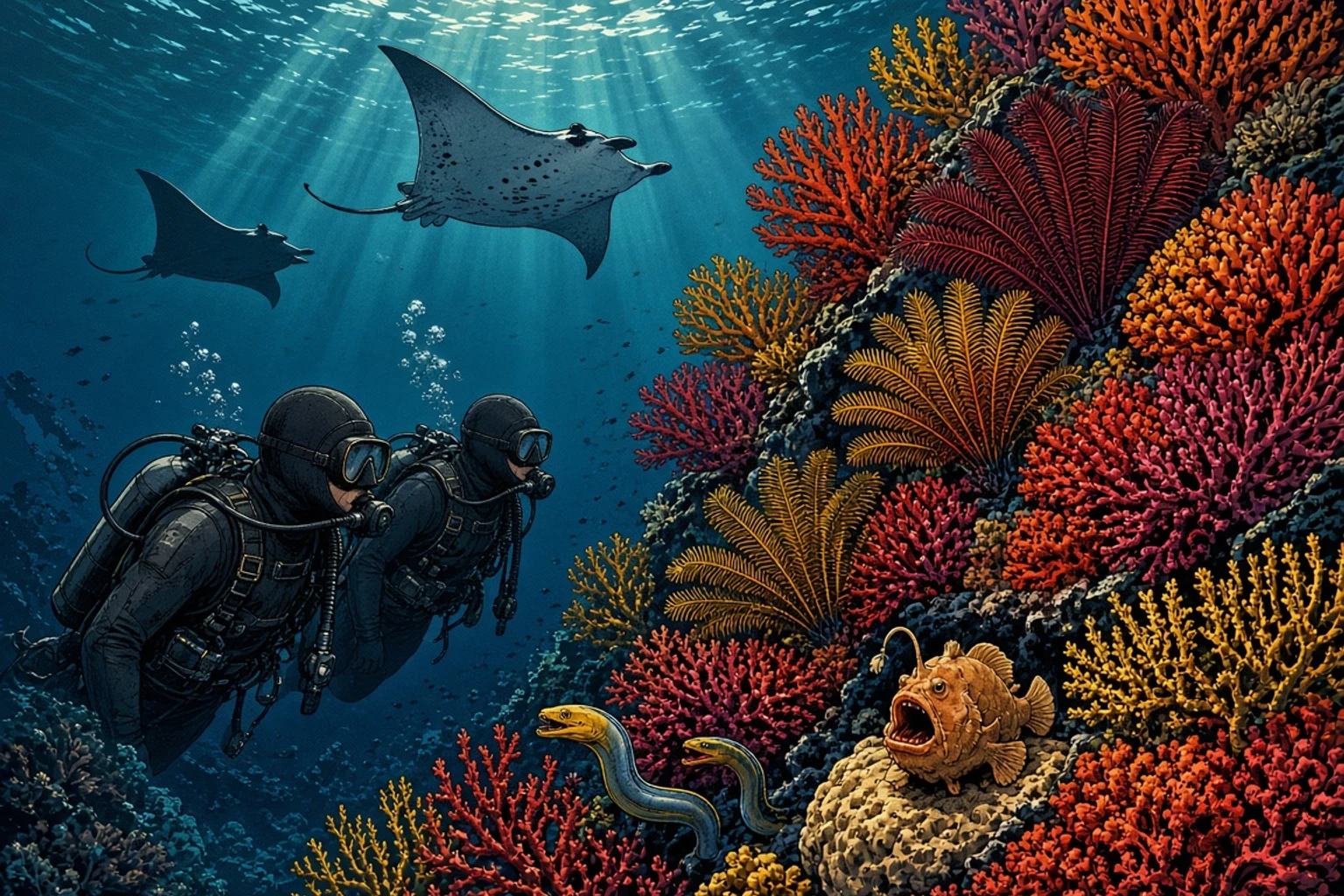
Manta Alley is the one everybody's heard of: a channel on the south coast where reef mantas pile in to feed when the upwelling is running, and in the wet season it runs hard. Horseshoe Bay at Nusa Kode gives you Cannibal Rock and Yellow Wall, which are about as good as Indonesia gets for small strange things. Pygmy seahorses, frogfish, ribbon eels, nudibranchs in a variety that stops being reasonable. Torpedo Alley earns its name after dark.
Two caveats before you build a trip around any of it. One is temperature, and it catches somebody out every single season, so it has its own section below. The other is access: the south is a long way from Labuan Bajo, and in practice you get there on a liveaboard of five days or more, not a day boat. Manta Alley faces open ocean, and most operators want Advanced Open Water and a tidy negative entry before they'll put you in. It's not where you do your fourth ever dive.
Can You Still Dive the Northern Sites in December?
Yes, and this is where December beats January outright.
Read enough Komodo writing and you'll find the northern sites described as shut from December onward. That's overstated. Castle Rock, Crystal Rock, Shotgun and Batu Bolong all get dived through the month. What you lose is reliability. Crossings get uncomfortable, the wind rules out a particular pinnacle on a particular morning, and visibility softens from that peak dry-season 25 to 35 metres down to something more like 10 to 20.
By January and February, losing northern days stops being bad luck and starts being the plan. In December you'll still get them. A well-built December week can put you on both halves of the park, and neither January nor February can honestly promise that.
None of which makes those sites gentle. Castle Rock and Crystal Rock are demanding in any month, down currents are well documented at the edges of Crystal Rock and Batu Bolong, and Komodo's washing-machine reputation was earned precisely there. December doesn't soften them.
Are the Mantas in Komodo in December?
Mantas are here all year. What shifts with the season is how many gather in one place at once, and December sits right at the front edge of the biggest aggregations of the year.
Two quite different experiences hide behind the word manta, and it's worth keeping them apart. Karang Makassar, which everyone calls Manta Point, is a shallow run of rubble and coral in the central park, 8 to 15 metres down. The current does the work. You drift in, settle near a cleaning station, and let them come to you. New divers manage it comfortably, and it works in December.
Manta Alley in the south is a different animal. Colder, deeper, more exposed, and in the wet season capable of numbers that leave a boat oddly quiet on the ride home. The upwelling that makes it happen is the same upwelling that makes it cold, which is not a coincidence you can negotiate with.
If mantas are the whole point of the trip, our guide to swimming with manta rays in Komodo goes much further on timing, etiquette and which site suits which diver.
What Wetsuit Do You Need in December?
Two halves of the park, two different oceans, and this catches more people out than anything else in December.
North and central, you're in 27 to 30°C. A 3 mm suit is ample and plenty of people dive a shortie. It's as warm as Komodo water ever gets.
Go south and the arithmetic changes. The upwelling that pulls mantas into Manta Alley and feeds the reef at Cannibal Rock is cold Indian Ocean water, and it commonly sits between 20 and 25°C, sometimes less, with thermoclines you'll feel on the way down. Call 5 mm the minimum. Most people who dive the south regularly add a hood and a vest, and 7 mm isn't silly if you're someone who feels the cold.
Every season somebody turns up with one thin suit, watches 20°C come up on their computer at Cannibal Rock, and thumbs the dive at thirty minutes. If the south is on your itinerary, bring the thicker suit, or check in advance that your operator has one in your size rather than assuming.
Why the Christmas Fortnight Costs Peak Prices
Everything you've read about December being cheap stops being true around the 20th.
Christmas to New Year fills boats and Labuan Bajo hotels months ahead at high-season prices, in the middle of the wet season, every year. It's the clearest exception to green-season pricing on the calendar, and people book it a year out. A cabin going at 30 per cent off on 10 December goes at full rate on the 27th, and by then the good boats aren't available at any price.
Which means December doesn't have a price. It has two. Before the 20th you're buying green season: lower rates, empty sites, room to change your mind. After it you're buying the most oversubscribed fortnight of the year at peak cost in weather that's wetter than August. High-season crowds and low-season weather in the same week is the worst trade the calendar offers, and it's the one most people accidentally book.
Two smaller things that move money. Indonesian public holidays fill boats in otherwise empty weeks, so check the national calendar against your dates. And park entrance tariffs run higher on Sundays and public holidays than on ordinary weekdays, so a Tuesday entry can quietly beat a Sunday one. The numbers are in our guide to Komodo National Park entrance fees, and for gear, nitrox and gratuities on top of the headline rate, our Komodo Island trip cost breakdown has it.
The Visitor Quota Changes the Christmas Maths
There's a new variable this year, and December 2026 is the first Christmas to meet it.
Since 1 April 2026 the park has run a cap of 1,000 visitors a day, allocated in timed sessions and booked in advance rather than paid at the gate. It covers Padar, Rinca and Komodo islands and the dive sites around them, and Padar carries a tighter limit of its own. Most of the year you'd never notice, because most days don't come near the ceiling.
Christmas is the stretch that does. And a ceiling behaves differently from a price: when the constraint was money, you could always pay more and get on the boat. A quota takes that option away. If your dates land between roughly 20 December and 2 January, treat the park permit as something to lock in early rather than sort out when you land, and book through an operator who handles it rather than assuming you can walk up. Our guide to Komodo National Park entrance fees walks through how the booking system works.
When the Harbourmaster Stops Every Boat
Here's the December risk that no booking page mentions.
When conditions turn, the harbourmaster in Labuan Bajo can stop issuing sailing approvals. No approval, no departure, and it doesn't matter what you paid or how blue the sky looks from your balcony. This isn't hypothetical, and it clusters in exactly the stretch of December most people want to travel.
Late December 2025 is the worked example. A tourist boat went down near Padar on the evening of the 26th. The next day the port authority issued a notice to mariners closing sailings to Komodo and Padar, and on the 29th they widened it to every tourist vessel across West Manggarai waters, speedboats included, with no permits issued until things improved. The fleet sat at the dock over New Year.
None of which is an argument against December. Blanket suspensions are uncommon and most Decembers come and go without one. But if you're booking the Christmas fortnight, put a spare day in the itinerary, buy the travel insurance properly, and have a read of our guide to whether Komodo Island is closed, which sorts out what genuinely shuts the park from what merely sounds like it does. And whatever you do, don't book the flight home for the morning after your last dive.
Where You Stay Matters More in December
In August your base barely matters, because the sea is flat and everything runs. In December the geography starts earning its keep.
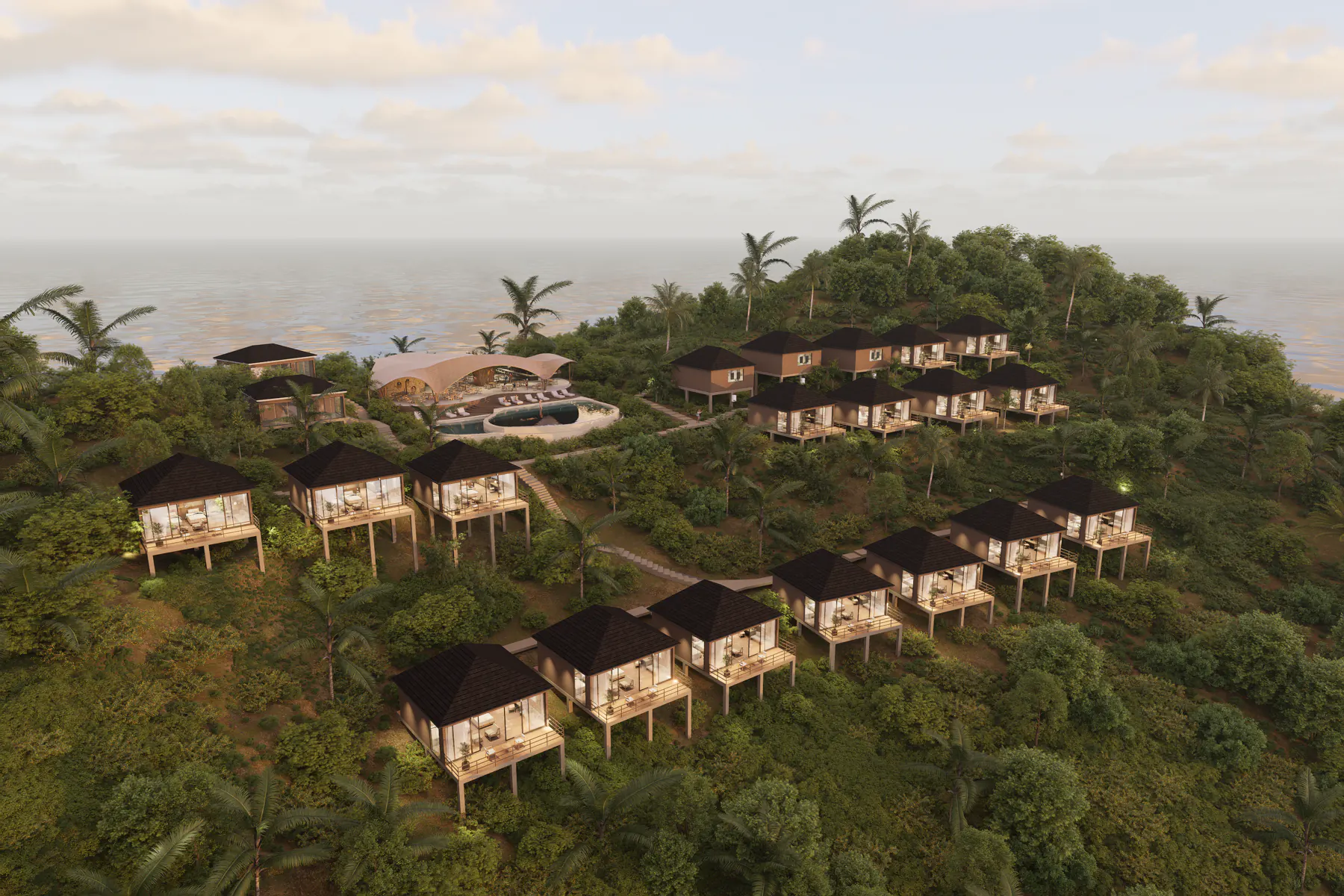
The run from Labuan Bajo out to the park is open water, and it's the part of the day a northwesterly makes miserable. Staying inside the park cuts that exposure right down, and when the weather closes in mid-afternoon there's a real difference between being an hour from shelter and three. It's also the difference between losing the day and just losing the boat dives: our Komodo Resort rooms sit above a house reef you can dive or snorkel straight off the jetty when the crossings aren't worth making.
We should be straight about where that advantage stops. A general suspension of sailing approvals covers everybody, us included, and being inside the park doesn't exempt a boat from a notice to mariners. What it does is delete the daily commute, turn a good number of marginal days back into diving days, and leave you somewhere to get wet that needs no crossing at all.
The Islands Turn Green
Photography undersells this one in both directions.
Every famous shot of Padar, the one with three bays curling away under a ridge, was taken in the dry season with those hills burnt amber and gold. That's the postcard, and it's a dry-season postcard. By December the same slopes are deep green and thick with growth, streaked with cloud, steaming after a downpour. Waterfalls run on Flores in December that simply don't exist in August.
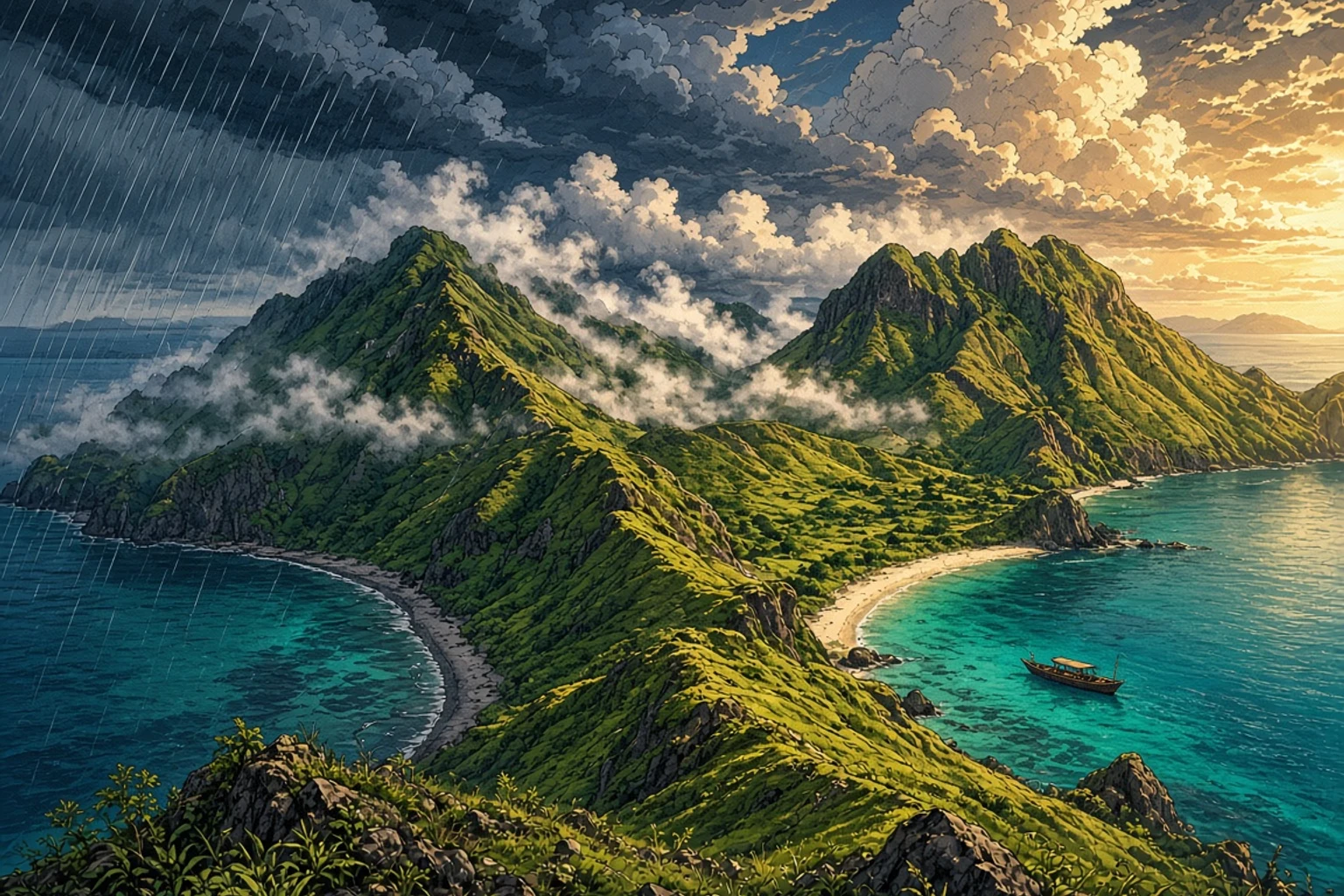
It's a beautiful version of the same view and a far less photographed one. It's also not the version you were sold, and every year one or two people reach the top of that ridge looking mildly cheated that the hills are the wrong colour. Now you know in advance.
Dragons and Trekking in the Rain
The dragons don't care about the rain. December trekking works fine.
What changes is their behaviour and your footing. In the cooler, wetter months they're less inclined to lie about in the open through the middle of the day, so sightings are a shade less predictable than the dry-season parade. The rangers know where they are, and the stations on Rinca stay reliable.
The trails are the real difference. The Padar ridge is steep, exposed and built of loose volcanic ground, and wet volcanic ground is genuinely slick. Proper shoes stop being a nice idea and start being the thing that keeps you upright. Take the early session if you can get it, partly for the light, mostly because you want the walk behind you before the afternoon builds.
Snorkelling and Non-Divers in December
Snorkelling holds up better in December than people expect, with one condition.
The water's warm enough that nobody gets cold, and the central park sites work all month. Visibility is softer than the dry season, 10 to 20 metres rather than 25 and up, and the plankton responsible for that softness is the same plankton bringing the mantas in. Sheltered reefs stay good on days when the exposed crossings aren't worth the fuel.
The condition is wind. Chop ruins a snorkelling day in a way it doesn't ruin a dive, for the obvious reason that you spend the whole time on the surface where the chop lives. If your group includes non-divers, pick a base with sheltered water so a windy afternoon still has somewhere to go. Our guide to Komodo snorkelling covers the sites that hold up in green-season conditions.
And if anybody in the party gets seasick, December is the month to take it seriously rather than gamble. The crossings are rougher than the brochure photos suggest. Our guide to seasickness on Komodo boat trips covers what works, which is mostly preparation and very little heroism.
What to Pack for December
Most of the list is the same as any other month, so here's only what December changes.
- A thicker wetsuit if you're heading south. 5 mm minimum, hood and vest if you feel the cold. The 3 mm that's perfect up north won't get you through Cannibal Rock.
- A real dry bag. Not a splash-resistant one. Decks are wet, tenders are wetter, and December rain arrives by the bucket.
- Two pairs of shoes with grip. Wet volcanic trails on Padar and Rinca are slippery, and one pair won't dry overnight in December humidity.
- A light rain shell. Warm rain still soaks you, and a wet shirt in the wind on a crossing gets cold fast.
- Something that keeps electronics dry. Cameras die of humidity in December as often as they die of rain. Silica packets earn their space.
- Seasickness tablets, taken before you need them. They don't work once you're already green.
Our full Komodo Island packing list covers everything else.
Who December Suits, and Who Should Book Another Month
December is for divers who want the southern sites and the big manta gatherings without signing up for everything January asks of you. It's for anyone who wants green-season prices and empty dive sites and can travel before the 20th. It's for photographers bored of amber hills. And it's for people who've already ticked off the famous northern pinnacles and want the colder, stranger, richer half of the park.
Book something else if you need certainty. Four days, one shot at Komodo, a flight you can't move? The dry-season shoulders, April to June or September to October, will treat you better. If northern pinnacles at 30 metres of visibility are the entire dream, come in July or August and accept the south is shut to you. And if Christmas is the only window you have, come anyway, but come knowing you're paying peak money for wet-season weather, and keep that spare day.
For the months on either side, we've written up Komodo in November and Komodo in January in the same detail, and Komodo in October covers the one month when both halves of the park are properly open at once.
The Short Version
December is two months. Before the 20th it's one of the best-value stretches of the year: green hills, empty sites, manta numbers climbing, the southern park moving into its best window, rates well under peak. After the 20th it's the most expensive and most heavily booked fortnight on the calendar, in the wettest part of the month, and now with a daily visitor quota that can genuinely sell out.
Warm water in the north, properly cold water in the south, so either pack two wetsuits or pick a half. The north isn't shut the way it will be come January. Rain won't cancel your diving but wind will, and in a bad spell the harbourmaster can stop every boat leaving Labuan Bajo, which is exactly why you want a spare day.
Come in the first three weeks if the choice is yours. If it isn't, come anyway, book early, and leave the morning after your last dive completely empty.