Twenty metres down, with a regulator in your mouth and a manta ray gliding overhead, you cannot say a single word. Everything you need to tell your buddy, from "look at that" to "I have a problem", travels through your hands. Scuba diving hand signals are the shared language of divers everywhere, and learning them properly is one of the fastest ways to feel confident underwater. At our dive center, they are among the first things we teach, and among the first things we review with every certified guest, because clear communication is the backbone of a safe, relaxed dive.
The good news is that the core vocabulary is small, standardised, and easy to remember. A couple of dozen signals cover almost every situation you will meet, whether you are doing your first reef dive or spending a week on a Komodo liveaboard with four dives a day. In this guide we walk through every signal that matters: the essentials every diver must know, air and gas communication, emergency signals, the marine life signals you will actually use in Komodo, the current-diving signals unique to places like this, and how communication changes at night. By the end, you will be able to hold a complete underwater conversation without a sound.
Why Divers Talk With Their Hands
Sound behaves strangely underwater. It travels more than four times faster than in air, which makes it nearly impossible for your brain to work out which direction a noise came from. Add a regulator between your teeth and a hood over your ears, and speech is simply off the table. Some professionals use slates, wet notes, or even electronic communication gear, but for everyday recreational diving, hands beat every alternative: they are always with you, they work at a glance, and they cost nothing.
Hand signals in recreational diving are largely standardised thanks to the training agencies. PADI, SSI, CMAS, and the rest teach a common core, so a diver certified in Mexico can buddy up with a diver certified in Japan and understand them immediately. That said, small regional variations exist, and dive guides often invent local signals for specific animals. This is exactly why every good dive briefing includes a review of the signals the guide will use. Listen during the briefing, even if you have two hundred dives. It takes thirty seconds and removes every ambiguity before you hit the water.
One principle sits above all the individual signals, and we repeat it in every course: every signal is a question that needs an answer. When your buddy signals "OK?", you respond, either with "OK" or with whatever is actually wrong. When your guide signals "turn the dive", you repeat the signal back. Confirming a signal closes the loop and tells the sender you both saw it and understood it. Most underwater misunderstandings are not caused by wrong signals; they are caused by signals that were never acknowledged.
The Essential Signals Every Diver Must Know
These are the signals taught in every entry-level course on the planet, and the ones you will use on literally every dive.
OK and Not OK
The most important pair in diving. OK is a circle made with thumb and index finger, the remaining three fingers extended. It means both "I am fine" as a statement and "are you fine?" as a question. Do not confuse it with a thumbs-up, which means something completely different underwater. Something is wrong is a flat hand rocked side to side, palm down, like an exaggerated "so-so" gesture. It is always followed by pointing at the source of the problem: your ear if you cannot equalise, your mask if it is flooding, your leg if you have cramp.
Up and Down
Thumbs-up means ascend, or "let's end the dive". It never means "great job". This is the single most common beginner mistake, and the reason instructors drill it so hard. If a dolphin swims past and you flash a cheerful thumbs-up at your guide, you have just told them you want to go up. Thumbs-down means descend, used at the start of the dive or when moving deeper along a wall or slope.
Stop, Slow Down, and Level Off
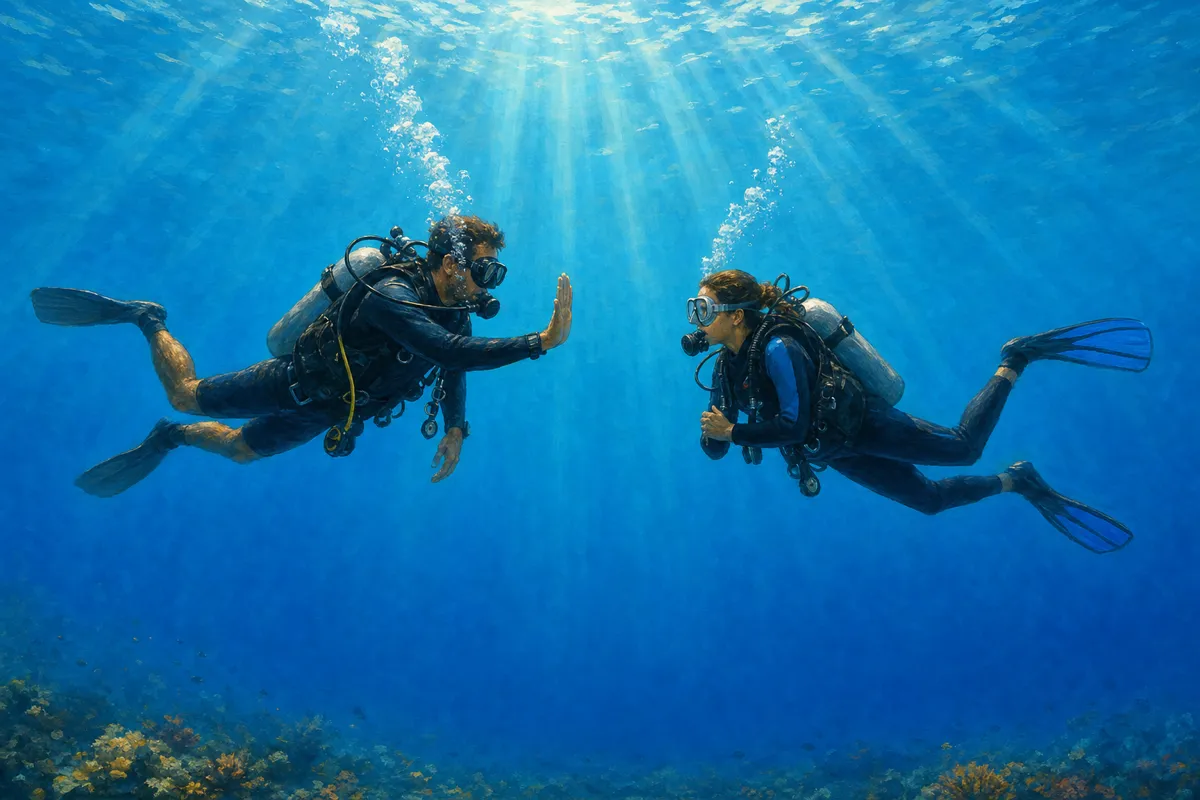
Stop is a flat palm facing your buddy, fingers up, exactly like a traffic officer. Hold it until they respond. Some agencies also teach a raised fist for "hold position", borrowed from technical diving. Slow down is a flat hand patting downward gently, palm to the seabed. You will see guides use it constantly with excited new divers who fin like they are late for a meeting. Level off is a flat hand moving horizontally side to side, meaning "stay at this depth", commonly used when reaching the planned maximum depth or settling in for a safety stop.
Look, Come Here, and Buddy Up
Look is two fingers pointing at your own eyes, then pointing at the thing to see. Simple and endlessly useful. Come here is a hand beckoning toward yourself. Buddy up or "stay together" is two index fingers held side by side, and guides use it when a pair starts drifting apart. If your guide points at you, then at another diver, then presses their two index fingers together, they are reassigning buddy pairs mid-dive, something that happens on group dives when photographers lag behind.
Which Direction, and Turn the Dive
Direction is communicated by simply pointing with a flat hand rather than one finger, which reads more clearly at distance. Turn the dive is an index finger drawing a horizontal circle, or a single finger twirled upward, meaning we reverse course and head back. On drift dives in Komodo you will rarely see it, because the current decides the route, but on reef dives from the beach it marks the halfway point of your air plan.
Talking About Air: Pressure Checks and Numbers
Air communication is where hand signals stop being safety theatre and start being arithmetic. Your guide will ask for your remaining pressure several times per dive, and you need to answer accurately without hesitation.
How much air do you have? is signalled by tapping two fingers on the opposite palm, or in some regions tapping the pressure gauge itself. The answer uses numbers. The most widespread system works like this: each extended finger held upright counts as ten bar, and a clenched fist counts as fifty. So a diver showing a fist followed by three fingers has 80 bar. Another common system shows hundreds first with one hand, then tens with the other: one finger then five fingers reads 150 bar. Both systems work; the briefing tells you which one your guide uses. If you dive in PSI, the convention is to signal thousands and hundreds the same way.
Two air signals are non-negotiable and identical everywhere. Low on air is a clenched fist against the centre of the chest. It is not an emergency; it means "I have reached the reserve we agreed on, plan the ascent". Out of air is a flat hand slashing across the throat. That one is an emergency, and the correct response is to offer your alternate air source immediately. Modern training drills this exchange until it is automatic, and if yours has gone rusty, a refresher session in calm water is the easiest fix there is. Our team runs refreshers every week for guests who have not been underwater in a while, usually right on the house reef in front of the resort.
Safety stop is a flat hand held horizontally with three fingers of the other hand beneath it, meaning "three minutes at five metres". Your computer counts it down, but the signal coordinates the group so everyone stops together rather than scattering across the water column.
Emergency Signals: the Ones You Hope Never to Use
Emergencies underwater are rare, and almost every serious one begins as a small problem that was communicated late. These signals exist so problems get shared while they are still small.
- Out of air: hand slashing across the throat, as above. Followed immediately by air sharing.
- Share air / give me air: a hand miming bringing a regulator to the mouth, sometimes preceded by the out-of-air slash. Your buddy donates the alternate regulator, you both stabilise, then ascend together.
- Cramp: a fist opening and closing, then pointing at the muscle. The fix is a stretch your buddy helps with, usually extending the fin tip while you hold the knee straight.
- I am cold: arms crossed over the chest, hands rubbing the upper arms. Being genuinely cold degrades judgement and burns air, so this signal legitimately ends dives.
- Entangled / cut: two fingers of one hand scissoring, or pointing at the entanglement. Stay still, let your buddy do the work; twisting usually makes it worse.
- Dizzy / vertigo: a finger circling beside the head. The response is physical contact, a fixed visual reference, and a controlled pause until it passes.
At the surface, the vocabulary changes because distance changes. A diver far from the boat signals OK with both arms curved overhead to form a large ring, or with one arm touching the top of the head if the other hand is holding something. Distress at the surface is one or both arms waving overhead, and it means "I need help now". Boat crews everywhere treat a waving arm as an emergency, which is why you should never wave casually at the boat from the water, however friendly you feel. If you want the full picture of how surface protocols work on multi-day trips, our first liveaboard guide covers boat procedures in detail.
Marine Life Signals You Will Actually Use in Komodo
This is the fun chapter. Divers have invented signals for almost every animal in the sea, and a good guide's briefing in Komodo always includes the local favourites, because this is a destination where the animals show up on cue.
- Manta ray: both arms sweeping slowly up and down at your sides, mimicking wing beats. You will use this one at Manta Point more than anywhere else in your diving life. If mantas are the reason you are coming, read our guide to swimming with manta rays in Komodo for the where and when.
- Shark: a flat hand held vertically against the forehead, like a fin. In Komodo this signal comes out constantly for whitetip and blacktip reef sharks, and our overview of the sharks of Komodo explains every species behind it.
- Turtle: two flat hands stacked, thumbs rotating like paddles. Green and hawksbill turtles are daily sightings on sites like Siaba Besar.
- Octopus: a hand held palm down with fingers wiggling downward like tentacles.
- Lionfish: fingers of both hands interlaced and spread, mimicking the fan of venomous spines. It doubles as a gentle "look, don't touch" warning.
- Nudibranch: guides improvise here; the most common version is two fists together with index fingers curling forward like rhinophores. Expect it often if you dive the critter-rich south of the park.
- Stonefish / scorpionfish: a fist placed on the back of the opposite flat hand. This one matters, because it means "well camouflaged venomous animal, control your buoyancy and your knees".
Animal signals are more than entertainment. They direct attention efficiently, which is half the craft of guiding. A guide who signals "turtle, eleven o'clock, look" with three quick gestures has just saved you from scanning the entire reef and missing it. If you are still working on your fish identification, our guide to the wildlife of Komodo National Park pairs nicely with the signals above.
Current Diving Signals: Komodo's Local Dialect
Komodo sits between two oceans, and the tidal flow between the islands creates the currents that make the diving here world class. Diving in current has its own vocabulary, and if you have only ever dived calm bays, these signals may be new to you. They will all be covered in your briefing, and our guide to Komodo's dive sites explains where and why the current matters site by site.
- Current direction: a flat hand pushed steadily in the direction of flow, sometimes with the other hand indicating strength.
- Hook in: a curled index finger, mimicking a reef hook. Used at sites like Castle Rock and Crystal Rock where you secure a reef hook to bare rock and watch the sharks hunt in the flow.
- Unhook / release: the same curled finger flicked away.
- Stay close to the reef: a flat hand pressed downward toward the coral, meaning tuck in where the friction slows the water.
- Cross the current: a flat hand cutting perpendicular to the flow direction, used when the group needs to ferry across to a pinnacle.
- Free drift: both hands open and relaxed, floating with the flow, the signal that the working part of the dive is done and the lazy river section has begun.
Current signals demand faster acknowledgement than reef signals, because the water is moving you while you think. When a guide signals "hook in" at Castle Rock, the window to act is seconds, not minutes. This is one of the reasons we match guests to sites carefully based on experience, and why conditions get their own section in our guide to scuba diving in Komodo National Park.
Night Diving: When Your Hands Disappear
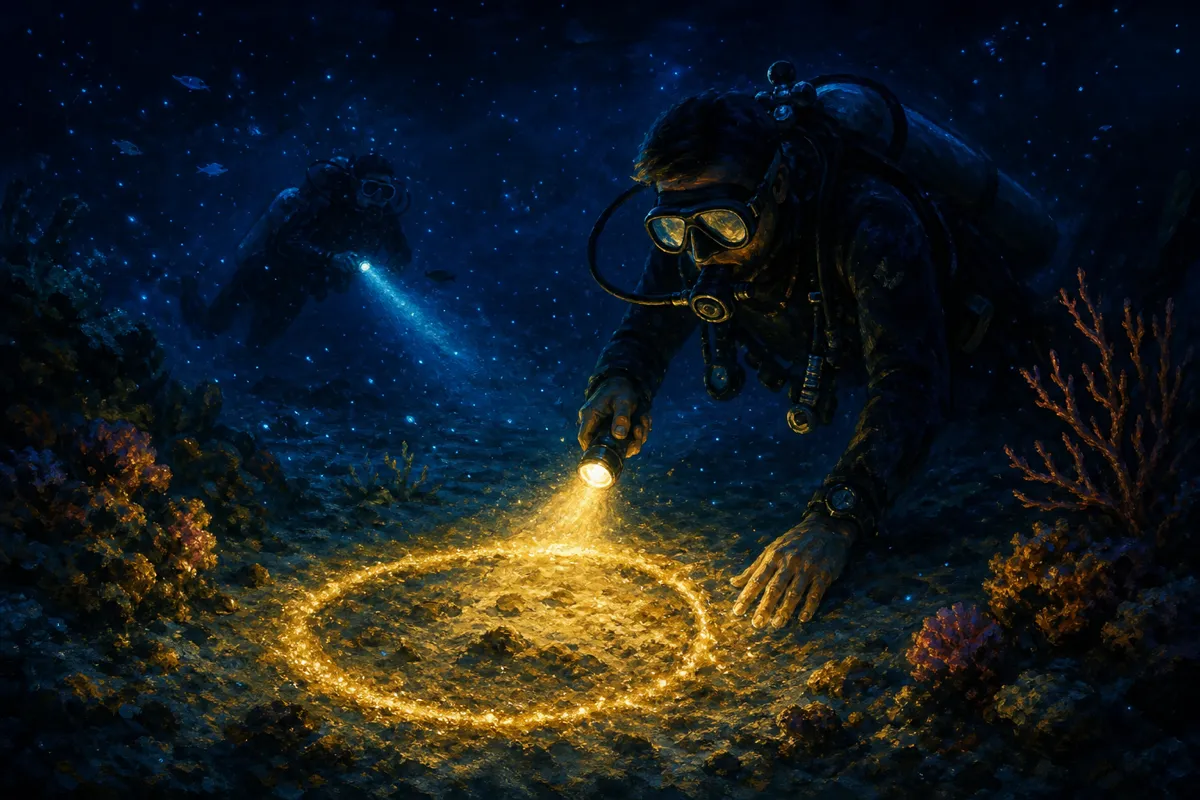
On a night dive, hand signals have an obvious problem: nobody can see them. The solution is elegant. Your torch becomes your voice.
The two core light signals are simple. A slow circle drawn with your torch beam on the reef or in open water means "OK", both as question and answer. A rapid side-to-side shake of the beam means "attention, something is wrong". The distinction between a lazy circle and an urgent shake is unmistakable even at distance, which is exactly the point. For everything more detailed, you shine your torch onto your own hand and make the normal signal in the pool of light, being careful never to aim the beam into anyone's eyes. A blinded buddy cannot read any signal at all.
There is also a quiet etiquette to light at night: keep your beam low and moving slowly, cover it with your palm when you want darkness for bioluminescence, and use the reef, not other divers, as your signalling backdrop. Night dives on the house reef are one of the highlights of a stay here, with Spanish dancers, hunting lionfish, and sleeping turtles, and the light discipline is half of what makes them magical.
How to Practise Until It Is Automatic
Reading about signals is one thing. Producing the right one instantly, at depth, with task loading, is another. A few habits make the vocabulary stick fast.
Rehearse the conversation, not the catalogue. Signals live in exchanges: "OK?" gets "OK", "how much air?" gets "120 bar", "turn the dive" gets a repeated "turn the dive". Practise with your buddy on the surface before every dive, running the six or eight exchanges you will actually have. It takes two minutes on the boat and pays for itself on every dive of the trip.
Learn the numbers cold. Air pressure is the one conversation where a mistake has consequences. Quiz each other: flash a number, get the answer, swap. If you can read "fist plus four fingers means 90 bar" as fast as you read text, you are done.
Take a course, or take a refresher. Every course from beginner upward layers on communication skills, and nothing beats practising with an instructor watching. If you are starting from zero, our guide to learning to dive in Komodo walks through the whole journey, and if you just want a taste before committing, here is what a first try dive in Komodo looks like. Certified divers who have been dry for a year or two get the most value from a one-hour refresher, and the skills come back astonishingly fast.
Watch the guides. Professional dive guides are fluent in a way no course can teach, compressing whole briefings into three quick gestures. On your next guided dive, watch how economical their signalling is, how they always confirm, and how they position themselves so the whole group can see their hands. It is a free masterclass on every dive.
Common Mistakes, and How to Avoid Them
After thousands of guided dives, our instructors see the same handful of communication errors over and over. All of them are easy to fix once named.
- The congratulatory thumbs-up. Covered above, but worth repeating, because it genuinely ends dives early. Underwater, applause is a clapping motion or a double OK, never a thumb.
- Signalling without eye contact. A perfect signal nobody saw is silence. Get your buddy's attention first: a tank banger, a rattle, or a gentle wave in their field of view, then signal.
- Not confirming. A nod is not a confirmation; masks and hoods hide nods. Answer signals with signals.
- Making up vocabulary mid-dive. Interpretive dance about a boat propeller you saw is entertaining but useless. If no signal exists, point, or save the story for the surface interval. This is also why underwater photographers, who spend dives half-distracted, should agree on extra signals beforehand; our underwater photography guide includes the photographer-buddy protocol.
- Gloved ambiguity. Thick gloves blur the difference between three and four fingers. In cold water or with gloves on, exaggerate every signal and slow down.
- Signalling too fast. Underwater, slow reads as clear. A deliberate signal held for two seconds beats three rapid ones every time.
A Shared Language, and Where to Speak It
There is something quietly wonderful about a language spoken by millions of people who have often never exchanged a word on land. A diver from Buenos Aires and a diver from Osaka can plan an ascent, share a manta sighting, and split the last fifty bar of a dive plan without a syllable in common. The vocabulary in this guide is all you need to join that conversation, and one honest week of diving will make it second nature.
And if you are going to practise a language, practise it somewhere worth talking about. The reefs of Komodo give you more to say per dive than almost anywhere on earth: mantas at cleaning stations, sharks stacked in the current, turtles asleep under table corals, and walls of fish that turn the water into weather. Whether you base yourself at the resort with the dive center handling your daily boats, or go all-in on a liveaboard week, your hands will be busy. We look forward to hearing what they have to say.