Batu Cermin is a limestone cave about 4 km from Labuan Bajo, full of fossil coral and shells. Entry is IDR 50,000 for foreign visitors, it opens at 09:00, and the famous "mirror" light needs a sunny morning, roughly 09:00 to 11:00.
Batu Cermin is the closest real sight to Labuan Bajo's airport and harbour, and the easiest one to fit around boats and flights. It takes about an hour, costs less than a coffee and a cake in town, and asks nothing of you except that you turn up on a sunny morning. For anyone who comes to Flores for Komodo National Park tours, it's the land trip that costs the least time.
It suits divers especially well. The cave sits about 75 metres above sea level, so there's no altitude to worry about after a week with our Komodo dive centre, and it's a few minutes from the airport on the day you fly. It also fits the new shuttle times between our island and town better than almost anything else on the mainland.
The catch is timing. The light effect that gives the cave its name lasts a short window and needs direct sun, and most of the disappointing reviews come from people who arrived in the afternoon or under cloud. Get that one thing right and it's a lovely, odd, slightly claustrophobic hour.
What is Batu Cermin cave?
Batu Cermin cave is a limestone cave on the edge of Labuan Bajo whose walls hold fossils of sea life and catch sunlight like a mirror.
- Fossil coral and shells
- Narrow, low passages
- A sunlit mirror chamber
- A guided walk underground
The visit depends on the sun: on a clear morning a beam drops through a gap in the rock and lights the walls.
You can fit it in:
- On the first or last morning of a Komodo island vacation
- Between a flight and a tour of Komodo National Park
Plan about an hour on site, arrive soon after 09:00, and bring cash.
Batu Cermin vs Rangko Cave: what's the difference?
Batu Cermin
A dry limestone cave on the edge of town, explored on foot with a guide, a helmet and a torch. Its light show happens on a sunny morning, and there's nothing to swim in.
Rangko Cave
A sea cave on the coast north of town, reached by road and then a short boat ride, with a clear saltwater pool you swim in. Its light falls around midday and depends on the tide as well as the sun.
- Key distinction: Batu Cermin is a short walk-through visit near the airport; Rangko is a half-day swim with a boat crossing.
- What it means for you: they peak at different times of day, so you can see both in one day, Batu Cermin first. Our Rangko Cave guide covers the second half.
Where is Batu Cermin, and how do you get there?
Batu Cermin is in the village of the same name, in the Komodo district of West Manggarai, about 4 km east of the town centre. From the harbour it's 10 to 20 minutes by car, depending on traffic on the main road. From Komodo Airport it's even closer, about 5 to 8 minutes, which is why it works so well on travel days.
The cave is a lone limestone hill rising out of a flat, built-up suburb. You won't see much from the road. The gate opens onto a car park with a ticket office, and the cave itself is about 300 metres further on, up a path shaded by arching bamboo. It's an easy walk, but it's the bit people forget to budget for.
By ride app or ojek
Grab and Gojek both work in Labuan Bajo, and a trip from town costs about IDR 15,000 to 30,000. A motorbike taxi is the cheapest option and every driver knows the place. For the ride back, book from the car park when you come out of the cave, and allow a few minutes for a driver to arrive.
By car with a driver
If you've hired a car for the day, about IDR 400,000 to 1,000,000, make Batu Cermin the first stop. It's on the edge of town, so it adds almost no driving to a day heading to Rangko or the hills. Our guide to getting around Labuan Bajo covers the apps, taxis and hiring a driver.
On foot
From the town centre it's about 40 minutes on foot along a busy road, mostly without a pavement, in heat that's already strong by 09:00. We wouldn't. A ride costs a couple of dollars.
By scooter
There's parking for around a hundred motorbikes. If you rent one, you'll need an International Driving Permit that covers motorcycles, and the main road out of town is busy with trucks.
What's inside: fossils, passages and the mirror chamber
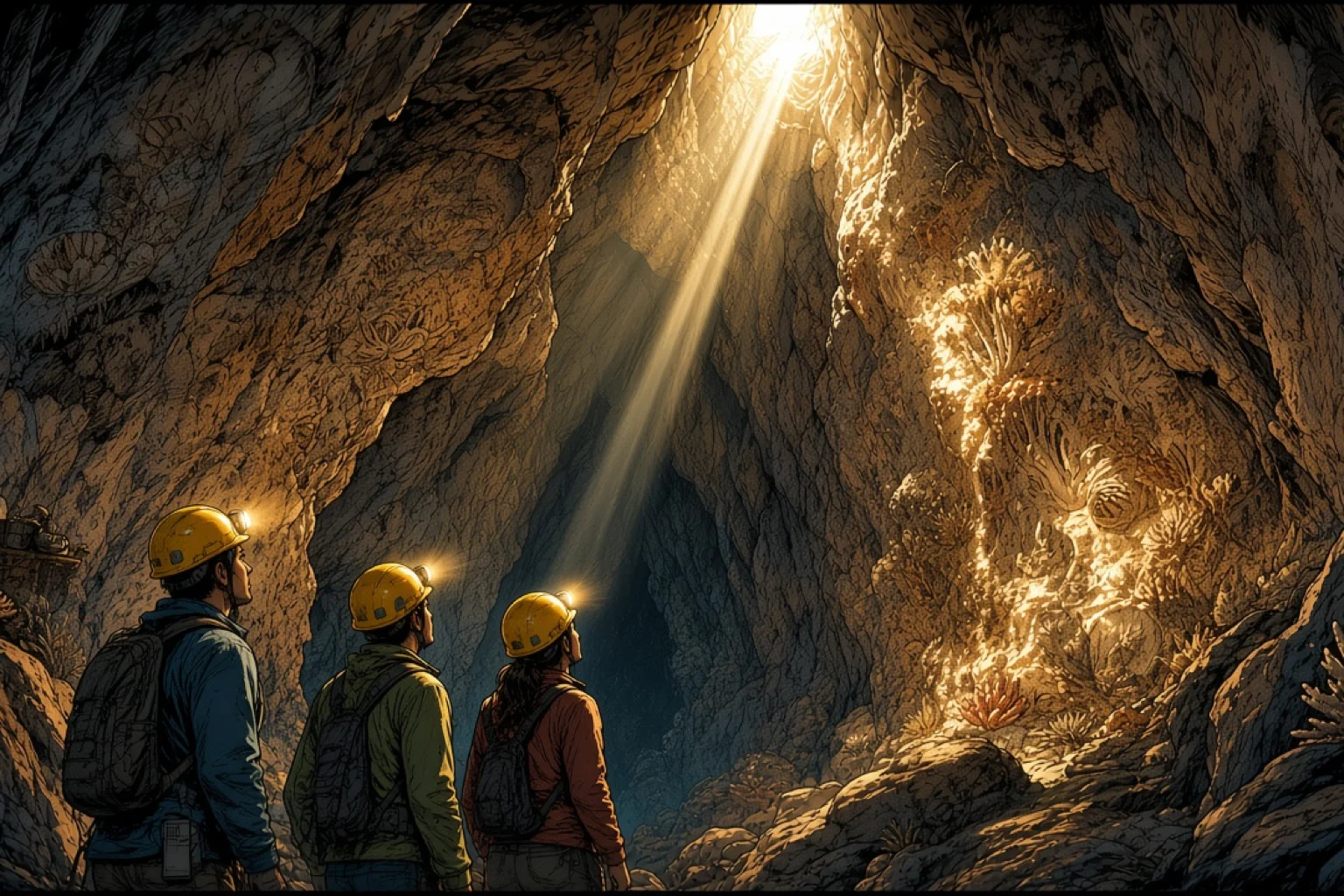
The hill is limestone, and limestone is mostly the remains of things that lived in the sea. That's the story the guides tell, and it's broadly right: the rock formed underwater, tectonic movement lifted it out of the sea, and rainwater dissolved the cave out of it long afterwards. The fossils are embedded in the rock itself, which is why you find them in the ceiling as well as the walls.
Inside, there's about 200 metres of passage. Some of it is roomy, with a concrete path and wooden or concrete steps. Some of it isn't: there are low sections where you stoop for a dozen metres or so, and squeezes where you turn sideways. The helmet you're handed at the start earns its keep within the first few minutes.
The fossils
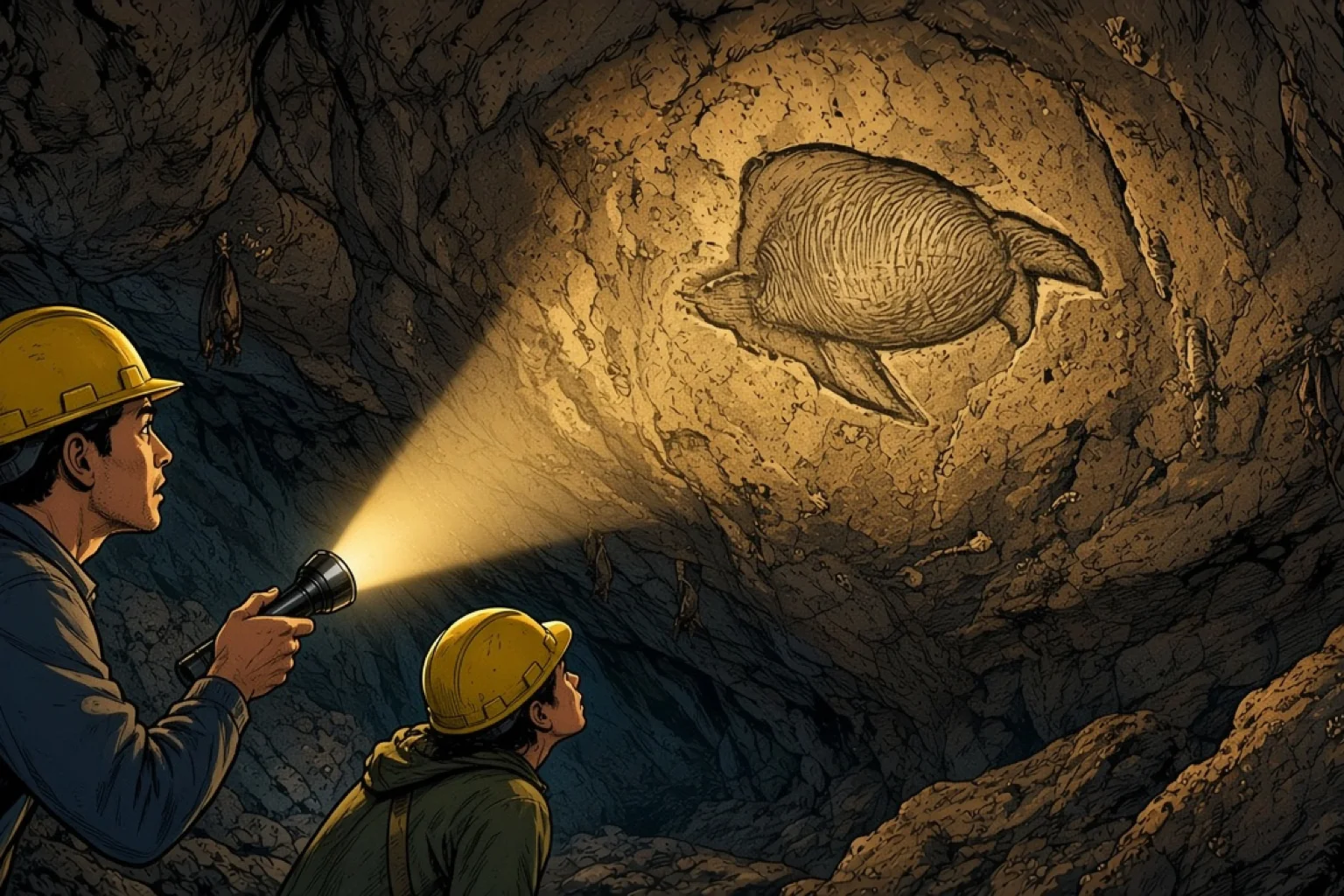
Your guide will point the torch at the ceiling and outline a shape more than 30 cm across that looks like a turtle, head, shell and back legs. Elsewhere there are piles of fossil coral in leaf and flower shapes, shells, and near the brighter outer passages a shape guides describe as a fish, with its fins and tail. Some of these are clear; some need a bit of imagination and a good torch. Look closely and the rock is full of smaller pieces nobody bothers to point out.
The Virgin Mary formation
High on one wall is a white formation, bright against the darker rock, that guides present as a natural likeness of the Virgin Mary. Flores is largely Catholic, and for many local visitors this is as much the point of the cave as the fossils. Whatever you see in it, it's treated with respect, so keep your voice down there.
The mirror chamber
Towards the middle of the cave, the passage opens into a chamber that holds about fifteen people, ending in a dead end with a gap high above it. When the sun is in the right place, light pours through that gap and strikes the walls, and the crystalline rock throws it back. That's the cermin, the mirror. Outside that window you're looking at a pleasant but ordinary chamber lit by torches.
Bats and the stone forest
There are bats roosting in the higher parts of the cave; they're harmless and mostly ignore you. Around the hill, a labyrinth of narrow cracks about 20 metres deep has trails cut through it, sometimes called the stone forest. Most visits leave the cave by a different opening from the one they came in by, so you see the hill from two sides.
A short history: Verhoeven and the 1951 survey
People in Labuan Bajo have always known the hill and its cave. It was put on the map for the outside world in 1951 by Theodor Verhoeven, a Dutch Catholic missionary and amateur archaeologist who spent years surveying caves and fossil sites across Flores.
Verhoeven is a bigger name in Flores than his visit to Batu Cermin suggests. He found fossils of stegodon, an extinct relative of the elephant, and stone tools on the island, and he dug at Liang Bua, the cave near Ruteng where the remains of Homo floresiensis, the so-called hobbit, were found in 2003. He didn't find the hobbit himself, but his work is a large part of why archaeologists went looking. Our article on Liang Bua and the Flores hobbit tells that story.
Batu Cermin has been a managed tourist site for years, and it became a stop on official visits as Labuan Bajo grew. It's run by the West Manggarai regency, which sets the fees and supplies the guides.
How the mirror light works, and when to see it
The light is the reason the cave has its name, and it's the thing most visitors miss. It needs two things together: direct sun, and the sun at the right angle to reach down through the gap into the chamber.
The cave's own management puts the best window at about 09:00 to 11:00. Other recent guides stretch it to midday or a little after, and the exact timing drifts with the season as the sun's path moves. Ask the guide at the ticket office whether the light is coming in that day; they know better than any website. Since the cave usually opens at 09:00, the simple rule is to be there when it opens.
Cloud cancels it. A grey morning gives you a perfectly good cave with fossils and bats, but not the mirror. In the dry season, roughly April to October, clear mornings are the norm. From December to March, mornings are more often overcast, and the paths can be muddy. Our guide to the best time to visit Komodo Island explains the seasons in more detail.
Don't confuse it with Rangko. Rangko's pool glows around midday, so on a day when you want both, Batu Cermin in the morning and Rangko after lunch is the natural order.
How a Batu Cermin visit works
1. Arrive soon after 09:00
Most listings, including the tourism ministry's, give opening hours of 09:00 to 17:00 every day. The cave's own FAQ says it opens at 08:00, but don't plan around that. The light window starts at about the time the doors open, so arriving at 09:00 gives you all of it.
2. Buy your ticket and meet a guide
Tickets are sold at the office by the car park: IDR 50,000 for foreign visitors and IDR 20,000 for Indonesians. A local guide goes in with you. Some visitors report the guide is included in the ticket and others that it's an extra fee, so ask before you set off and agree any price first.
3. Walk up through the bamboo
The path from the gate to the cave mouth is about 300 metres, under a tunnel of bamboo that's welcome shade by mid-morning. Allow 5 to 10 minutes.
4. Put on the helmet and go in
A helmet and torch are required, and they're handed out or rented at the start. The first section is wide and easy. Then the roof comes down, and you'll stoop and squeeze through the lower passages for a while.
5. Stop in the mirror chamber
If the sun is in, this is where you'll spend the most time. Turn off the torches, let your eyes adjust, and watch the walls. Photos work best with no flash and a steady hand.
6. Leave by the other exit
Most tours come out through a different opening and loop back to the path. The whole underground part takes 20 to 30 minutes; with the walk, the ticket office and some time at the fossils, plan on about an hour.
A worked example: a day trip from the island
A couple staying with us on Sebayur take the 08:00 complimentary shuttle to Labuan Bajo, a 30 to 40 minute speedboat ride, and land around 08:40. A Grab car to Batu Cermin costs about IDR 30,000, and they're at the ticket office by 09:05, IDR 100,000 for the two of them. The sun is out, the light reaches the chamber at about 09:40, and they're back at the car park at 10:15. They spend the middle of the day in town: lunch, some shopping and a walk up Puncak Waringin. They're back at the harbour well before 14:00 for the 15:00 shuttle to the island. Batu Cermin itself costs them under IDR 200,000 including the rides, and they're back at the resort in time for the sunset.
What Batu Cermin costs in 2026
| Item | Price | Notes |
|---|---|---|
| Entry, foreign visitors | IDR 50,000 | Cash at the ticket office |
| Entry, Indonesian visitors | IDR 20,000 | Show ID if asked |
| Guide | Varies | Sometimes included; ask first |
| Helmet and torch | Included or small rental | Required inside |
| Ride app from town | IDR 15,000 to 30,000 | Each way |
| Car with driver | IDR 400,000 to 1,000,000 | Per day, for several stops |
Bring cash in small notes. There's no reason to expect card payment at the ticket office, and change for a large note isn't guaranteed. If you need to draw money first, our guide to money, ATMs and tipping in Labuan Bajo covers which machines to use.
For a sense of scale: two foreign visitors on ride apps spend roughly IDR 160,000 to 220,000 on the whole trip, about 10 to 14 US dollars, before any guide fee or tip. It's one of the cheapest things you'll do in Flores.
Safety, access and who it suits
Batu Cermin is a gentle outing as caves go, but it's a real cave rather than a show cave with lighting and handrails all the way. A few things are worth knowing before you go.
- Low passages. If you can't stoop for a dozen metres or don't like tight spaces, you'll find parts of it hard. Tell the guide at the start, so they can pace the group and warn you before each low section.
- Footing. The trail is part concrete and part uneven rock, and it gets slippery after rain. Wear closed shoes or sport sandals with grip, not flip-flops.
- Not accessible. The path, steps and low sections rule out wheelchairs and pushchairs. There's one public toilet on site and no accessible toilet.
- No visitor insurance. The tourism ministry's listing records no insurance for visitors, so make sure your own travel insurance is valid.
- Don't touch the formations. Skin oil stops stalactites from growing and dulls the fossils. Look with the torch, not your fingers.
- Heat outside, humidity inside. The walk up is hot by late morning and the cave is close and damp. Bring water.
Children usually love it: helmets, torches, bats and fossils make it an easy sell. Older children are fine; with small ones, carry them through the low sections or skip them. Our Komodo with kids guide has more on what works at which age.
The site has closed for safety reasons twice in 2026: briefly for a storm warning in January, according to one visitor guide, and for checks after the 15 August earthquake, when it reopened the next day, on 16 August. If the weather is bad or there's been a tremor, check before you go. Our article on whether Komodo Island is closed tracks what's open across the region.
What to look for in a Batu Cermin guide or driver
1. A clear price before you start
Guide arrangements at the ticket office vary, and a misunderstanding at the end spoils an otherwise good visit. Ask: "Is the guide included in the ticket, and if not, how much is it for our group?"
2. Someone who knows where the light falls
A good guide knows whether the sun is reaching the chamber today and when, and paces the tour to arrive at the right moment. Ask: "Is the light coming in this morning, and when should we be in the chamber?"
3. Fossils pointed out, not just shown
The turtle and the coral are much clearer when someone outlines them with a torch. Ask: "Can you show us the turtle fossil and the coral before we go through to the chamber?"
4. Patience with squeezes
Some guides go fast through the low passages. If anyone in your group is nervous, say so at the start. Ask: "Is there a way around the tightest section?"
5. A driver who will wait
If you're on a car day, agree that the driver waits at the car park and whether parking is included. Ask: "Does the price include parking and waiting time here?"
6. Up-to-date news on closures
After the 2026 earthquake and storm closures, a driver who checks ahead is worth having. Ask: "Is Batu Cermin open today? Can you call ahead?"
How to fit Batu Cermin cave into your trip
Divers on a no-fly day
After several days of diving you should wait at least 18 hours before flying. At about 75 metres above sea level, Batu Cermin is nowhere near the altitudes that matter for divers, so it's an ideal way to spend part of that day. Our guide to flying after diving explains how to count the hours.
Arrival day
If your flight lands in the morning, Batu Cermin is five minutes from the airport. See it, have lunch in town, and be at the harbour by 14:00 for the 15:00 shuttle to the island. If your flight lands after about 13:00, skip it and save it for the way home.
Departure day
The 08:00 shuttle from the island lands in time for Batu Cermin's opening, and the airport is minutes away. With an afternoon flight and your bags in the car, it's the most efficient sight in Flores.
Families
It's short, cheap and exciting for children, with no swimming or long drive involved. Combine it with a swim at Pede Beach and an early dinner at the Kampung Ujung seafood stalls.
Photographers
Go for the first slot of the morning on a cloudless day and carry a fast lens; flash ruins the effect. Ask the guide for a moment alone in the chamber when the light comes in.
Visitors in the wet season
From December to March, check the sky before you go. Overcast mornings mean no mirror, and muddy paths mean more care on the steps. It's still a good hour out of the rain if your boat day is cancelled.
What to combine with Batu Cermin
On its own, Batu Cermin fills a morning. Paired with one or two other stops, it makes a full land day.
- Rangko Cave: a swim in a sea cave's turquoise pool, best around midday. It needs a car and a short boat crossing, and our Rangko Cave guide explains how to time it.
- Puncak Waringin: the hill above the harbour, five minutes from town, with the best easy sunset in Labuan Bajo.
- Kampung Ujung: the waterfront seafood stalls, open from about 17:00.
- Melo village: a caci whip-dance performance in the hills, booked a day or two ahead.
Our guide to the best things to do in Labuan Bajo on land puts all of these in order with times and prices, and flags the waterfall that's still closed. For the wider picture of the town, see the Labuan Bajo travel guide.
Who Komodo Resort is for, and who it is not for
Komodo Resort is on Sebayur Island, inside the national park, 30 to 40 minutes by speedboat from Labuan Bajo. Our complimentary shuttle leaves the island at 08:00 and 11:30 and leaves town at 10:30 and 15:00, so a morning in Labuan Bajo, Batu Cermin included, fits into a normal day of your stay. You're back for the afternoon on the beach, at the pool or on the house reef. See the rooms at Komodo Resort, the Komodo Resort facilities and our dive centre in Komodo for the rest of the day.
We're the wrong base if most of your trip is on the mainland. If you want to spend several days on caves, waterfalls and hill villages, and evenings in town, stay in Labuan Bajo for those nights and spend the rest of the trip on the island. Late flights are the other limit: if you land after about 14:00, you'll need a night in town or a private speedboat transfer booked in advance.
Key takeaways
- Batu Cermin is a limestone cave of fossil sea life, about 4 km from Labuan Bajo and 5 to 8 minutes from the airport.
- Entry is IDR 50,000 for foreign visitors. Ask whether the guide is included before you start.
- The mirror light needs direct sun, roughly 09:00 to 11:00. Arrive when it opens at 09:00.
- Plan about an hour on site, with low passages, helmets, torches and no swimming.
- At about 75 metres above sea level, it's an easy choice for a diver's no-fly day.
- From Sebayur, the 08:00 shuttle and the 15:00 return make it a simple morning trip.