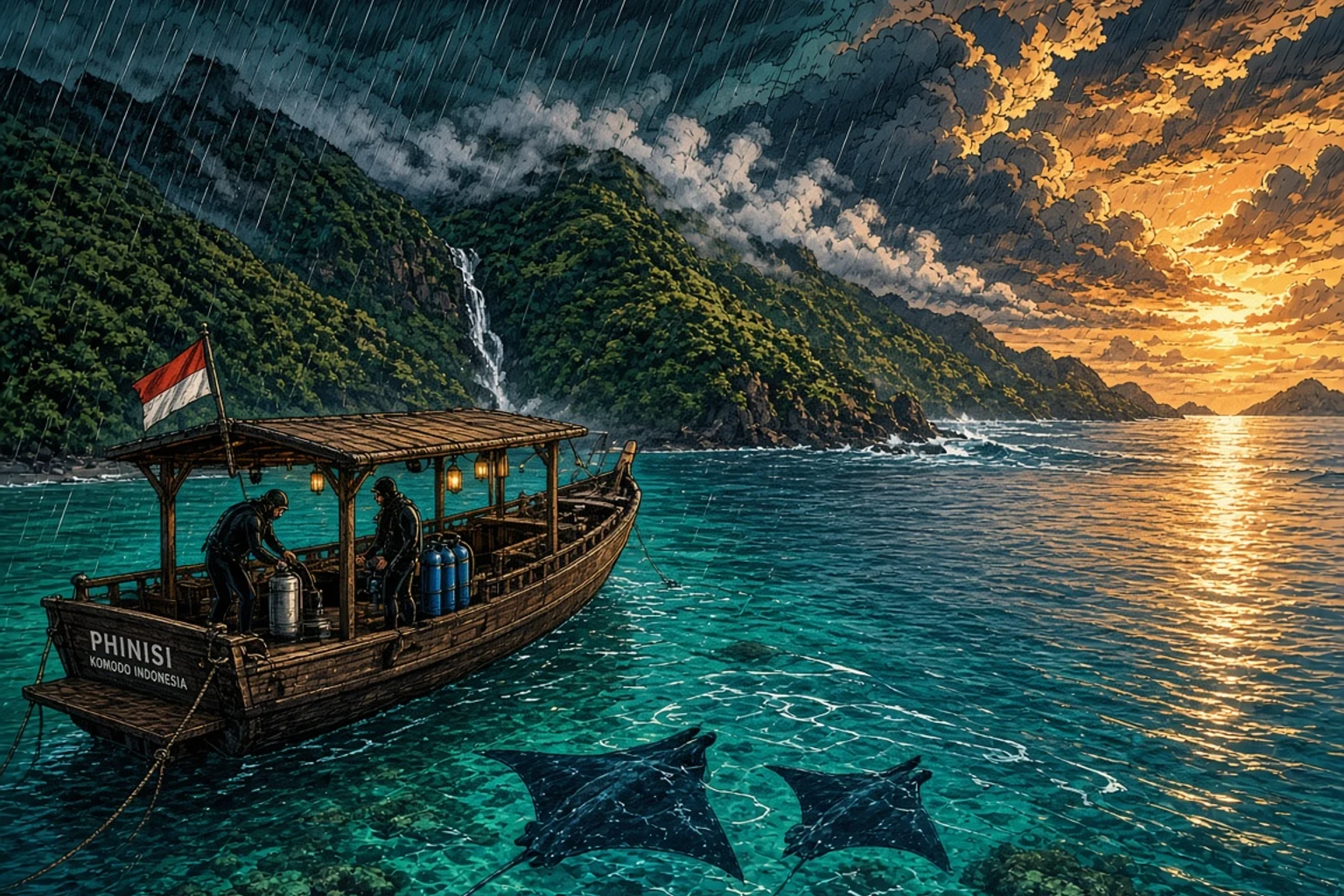
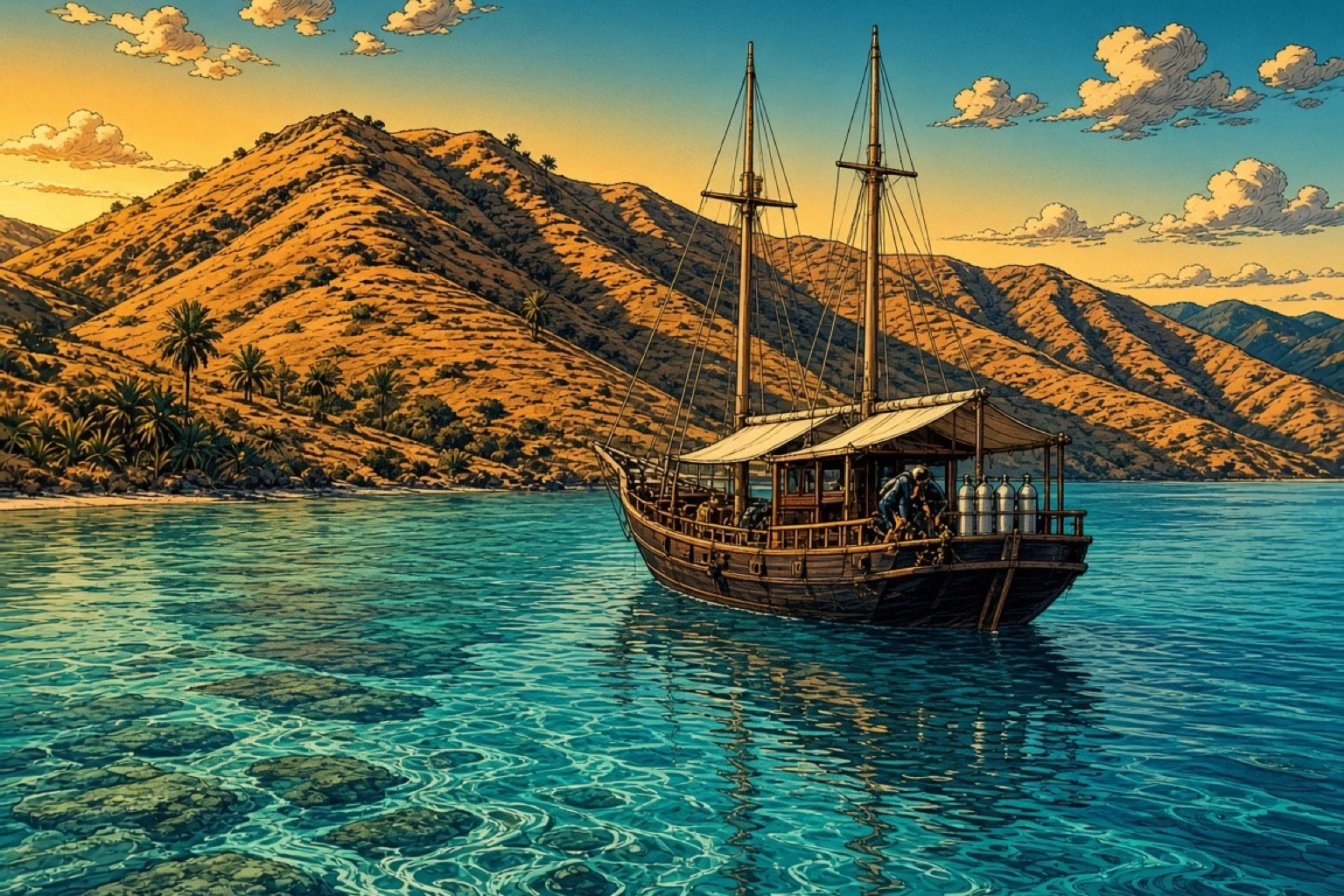
November is the month we quietly recommend to friends. The high-season crowds have gone home, the rates have come off their peak, the water is warm, the islands have turned green again after months of brown, and the manta numbers at Karang Makassar are building rather than thinning. It is also the month almost nobody books, because it sits just outside the dry-season window that every travel article tells people to aim for. Guests who come now tend to be repeat visitors, and there is a reason for that. Our PADI five-star Komodo dive centre runs the full programme through November exactly as it does in July.
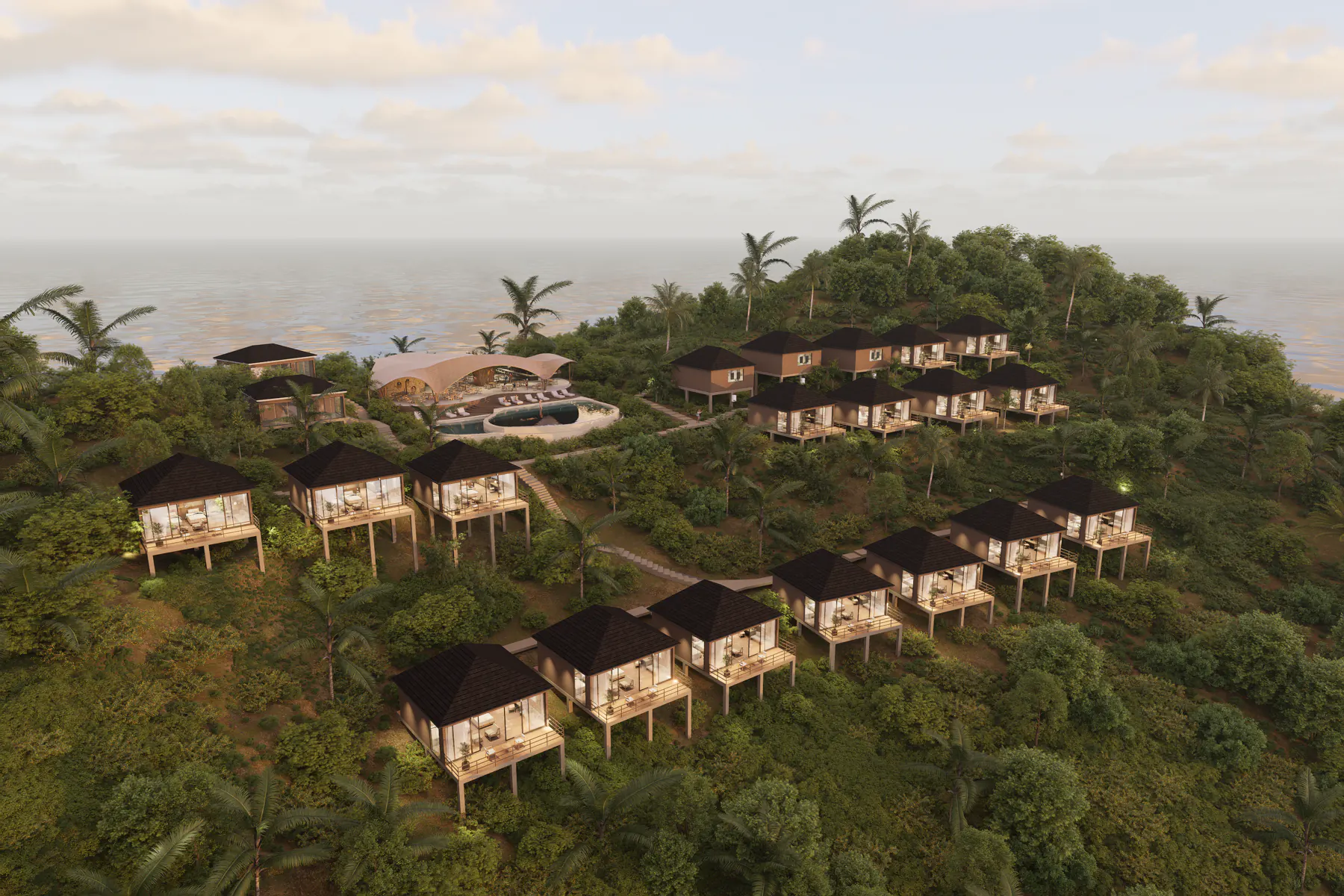
The honest version is that November is a trade. You accept more variable weather in exchange for a park that feels like a park instead of a queue, and for prices that are not set by scarcity. Whether that is a good trade depends on what you came for, and this guide is an attempt to answer that properly rather than to sell you a month. If you are weighing it against the peak, it helps to know what high season actually costs you, and staying in one of our Komodo Resort bungalows inside the archipelago changes the calculation in both seasons.
Below: what the weather really does across the month, diving conditions and visibility, where the mantas are, a frank accounting of what July and August cost in money and experience, what November asks of you in return, and how to plan around it. Our guide to the best time to visit Komodo Island covers the whole year in overview; this goes deep on one month.
The Case for November, in One Paragraph
Water at 27 to 29 degrees, air around 30 by day and 23 at night. Visibility that is still genuinely good, commonly in the 15 to 25 metre range and better than that on calm days early in the month. Reef mantas building back up at the central sites. Roughly a third to a half fewer boats at the popular dive sites and viewpoints than in August. Accommodation you can actually choose rather than take what is left. Green hills instead of dust. And, as the counterweight, afternoon showers that become steadily more likely as the month goes on and the occasional day when the wind decides where you dive.
What the Weather Actually Does in November
November is a transition month, and the single most useful thing to understand is that it is not one uniform month. The first half and the second half behave differently.
Early November
The first two weeks often look and feel like an extension of the dry season. Seas are calm, mornings are clear, visibility is still high and boat transfers are comfortable. If you want the settled conditions of October with even fewer boats around, the first fortnight of November is the window, and it is the part of the month we push people toward when they have flexibility.
Late November
As the northwest monsoon starts to assert itself, the pattern shifts. Mornings usually stay clear, but afternoon showers become common, typically arriving as short heavy bursts of thirty to sixty minutes and then clearing rather than settling in for the day. Rainfall across the month averages somewhere around 100 millimetres, which sounds like a lot until you realise how much of it falls in concentrated afternoon downpours while you are having lunch.
Wind is the more consequential variable. Occasional multi-day systems can push through and make the exposed crossings uncomfortable, which is when itineraries get rearranged toward sheltered sites. This is not the same as being unable to dive; it means diving somewhere other than first choice. Complete cancellations this early in the season are uncommon.
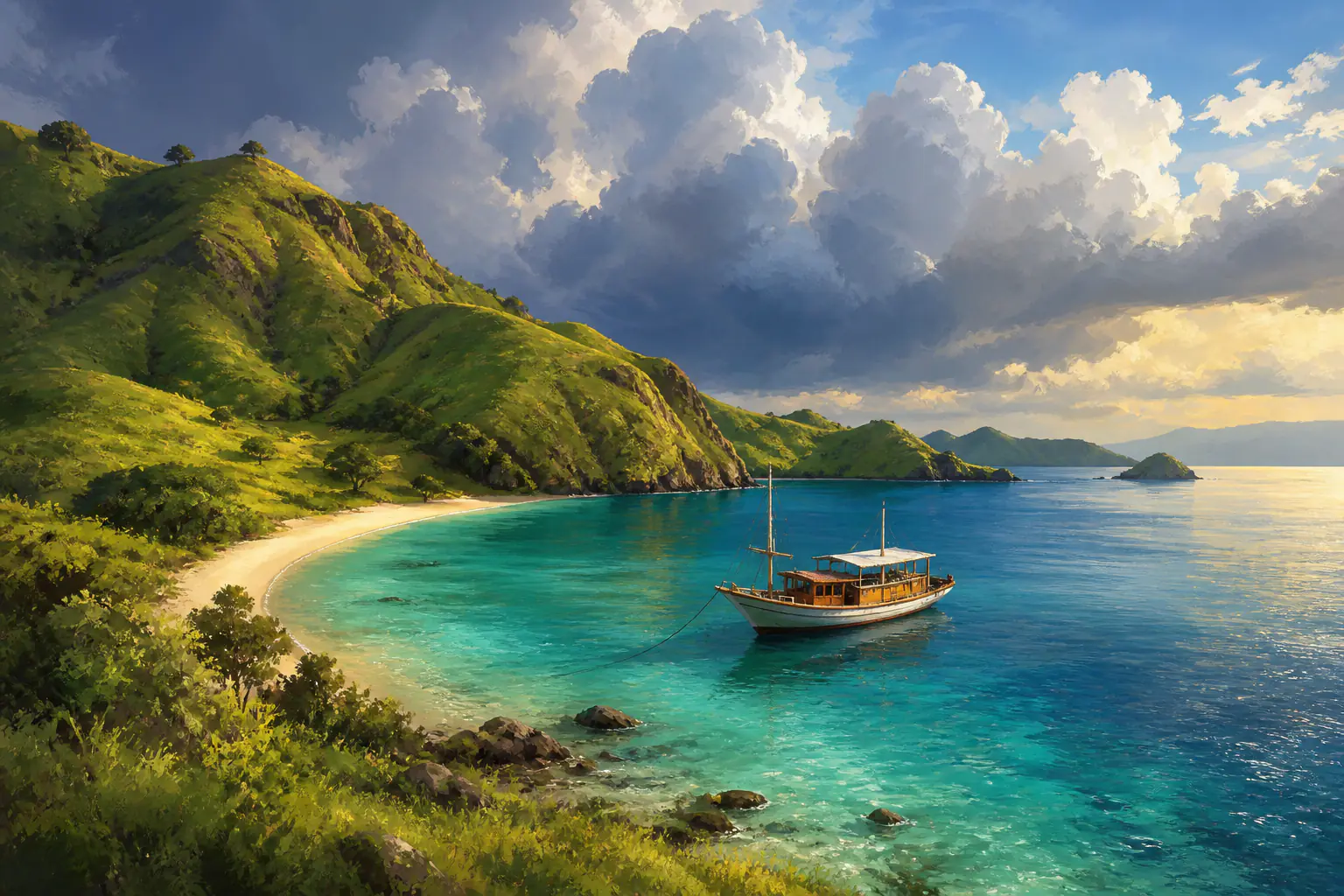
Practically, all of this argues for the same thing: dive and hike in the morning, keep the afternoon loose, and build one spare day into a November trip. Do that and the weather stops being a risk and becomes a detail.
Diving in Komodo in November
Conditions in November are good, and describing them as merely acceptable does the month a disservice.
Water temperature sits at 27 to 29 degrees, which is the warm end of the Komodo range and means a 3mm suit is plenty for most people. Visibility is commonly 15 to 25 metres and can be substantially better on calm days in the first half of the month; it becomes more variable late on as plankton increases and the water gets busier with life. That plankton is the trade-off in miniature: it costs you some clarity and it is precisely what brings the big animals in.
Currents run as they always do here, driven by tide rather than season, so the skills that matter in November are the skills that matter in June. Our guide to diving Komodo's currents covers them, and the site-by-site picture is in our Komodo dive sites guide. The central sites, which is most of what a resort-based or day-trip diver will see, are reliable through the month. The far southern sites are more weather-dependent and are better approached from a Komodo liveaboard that can move with conditions.
One underrated November advantage: with fewer boats out, guides have more say in when they drop. Diving Batu Bolong or Castle Rock on the tide you actually want, rather than the slot you were given, changes those dives considerably.
Mantas in November
This is where November earns its reputation among people who dive here often.
Reef mantas are resident at Karang Makassar year round, so there is no month when the site is pointless and no month that guarantees a spectacle. What changes is how many animals are there, and that tracks the plankton. The largest feeding aggregations of the year come in the wet season, roughly December to February, when the water is thick with food. The dry months from June to September still produce mantas on most days, but in smaller groups, in clearer water. October and November sit in between, with numbers building back up as the plankton returns, and they are our own favourite window for the combination of decent numbers and still-pleasant conditions.
That is the honest picture, and it is worth being precise about it because the internet contains a lot of confident nonsense in both directions. Nobody should tell you the mantas vanish in August; they do not. Equally, if manta rays are the specific reason you are making this trip, aiming at July is a strange choice when the same money in November or January buys you more animals.
What matters more than the month, in any month, is the tide. Mantas come onto the shallow plateau to feed and be cleaned on moving water, and an operator planning around the tide will show you more than one turning up when it suits the schedule. Our guide to swimming with manta rays in Komodo covers the etiquette that decides whether they stay.
What High Season Actually Costs You
July and August are wonderful in Komodo. The weather is as settled as it gets, the water is at its clearest, and if those are your priorities you should come then and enjoy it. But the peak has real costs, and they are rarely spelled out.
Rates and availability
Accommodation across Labuan Bajo and the islands is at its most expensive in July and August, and the good places fill months ahead. That combination is the part people underestimate: it is not simply that you pay more, it is that paying more does not guarantee you a choice. Guests who leave it late in peak season routinely end up in their third or fourth preference at their first preference's price.
Liveaboards feel this hardest because capacity is genuinely fixed. Our own Komodo Sea Dragon takes a maximum of twelve guests, so a peak-season departure is either available or it is not, and there is no flexing. November departures, by contrast, tend to still have space a few weeks out.
Crowding above water
The Padar ridge at eight in the morning in August is a queue with a view. Boats leave Labuan Bajo in the same window each morning, travel as a loose convoy, and arrive at the same stops together, so the crowding is concentrated rather than spread. The dragon treks on Rinca run back-to-back groups. None of this ruins the park, but it does change what it feels like, and it is the single most common complaint we hear from peak-season first-timers.
Crowding underwater, and the rule that formalised it
Underwater congestion used to be an informal problem and is now a regulated one. In 2026 the park authority introduced what it calls the 20 Minutes Rule, which a wave of coverage wrongly reported as a twenty-minute cap on dive duration. The authority corrected that publicly at the end of April: the twenty minutes is the minimum interval between successive groups of divers entering the same site, not a limit on how long you dive. Its marine division head said plainly that it is not dive time being limited but the gap between groups.
It runs first-come, first-served, with Batu Bolong, Crystal Rock and Castle Rock named as priority sites, and where a site is busy operators are expected to wait their turn or move elsewhere. The aims are reducing reef pressure, improving safety in strong current, and stopping the best sites turning into a scrum.
The seasonal consequence is straightforward. In August, at Batu Bolong, that rule is doing real work and your dive may be delayed or relocated. In November there are few enough boats that most divers will never notice it applies.
The manta trade-off
The last cost of high season is the one that surprises people most, because it runs against the assumption that the best weather means the best diving. The clearest water of the year is also the least plankton-rich water of the year, and at the central manta sites that means smaller groups. You get better photographs of fewer animals. Whether that is a good trade is genuinely a matter of taste, but it should be a choice rather than a surprise.
What You Actually Save
We are not going to quote you percentages, because rates across Labuan Bajo and the islands move constantly and anyone publishing a fixed figure is guessing. But the shape of it is consistent year to year and worth understanding, because the saving is not only monetary.
Accommodation is where the difference is largest. Peak-season pricing across the region is set by scarcity in July and August, and it comes off through the autumn. By November you are usually choosing between places that all have availability, which quietly gives you a second kind of saving: the ability to pick the room, the location and the standard you actually want instead of paying a premium for whatever remains.
Diving and boat costs behave differently and it is worth being straight about it. Our own dive rates do not swing with the season, and neither do national park fees, which are charged per person per day with a separate permit for diving regardless of month. So the November saving is concentrated in beds and flights rather than in the water. Our guide to Komodo National Park entrance fees sets out what is fixed, and money in Labuan Bajo covers how to pay for it.
The saving that does not appear on any invoice is the one most guests end up talking about: guide attention. Fewer guests in the water in November means smaller groups and more flexibility about where and when you dive, and that is worth more to the quality of a trip than a discount on a room.
Dragons and Wildlife in November
The land side of the park holds up well in November, and in a couple of respects it improves.
Komodo dragons are active and visible year round; they are not seasonal in any way a visitor needs to plan around. Every trek on Komodo Island and Rinca is escorted by a ranger, which is compulsory rather than a courtesy, and our guide to how dangerous Komodo dragons really are explains why that matters. What November changes is the walking: cooler ground, settled dust and firmer footing than the sliding grit of late dry season, which makes the longer loops considerably more pleasant. Options are on our Komodo dragon tours page.
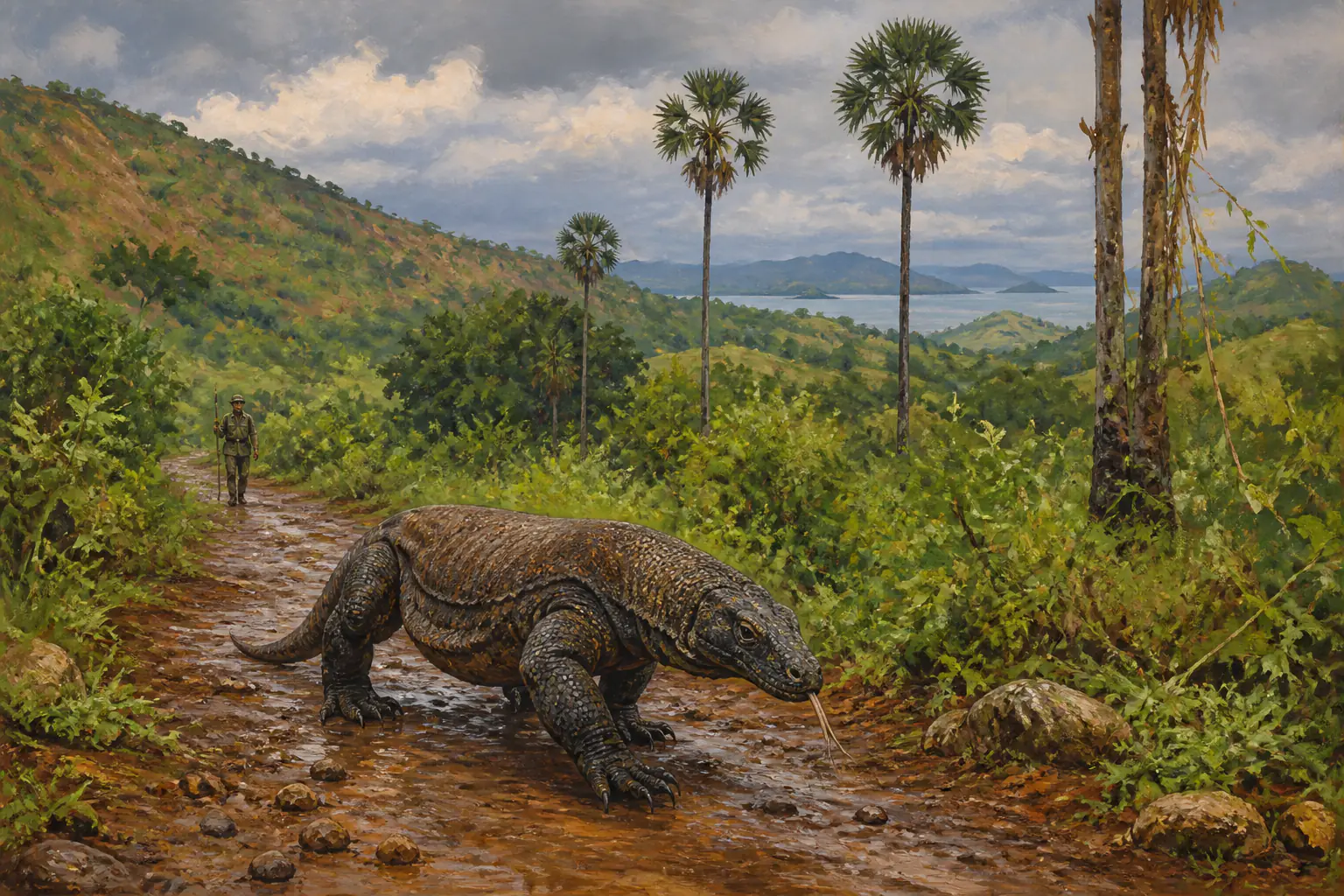
The flying foxes at Kalong are unaffected by season and still stream off the mangroves at dusk in their thousands, and with fewer boats parked up for sunset it is a quieter thing to watch. Birdlife picks up noticeably as the vegetation comes back. The one genuine loss is that a heavy afternoon can flatten a sunset entirely, so if Kalong matters to you, take the first clear evening rather than saving it for the end.
The Islands Are Green Again
This one does not show up in any conditions table and it changes photographs completely.
By the end of the dry season the hills of Komodo, Rinca and Padar are burnt brown and dusty, which is dramatic in its own way and is what most of the famous images show. The first rains of November turn them green, quickly. The same ridge on Padar over the same three bays reads as a totally different landscape, softer and more alive, and the light after a shower is the best light the park gets.
The trekking is more pleasant too, once the dust has settled and the ground firms rather than sliding underfoot. Dragons remain active and visible; they are not seasonal in any way that affects a visitor, though the rangers who escort every trek will tell you the animals move differently as the ground cools.
What November Asks of You
Every honest recommendation has conditions attached, and November has three.
Flexibility. Build in a spare day. If you have exactly three days and all three must deliver, November is a worse bet than June, because one afternoon of weather can eat a third of your trip. With four or five days it barely matters.
Morning discipline. The pattern favours early starts, and people who insist on a leisurely breakfast will lose more dives and hikes than people who do not. Almost everything good in a November day happens before two in the afternoon.
Accepting the water is not at its clearest. If you are here specifically to shoot wide-angle reefscapes at maximum visibility, come in the dry season. If you are here to see animals, the trade runs the other way, and it runs in your favour.
November Against the Other Quiet Months
November is not the only shoulder option, and it is worth knowing where it sits.
October is November's more settled twin: slightly more reliable weather, slightly clearer water, slightly more boats and slightly higher rates. If the weather risk of late November bothers you, October is the safer version of the same idea.
April and May are the other shoulder, coming out of the wet season rather than into it. Seas are calming, visibility is improving and the park is quiet, and May in particular is one of the strongest all-round months of the year.
December to February is the real wet season: the biggest manta aggregations of the year and the lowest prices, paid for with rain, wind, softer visibility and a genuine chance of losing days. Experienced divers who come specifically for the mantas often prefer it, and first-timers usually should not start there.
March is the least predictable month of the twelve, transitional in both directions at once. Our guide to Komodo's seasons sets out the monsoon pattern behind all of this.
What to Pack for November
Almost the same as any other month here, with two additions.
Bring a light rain layer, which is the thing dry-season packing lists leave out and the thing you will use most; a cheap packable shell is fine and an umbrella is useless on a boat. Bring a dry bag, properly, because in November it will earn its place protecting a phone and a camera on an open boat in an afternoon shower. Beyond that: reef-safe sunscreen and a hat, because the sun between showers is as strong as ever and the cloud cover makes people careless; a 3mm wetsuit or a shorty for the warm water; closed shoes with grip for Padar and the dragon trails; and motion sickness tablets taken before departure rather than once you feel it, since the crossings can be livelier late in the month. Our full Komodo packing list covers the rest, and seasickness on Komodo boat trips is worth a read if you are prone to it.
Planning a November Trip
A few things make a November trip work better than it otherwise would.
Aim at the first half of the month if you can choose freely, and stay somewhere already inside the archipelago so a bad forecast means changing the site rather than losing the day to a two-hour crossing. Book five days rather than three so that one weather afternoon is an inconvenience instead of a disaster. Do the must-do things first rather than saving them for the last day, which is good advice in any month and essential in this one. And keep the last morning clear of diving if you are flying out, which our guide to flying after diving explains.
If you are combining a resort stay with island-hopping, our Komodo boat tour guide covers the options and our Komodo day trip guide covers how much fits into one. For a longer plan, our Komodo island itinerary guide maps out three, five and seven day trips.
The Short Version
November gives you warm water, good visibility, building manta numbers, green islands, room to book what you actually want and a park that is not crowded, in exchange for accepting that some afternoons will rain and one day might be rearranged. For most visitors, and particularly for anyone who has already done a peak-season trip somewhere and found it busy, that is a straightforwardly good trade.
July and August are not a mistake. They are the clearest, calmest, most expensive and most crowded weeks of the year, and if settled weather matters more to you than anything else then that is where to spend your money. But the idea that the dry season is the only time worth coming has cost a lot of people a better trip. We are here every month; tell us your dates and we will tell you honestly what to expect, or just get in touch and we will plan around them.