Food is the thing people ask about last and think about most. On a liveaboard you dive three or four times a day, sleep in a cabin the size of a generous bathroom, and eat five times between waking and bed. Over a week that is thirty-odd meals produced in one small room, and it shapes how the trip feels more than the thread count in your cabin ever will. Yet most people booking a Komodo liveaboard, or a boat anywhere else, ask about dive sites and cabin layout and never once ask how the food actually works.
It matters more if you eat differently from the person next to you. A galley at sea is a small room with finite storage, no supermarket for hours in any direction, and a cook feeding everyone at once. That is a very different proposition from a restaurant that can improvise a substitute at eight in the evening. On Komodo Sea Dragon, which carries twelve guests in six cabins, the kitchen caters to standard dietary preferences and allergies, but that works because the crew is told in advance and buys accordingly before the lines come off.
This guide is about liveaboards generally, not one region. I use our own boats for the numbers because I can state those with confidence, but the mechanics are the same in the Red Sea, the Maldives, Thailand or Raja Ampat. It covers how meals are served and why that varies so much between boats, how eating is timed around diving, what is included, and then the part that is genuinely hard to find good information on: running a vegan diet, a coeliac diagnosis or a serious allergy a long way from a hospital. Some of that is a safety conversation rather than a catering one, and I have tried to be straight about where the limits are.
How Meals Are Served: Buffet, Plated and A La Carte
This is the single biggest difference between boats, and almost nobody explains it before you book. Two vessels with the same star rating and the same itinerary can feed you in completely different ways.
Why buffet is the default
Most liveaboards serve buffet, and there are good reasons for it rather than lazy ones. Appetite on a dive boat is wildly unpredictable: the same guest who wants fruit and coffee at six will demolish three plates at one. A buffet lets people take what their body is asking for without a cook guessing. It also collapses five services a day into something one or two people can physically deliver from a galley the size of a corridor, while the boat is moving.
Buffet is not a downgrade. On a well-run mid-market boat it means more variety on the table at once than any plated menu would give you, and second helpings without asking. It is the format the middle of the market runs on, and it works.
The small-boat exception
Very small vessels often do not buffet at all, and for two quite different reasons.
The first is simple arithmetic. If a boat takes six or eight guests, that is six or eight orders, and a cook can genuinely make your eggs the way you want them and adjust a dinner to suit you. Cooking to order stops being a luxury and becomes the obvious way to do it. The second reason is less glamorous: some small boats, particularly catamarans, have no room to lay out a buffet spread, so meals arrive plated because there is nowhere to put the alternative.
Either way, the practical result for anyone with a dietary requirement is good. Fewer guests means more attention, and plated food means your meal is assembled in the galley rather than assembled by you from shared dishes.
The high-crew exception
At the other end, larger premium boats plate too, and increasingly they plate everything. A dedicated chef with a sous chef under them can run multi-course dinners that change every night, and some operators have now dropped the buffet format entirely in favour of restaurant-style service, arguing that it cuts waste and lets them control presentation. On boats like that, an a la carte request is not an imposition; it is what the kitchen is staffed to do.
What actually determines it
Not length. Crew headcount per guest.
One cook is standard on a mid-market boat, and one cook plus five services a day means buffet, whatever the vessel measures. Premium boats add a second cook, and that one extra pair of hands is what buys you plated dinners and special requests. At the top of the market you see something like thirty guests carried by seventeen crew, and at that ratio the galley can behave like a restaurant. Our own King Neptune, a 46-metre yacht built in 2024, takes up to twenty-two guests in ten cabins, and the difference a bigger vessel makes to catering is really a difference in how many people are working in and around the kitchen.
Plenty of boats also run a hybrid, which is probably the most common arrangement of all once you get above the budget tier: buffet at breakfast and lunch, when everyone is on a different schedule and dripping wet, and plated service at dinner, when the diving is finished and there is time to sit. If a boat tells you dinner is plated, that usually tells you there is real capacity in the galley.
How to find out before you book
Ask the question directly, because brochures rarely answer it: is service buffet, plated, or a mix, and how many cooks are aboard for how many guests? The second half of that question is the one that matters. A boat that answers "one cook, twenty-four guests, buffet" is being honest and you now know what you are buying. A boat that promises tailored a la carte dining for twenty-four guests with a single cook is telling you something that cannot be true five times a day for a week.
What a Day of Eating Looks Like
The rhythm is built around dives, not around the clock. That surprises people who expect hotel mealtimes.
A typical day starts with something light before the first dive, usually around six. Fruit, toast, porridge, coffee and tea. Nobody sensible eats a full breakfast before dropping into current, and no good crew will push you to. The real breakfast lands after that first dive, when everyone is back on deck, warm and suddenly ravenous. Eggs cooked to order, bread, fruit, often a hot local dish. That post-dive breakfast is frequently the best meal of the day precisely because you have earned it.
Lunch comes after the second dive, typically early afternoon. Snacks appear between everything: fried bananas, cakes, fresh fruit, biscuits. Dinner is served after the last dive of the day, once tanks are filled and the boat has moved to its overnight mooring. If there is a night dive, dinner waits until after it, which can mean eating at nine.
Seating is almost always communal. There are no tables for two on a dive boat, and by day three that stops feeling like a compromise and starts being one of the better parts of the week.
How a Galley Actually Works
The constraint that explains most liveaboard food is provisioning. The boat loads before departure and then, on most itineraries, does not shop again. No resupply run, no corner shop, no way to source oat milk on day four because someone mentioned it on day three.
That has consequences you can predict once you know it. Fresh leafy vegetables and soft fruit appear heavily in the first two or three days and taper off. Root vegetables, cabbage, carrots, pumpkin and hardy fruit last the week. Fish is often the freshest protein aboard because it can be bought from local boats en route. Dairy is limited and long-life milk is the norm. Bread may be baked onboard on longer trips because it does not keep.
How hard that bites depends on two things people rarely think about: where you are, and how long you are out. A four-night trip leaving a port with a market ten minutes from the dock is a different provisioning problem from a ten-night crossing through the Banda Sea, where the boat carries everything it will ever have from day one. Remote itineraries in eastern Indonesia and the Pacific are the demanding end of this. Short trips from a well-supplied harbour are the easy end.
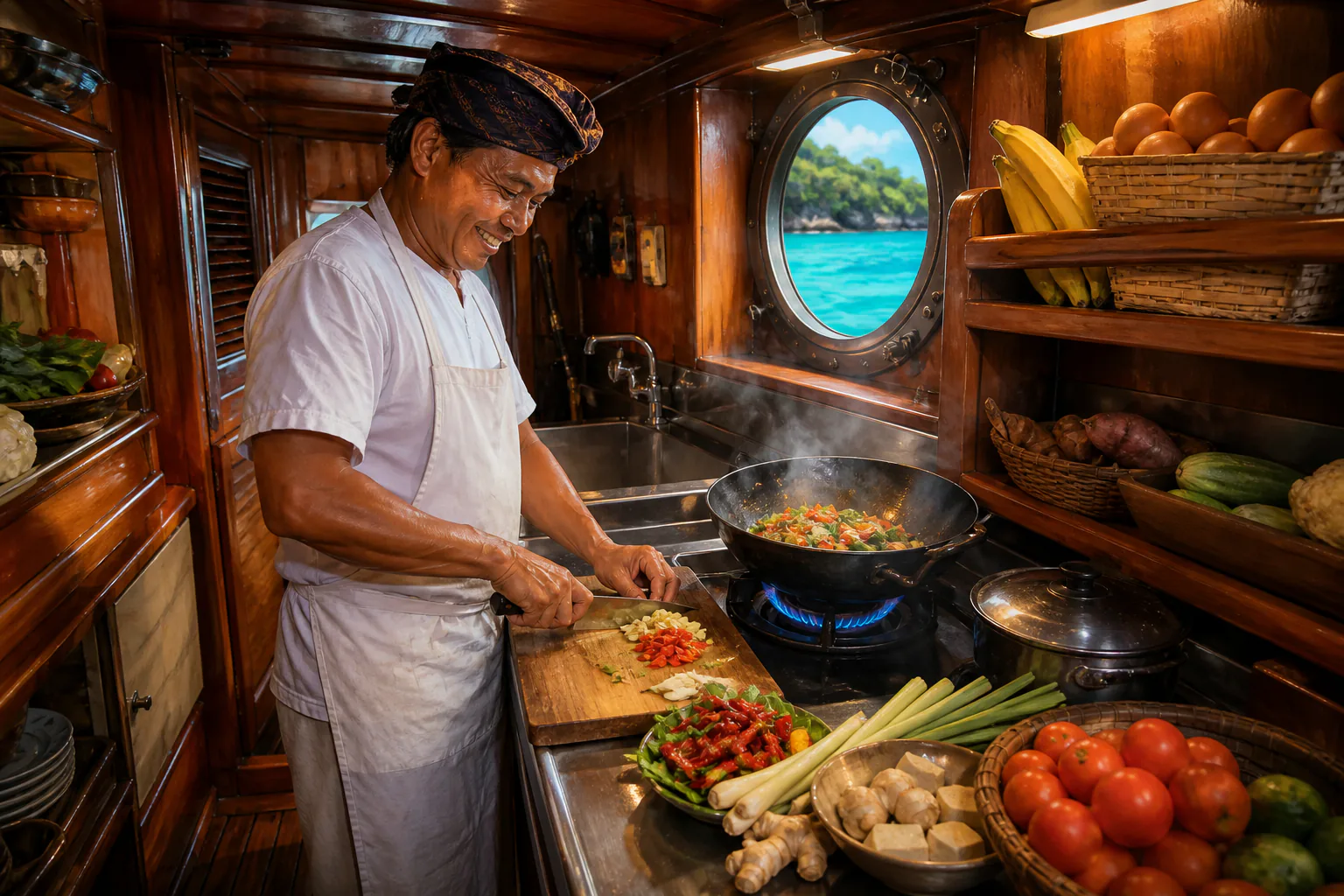
The galley itself is small, hot and moving. One or two cooks produce five services a day in a space narrower than most home kitchens, on a boat that rolls. Understanding that tends to make people both more forgiving of a repeated dish and more appreciative of what does come out, which on a good boat is genuinely impressive.
What the food actually is
Menus follow the region. Indonesian boats lean on rice, grilled fish, curries, tofu and tempeh; Thai boats on curries and stir-fries; Red Sea and Mediterranean boats on mezze, grilled meats and pasta; Maldivian boats on coconut-based curries and fresh fish. Almost all of them also cook Western staples, because a week is a long time and cooks know it.
Our chefs cook a mix of international, Indonesian, Italian and Thai. In practice that means you are not eating rice and sambal for seven days straight, which is the fear people arrive with. There will be pasta. There will be curries and grilled fish. There will be a soup most days, because soup is efficient and it works when the sea is lively and people want something gentle.
Portions are generous and second helpings are normal. Diving four times a day burns a startling amount of energy, and appetite tends to climb through the week.
What Is Included and What Costs Extra
On our liveaboards, drinking water, tea, coffee and all-day snacks are included in the trip price. Alcoholic drinks are not. Spirits, wine, beer and soft drinks are available to buy onboard.
That split is close to standard across the industry, though never assume it. Some boats include soft drinks, some charge for every bottle of water, some run an honesty book you settle at the end, and a few include beer after the last dive. Ask before you book rather than discovering it when the bill arrives. If you are working out a total budget, our guide to Komodo Island trip cost puts drinks and extras in context alongside park fees and gear rental.
One thing worth planning for: on most boats you settle onboard purchases in cash at the end of the trip, in local currency. Card facilities at sea are unreliable at best. Draw enough before you board.
Eating and Diving: The Timing That Actually Matters
There is a lot of folklore about food and diving, and some of it is worth taking seriously.
Eat light before a dive and properly after one. A heavy meal immediately before descending is uncomfortable, makes you more prone to nausea in swell, and does nothing good for your buoyancy or your breathing rate. This is not a rigid medical rule so much as accumulated experience, and every dive guide you meet will tell you the same.
Hydration deserves more attention than it usually gets. You lose fluid steadily on a dive boat through breathing dry compressed air, through sun and heat, and through the mild diuretic effect of immersion. Dehydration is widely regarded within the diving community as a contributing factor in decompression illness, and it certainly makes you feel worse regardless. Drink water between dives rather than waiting for thirst, and go easy on making coffee your only fluid.
Alcohol is its own conversation. The short version is that drinking and diving do not belong on the same day, and we have written about drinking and diving at length because it comes up constantly. On a liveaboard the temptation is structural: the bar is twelve steps from your bunk and there is nowhere to drive. The last dive of the day is the line, and a good crew will hold it.
Telling the Operator: What to Say and When
This is the single highest-value thing in this article. Tell your operator your dietary requirement at the time of booking, in writing, and be specific rather than polite.
"Vegetarian" means at least four different things to four different people. "No dairy" might mean a lifestyle preference or an anaphylactic response. A galley cannot read intent, and the difference determines whether the crew simply cooks you a different dish or completely changes how they store, prep and serve your food.
A useful format is three lines. What you cannot eat. What happens if you do. What you are happy to eat instead. That last line matters more than people expect, because it turns a restriction into a shopping list. A cook who knows you eat tofu, eggs and beans can plan around you. A cook who only knows you do not eat meat will serve you the vegetable side dish for six days.
Reconfirm at the dock. Say it again to the cruise director on day one, face to face. Bookings pass through agents, spreadsheets and translation, and the person actually cooking is the last link in that chain. Ten seconds of conversation closes the gap.
Vegan and Vegetarian at Sea
The raw material is rarely the problem. Vegetables, rice, pulses, tofu and fruit are aboard every boat. The difficulty is that in most cuisines the standard flavour bases are animal-derived, and they are invisible in the finished dish.
In Indonesia the main one is terasi, a fermented shrimp paste that forms the base of most sambal and a great many vegetable dishes and spice pastes. It is treated as a seasoning rather than as an ingredient, which is exactly why it catches people out. A plate of stir-fried greens can look impeccably vegan and be built on shrimp. Southeast Asia more broadly has the same issue with fish sauce; the Mediterranean and Red Sea equivalent is stock, butter and yoghurt appearing in things that look plant-based.
The Indonesian ones worth knowing by name:
- Terasi - fermented shrimp paste, in most sambal and many vegetable dishes.
- Kaldu ayam - chicken stock, used in soups and often in rice.
- Kecap ikan - fish sauce, common in stir-fries and noodles.
- Krupuk - the crackers served alongside almost everything, usually prawn-based.
- Shared frying oil - tempeh and tofu fried in the same oil as fish.
A handful of phrases does real work, and crews appreciate the effort. Saya vegan is "I am vegan". Tanpa terasi is "without shrimp paste". Tanpa kaldu ayam is "without chicken stock". Tanpa telur is "without egg". Sayur saja is "vegetables only". Write them down and hand them over; a written note travels better than an accent.
On a boat told in advance, none of this is a problem, because the cook buys and prepares differently from the start. Sambal is made without terasi, or a portion is set aside before the paste goes in. Vegetable stock replaces chicken. It is a planning problem, not a cooking problem. Announced on day two, it becomes a scramble.
One honest caveat about veganism specifically. Vegetarian is straightforward almost anywhere. Strict vegan across a week, with no dairy or egg and no compromise on hidden ingredients, needs a galley that has genuinely understood the brief. Ask whether they have catered vegan trips before, and ask what a typical vegan dinner looks like. A confident, specific answer tells you a lot.
Food Allergies at Sea: The Part That Is About Safety
Everything above is about comfort. This part is not, and it deserves plain language.
A liveaboard is a remote environment almost by definition, and how remote varies enormously. In Komodo, operators generally put the park around two hours from Labuan Bajo by boat, less if a speedboat is available for an emergency, and Labuan Bajo is where the care is: Siloam Hospital there runs an international medical centre with the region's only hyperbaric chamber, along with emergency and intensive care. That is a genuinely good facility by the standards of a remote archipelago. Itineraries in the Banda Sea, Raja Ampat or the far south of the Red Sea can be considerably further from help than that, sometimes a day or more.
If your allergy is the kind that can produce anaphylaxis, plan on the basis that definitive treatment is hours away rather than minutes, and ask your operator specifically how far their itinerary goes from a hospital.
What that means in practice
- Bring your own adrenaline auto-injectors, and bring more than one. Two devices is a common travel baseline. Do not plan to replace one locally; prescriptions do not transfer automatically between countries and you cannot rely on a specific brand being stocked.
- Carry them properly documented. Original packaging, pharmacy label matching your passport name, and a signed doctor's letter in English describing the diagnosis and the medication. Indonesian customs, for example, expects English-language documentation and medication declared on arrival, which can be done in advance through the electronic customs declaration. Rules differ by country, so check yours.
- Keep them with you, not in the hold. Cabin, dive bag, day bag. An auto-injector in a suitcase under a bunk on a rolling boat is not an auto-injector you can reach.
- Show the crew where your kit is on day one. Physically show two people. Say what a reaction looks like and what you want them to do. Dive crews are trained in emergency first response and oxygen administration and will not be fazed by the conversation.
- Declare it on your dive insurance. Some policies exclude pre-existing conditions unless you disclosed them at purchase. Diving insurance is effectively mandatory on remote itineraries anyway.
Why service style matters here
This is where the buffet question stops being about comfort and starts being about risk.
Buffet service and severe allergies sit awkwardly together. Shared spoons move traces between dishes, and a well-meaning guest reaching across with the wrong utensil undoes careful cooking. If your boat buffets and your allergy is severe, ask the crew to plate your meals in the galley before service rather than expecting you to pick your way through shared dishes. Any decent operator will agree immediately, and it removes the largest single source of cross-contamination aboard.
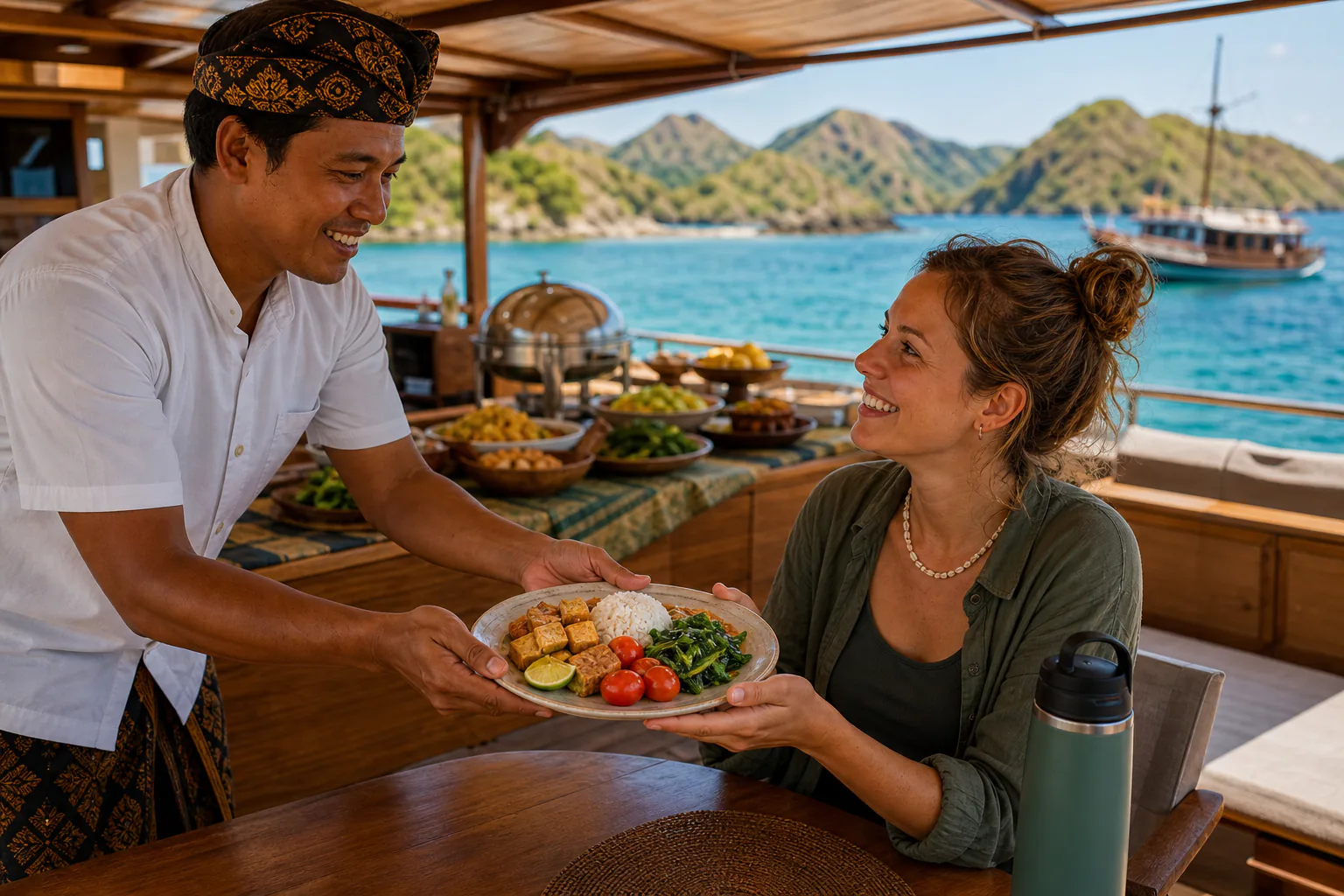
It also means a boat that plates every meal as standard, whether a six-guest vessel or a high-crew premium one, is materially easier to manage a serious allergy on. If you have been wondering whether the step up in price buys anything real, for this particular problem it does.
Ask about the galley too. A small kitchen has one set of boards, one wok and limited surfaces. Complete separation is not always physically possible, and an operator who tells you that honestly is more trustworthy than one promising a nut-free environment they cannot deliver. Nut allergies deserve a direct conversation in Southeast Asia in particular, because peanut is deeply embedded in the cooking through satay sauce and gado-gado.
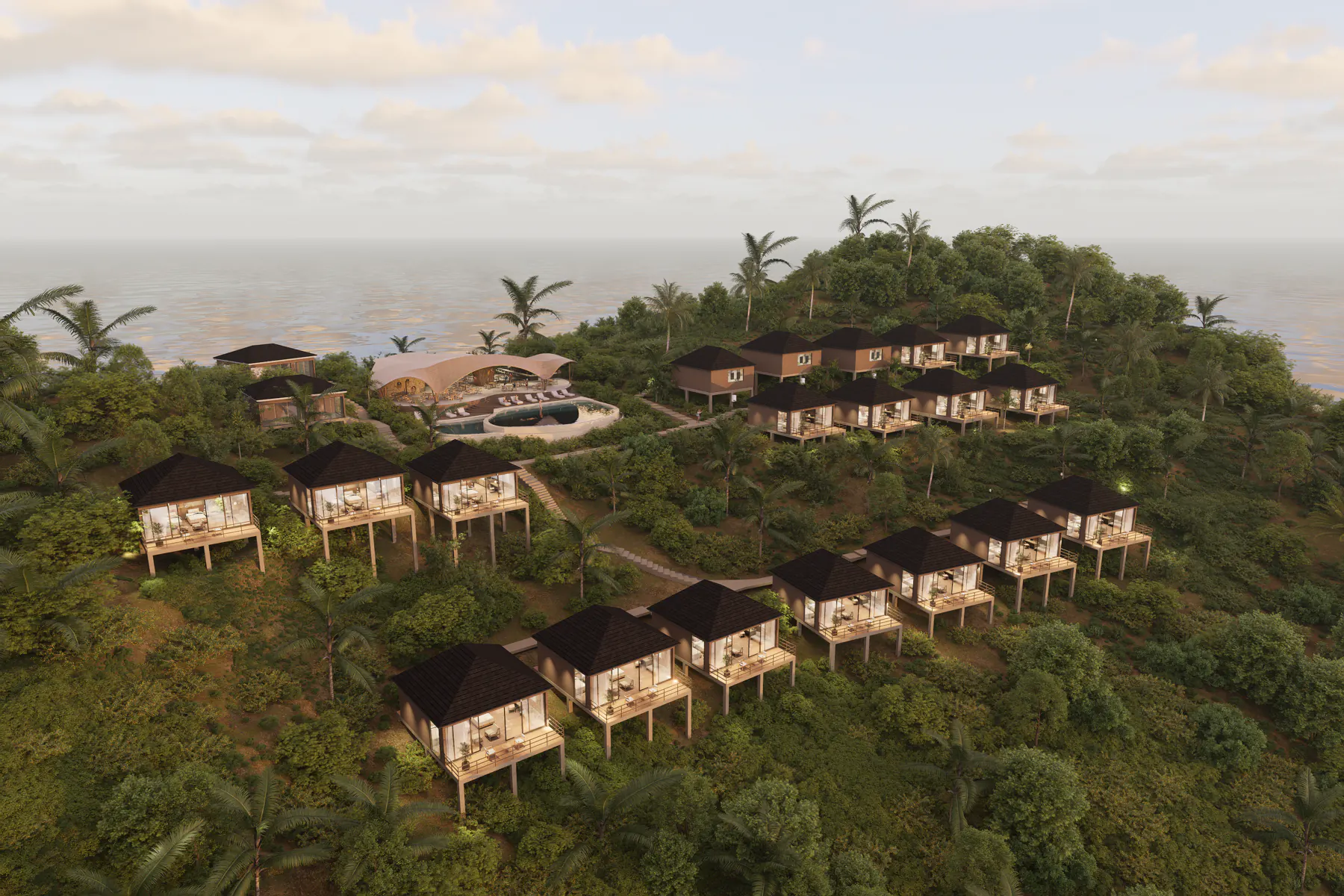
If the honest answer is that they cannot guarantee what you need, that is useful information. A resort with a full kitchen ashore may suit you better than a boat, and our Komodo resort facilities include a restaurant with far more room to work around a serious allergy than any galley has.
Gluten-Free, Halal and Other Requirements
Gluten-free is moderately straightforward on most boats because rice is a default carbohydrate almost everywhere liveaboards operate. Rice, fresh fish, vegetables, eggs and fruit already form the backbone of most meals. The traps are soy sauce, which normally contains wheat, plus bread, pasta nights, crackers and thickened sauces. Coeliac disease as opposed to a preference needs the same separate-plating conversation as an allergy.
Halal is generally easy in Indonesia, Malaysia and the Maldives, where crews are frequently Muslim and pork is rarely on the menu in the first place. It is a bigger ask in Europe or the Caribbean. Say it at booking either way.
Pescatarian is arguably the easiest diet on any dive boat. Fish is usually the freshest thing aboard.
Low-FODMAP, diabetic and other medical diets are workable, but they demand the most detailed briefing, because they involve quantity and timing rather than simple exclusion. Send the specifics well before departure.
Seasickness, Appetite and What to Eat When the Sea Is Up
Some crossings are short and sheltered; others are genuinely open water, and that is when appetite becomes a real factor.
The counterintuitive part is that an empty stomach makes seasickness worse, not better. Dry, bland, plain carbohydrate is what works: crackers, plain rice, toast, bananas. Ginger tea genuinely helps some people. Avoid the greasy plate and the second coffee, and eat on deck in fresh air with the horizon in view rather than in the saloon. Our guide to seasickness on Komodo boat trips goes through prevention properly, including why you take the tablet the night before rather than when you already feel unwell.
Water, Hydration and Plastic
Drinking water is included on our boats and on most others, and you should be drinking a lot of it. Bring an insulated reusable bottle and refill it. Larger vessels make their own fresh water: King Neptune carries a watermaker producing up to ten tons a day, backed by a 45,000-litre tank, which is why showers are not rationed on that boat the way they are on some smaller ones.
Two practical notes. Ask whether refill stations exist before you assume, because a boat handing out small plastic bottles all week is both an environmental problem and a nuisance. And do not drink from the tap in your cabin unless the crew explicitly tells you it is potable; tank water is usually for washing.
What to Bring Yourself
You do not need to pack a pantry. A short list genuinely helps, though.
- Any specialist item you cannot live without for a week - a particular milk alternative, a specific protein bar, a favoured tea.
- Electrolyte sachets. Cheap, tiny, and they make a real difference after four dives in the heat.
- Your own snack backup if you are a nervous eater, so a repeated dish never becomes a problem.
- Antihistamines and any personal medication, in your cabin rather than your hold bag.
Our full what to pack for Komodo Island list covers the rest of the kit, and if this is your first time sleeping on a dive boat, what to expect on your first liveaboard walks through the whole routine from boarding to disembarkation.
Questions Worth Asking Before You Book
Seven questions separate a boat that will look after you from one that will improvise:
- Is service buffet, plated, or a mix, and how many cooks are aboard for how many guests?
- How do you handle my specific requirement, and have you catered it before?
- Can my meals be plated in the galley rather than served from the buffet?
- What is included beyond meals - water, tea, coffee, snacks, soft drinks?
- How are onboard purchases settled, and in what currency?
- Do you reprovision during the itinerary, or is everything loaded at the start?
- How far does this itinerary go from a hospital?
The tone of the answers tells you as much as the content. Comparing operators on more than price is the whole point of our guide to the best Komodo liveaboard, and catering is a fair proxy for how a boat treats the rest of its service. If you are booking a shared departure rather than a private charter, open trip Komodo explains how those boats are run and where the compromises usually sit.
Boat Galley Versus Resort Kitchen
It is worth being clear about the difference, because for some people it decides the trip.
A galley is constrained by storage, by crew headcount, and by a shopping run that happened before you boarded. A kitchen ashore has a cold room, deliveries, more hands and the ability to cook something else at short notice. At the resort we bake bread daily, serve pastries at breakfast and pasta at dinner, and work with organic produce and fish landed the same day. That flexibility is simply not available at anchor.
None of which makes the boat worse. Eating grilled fish on a deck at anchor with the engines off, after four dives, watching the light go orange over a ridge, is a better dinner than most restaurants will ever serve you. But if you are travelling with a complicated medical diet or a child who eats five things, a room ashore with day boats out to the sites may be the calmer choice. Some guests split the difference and do both.
A Realistic Day's Menu
So you can picture it rather than imagine it. This is a buffet boat, which is what most people will be on:
05:45 Fruit, toast, porridge, coffee. 06:30 Dive one. 08:00 Full breakfast - eggs to order, fresh fruit, bread, a hot local dish. 10:00 Dive two. 11:30 Fried bananas and tea on the sun deck. 12:30 Lunch - grilled fish, rice, two or three vegetable dishes, sambal on the side. 14:30 Dive three. 16:00 Cake and coffee. 18:00 Dive four, or a sunset ashore. 19:30 Dinner - soup, pasta or curry, vegetables, fruit for dessert.
On a plated boat the timings are identical and only dinner really changes: instead of a spread you get two or three courses brought to the table, often with a choice offered the night before. Five eating occasions either way. Nobody goes hungry.
The Short Version
Find out how your boat serves food before you book, because buffet, plated and cook-to-order are three genuinely different experiences and the deciding factor is how many cooks are aboard per guest. Tell them your requirement early, specifically, and again at the dock. Understand that most boats shop once and cannot shop again, and that remote itineraries make that stricter. Know that animal-derived flavour bases hide in dishes that look plant-based, and learn the words for them. If your allergy is severe, bring your own auto-injectors, document them properly, show the crew where they are, and ask for plated service rather than trusting a buffet.
Do that, and food stops being something to worry about and goes back to being one of the better parts of the week. If you want to talk through a specific requirement before booking, get in touch and tell us exactly what you need - it is a conversation we have most weeks.