Yes, you can dive on your period, and yes on hormonal contraception. Pregnancy is the one firm no. The largest study on the subject found more problems reported during dives in the first week of the cycle, but the problems were mostly feeling cold and losing buoyancy control rather than decompression illness, which in Komodo is worth knowing because cold and current are exactly what this destination serves up.
This is one of the most searched questions in recreational diving and one of the least often asked out loud. It usually reaches our Komodo dive centre as a message the night before a trip, frequently with an apology attached that nobody needs. So here is the plain version first: no training agency and no diving physician tells menstruating divers to stay out of the water, and most of what circulates online about why they should is either badly misread research or pure invention.
What follows is the research rather than the folklore, because on this topic the folklore is unusually bad. There is also a practical half that almost nothing published addresses, and it matters more here than in most places. Komodo is remote, the southern sites are genuinely cold, and Labuan Bajo has a supply problem that has caught out more than one visiting diver. If you are staying in one of our Komodo Resort rooms you have a private bathroom and a door that closes, which quietly solves most of the logistics. If you are booked on a boat, the answers change. We will cover both.
The Short Answers, Before the Detail
Most people want one line rather than fourteen sections, so:
- On your period: yes. There is a real signal in the data about the first week of the cycle, and we will show you what it actually measured, because that part gets misreported constantly.
- On the pill, an implant, a coil or an injection: yes. Thirty years of looking for a link with decompression illness has not produced one anybody is confident about.
- Pregnant, or actively trying to conceive: no. This is the one place in the article with no grey zone, and the reasoning is specific rather than a vague appeal to caution.
- Breastfeeding: yes, and the reason is simple physics.
- After giving birth: yes, on a timeline of roughly four weeks after an uncomplicated vaginal delivery and at least eight after a caesarean.
- Endometriosis, PMS, heavy bleeding: none of these rules you out, though any of them can reasonably change how hard you load a dive week.
The rest is the detail behind those answers, plus the Komodo-specific part, which is the bit we can tell you that a generic article cannot.
What the Biggest Study Actually Measured
The largest dataset on diving and the menstrual cycle comes from the Diving Diseases Research Centre in Plymouth. Female recreational divers kept menstrual and diving diaries for up to three consecutive years. The numbers are serious by the standards of diving research, where a study of forty people is normal: 533 menstruating women, 34,625 dives across 21,165 dive days, inside 11,461 menstrual cycles.
The headline finding is the one you will see quoted. Reported problems ran at 28.3 per 1,000 dives overall, and they were not spread evenly across the cycle. The rate was 39.2 per 1,000 in the first week, fell to 19.7 in the third week, then climbed back to 31.9 at the end of the fourth. The relationship was statistically significant and not linear, at p = 0.004. Two earlier studies of decompression illness found the same uneven shape, which is why the finding is taken seriously.
What "Problems" Means Here, Because It Is Not What You Think
This is the part almost every article on the subject gets wrong, including a couple we admire. The study did not measure post-dive aches, and it did not measure decompression illness. The authors say plainly that they never set out to observe physician-diagnosed and treated cases.
What they actually recorded was "reported problems during diving", chosen from a fixed list of eleven options. When you look at the totals, the picture changes completely:
- Equipment failure or trouble: 162 reports
- Felt cold during the dive: 155
- Could not control buoyancy: 137
- Self-reported symptoms of possible decompression illness: 93
- Feeling unwell: 73
- Could not cope with poor visibility: 56
- Out of air: 21
- Risk taking, pushing tables or computers: 13
- Alcohol: 7
So the signal in the biggest study we have is mostly about being cold, fumbling your buoyancy and having a bad time with your kit. Possible decompression symptoms are the fourth category down and under a tenth of the reports. The authors go further and suggest that the spike in equipment problems just before bleeding starts may reflect errors of judgement or procedural error rather than anything about gas.
There is a small comparison group in the same paper that rarely gets mentioned. Thirty-seven postmenopausal or non-menstruating women logged 3,408 dives, and 62 per cent of them reported some problem, from 2 per cent of their dives. In the menstruating group it was 65 per cent, from 3 per cent of dives. The gap is not large.
None of this makes the finding useless. It makes it a different and frankly more useful finding: for some women, in some cycles, the week of a period is a week when diving feels harder and goes less smoothly. That is worth planning around. It is not evidence that you are about to get bent.
Why That Reads Differently in Komodo
Here is where a Komodo article can earn its keep. If the two things the data flags hardest are feeling cold and losing buoyancy control, then this is a destination where both deserve real attention, because Komodo produces more of each than almost anywhere in Indonesia.
Start with cold. Most people picture bathwater, and in the north they get it, with water at 27 to 29 degrees for much of the year. The south is a different ocean. Cold upwellings off the Indian Ocean push temperatures at sites like Cannibal Rock, Torpedo Alley and Manta Alley down to 22 degrees and sometimes as low as 19, and the drop arrives as a thermocline you swim into rather than a gradual change. Cramps and cold together are miserable in a way that neither is alone. The fix is unglamorous and completely effective: ask us for a 5 mm suit, or a 5 mm with a hooded vest for a southern day. We would rather hand over a thicker suit than have you shivering through a safety stop, and there is no charge for it.
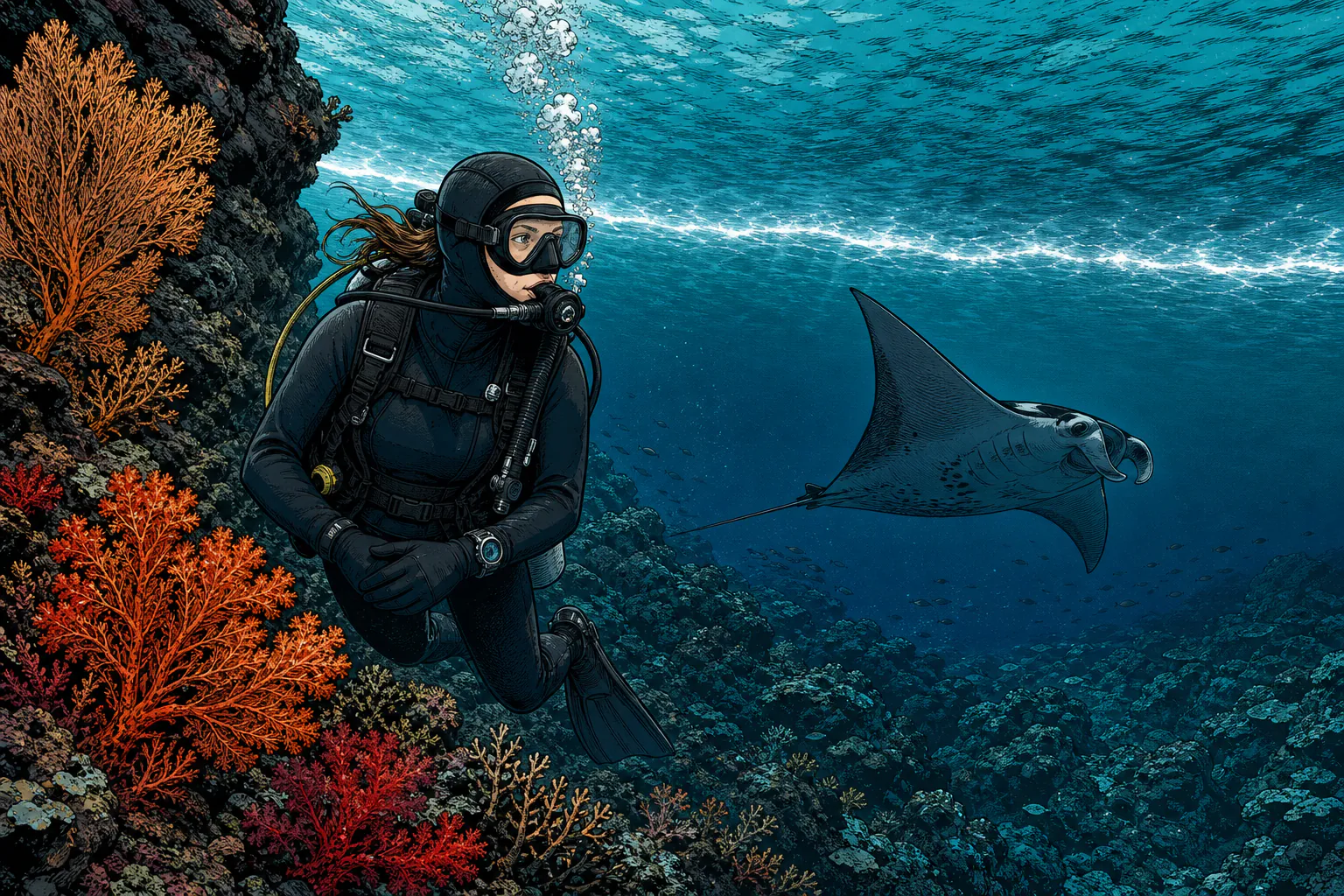
Then buoyancy, which in Komodo is inseparable from current. This park is famous for moving water, and our guide to diving Komodo currents goes through the skills that actually matter in it. Working against a current is physical, and exertion is one of the few things that genuinely and reliably raises decompression risk for anybody of any sex. If you know that this particular week tends to leave you with less in the tank, the sensible response is not to skip the trip. It is to choose the day well. There are plenty of gentler sites among our Komodo dive sites, and a guide who knows you would rather not fight anything today can plan around that without a word to the rest of the group. Tell your guide at the briefing, or by message the night before if you would rather.
The honest framing is this. Where you are in your cycle is not a reason for us to give you a different dive plan, and no diving physician would prescribe one. But if you want a quieter day that week, the levers are the ordinary ones available to every diver: fewer dives, less depth, a longer safety stop, a site out of the current, a thicker suit. Those are choices, not medical corrections, and you do not need to justify them.
Are Women at Higher Risk of Decompression Sickness?
This one needs handling carefully, because there is a figure in circulation that sounds alarming and does not say what people think.
A retrospective review of 956 women divers who had been treated for decompression illness found 38 per cent were menstruating when they were injured. Set on its own that looks like a big effect. But a period covers roughly a fifth to a quarter of a typical cycle, so 38 per cent is somewhat elevated rather than dramatic, and more importantly the review had no comparison group of uninjured divers, no record of how many dives happened on which cycle days, and no adjustment for depth, exposure or anything else. It describes when injuries happened within one group. It cannot tell you that group's risk against any other.
DAN's own summary of the theory, which is that fluid retention and tissue swelling might make nitrogen marginally harder to offload, is that it is not definitively proven. DAN does go on to say that conservative diving may be advisable while menstruating, particularly for women on oral contraceptives, and we would rather quote that accurately than pretend the guidance is more relaxed than it is. Meanwhile the Plymouth researchers, who have looked at this longer than almost anyone, conclude that women do not appear to be at greater risk of decompression illness than men on the same dive profiles.
Put together, the useful conclusion is that sex on its own is not a helpful predictor. The helpful predictors are the same for everyone: depth, bottom time, ascent rate, thermal stress, exertion against current, and how heavily you load a week of repetitive diving. On a full Komodo dive week that last item does more work than anything on this page. If you want to know what happens in the rare case something does go wrong here, our guide to the hyperbaric chamber in Labuan Bajo covers it, and the short version is reassuring: the chamber is thirty minutes of boat plus a short drive away, not a flight to Bali.
The Shark Story, Which Will Not Die
Somebody raises this every few weeks, sometimes as a joke and sometimes not. There is no evidence that menstruating divers attract sharks or are more likely to have an encounter go badly. It has been looked for and not found.
The arithmetic helps if the myth still nags at you. Total flow across a whole period is a small volume released slowly over several days, much of it shed tissue and mucus rather than blood, and most of it inside a tampon or a cup. Now compare that with the quantity of fish oil and protein in the water around a Komodo reef at feeding time. The sharks you will actually meet here are reef whitetips, blacktips, grey reefs and the occasional wobbegong parked under a ledge, and our guide to the sharks of Komodo is honest that they are a highlight people travel for rather than a hazard. Operators across this park run many thousands of guest dives a season, a large share of them by women. This simply is not a thing that happens.
The Labuan Bajo Supply Problem, Which Is Real
Now the genuinely practical part, and the one piece of advice in this article that we would put in bold if we only had one line. Bring what you use. Do not plan to buy it here.
Pads are stocked widely across Indonesia and you will find them without trouble in Labuan Bajo. Tampons are a different story. They are unreliably stocked once you are east of Bali and Java, and multiple independent traveller accounts describe searching the whole of Labuan Bajo without success. One of them is a diver who had travelled three days to get here and lost dive days to it, which is a miserable way to spend a trip you have saved for. Menstrual cups are not sold locally either.
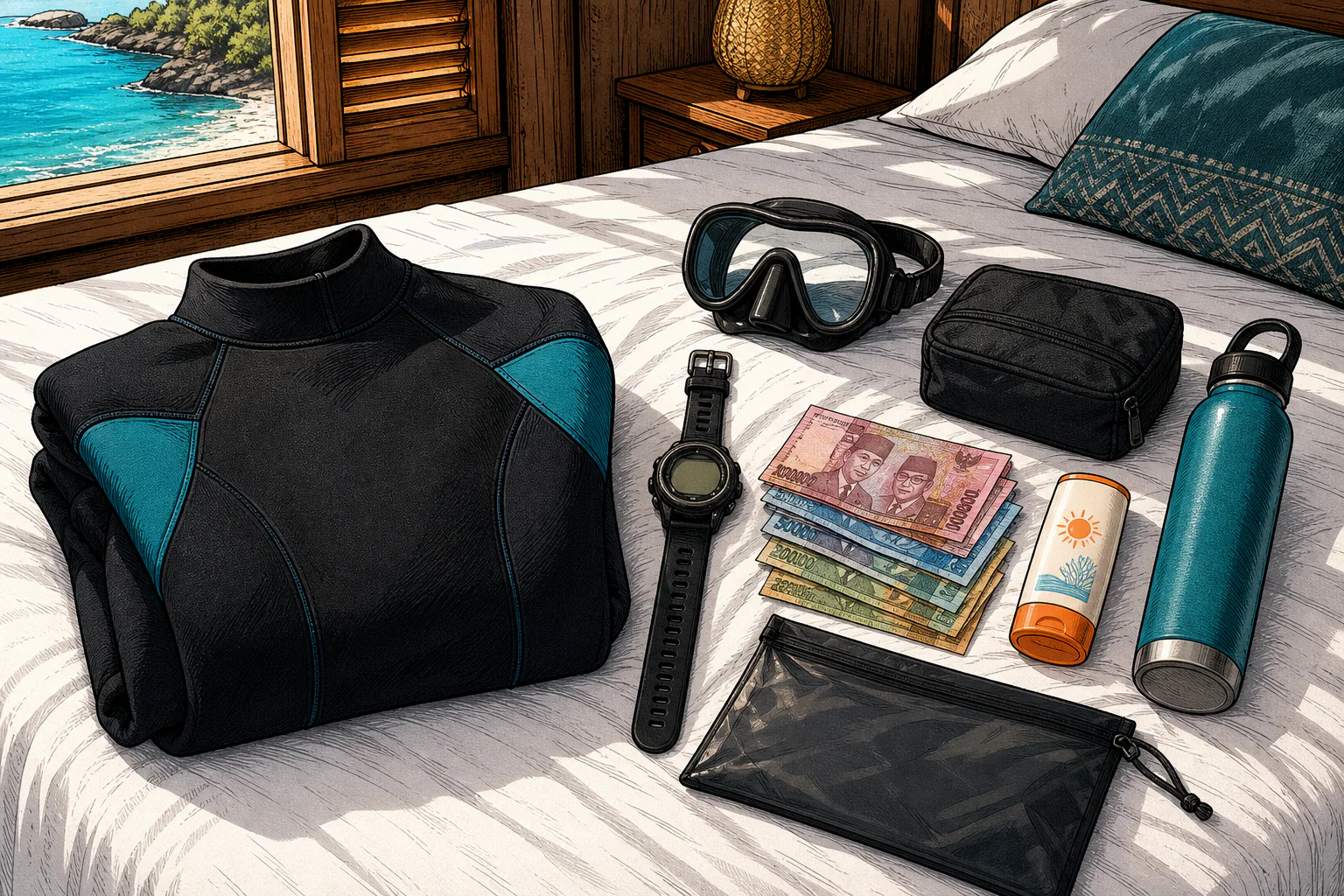
So the plan is simple. Buy in Bali at a large supermarket or an international pharmacy while you are still in transit, or better still pack from home, and bring the whole trip plus a few days of margin. Margin matters more here than it sounds, because Komodo trips get extended by weather and by cancelled domestic flights more often than people expect. Our guide on what to pack for Komodo Island has the rest of the list, and this belongs on it.
A menstrual cup suits a dive trip unusually well, since there is nothing to run out of, nothing to carry home and the interval between changes covers a full day on the boat. The one caveat we would add is that a remote dive trip is a poor place to use one for the very first time. Try it at home first.
One more thing worth knowing. There are no ATMs anywhere inside the national park, and card payment is patchy in town, so if you do need to make a pharmacy run in Labuan Bajo, have rupiah in cash.
A Resort Week and a Boat Week Are Not the Same Question
Almost everything written on this subject assumes you are on a day boat or a liveaboard, and the honest answer is that where you sleep changes the problem more than any of the medical detail does.
On a liveaboard you have a small cabin bathroom, limited privacy, four dives a day on a schedule you do not control, and a firm rule that nothing goes down a marine toilet, so everything is bagged and binned. None of that is a reason to avoid a boat, and our Komodo liveaboard trips carry plenty of women through plenty of cycles every season. But it is worth knowing in advance rather than discovering on day two, and if you are weighing it up, the Komodo Sea Dragon cabin layouts are all published so you can see exactly what you would be working with.
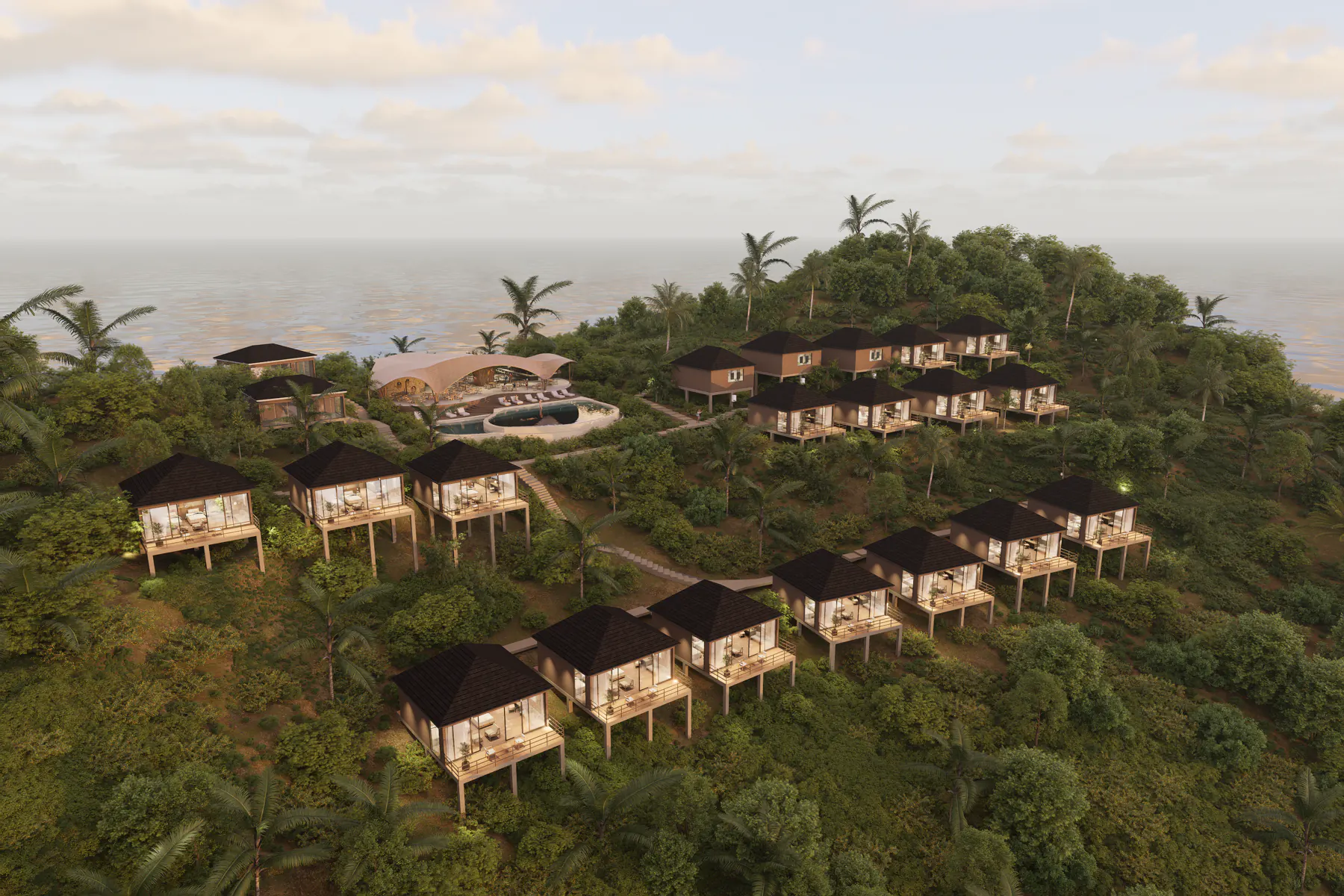
Staying at the resort inverts most of it. You get your own bathroom with a door, a room you return to between dives rather than a bench on a deck, somewhere to rinse and dry things privately, and a bed on solid ground at the end of the day. You are also about thirty minutes from Labuan Bajo by boat, which means a pharmacy is a reachable errand rather than a fantasy. Our Komodo Resort facilities cover the rest of what is on the island, and there is a house reef straight off the beach for a day when you would rather potter about in shallow water than get on a boat at all.
That last option deserves saying out loud, because people forget it exists. A bad first day does not have to mean a lost day. Snorkelling over the house reef, a hammock and a book, and a proper dive tomorrow is a perfectly good use of a Komodo holiday.
Cramps, Painkillers and the Dehydration Trap
Ibuprofen and paracetamol are both fine to dive on, and neither is a barrier at the desk. What deserves a moment's thought is what else is going on around them.
Dehydration is a mild independent risk factor for decompression illness, and a tropical dive day is already dehydrating: heat, sun, salt, breathing dry compressed gas, and the diuretic effect of being immersed. Add a hot boat deck and it stacks up quietly. Drink more than you think you need, and go easy on coffee in the morning and alcohol in the evening. Our piece on drinking and diving explains why the evening half of that matters more than most divers admit.
The one thing we would avoid is a strong sedating painkiller or anything that makes you drowsy before a dive. Not because of any interaction with pressure, but because feeling foggy at twenty metres in a Komodo current is its own problem. If a cramp is bad enough to need something that strong, that is a good day to take the boat trip and skip the dive.
Ears That Will Not Clear That Week
This one comes up often and has nothing to do with decompression. Fluid retention in the days before a period can bring mild nasal and sinus congestion, and a lot of divers report their ears clearing less easily that week. This is widely described rather than firmly established, so treat it as something to watch rather than a rule.
The response is the ordinary one. Start equalising at the surface before you go down, descend slowly, go feet first if it helps, and stop if it is not working. Our guide on how to equalize your ears when diving runs through the techniques properly. A blocked ear is the single most common reason a guest here pauses diving mid-trip, and it is very largely preventable with a slower descent and a bit of patience. Forcing it is how people lose the rest of the week.
The Pill, the Coil and the Implant
The theory was reasonable: hormonal contraception affects fluid retention and venous tone, which could in principle slow nitrogen offloading. It has been examined for over thirty years and nobody has managed to demonstrate it. DDRC's own summary is that the jury is still out on oral contraception and decompression risk overall, which is a fair description of a literature that keeps failing to find a clear effect.
The other figure that circulates comes from the same 956-diver review: 85 per cent of the injured divers who were on oral contraceptives were menstruating at the time. It reads alarmingly and it has the same flaw as its sibling statistic. It describes the timing of injuries inside one group rather than that group's risk against anyone else, and plenty of people on the pill deliberately shift or skip their bleed, which makes cycle-day analysis unreliable in exactly this population.
Practically: hormonal contraception is not a barrier to diving and does not need a doctor's sign-off before a trip. If you would like to trim your exposure during your period anyway, every conservative option listed earlier is available to you. We will tell you honestly that the evidence behind that choice is weak, and we will also set your day up that way without argument if you ask.
The Interaction Nobody Mentions
Here is the one that actually catches people out, and it has nothing to do with bubbles. If you are being sick, an oral contraceptive pill may not be absorbed, and the same is true of severe diarrhoea. Most pill leaflets give a window, commonly a couple of hours, inside which vomiting means that dose should be treated as missed.
Now put that next to a Komodo itinerary. Crossings in this park can be lively, particularly repositioning past the southern capes or on a windy day in the wet season, and our guide to seasickness on Komodo boat trips makes the point that once vomiting starts, tablets have a habit of not staying down long enough to help. That applies to your contraception exactly as it applies to the anti-emetic. If seasickness is a known quantity for you and you are relying on the pill, that is a conversation to have with your pharmacist before you fly, not something to work out on day three.
Skipping a Period for the Trip
Guests ask this fairly often, usually about a trip they have waited years for, and it is a completely legitimate thing to want. It is also a decision for your own doctor or pharmacist, made weeks before you fly rather than improvised here.
Broadly there are two ordinary routes. If you take a combined pill, running packs back to back to skip the withdrawal bleed is common practice, and your prescriber can tell you whether yours suits it. If you do not use hormonal contraception, a short course of a period-delaying tablet is something GPs and many pharmacists prescribe for exactly this situation, usually started a few days before the bleed is due. Neither is something to start for the first time on the day you get on a boat.
Pregnancy: The One Clear No
Every training agency and every diving medicine body we are aware of says the same thing, and so do we, without exception: do not dive while pregnant, at any stage, or while actively trying to conceive. We will not certify a pregnant diver and we will not take one on a fun dive. It is worth understanding why, because the reasoning is specific.
The honest starting point is that there is very little research, for the obvious ethical reason that nobody is going to run a controlled trial. Animal work is conflicting. What exists is a set of mechanisms that all point the same way. Fluid distribution changes in pregnancy, which alters how dissolved gas moves in the central circulation. Nasopharyngeal swelling is common, which makes ear and sinus barotrauma more likely. Morning sickness on top of a rocking boat is its own hazard, since being sick underwater is dangerous rather than merely unpleasant.
The argument that settles it, though, is about treatment rather than the dive. There is a baseline rate of decompression illness in diving that no amount of care removes. If a pregnant diver needs recompression, the fetus is committed to that treatment too, and the consequences of a hyperbaric schedule for a developing fetus are not something anyone can consent to on its behalf. That is a different kind of risk from the ones divers normally accept, and it is why the guidance has no grey zone in it.
What You Can Still Do Here
An uncomplicated pregnancy does not mean staying at the hotel. Snorkelling is a physiologically different activity, with no compressed gas and no meaningful pressure loading, so the mechanism that rules out diving does not apply. It is generally regarded as fine in a straightforward pregnancy with sensible limits: stay shallow, skip breath-hold descents, be careful about overheating and dehydration, and be realistic about current and about getting in and out of a boat in swell. Our comparison of snorkeling vs diving in Komodo sets out what you would actually see, and the honest answer is that the mantas at Karang Makassar are a snorkelling highlight rather than a consolation prize. The Komodo snorkeling trips run to the same reefs the divers visit.
The separate question, and the one we would rather raise than skirt, is remoteness. Being pregnant on Sebayur Island is a different matter from being pregnant in a city. We are a boat ride from Labuan Bajo and the hospital there, which is far better than a liveaboard three days into the far south, but it is not a maternity unit around the corner. A straightforward second-trimester pregnancy with your obstetrician's agreement and insurance that genuinely covers you is a reasonable trip. The first trimester, or anything complicated, is not the moment. Check the policy wording specifically, since many travel insurers cut off cover past a certain gestational week, and note that airlines want a fit-to-fly letter late on and decline travel near term.
If you tell us at the contact stage, we can be straight with you about how far a given plan sits from help.
Coming Back to Diving After Giving Birth
The usual guidance runs roughly like this. After an uncomplicated vaginal delivery, obstetricians generally advise avoiding immersion for about three weeks so the cervix can close, which makes four weeks a sensible rule of thumb before diving. After a caesarean, wound healing and the weight of dive gear both come into it, and at least eight weeks is the common advice. Any significant complication, from pre-term labour to hypertension, pushes that out further and makes a medical clearance worth having rather than optional.
There is a point DAN makes that we would repeat, because it is the one people underestimate. Looking after a newborn is a sustained stretch of broken sleep, and fatigue does more to how a first dive back feels than almost anything else on the list. Clearance to dive is clearance for a dive. It is not the same request as a full Komodo week with three or four dives a day in current.
Which is a reasonable argument for making your first trip back a resort-based one. You can do two dives and stop, take a day off without forfeiting anything, and sleep in a proper bed. If it goes well you can load the week up. Our guide to learning to dive in Komodo is written for beginners, but the pacing advice in it applies just as well to a comeback.
On breastfeeding, the answer is a straightforward yes, and the physics is simple. The nitrogen you absorb from compressed air is inert, plays no part in metabolism, and washes out quickly after a dive. Whatever trace reaches breast milk is insignificant, and there is no mechanism by which an infant would accumulate it. The only caveat is the practical one: hold off if you have any breast infection or inflammation.
What to Tell Us, and When
Nothing in this article needs raising at the desk in front of other guests. A message works, and it reaches the same people.
The things genuinely worth telling us in advance are short. If you would like a thicker wetsuit, say so and it will be waiting. If you would rather not fight a current on a particular day, tell your guide at the briefing and the site choice can quietly accommodate it. If you are pregnant, we need to know because it changes what we can take you on. If you are coming back after a birth, tell us so we can pace the first day properly. And if you would rather move a dive day by twenty-four hours, we will move it, without a fee and without asking why.
If you are still deciding when to come, our guide to the best time to visit Komodo Island covers the seasons, and it is worth reading alongside this one: the southern sites that get cold are also the ones that are best in the dry season, which is exactly when you might want that 5 mm suit. And if you are travelling by yourself, our guide to solo travel in Komodo deals with the rest of the practicalities.