There is a photograph of Rangko Cave that does a great deal of work in Labuan Bajo's tourism. A shaft of sunlight drops through a hole in a limestone roof into a pool of impossibly clear turquoise water, someone floats in the middle of it, and the whole chamber glows. It is a real photograph of a real place, roughly an hour from town, and you can absolutely swim in that pool.
What the photograph does not tell you is that the light only does that for about half an hour a day, that the half hour moves through the year, that it does not happen at all under cloud, and that a good share of visitors arrive at ten in the morning and float around in a dim grey cave wondering what everyone was talking about. The cave is worth visiting. It is worth visiting at the right hour, and that single piece of planning is the difference between the best half day you spend off the boat and a mildly damp anticlimax.
We run a dive resort in the Komodo archipelago, and Rangko is the land trip our guests ask about most, partly because it is close and partly because it is the one thing on the mainland you can do without giving up a dive day. This guide covers what the cave actually is, how to get there from Labuan Bajo and from inside the park, how the light really works, what it costs in 2026, how deep the pool is and what to watch out for on the way down to it, and the one scheduling advantage it has over every other trip in this region.
What Rangko Cave Actually Is
Rangko Cave, or Goa Rangko in Indonesian, sits on the coast north of Labuan Bajo, near the small village of Rangko in the Boleng district of West Manggarai. It is a limestone sea cave, and the distinction matters more than it sounds.
Most caves you can swim in are freshwater, carved by an underground river. Rangko is not. The pool at the bottom of the chamber is seawater, connected to the ocean through cracks and channels in the limestone bedrock, which makes it a tidal cave: the water in it is the same water as the bay outside, arriving by a slower route. That is why it is warm, why it is startlingly clear, and why you float in it more easily than you expect.
The chamber itself is a proper cave. Stalactites hang from the ceiling and drip continuously, a heavy pole-like stalagmite stands near the water's edge, and the air is humid enough to fog a camera lens the moment you carry it down. There is no artificial lighting of any kind. Everything you see inside is daylight that has found its way in through the opening above.
Manage your expectations on scale. This is a single chamber, not a cave system. You are not exploring for hours; you are climbing down into one beautiful room, swimming in it, and climbing back out. An hour inside is a generous visit.
Getting There From Labuan Bajo
The trip is three short stages, and the whole thing takes about an hour each way.
Stage One: The Drive to Rangko Village
From Labuan Bajo it is a 30 to 45 minute drive north to Rangko village, by car with a driver or by scooter. The road is mostly in reasonable condition these days, though it gets rougher and less predictable in the wet season. Rangko is a quiet coastal settlement with a pier, and it is the last point reachable by road.
Stage Two: The Boat Crossing
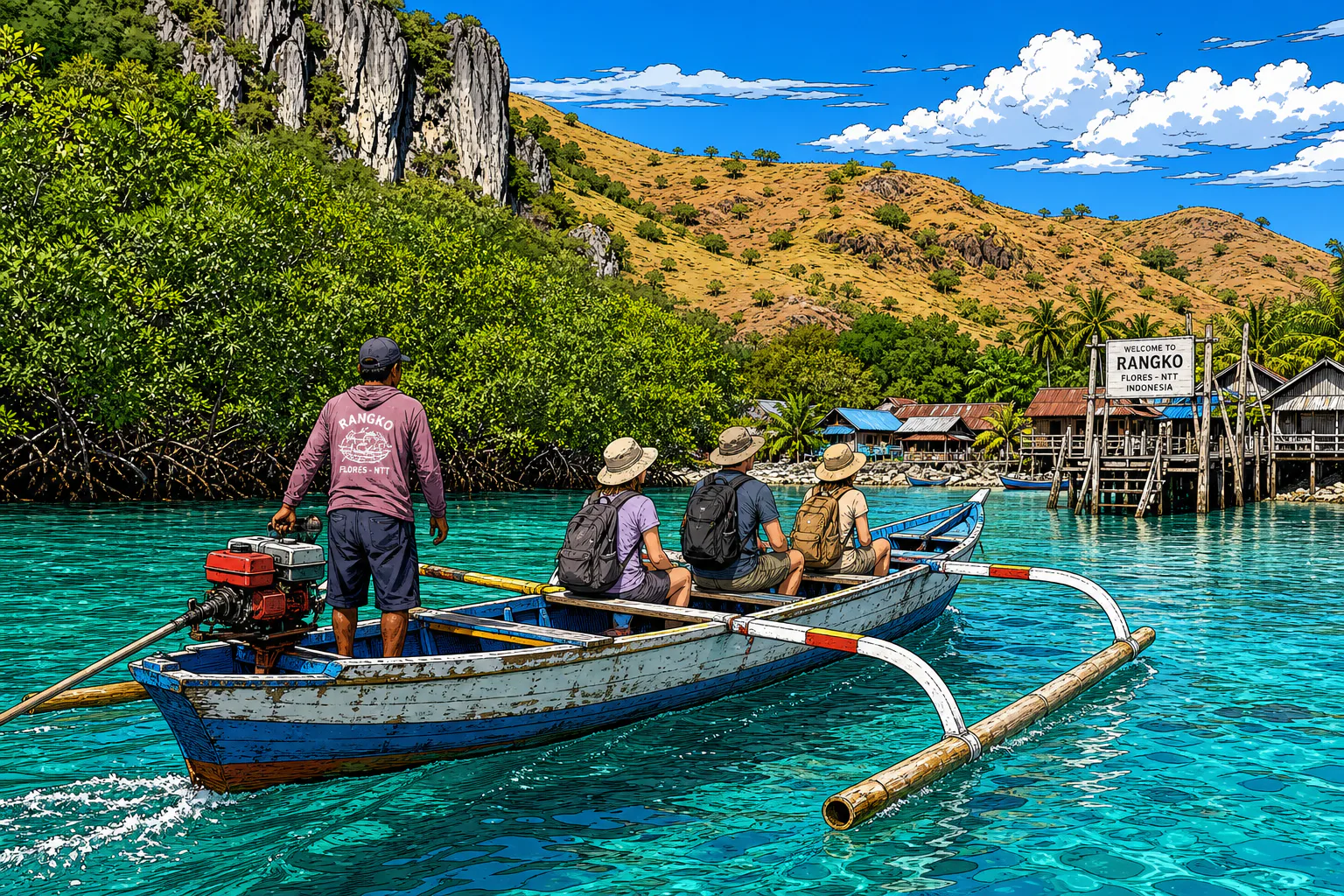
From the village pier a small wooden outrigger takes you across a calm, mangrove-lined bay in roughly 10 to 20 minutes. These are working local boats: functional, noisy, and entirely adequate for a sheltered crossing. They typically carry up to five people, and your boatman waits while you visit rather than dropping you and leaving.
Prices are negotiated at the pier, and the first number quoted will not be the last. This is normal and good-natured, but see the costs section below so you know roughly where to land.
There is a second option worth knowing: you can charter a boat directly from Labuan Bajo harbour and go the whole way by sea, which takes about 50 to 70 minutes along the coast. It costs meaningfully more than the drive-and-crossing combination, but it removes a transfer and it is a pleasant run.
Stage Three: The Walk and the Descent
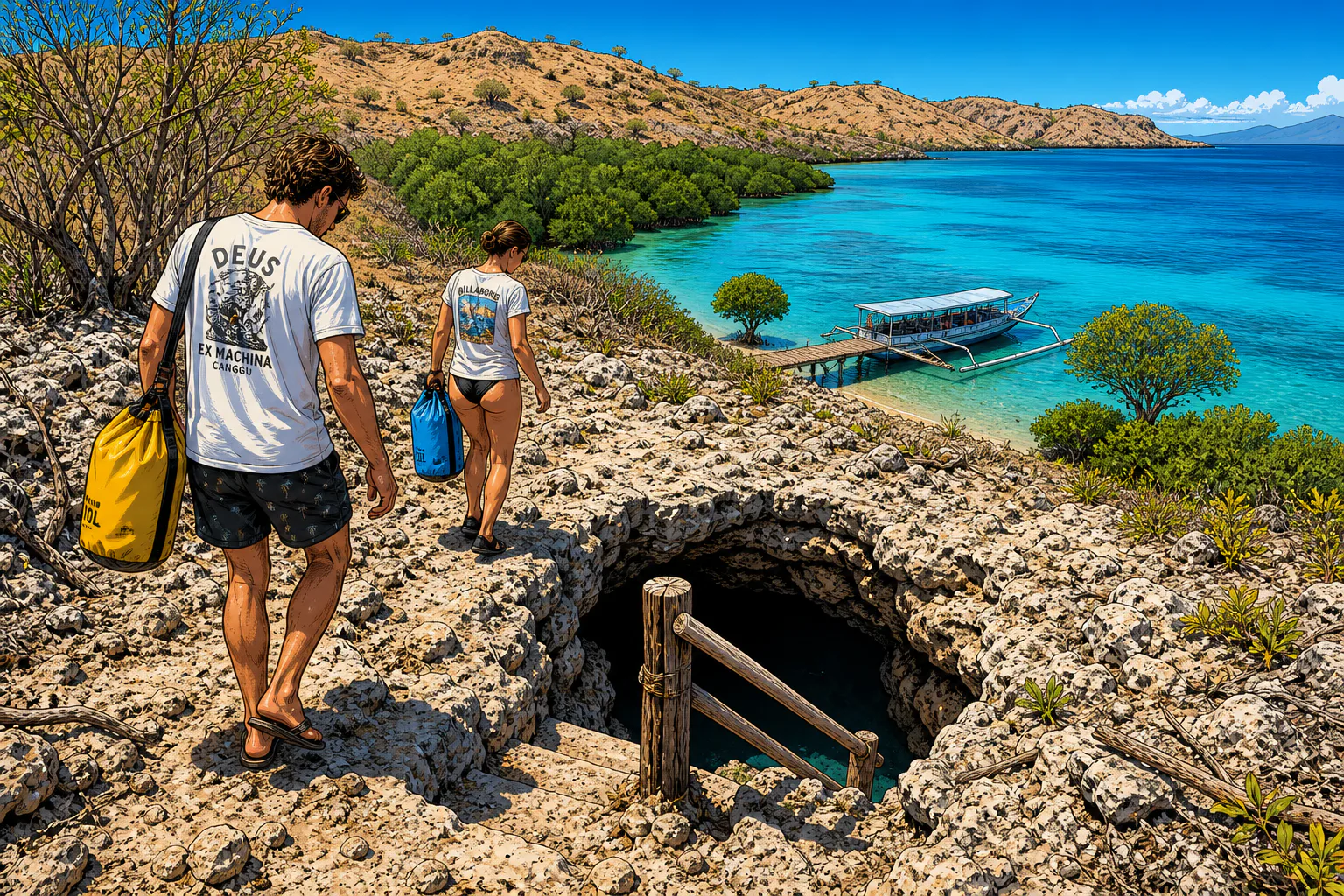
The boat lands at a small beach with a jetty, where you pay the entrance fee at a ticket booth. From there it is a five to fifteen minute walk over rocky ground to the cave mouth, which is an unremarkable opening in the ground roughly two by three metres. Nothing about the outside prepares you for the inside, which is a large part of the appeal.
Then you go down. There are natural calcite steps with a wooden railing, and they are permanently wet from the dripping ceiling. Read the safety section before you do this bit, because the steps are the single most hazardous part of the entire outing.
Getting There If You Are Staying Inside the National Park
If you are based in the archipelago rather than in town, as our guests are, add a leg. Rangko is on the Flores mainland, so you first need your boat transfer into Labuan Bajo, then the drive and the crossing. In practice that makes Rangko a half to three-quarter day commitment rather than the two-hour excursion it is for someone staying in town.
It is still very doable, and it is one of the few mainland trips we would actively recommend fitting in, but it wants to be planned into a specific day rather than improvised. Our guide to where to stay in and around the national park explains the geography that drives this, and if you are with us, talk to the front desk the day before so the timing lines up with both the boat schedule and the light.
The Light, and Why Most Visitors Miss It
Here is the part that decides whether your trip succeeds.
The glowing turquoise pool is a lighting effect. Sun has to be high enough and at the right angle to come through the opening and hit the water, and when it does, the pool lights up from within and the whole chamber turns blue. When it does not, you are looking at dark, clear, perfectly pleasant water in a dim cave.
The usable window is roughly midday to mid-afternoon, about 12pm to 3pm. Within that, the genuinely spectacular light lasts around half an hour, and the exact timing drifts through the year with the sun's angle. Local operators and boatmen know the current timing far better than any website, so ask at the pier or ask someone who went in the last few days, and build your departure around their answer rather than around a generic recommendation.
Two more honest points. Cloud cancels it: no direct sun, no glow, regardless of the hour. And the same window that produces the light produces the crowds, because everyone is working from the same information. If a quiet cave matters more to you than the blue water, go outside the window deliberately and enjoy a peaceful swim in ordinary light. That is a legitimate choice, and it is the one many repeat visitors make.
Tides, and Why They Matter Here
The Komodo region has a large tidal range, which is exactly why its dive sites have the currents they are famous for, covered in our guide to diving in Komodo. Those same tides reach into Rangko.
Because the pool is connected to the sea, its level moves with the tide, and the shallow bay crossing and the beach landing are tide-dependent too. This rarely cancels a trip outright, but it does mean a local boatman may tell you a particular hour is a poor idea, and when that happens the correct response is to believe him. It also means the drop from the last step to the water is not the same on every visit, which matters if you were planning to jump.
What It Costs in 2026
Rangko is one of the better value outings in the region, particularly if you are a group of three or more, because the boat is charged per boat rather than per person.
- Cave entrance fee: around IDR 50,000 per person, paid in cash at the booth by the jetty.
- Boat charter from Rangko village: commonly IDR 200,000 to 500,000 per boat for up to about five people, with IDR 250,000 to 300,000 a typical settled price. Negotiate politely at the pier.
- Scooter rental: around 10 US dollars a day.
- Car with driver: more, but it is the sensible option if you are not a confident rider.
- Organised tour from Labuan Bajo: roughly 45 US dollars per person, including transport, boat, fees and a guide.
- Doing it independently: roughly 36 US dollars per person all in, on the scooter-and-charter model.
Bring cash in small rupiah notes. There is no card payment anywhere in this chain, no ATM in Rangko village, and no way to settle up later. Draw what you need in town before you set off; our guide to money and ATMs in Labuan Bajo covers which machines to trust.
Swimming in the Pool
Swimming is the whole point, and it is genuinely lovely. The water is warm, clear enough to see the rock below you, and salty enough that floating takes no effort at all.
The pool averages around three to four metres deep, so this is out-of-your-depth swimming rather than paddling. Non-swimmers and weak swimmers should wear a life jacket, and chartered boats generally carry them; confirm that before you leave the pier rather than discovering it at the bottom of the steps.
That prominent stalagmite near the edge functions as an unofficial jumping platform, and people use it. If you are going to, check the water below you first, every single time, because the level changes with the tide and there is rock down there in places. A tidal pool is not a swimming pool and it does not have a fixed depth.
The chamber is dim and the water is dark once you are away from the light shaft, which some people find magical and others find unnerving. Both reactions are reasonable. There is no lifeguard, no supervision and no mobile signal inside the cave, so swim within yourself and do not go alone.
Safety: The Steps Are the Real Hazard
Nothing about Rangko is dangerous in the way a strong current or a volcano rim is dangerous. The risk here is mundane and entirely avoidable: it is a slip.
The descent is over natural calcite steps that are permanently wet, because the ceiling above them never stops dripping. There is a wooden railing and you should use it. Wet limestone is genuinely slick, more so than it looks, and it does not forgive a casual approach with a phone in one hand. The approach path from the beach is rocky and sharp in places too, which is why proper footwear matters more here than at any beach you will visit in Flores.
Take your time on the way down, take even more on the way up when you are wet, and carry nothing in your hands that you are not willing to drop. If you are travelling with children, this trip is fine with genuinely close supervision on the steps and life jackets in the water, and our Komodo with kids guide covers what tends to work at what age. Toddlers are a bad fit for those steps.
There Are No Facilities. None.
This surprises people, so it is worth being blunt: at the cave there are no toilets, no changing rooms, no food, no drinks and no shade to speak of. The nearest anything is back in Rangko village.
The practical answer is to wear your swimwear under your clothes before you leave town, use the facilities at the village pier before boarding, and bring your own water. You will be changing on a boat or behind a rock otherwise, and doing so while damp, salty and out of drinking water is an avoidable way to end an otherwise excellent morning.
What to Bring
- Swimwear worn under your clothes, and a quick-dry towel.
- Footwear with grip that you can get wet. Water shoes or sport sandals. Not flip-flops, and not your only dry shoes.
- Cash in small notes for the fee and the boat.
- Drinking water and a snack.
- A dry bag. The cave is humid, the ceiling drips constantly, and the boat is wet. This is the single most useful thing on the list.
- Sun protection for the drive and the open boat, which is where you will actually catch the sun.
- A headtorch if you want to look properly at the rock away from the light shaft.
Leave anything precious and non-waterproof behind. The humidity inside is hard on electronics even when nothing gets splashed, and our Komodo packing guide covers dry bags and gear protection for the region generally.
When to Go
The dry season, roughly April to September, gives the most reliable sun, the calmest crossing and the best road, and it lines up with the best conditions in the park, covered in our guide to the best time to visit Komodo. In the wet season the road deteriorates, the crossing is less certain, and cloud makes the light effect a lottery.
Within the day, you already know the trade-off: midday for the light and the crowds, outside it for the quiet and no glow. The cave is generally open from around half past six in the morning until six in the evening, so there is room to choose.
One last piece of timing advice: do not make Rangko the last thing you do on a day when you have a flight. It is not far, but it involves a boat, a negotiation and a road, and any of the three can run long.
If You Are Diving, This Is the Easy One
Here is Rangko's quiet advantage, and it is the reason we recommend it above the more famous mainland trips for guests who are diving.
Rangko is at sea level. Unlike Wae Rebo at 1,200 metres or the Kelimutu crater lakes at 1,639 metres, it involves no ascent to altitude, so it creates no decompression problem whatsoever. There is no waiting period to observe, no arithmetic to do with your surface intervals, and no conversation to have with your dive guide. You can dive in the morning and float in Rangko in the afternoon.
That also makes it close to the ideal activity for a no-fly day. If you have finished diving and you are waiting out the 12 to 24 hours before your flight, as explained in our guide to flying after diving, Rangko fills that day nicely: it is a swim, not a dive, and it takes you nowhere near altitude. Just leave a comfortable margin before you need to be at the airport.
One sensible caveat. Swimming in a three to four metre pool is not diving and poses no decompression issue, but if you are the sort of person who free-dives to the bottom repeatedly, treat that as breath-hold diving and apply the usual common sense about doing it on the same day as scuba.
Is Rangko Cave Worth It?
Yes, with conditions, and the conditions are the entire point of this article.
It is worth it if you go between roughly noon and three on a sunny day, if you accept that you are visiting one chamber rather than exploring a cave system, if you bring cash and grippy shoes and a dry bag, and if a warm, clear, weirdly buoyant swim in an unusual place is the thing you are after.
It is not worth it if you are chasing a specific photograph and your schedule only allows a morning visit, if you were expecting facilities, or if the idea of climbing down slick wet steps in a dim cave sounds like a chore rather than an adventure. And it is genuinely not the best use of a short trip: if you have three days in Komodo, spend them on the water. Our guide to things to do in Komodo and the Komodo itinerary guide set out what earns a place on a compressed schedule, and Rangko is a bonus rather than a headline.
Where it really shines is as the answer to a specific question: what do I do with a day when I am not diving, or cannot dive, and do not want to spend another eight hours on a boat? For that, in this region, Rangko is close to unbeatable.
Combining Rangko With Other Things
Because the cave itself takes an hour, most people build a half day around it. The obvious companion is Cunca Wulang, the canyon and waterfall inland of Labuan Bajo, though that is a proper walk and swimming trip in its own right and the two together make a long day. Closer to town, the Batu Cermin mirror cave is a short and easy add-on, and there are beaches near Rangko where boatmen will happily stop for a swim or a picnic if you ask.
Update: Cunca Wulang has been closed to visitors since May 2026, after a footbridge on the approach collapsed and two tourists died. The Manggarai Barat authorities suspended tourism at the site indefinitely and no reopening has been announced, so confirm its status locally before planning a visit.
If Rangko has given you a taste for the mainland, the wider island is covered in our guide to Flores, and the town end of things in the Labuan Bajo travel guide. For land legs that go further, Wae Rebo and Kelimutu are the two big ones, and both need considerably more planning than this.
How Rangko Fits a Komodo Trip
The shape that works, in our experience: give the water your best days. Dive, see the dragons, climb Padar at sunrise, do the park properly. Then use Rangko for the day that does not fit that pattern, whether it is a rest day, a weather day, a non-diving partner's day, or the no-fly day before you go home.
Slotted there, it costs you nothing you wanted to be doing anyway, it takes half a day, and it is completely unlike everything else on the itinerary, which is exactly what you want from a change of pace. Slotted anywhere else, it competes with the reason you came, and it will lose.
If you are staying with us and want help fitting Rangko around your dive days and the boat schedule, get in touch and we will sort the timing, including aiming you at the right hour for the light rather than the convenient hour for the transfer.