In September 2003, in a limestone cave in the highlands of Flores, a team of Indonesian and Australian archaeologists dug down through six metres of sediment and found the skeleton of an adult woman who stood about a metre tall and had a brain the size of a chimpanzee's. She was not a child, not a dwarf modern human as far as most researchers can tell, and not any species anyone had described before. The press named her the hobbit within days. Her cave, Liang Bua, sits a short drive north of Ruteng, in the middle of the island most of our guests fly over on their way to a Komodo island vacation.
This is the strangest thing that has ever been found in Indonesia and one of the strangest in the history of palaeoanthropology, and it happened about four hours' drive from the harbour at Labuan Bajo. Almost nobody who comes to dive with us at our Komodo dive centre knows they can go and stand in the room where it happened, which seems a waste, because you can, for the price of a taxi fare, and there is a small museum at the mouth of the cave.
There is a second reason to write this down carefully. The popular version of the hobbit story is out of date, and confidently so. You will still read that these people survived until 12,000 years ago, which the excavators themselves withdrew a decade ago. You will read that the whole thing was a diseased modern human, a claim that has been made four different ways and rejected four different times. And you will read that the short-statured villagers who live near the cave are their descendants, which a genome study has ruled out. What follows is what the published research actually says, and how to go and see the place.
What Was Actually Found
The skeleton is catalogued as LB1, and it is the type specimen of Homo floresiensis, the species described in Nature in October 2004. The excavation team credited with the find included Wahyu Saptomo, Benjamin Tarus, Thomas Sutikna, Rokus Due Awe, Raden Soejono and the New Zealand-born archaeologist Mike Morwood, who co-led the work and died in 2013 before the dating of his own site was overturned.
LB1 is remarkably complete for a hominin: most of a skull, leg bones, parts of the pelvis, hands and feet. She is thought to have been female and about thirty when she died. She stood roughly a metre tall, weighed something like 25 kilograms, and her braincase measures between 380 and 430 cubic centimetres depending on whose method you use, with a high-resolution micro-CT scan putting it at 426 cc against the 400 cc figure that gets quoted everywhere. For comparison, your own brain is somewhere around 1,300 cc. Hers was in the range of a chimpanzee.
Two details tend to get lost. The bones are not fossilised, which is part of why the early dates looked so recent: they are old bone, not stone. And she was not buried. The body was covered soon after death by fine sediment while still partly fleshed, which is the sort of accident that preserves a skeleton in one piece.
What makes her a species rather than a curiosity is the combination. A brain that small in a body that small, with relatively large teeth, pronounced brow ridges, long flat feet and a wrist bone shaped more like an ape's than ours, is not what a shrunken modern human looks like. And crucially, she is not alone: fragmentary remains of other individuals have come out of the same cave, and they are small too.
The Date Almost Everyone Still Gets Wrong
This is the part worth reading even if you already know the story.
When LB1 was announced, the layer she came from was dated to about 18,000 years ago, and other fragments in the cave were thought to be as recent as 12,000 years. That was extraordinary. It meant a second kind of human had been living on Flores while our own ancestors were painting caves in Europe and had already reached Australia, and it produced the irresistible idea that the hobbits might have survived into the era of human memory.
It was wrong. Eight more seasons of excavation between 2007 and 2014 showed that the original sample had come from a remnant pedestal of much older sediment, with younger material banked against it in a way that made the sequence look simpler than it was. In 2016 the same team published a revised chronology in Nature: the skeletal remains of Homo floresiensis date to between about 100,000 and 60,000 years ago, and the stone tools attributed to them run from roughly 190,000 to 50,000 years ago.
So the hobbits were gone from that cave by about the time modern humans were moving through the islands towards Australia, rather than 40,000 years later. Whether the two ever met on Flores is genuinely unknown and the excavators say so. I find the correction more interesting than the original claim, because it is a rare public example of a research team dismantling its own headline finding, in the same journal, with better evidence.
The practical point for a reader: if a website, documentary or guide tells you these people were alive 12,000 years ago, it has not been updated since 2016. Treat everything else it says with the same caution.
Was It Really a New Species?
From the beginning a minority of researchers argued that LB1 was simply a small modern human with something wrong with her. That argument has been made in at least four forms: microcephaly, endemic hypothyroidism, Laron syndrome, and, most persistently, Down syndrome. Each has been examined in detail and rejected by most specialists in the field, including a 2016 evaluation in PLOS One that went through the Down syndrome case trait by trait and found that the features cited either are not diagnostic of the condition or are not present in the fossil.
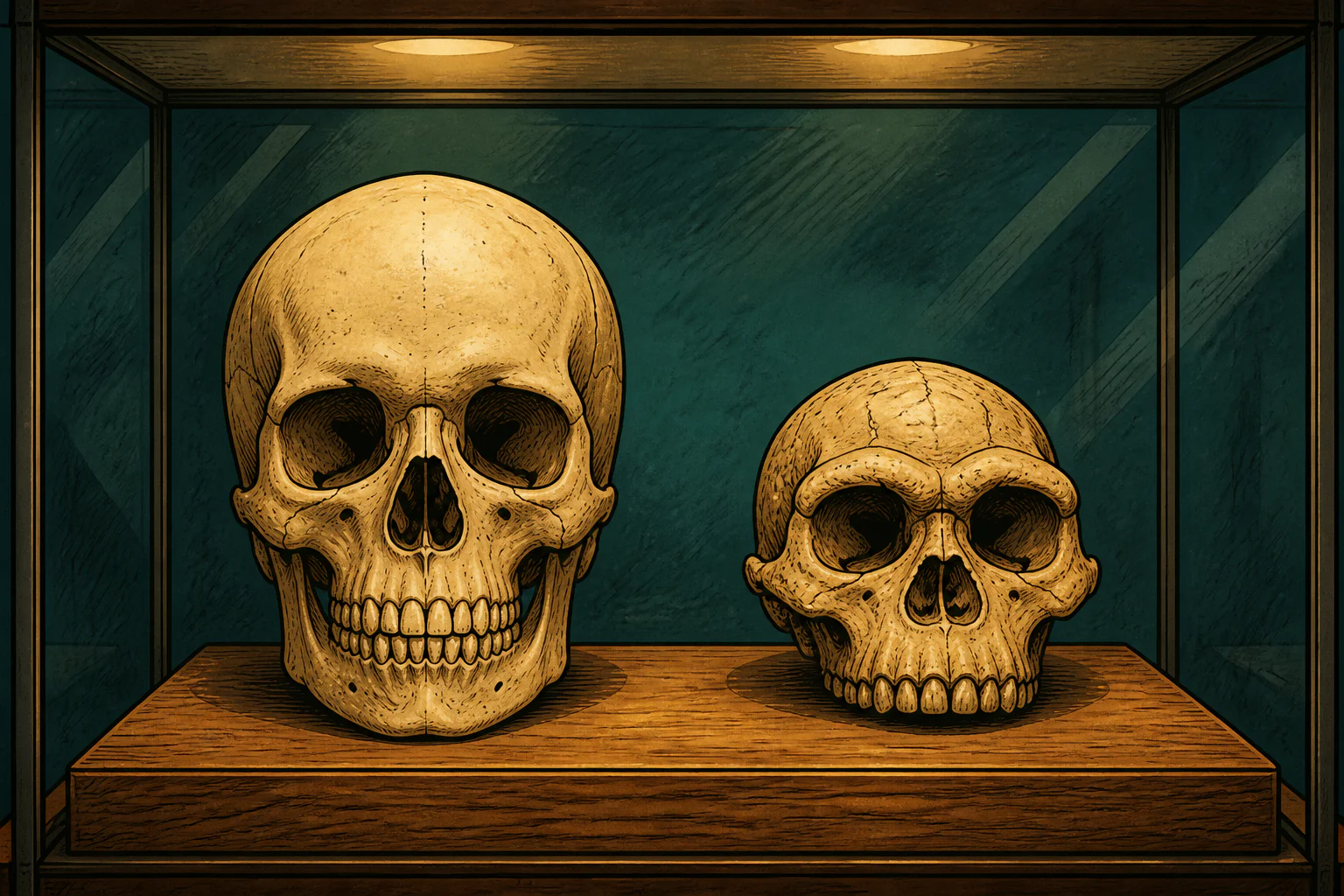
The 2016 re-dating also quietly weakened the pathology argument in a way that is easy to miss. If the bones are 60,000 years old or more, they predate any evidence of modern humans in the region, so a diseased member of a modern human population is a harder thing to argue. A handful of researchers, principally Maciej Henneberg and Robert Eckhardt, continue to press the Down syndrome interpretation, and it would be dishonest to pretend the dissent does not exist. But it is a minority position, and the consensus is that Flores had its own species of human.
One thing that would settle it is not available. No DNA has been recovered from the Liang Bua remains: the tropics are about the worst environment on earth for preserving genetic material, and the bones have so far yielded nothing usable. Everything we know comes from the shape of the bones and the ground they were found in.
Where the Hobbits Came From
Flores has been occupied by toolmaking hominins for around a million years, which is far longer than the hobbit story itself. The interesting question is what happened to them in between, and the answer came from a completely different site.
Mata Menge lies in the So'a Basin about 75 kilometres east of Liang Bua, in open grassland near Bajawa. It is the only other place on Flores where hominin fossils have been found. In 2016, excavations there produced a jaw fragment and six teeth from deposits about 700,000 years old, already strikingly small. Then in 2024, a team led by Yousuke Kaifu published something better: the shaft of an adult upper arm bone from the same layer, initially mistaken for a reptile bone and later identified in a museum in Bandung.
It is tiny. Estimated at 9 to 16 per cent shorter and thinner than the equivalent bone in LB1, it implies an adult standing about 100 centimetres tall, and it is the smallest adult limb bone known from anywhere in the hominin fossil record. The conclusion is that the lineage was already extremely small 700,000 years ago, and that the shrinking most likely happened from large-bodied early Asian Homo erectus somewhere between about a million and 700,000 years ago, quite quickly in evolutionary terms, after they became stranded on the island.
Island dwarfing is a well-documented phenomenon: put a large mammal on an island with limited food and no serious predators and it tends to get smaller over generations, which is also how Flores ended up with a pygmy elephant. What Liang Bua showed is that it can happen to us too. The Philippines has since produced a comparable case in Homo luzonensis, so Flores is no longer quite the outlier it was in 2004.
How Did They Get There At All?
This is the question that turns the hobbits from a curiosity into a genuine problem, and it is the one I would ask a palaeontologist first.
Flores lies east of the Wallace Line, the biogeographic boundary running between Bali and Lombok that separates Asian animals from Australasian ones. It exists because the strait there is deep. During the ice ages, when sea levels dropped far enough to join Sumatra, Java and Borneo to mainland Asia in one continuous landmass, Flores stayed an island. There has never been a walkable route to it.
Which means that whoever left those million-year-old stone tools crossed open water to get there, and so did the pygmy elephants, and so, eventually, did the ancestors of the Komodo dragons. For a hominin a million years ago, with no evidence of boats anywhere in the record, that is a startling thing to have managed. The usual explanation is that they did not manage it deliberately at all: tsunamis and storms strip vegetation off coastlines and send rafts of it out to sea, and over a long enough period some of those rafts arrive with passengers. It is an unglamorous mechanism for a dramatic outcome, and it also explains why the islands of this region ended up with such odd, patchy collections of animals.
The same deep water is why the whole region is strange. Wallacea, the belt of islands that includes Flores, Sumbawa, Sulawesi and Komodo, is a place where things arrived rarely, by accident, and then evolved on their own for a very long time. A metre-tall human is exactly the kind of thing that happens under those conditions, and so is a three-metre lizard.
The Lost World in the Same Cave
The hominin bones are the headline, but the rest of the animal remains from those deposits read like an invented island.
Alongside the hobbits, Liang Bua produced the bones of Stegodon, a pygmy relative of the elephant, which the tool marks suggest was being hunted. There were rats the size of rabbits. There was a marabou stork so large it stood taller than the people, and a vulture. And there were Komodo dragons, which is the detail that closes the circle for anyone reading this on our website: the same animal you can go and watch in the national park was sharing an island, and evidently a cave system, with a species of metre-tall human.
That is worth sitting with for a second. Everything we tell guests about the dragons being a relic of an older world is more literally true than it sounds. Our guide to Komodo dragon facts covers what they are and how they got here, and the wider ecology of the park is in our overview of Komodo National Park wildlife.
Ebu Gogo, and What Not to Do With a Legend
Flores has its own folklore about small, hairy, cave-dwelling people called the Ebu Gogo, described in local stories as roughly the size the hobbits were. It has been suggested, cautiously, in the academic literature that these tales might preserve some distant memory of a real encounter, or of a population that survived elsewhere on the island later than at Liang Bua.
It is a wonderful thought and there is no evidence for it. Oral traditions about small forest people are common across the world, including in places where no second species of human ever lived, and the revised dating has put a large gap between the last hobbit tools and any human who could have remembered them. Enjoy the story, ask about it locally, and do not repeat it as fact. The genuine finding is remarkable enough without the embellishment.
The Villagers of Rampasasa
Near the cave is a village whose residents are, on average, notably short, and for years tour operators sold this as a living link to the hobbits. It is not one, and the point matters both scientifically and as a matter of basic decency towards people who are not an exhibit.
A genome study published in 2018 looked specifically for Homo floresiensis ancestry in the population near Liang Bua and found none. What it did find was evidence of selection for short stature acting independently in this group, the same phenomenon seen in other populations around the world. Their height has a modern explanation, and their ancestors arrived on Flores tens of thousands of years after the hobbits had gone. If a guide offers you a visit to see the "descendants of the hobbits", you are being sold something untrue.
How to Visit Liang Bua
The cave is a real, visitable, community-run site rather than a fenced-off dig, and getting there is straightforward if you are anywhere near Ruteng.
Getting there
Liang Bua village sits in the Rahong Utara district of Manggarai regency, about 13 to 15 kilometres north of Ruteng. That short distance takes 40 minutes to an hour, because the road is narrow, steep and slow, and because the drive through the rice terraces is good enough that you will stop. A car and driver from Ruteng for the round trip is the usual arrangement; a motorbike is fine if you ride, and public minibuses run in that direction.
Ruteng itself is three and a half to four hours from Labuan Bajo, which makes Liang Bua a poor day trip from the coast and an easy morning if you are staying in the highlands. The comfortable way to reach Ruteng without a private car is the Gunung Mas shuttle, which is a proper minibus with individual seats that picks up from accommodation and costs on the order of IDR 160,000. Most people see the cave as part of a longer crossing of the island, which we lay out leg by leg in our Flores road trip guide.
What it costs in 2026
Since 2025 the site has been managed by a community tourism group, a Pokdarwis, and tickets are bought at their post rather than at the cave. Foreign visitors pay IDR 80,000, domestic visitors IDR 60,000, Manggarai residents IDR 35,000 and students IDR 20,000. The foreign price is itemised locally as IDR 30,000 to the regional treasury and IDR 50,000 covering a local guide, sarong hire, coffee or tea and a plate of local food, usually tubers and fruit.
That was a roughly threefold increase on the previous IDR 30,000 and it caused audible complaint from guides at the time, so expect the occasional grumble and do not be surprised if the figure has moved again by the time you read this. Set against a day of car hire it is still a rounding error, and the money now stays much closer to the people whose land it is, which seems right.
You may also be offered a Wae Lu'u welcome ritual, a small Manggarai rite of respect for the ancestral dead, with a voluntary donation. It is the same tradition you meet on arrival at Wae Rebo village, and the same etiquette applies: accept graciously, follow your guide, and give something reasonable.
What you actually see
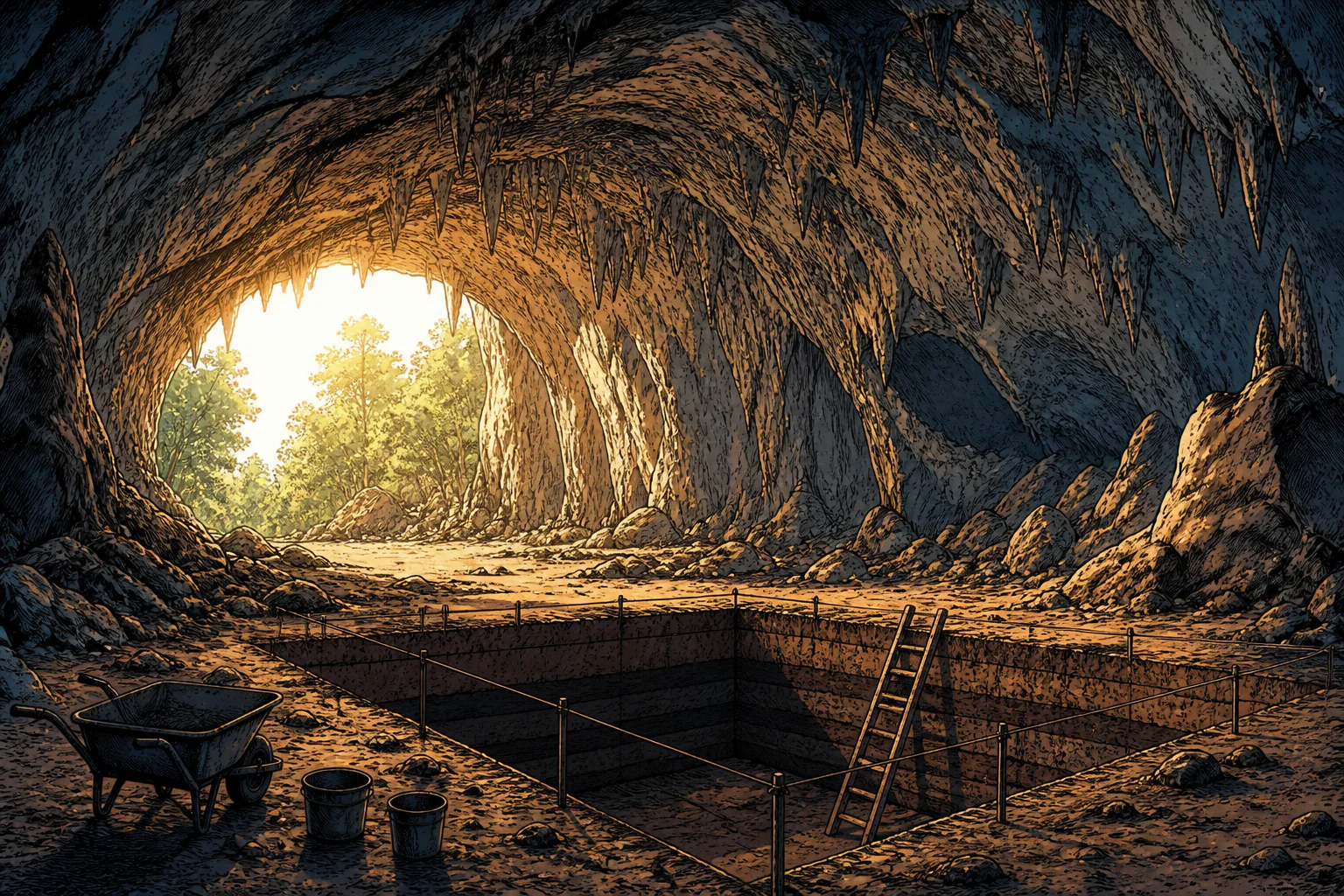
Two things. The cave is a genuinely impressive limestone chamber, high-roofed, cool and bright at the mouth, with the excavation pits marked out so you can see how far down they went and where in the sequence LB1 lay. Six metres is deeper than it sounds when you are standing over the hole.
The other is a small museum by the entrance, which takes about fifteen or twenty minutes and does a decent job with limited means: displays on the excavation, the other hominins, the extinct animals from the same layers. Be clear about one thing before you go, because visitors are sometimes disappointed. The original bones are not here. They are curated by the national archaeology institute in Jakarta, as material of that importance always is, and what you see in the case is a cast. A second cave nearby, Liang Galang, has also been opened to visitors and is usually offered as an add-on.
Go in the morning. It is a community-run site with ordinary daytime hours rather than a monument with reliable published opening times, and arriving early also means someone is around to guide you and the light in the cave mouth is at its best.
Is It Worth Going?
Honestly: it depends entirely on whether standing in the actual place matters to you.
There is not much to look at. A big cave, some marked pits, a modest museum, a cast in a glass case. You can be finished in under an hour. If you need a site to be spectacular, this one is not, and the spider-web rice fields down the road will impress you more.
But if you are the sort of person who finds it extraordinary that for hundreds of thousands of years there was another kind of human being on this island, hunting pygmy elephants and sharing the ground with Komodo dragons, and that we only found out in 2003, then this is one of the great places on earth to stand, and the fact that it is a quiet cave with a tin-roofed museum and a man who brings you coffee makes it better rather than worse. It is also, unusually, a world-famous scientific site with no crowd at all.
Fitting It Into a Komodo Trip
The natural pattern is to dive first and drive second. Komodo rewards flexible dates and good weather, so use your best days in the water and then head inland with whatever time you have left.
From there, Liang Bua slots in as a morning out of Ruteng, ideally combined with the Lingko spider-web rice fields at Cancar, which are a few kilometres the other side of town. Give it a night in Ruteng rather than trying to bolt it onto a drive from the coast. If you continue east, you are within reach of Kelimutu crater lakes, and you will pass close to the So'a Basin near Bajawa where the 700,000-year-old fossils came from, though Mata Menge is a working excavation in open country rather than a visitor site. For how the island fits together as a whole, there is our Flores Indonesia travel guide, and if the geography is still hazy, where Flores Island is untangles Flores, Komodo and Labuan Bajo.
Two practical notes. Ruteng is cold at night by Indonesian standards and our what to pack for Komodo Island list assumes the coast, so add a layer. And the highlands are much better in the dry season, roughly April to November, for reasons our guide to the best time to visit Komodo Island goes into; wet-season landslides are a normal feature of that road.
If you want to do both halves properly, dive the park from the resort and then cross the island, we are happy to help line it up. You can look at the Komodo Resort rooms for the diving half, and get in touch with your dates and we will tell you honestly how much driving fits in the time you have. We can also point you at drivers in Ruteng who know the site.