Komodo's water is 27 to 29°C in the north and centre of the park for most of the year, so a 3 mm wetsuit covers most dives. The exception is the south from June to September, when upwelling drops it to about 21 to 25°C and a 5 mm suit with a hood is the sensible choice.
Komodo is warm water with a cold corner, and the cold corner is where people get caught out. Most of the park sits in the Flores Sea and stays tropical all year, but the south coast faces the Indian Ocean, and for a few months each year deep water rises up the reefs and takes several degrees with it. Diving with a Komodo dive centre means planning for both, because a trip can put you in 29°C water one morning and 23°C water a couple of days later.
Snorkellers feel it less, since they stay in the warm surface layer and rarely meet a thermocline, but a long session still cools you more than you'd expect. On Komodo snorkeling trips in the north and centre, a rash guard or thin shorty is usually all you need, and it doubles as sun protection.
The numbers in this guide come from three places: our own monthly dive log for the central park, published readings from operators who dive the south every season, and satellite studies of the sea around the Lesser Sunda Islands. Where they disagree, we say so.
What is the Komodo water temperature?
Komodo water temperature runs 27 to 29°C in the north and centre most of the year, and drops to about 21 to 25°C in the south from June to September.
- Warm Flores Sea water
- Southern Indian Ocean upwelling
- Thermoclines at depth
- The monsoon calendar
Where you dive matters more than when you go, because the same week can hold a five degree gap between the north and the south.
You'll meet the full range:
- On day dives at the central and northern sites
- On snorkelling tours in Komodo at Manta Point and the central reefs
- On a Komodo liveaboard that crosses to the southern sites
A 3 mm full suit covers most Komodo dives; add a hood or a 5 mm only for the south between June and September.
Surface temperature vs temperature at depth: what is the difference?
Most published figures for Komodo are one of two different measurements, and mixing them up explains a lot of the confusion online.
Sea surface temperature
This is the top layer of the ocean, measured by satellites across wide stretches of coast. It's smooth, reliable and slow to change, which is why satellite studies give a narrow range of 25 to 27°C for the southern coasts of the Lesser Sunda Islands in the cool season.
Temperature at depth
This is what your dive computer reads at 15 or 25 metres on a specific reef. In the south it can sit several degrees below the surface figure, because the cold water arrives from below and gathers in bays and on the deep sides of pinnacles.
Key distinction:
- Surface figures tell you the season; depth figures tell you what you'll feel on the dive.
- Snorkellers live in the surface number, divers in the depth number, so pack for the one you'll actually be in.
Komodo water temperature by month
The table below splits the park in two. The north and centre column covers the sites day boats reach, such as Castle Rock, Crystal Rock, Batu Bolong, Manta Point, Siaba Besar and Tatawa, and brackets our own monthly figures for the central park. The south column covers Manta Alley, Cannibal Rock, Yellow Wall and the bays of south Rinca, and is based on readings published by operators who dive there every season.
| Month | North and centre | South | Suit for most divers |
|---|---|---|---|
| January | 28 to 29°C | 27 to 28°C | 3 mm full suit |
| February | 28 to 29°C | 27 to 28°C | 3 mm full suit |
| March | 28 to 29°C | 27 to 28°C | 3 mm full suit |
| April | 28 to 29°C | 25 to 27°C | 3 mm full suit |
| May | 27 to 29°C | 25 to 27°C | 3 mm, plus a vest for the south |
| June | 27 to 28°C | 23 to 25°C | 3 mm north, 5 mm south |
| July | 26 to 28°C | 21 to 24°C | 3 mm north, 5 mm and hood south |
| August | 25 to 27°C | 21 to 24°C | 3 mm north, 5 mm and hood south |
| September | 25 to 27°C | 21 to 24°C | 3 mm north, 5 mm and hood south |
| October | 26 to 28°C | 24 to 26°C | 3 mm, plus a vest for the south |
| November | 27 to 29°C | 26 to 28°C | 3 mm full suit |
| December | 28 to 29°C | 26 to 28°C | 3 mm full suit |
Treat the south column as a typical range, not a promise. On a strong upwelling day, divers at the deep end of Cannibal Rock report readings below 21°C, and a sharp thermocline can make 24°C at the surface feel like 20°C at 20 metres.
Read the months together with the weather, too. July to September is also when the southeast wind is strongest, which makes the south rough as well as cold and is why many boats route north in those months. Our guide to the best time to visit Komodo Island covers rain, wind and sea state month by month.
Why the south of Komodo is colder: the upwelling
From June to September the southeast monsoon blows steadily along the south coasts of Sumbawa, Komodo, Rinca and Flores. The wind and the Earth's rotation together push the surface water offshore, and cold, nutrient-rich water rises from the deep Indian Ocean to replace it. Oceanographers call this coastal upwelling, and it's the single reason the south of the park is colder than the north.
Satellite records show the pattern clearly. A study of the southern Lesser Sunda coast found sea surface temperatures of 25 to 27°C during the southeast monsoon, against 28 to 31°C in the northwest monsoon. A second study around the Savu Sea, just east of Komodo, puts the coldest coastal water in July and shows it warming again from October as the wind eases.
The wet season reverses the picture. From December to March the wind swings round to the northwest, the south coast stops upwelling, and the southern sites run warm and often clearer. Several older guides, including a few of our own, place the cold southern water in the wet season; the monsoon data puts it firmly in the middle of the year.
Two more things nudge the numbers. Strong tides squeezing through the narrow straits between the islands mix cooler water upwards and can shave close to a degree off the surface during spring tides. And from year to year, climate swings in the Indian Ocean make the upwelling stronger or weaker, so one August can be noticeably colder than the last.
The upwelling isn't a nuisance to be avoided. The plankton it carries is what feeds the manta aggregations in the south and covers Cannibal Rock in soft corals, sea apples and frogfish. Divers who know what it is often plan their trip around it. Our guide to swimming with manta rays in Komodo explains how the seasons move the mantas around the park.
Thermoclines in Komodo: what they feel like
A thermocline is the boundary between a warm upper layer and colder water below it. In the north of Komodo they're usually gentle, a degree or so you might not notice. In the south during the upwelling they're sharp, often a drop of three or four degrees somewhere between 15 and 22 metres, and you feel them as a wall of cold on your face and hands.
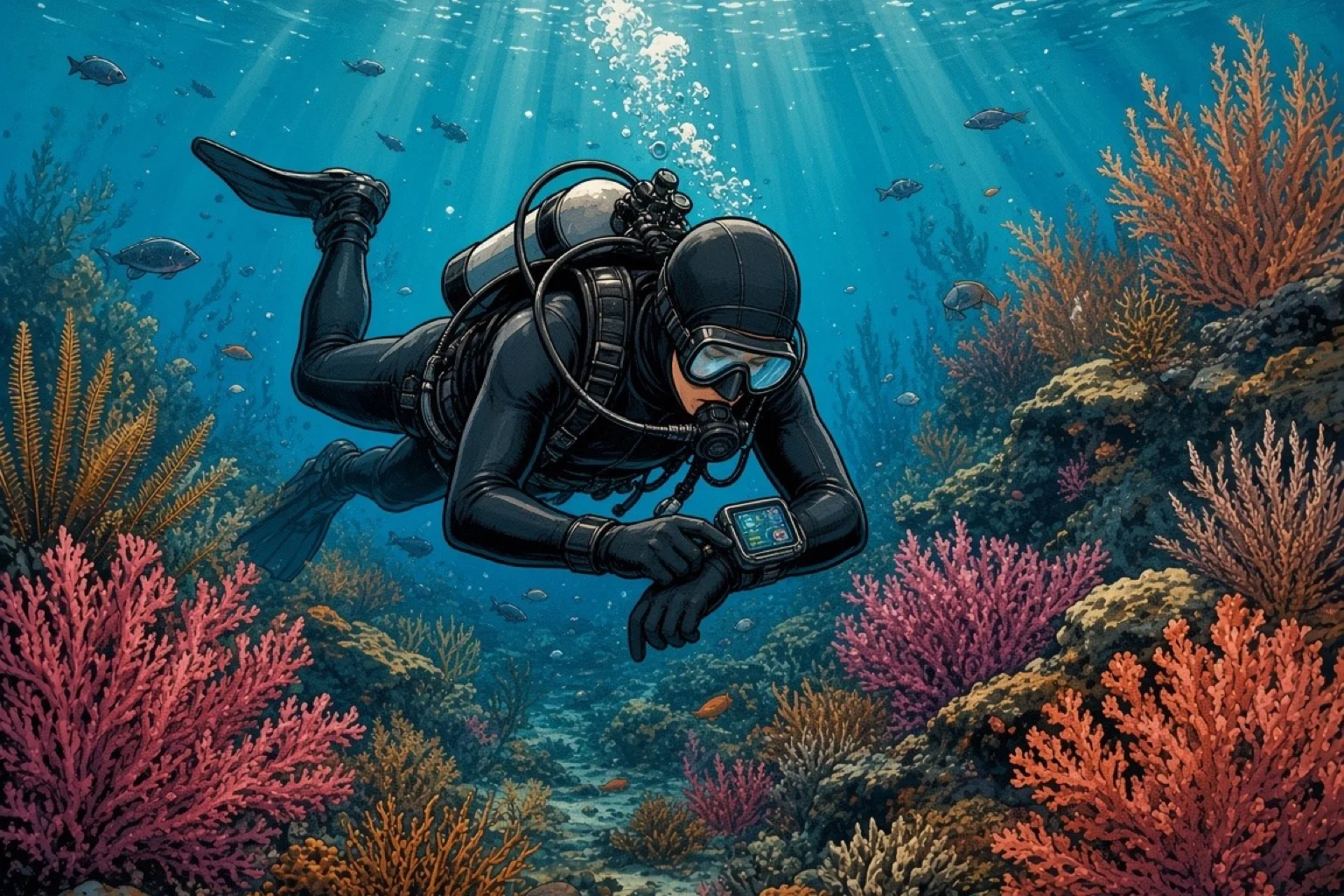
You can often see one before you feel it. The water shimmers like heat haze over a road, visibility drops below the line, and the colour turns from blue to green. Photographers see it first as a blur in their frame.
Thermoclines change the dive as well as the temperature:
- Buoyancy shifts. Cold, dense water and a compressed wetsuit change your trim, so expect to adjust as you cross the line.
- Air use climbs. Shivering burns air, and so does working against a current at the same time.
- Visibility splits. It's common to have 20 metres above the line and 8 below it.
- Life gathers below. The cold, green layer is where the plankton is, and often where the action is too.
Your guide will usually plan the deepest part of the dive first and bring the group back up into warmer water for the second half. Thermoclines also come with vertical currents at some sites, so read our guide to Komodo currents and drift diving before a southern trip.
What wetsuit do you need for Komodo?
Match the suit to the coldest dive on your plan, not the average one. Repetitive diving drains heat in a way a single dive doesn't: three or four dives a day at 23°C will chill you far more than the number suggests, and slow dives at a manta cleaning station or over a macro subject generate almost no body heat.
| Type | How it works | Best for | Strengths | Limits |
|---|---|---|---|---|
| Rash guard | Thin Lycra top, no insulation | Snorkelling in the north | Sun and sting protection | No warmth at depth |
| 2 to 3 mm shorty | Neoprene over torso and thighs | Snorkelling, one or two warm dives | Cool and easy on the boat | Arms and legs exposed |
| 3 mm full suit | Full-length neoprene, arms and legs | Most Komodo diving, all year | Warm enough at 26 to 29°C | Not enough for the south mid-year |
| Hooded vest | Thin layer with hood, under a suit | Divers who run cold | Packs small, big warmth gain | An add-on, not a suit |
| 5 mm full suit and hood | Thicker neoprene with a separate hood | The south, June to September | Comfortable at 21 to 25°C | Hot on the boat, bulky |
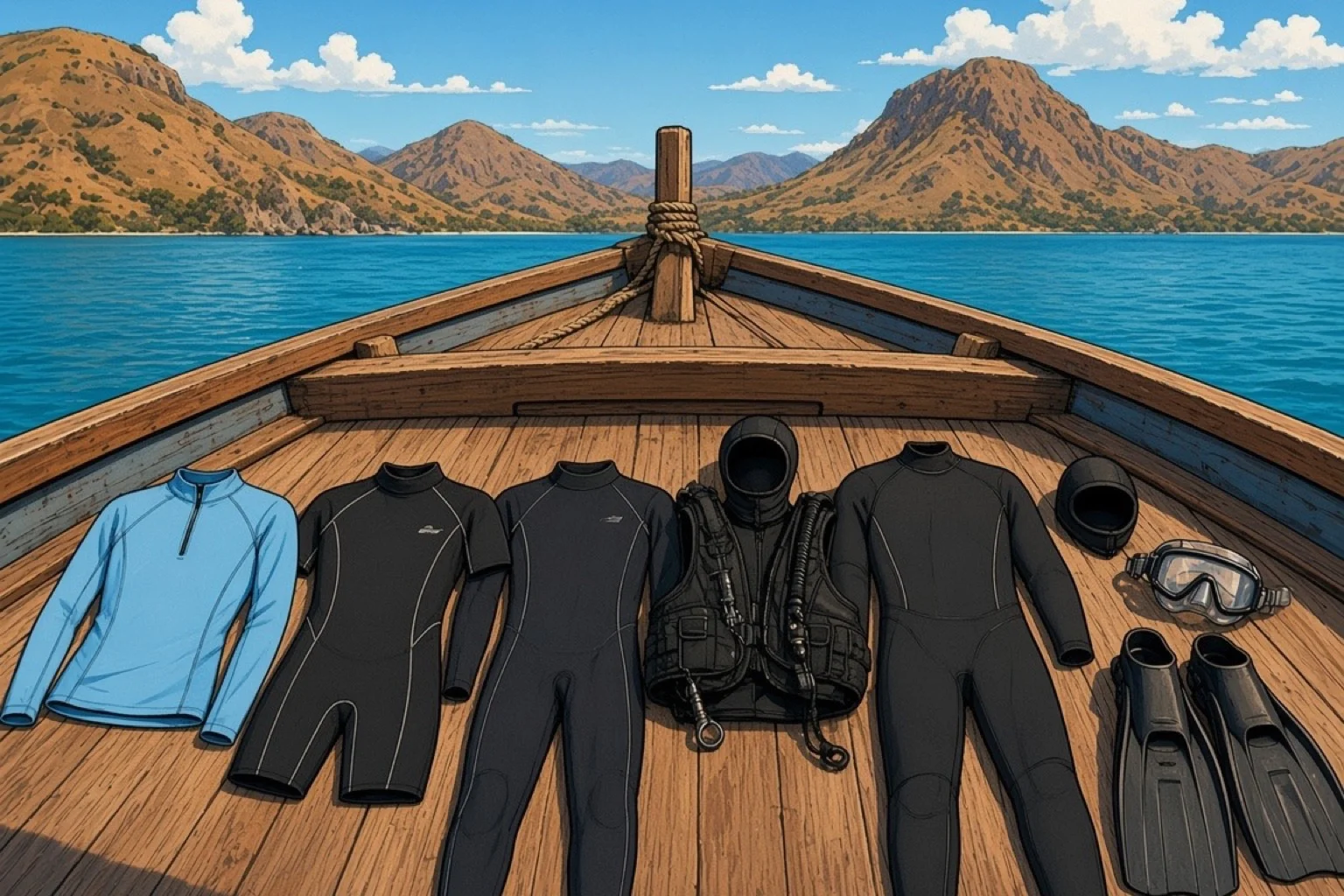
Your own cold tolerance is the deciding factor. As a working rule:
- If you run warm, a shorty or 3 mm full suit in the north and centre, and a 3 mm with a hooded vest in the south.
- If you're average, a 3 mm full suit everywhere except the south mid-year, where a 5 mm with a hood is right.
- If you get cold easily, a 3 mm with a hooded vest even in the north, and a 5 mm with a hood and a vest layer in the south.
A hood is the most efficient upgrade you can make. It adds a lot of warmth for almost no weight in your bag, and it's far easier to pack than a second wetsuit. If you're only bringing one extra piece of kit to Komodo, make it a hooded vest.
How to plan your wetsuit for a Komodo trip
Exposure protection is easy to get right if you plan it in the same order you plan the dives.
1. List the sites, not just the dates
Ask your operator which sites the trip is likely to visit. Day trips from Labuan Bajo or Sebayur stay in the north and centre; the south is a liveaboard area for most divers, because the run is too long for a comfortable day.
2. Check the month against the table
If the trip touches the south between June and September, plan for 21 to 25°C. Any other month, or north and centre only, plan for 25 to 29°C.
3. Count the dives per day
Two dives a day in warm water is forgiving. Three or four, especially on a liveaboard, adds up fast, so go one step warmer than you think you need.
4. Decide what to bring and what to rent
Most dive centres in Komodo rent 3 mm suits as standard. Thicker suits and hoods are much harder to find, so if you want a 5 mm or a hooded vest, bring your own and ask the operator before you travel.
5. Plan the time between dives
A dry towel, a windproof jacket and a hot drink between dives do as much for warmth as another millimetre of neoprene. On a breezy boat ride, a wet suit cools you faster than the water did.
A worked example: a resort week in August, then the south
Two certified divers stay on Sebayur Island in August and book three days of two morning dives. The first day goes to Siaba Besar, about 25 minutes by boat, and Batu Bolong, about 45 minutes away. The second adds Manta Point, about 40 minutes out. The water reads 25 to 27°C, close to our August figure of 25°C for the central park, and both divers are comfortable in the 3 mm full suits included in the dive package. Each day costs IDR 2,500,000 per person with full equipment rental, plus IDR 245,000 if they rent a dive computer.
One of them runs cold, so she packed a hooded vest from home and wears it on the third dive of the day and on slow manta dives. For the second half of the trip they join a liveaboard that crosses to the south, where Cannibal Rock sits about 90 minutes from Sebayur by boat. Their computers read 23°C at the surface and 20°C below a thermocline at 18 metres. She dives in a 5 mm suit with her hood; he wears a 3 mm with a borrowed vest and cuts his dives short, which is the usual price of packing for the average instead of the coldest dive.
What to look for in a Komodo dive operator when the water turns cold
Water temperature is a fixed fact; how an operator handles it isn't. These are the questions that separate a comfortable trip from a chilly one.
1. Suits that fit, in your size
A loose suit flushes cold water through on every kick, so a well-fitting 3 mm can be warmer than a baggy 5 mm. Ask: "Which sizes and thicknesses do you rent, and can I try one on before the boat leaves?"
2. Honest routing by season
An operator who offers the south in August without mentioning the cold, the swell or the long boat ride isn't telling you the whole story. Ask: "Which sites do you visit this month, and what temperature do you see there?"
3. A briefing that mentions temperature
A good briefing tells you where the thermocline usually sits, how deep the dive goes and when you'll come back up into warmer water. Ask: "Do you brief the expected temperature and thermocline before each dive?"
4. Dive length that fits the conditions
Long dives are a selling point in warm water and a problem in cold water. Ask: "Can I end a dive early with my buddy if I get cold, and how do you handle that in a group?"
5. Warmth on board
Towels, shade, a sheltered spot out of the wind and hot drinks between dives matter more in the south than any spec sheet. Ask: "Is there hot water for tea and a sheltered area on the boat?"
6. Small groups
With fewer divers per guide, the dive can be planned around the coldest diver rather than the warmest. Ask: "How many divers does each guide take?"
How to choose exposure protection for your trip
What you need depends on how you'll spend your time in the water.
Snorkellers and non-divers spend their time in the warm surface layer, so a rash guard or a 2 mm shorty is enough for most of the year. If you'll be in for an hour or more at a time, a full-length thin suit stops you cooling slowly without noticing.
First-time divers train in the north and centre, where the water is warmest and the dive centre supplies the suit. Our guide to how to learn to dive in Komodo covers courses and what's included.
Certified divers on day trips need a 3 mm full suit most of the year, and a hooded vest if they run cold. Those heading south on Komodo liveaboard trips between June and September should bring a 5 mm and a hood.
Freedivers move less and stay down longer at a time than you'd think, so they get colder than snorkellers in the same water. Our guide to freediving in Komodo covers sites and courses.
Underwater photographers spend long minutes nearly still over a subject, which makes them the coldest divers on any boat. Go one step warmer than your buddy, and wear a hood in the south even if you don't usually.
Who Komodo Resort is for, and who it is not for
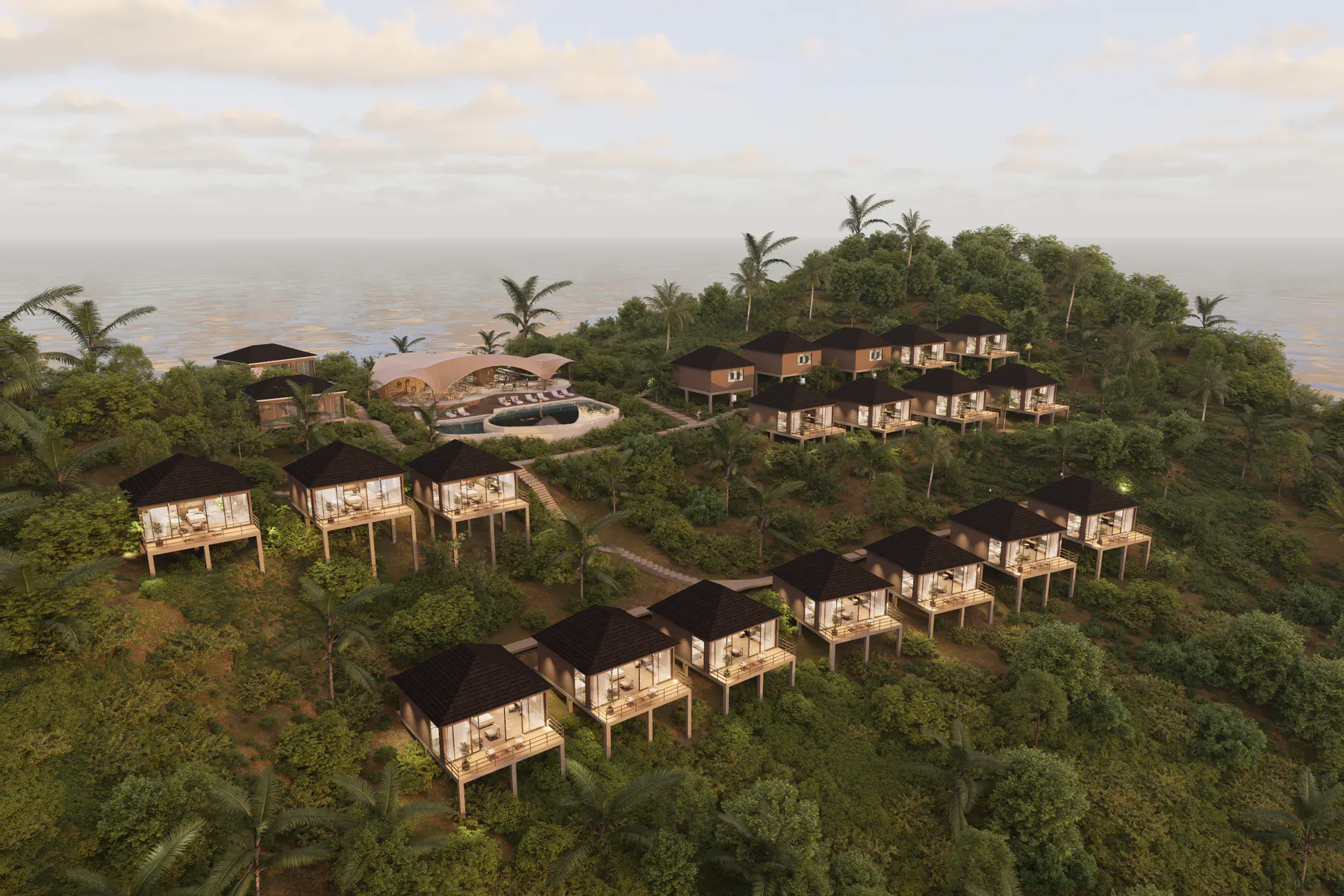
Komodo Resort is on Sebayur Island, inside the national park and about 30 minutes by speedboat from Labuan Bajo. Our daily dive boats reach the central and northern sites, from Siaba Besar about 25 minutes away to Crystal Rock about 50 minutes out, where the water stays between 25 and 29°C all year. Dive packages include full equipment rental, with 3 mm shorties and full suits in a range of sizes. Stay in one of the 31 bungalows at Komodo Resort, warm up between dives at the Komodo Resort pool and restaurant, and dive with the dive centre at Komodo Resort.
We're the wrong choice if you want to dive the cold southern sites every day. Cannibal Rock and Manta Alley are about 90 minutes or more from Sebayur, so we treat them as liveaboard sites; a Komodo Sea Dragon liveaboard trip is the better way to reach them. We also don't rent 5 mm suits or hoods, so divers who need thicker protection should bring their own. And diving on the Sebayur house reef isn't allowed, so if you were hoping to walk in from the beach, our boats take you to the reefs instead.
Key takeaways
- Most of Komodo sits at 27 to 29°C all year; only the south cools, to about 21 to 25°C, between June and September.
- The cold comes from monsoon upwelling, which also feeds the southern mantas and soft corals.
- In the wet season, December to March, the south is warm too.
- A 3 mm full suit covers most Komodo diving; add a hood or a 5 mm for the south mid-year.
- Thermoclines of three or four degrees are normal in the south, often between 15 and 22 metres.
- Pack for the coldest dive on your plan, not the average one.