You have almost certainly seen the photograph. Seven conical houses, thatched from apex nearly to the ground, standing in a circle on a shelf of grass with forested ridges rising behind them and cloud pouring over the rim. It is one of the most reproduced images in Indonesian travel, and it is genuinely what the place looks like. What the photograph does not tell you is that there is no road to it, that the last stretch is a two to three hour climb through rainforest, and that most people who add it to a Komodo trip badly underestimate what the day costs them.
Wae Rebo deserves the attention it gets. It is the last intact cluster of traditional Manggarai Mbaru Niang houses anywhere on Flores, it is a living village rather than a reconstruction, and the community that restored it won the highest award UNESCO gives in its Asia-Pacific heritage programme. It is also a real logistical commitment from Labuan Bajo, roughly a full day each way, and there is one specific reason a diver needs to plan it carefully that almost no travel guide mentions. We will get to that, because it matters more than anything else in this article.
We run a dive resort in the Komodo archipelago, and Wae Rebo is the land trip our guests ask about most often after the dragons. This guide covers what the village actually is, how the houses are built and why there are seven of them, how to get there and what it costs, what a night inside a Mbaru Niang is like, the etiquette that genuinely matters when you arrive, and how to slot it into a diving itinerary without creating a decompression problem for yourself.
What Wae Rebo Actually Is
Wae Rebo is a Manggarai village in the highlands of Manggarai Regency, in the Satarmese Barat district of western Flores, sitting at roughly 1,200 metres above sea level. Locals and Indonesian travel writing call it kampung di atas awan, the village above the clouds, and on a normal morning in the dry season that is a literal description rather than a marketing phrase. Cloud collects in the valley below the shelf the village sits on, so you look down onto the top of it.
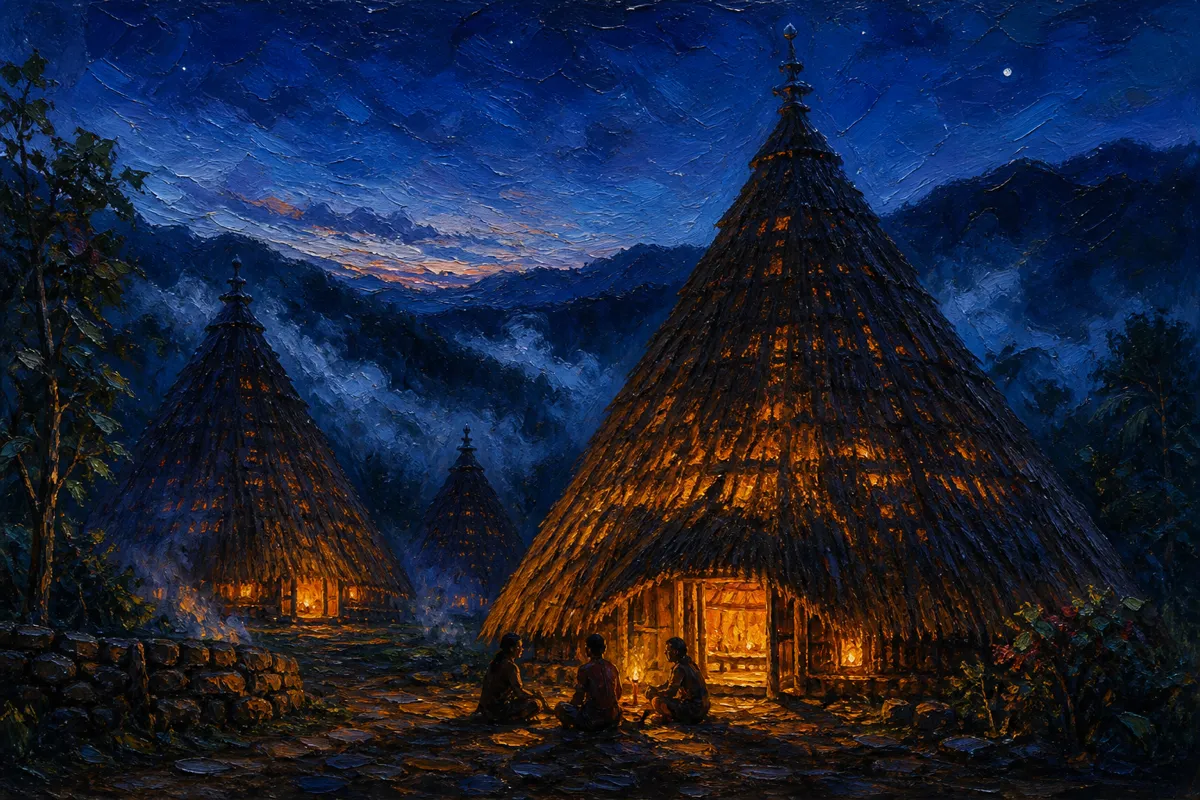
The village consists of seven circular, cone-roofed houses arranged in an open ring around a low round stone platform called the compang, the ceremonial altar at the centre of village life. Every house has a name. Going around the circle they are Niang Gena Mandok, Niang Gena Jekong, Niang Gena Ndorom, Niang Gendang, Niang Gena Pirung, Niang Gena Jintam and Niang Gena Maro. Niang Gendang is the principal house, named for the ceremonial drums kept inside it, and it is where you will be received when you arrive.
The most important thing to understand before you go is that this is not a heritage site with a ticket booth and a gift shop. It is somebody's home. Each house is shared by around six extended families, with eight in Niang Gendang, historically about forty-four families in total, though these days not everyone lives in the village full time. Younger residents move down to Denge and the coast for school and work and come back for ceremonies and harvests. People are farming while you photograph them. Coffee is the main crop, grown on the slopes around the village and processed by hand, and the women weave songke cloth with Manggarai motifs. Visitors are genuinely welcome, but you are a guest in a working settlement, and the village's own rules reflect that.
The Seven Houses, and What the Cones Mean
A Mbaru Niang is not a hut with a tall roof. It is a single structure in which the roof is the building: a conical frame sheathed entirely in lontar palm thatch and fibre that drops from the point at the top to within about a metre of the ground, with no separate walls at all. The traditional materials are specific and locally sourced, including majegau wood, mahogany boards and beech blocks, cut from the surrounding forest with permission rituals performed at the place of felling.
The construction carries meaning at every stage. The main support pole is called the molos, which is also the Manggarai word for a young woman, and when a new molos is carried into the village it is welcomed with the same ceremony used for a bride arriving from another village. It must not touch the ground along the way, and rituals are performed at every river crossing on the journey.
Five Levels, Each With a Job
Step inside and you find the interior divided vertically into five levels, each with a defined function. It is a granary, a home and a shrine stacked into one cone.
- Level one, lutur (also called tenda): the living floor, where the extended families sleep, cook and gather around the hearth.
- Level two, lobo: an attic for storing food and everyday goods.
- Level three, lentar: storage for seed stock held back for the next planting.
- Level four, lempa rae: reserve food, kept against the possibility of a failed harvest or drought.
- Level five, hekang kode: offerings to the ancestors. This is the most sacred part of the house.
Read that list again and you have the logic of a community that had to survive isolation at altitude without outside supply. Two of the five levels exist purely to guarantee next year's food.
Why Seven, and How They Nearly Disappeared
There are seven houses because seven mountain peaks surround the village, and those peaks are honoured as the protectors of the community's prosperity. The circle of houses faces outward to them and inward to the compang, which is understood as the navel of the community.
That arrangement came close to being lost. By 2008 only four Mbaru Niang were still standing. Across the rest of the Manggarai highlands the form had already been abandoned through the twentieth century in favour of rectangular modern houses, which is why Wae Rebo is now the last intact example. A team of Indonesian architects worked with the community to restore the missing houses using customary techniques and materials, and the ring of seven was completed again.
In 2012 that work received the UNESCO Asia-Pacific Award of Excellence for Cultural Heritage Conservation, the programme's top category, and the following year the project was in contention for the Aga Khan Award for Architecture. What the UNESCO citation singled out was not the buildings themselves but who did the work: this was a community taking ownership of its own built heritage using customary knowledge and collective labour, rather than a restoration imposed from outside. The village runs its own cultural preservation body, whose motto, Mohe Wae Rebo, translates roughly as "keep Wae Rebo alive."
The Story the Village Tells About Itself
Ask in the village how it came to be here and you will be told about Empo Maro. According to oral tradition passed down the generations, Maro came from Minangkabau in West Sumatra, fleeing his home village after being slandered and threatened, and sailed east. He wandered for years, stopping in Gowa in Sulawesi and then moving through a string of places on Flores, Waraloka, Nangapa'ang, Todo, Golo Damu, finding a wife along the way.
What settled him was a dream. An elder he did not recognise appeared and told him to build his community in a place called Wae Rebo. Maro took it as instruction from the ancestors, went looking for the place, and when he reached this shelf in the Manggarai highlands he stayed. The residents today count themselves as roughly the nineteenth or twentieth generation of his descendants.
The religious life of the village layers Catholicism over ancestral practice rather than replacing it, which is characteristic of Flores generally and unusually explicit here. The community accepted Catholicism relatively recently, within living memory of the oldest generations, and continues ancestral observance alongside it. Understanding that helps the welcome ritual make sense when you arrive: it is not a performance staged for tourists, it is a genuine request to the ancestors on your behalf.
Getting There From Labuan Bajo
This is where expectations and reality tend to part company. Wae Rebo is only around 110 to 150 kilometres from Labuan Bajo depending on the route, which sounds like a morning's drive and is nothing of the sort.
Stage One: The Drive to Denge
The road journey runs Labuan Bajo to Ruteng, about three and a half to four hours on sealed and much-improved road, then Ruteng onward through Todo to Denge, another one and a half to two hours on a narrower mountain road. Budget four to five hours total in good conditions, and understand that five to six is common. Denge is the last village a car can reach.
Almost everyone hires a private car with a driver, which at the time of writing runs roughly IDR 1,000,000 to 1,500,000 one way, or books a package that includes it. The Ruteng to Denge section genuinely benefits from a driver who knows the mountain roads. Scooters are a bad idea over this distance and surface, whatever you may have read.
If you want to take the pressure off, break the drive and sleep in Ruteng, then continue to Denge the following morning and start the climb fresh. Ruteng is also the base for the lingko spiderweb rice fields at Cancar, so the stop earns its place. Our guide to Flores covers the wider overland route east if you are continuing that way.
Stage Two: The Ojek and the Trek
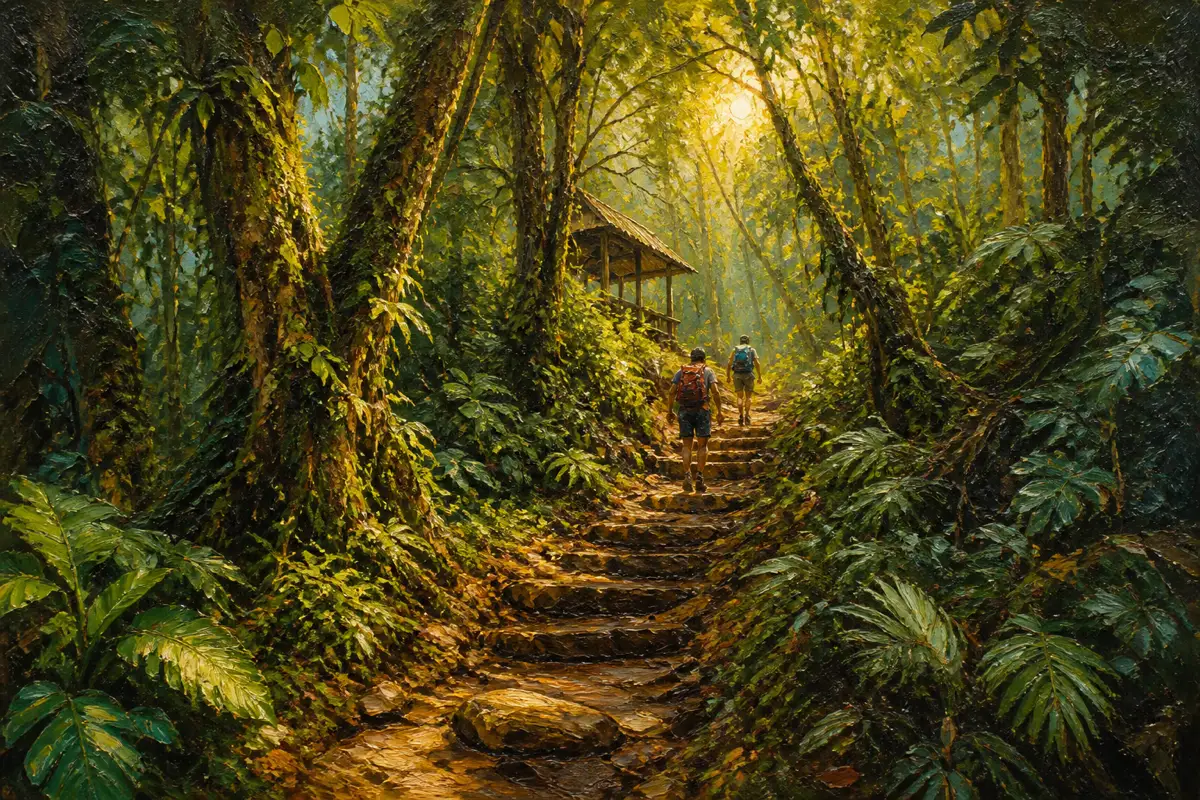
From Denge a motorbike taxi, an ojek, carries you ten to fifteen minutes up a steep rough section of track to the trailhead at Pos 1, sometimes called Selem or Wae Lomba. This spares you a punishing paved incline on foot and costs very little. You register and pay your contribution at a shelter here.
Then you walk. The numbers, honestly:
- Distance: roughly 4.5 to 5 kilometres each way, so 9 to 10 kilometres round trip.
- Elevation gain: around 600 metres, from a trailhead near 600 metres to the village at about 1,200 metres.
- Time up: two to three hours at a steady pace.
- Time down: one and a half to two hours.
- Surface: dirt and natural stone steps through dense rainforest, steep in sections, mostly shaded, and slippery for days after rain.
There are three rest posts on the way up, Pos 1 at the start, Pos 2 at Pocoroko and Pos 3 at Nampe Bakok. The trail is well trodden and hard to lose, so a guide is not compulsory, but taking one from Denge is customary, inexpensive and genuinely useful on the less obvious sections. Your driver can usually introduce you to one.
Fitness needed is moderate rather than exceptional. If you can manage the Padar Island climb comfortably you will be fine here, though this is roughly five times longer and involves three times the ascent. Our Komodo hiking guide gives a sense of how the park's walks compare. The trail is not suitable for anyone with significant mobility limitations, and there is no alternative access.
One rule to know before you plan your timings: you are not permitted to begin the climb from Pos 1 after 4pm, for the safety of both visitors and the community. Arriving in Denge late in the afternoon means you are not going up that day.
Day Trip or Overnight? An Honest Answer
You can do Wae Rebo as a day trip from Labuan Bajo. We would gently suggest you do not.
The day-trip version means a pickup at around 4am, four to five hours in a car on mountain roads, an ojek, a two to three hour climb, a couple of hours in the village, the descent, and the whole drive again in reverse, arriving back in Labuan Bajo somewhere around 11pm. It is nineteen hours of effort to spend perhaps two hours in the place you came to see, and you will spend most of those two hours recovering rather than paying attention.
The standard and much better option is two days, one night: drive to Denge on day one, climb in the afternoon, sleep in a Mbaru Niang, and come down and drive back the next day. Packages typically run IDR 1,500,000 to 2,500,000 per person including transport, the overnight stay, meals, a local guide, entrance contributions and the ojek. Three-day, two-night versions loop in Ruteng, Cancar and the highlands properly and run around IDR 4,000,000 to 4,500,000 per person.
The overnight is not merely more comfortable, it is a different experience. Day visitors arrive in the middle of the day, when the light is flat and the village is at its busiest with other groups. Staying means you are there for the late afternoon when the day trippers have gone, for the evening around the hearth, and for the morning when cloud is still sitting in the valley. That is the Wae Rebo of the photographs.
The Waelu'u Welcome, and Why You Do Not Take Photos Yet
When you walk into the village, do not lift your camera. Wait.
Every visitor is received through a welcome ritual called Waelu'u, held inside Niang Gendang and led by a village elder. It takes five to seven minutes. The elder addresses the ancestors, introduces you as a guest, and asks for their protection over you for the duration of your stay and your journey home. You will usually be seated, sometimes offered coffee, and the elders may shake hands and introduce themselves.
Until that ritual is done you should not photograph, film or wander between the houses. The community's position is straightforward: the ancestors are present, and the ritual is the moment you are formally accepted by both the living village and the dead. Photographing before it inverts the order of things. There is a modest fee for the ritual, usually around IDR 50,000 per person, and it is the most worthwhile money you will spend on the trip. Afterwards you are free to visit homes, take photographs, and talk to people.
Sleeping in a Mbaru Niang
Guests sleep on the floor of one of the houses, on a thin mattress with a blanket provided, in a shared communal space. There are no rooms, no beds in the sense you are used to, and no privacy beyond the dark. Washing facilities are basic. Meals, usually simple rice and vegetable dishes with the village's own coffee, are included in the overnight rate.
Two practical things surprise people. First, there is no mobile signal in the village, and electricity generally runs only from about 6pm to 10pm. Bring a power bank and a headlamp, and tell anyone who worries about you that you will be uncontactable for a night. Second, it gets cold. You are at 1,200 metres in the mountains, and visitors who packed exclusively for a dive holiday on the equator spend the night shivering under one blanket. A fleece or light down layer and long trousers make the difference between a memorable night and a miserable one.
What It Costs
Fees are set by the community and go toward conservation and village development, and they do change, so treat these as a guide and confirm current rates when you book. As of 2026 the shape of it is:
- Waelu'u welcome ritual: around IDR 50,000 per person.
- Day visit contribution: roughly IDR 200,000 to 225,000 per person. Some operators quote a combined trailhead contribution nearer IDR 150,000 to 200,000.
- Overnight including meals, mattress and blanket: around IDR 325,000 to 350,000 per person.
- Local guide: optional, commonly IDR 50,000 to 200,000.
- Ojek from Denge to Pos 1: a small fee, a few tens of thousands of rupiah each way.
- Private car and driver from Labuan Bajo: roughly IDR 1,000,000 to 1,500,000 one way.
Do not haggle over the village contributions. They are a community levy rather than a tourist price, and they are the mechanism by which the houses stay standing and the young people have a reason to come back.
Bring cash, in rupiah, in small notes. There is no ATM in Denge and nothing resembling card payment in the village. Draw what you need in Labuan Bajo before you leave, and bring more than you think you need. Our guide to money and ATMs in Labuan Bajo covers where to withdraw reliably and which machines to trust.
The Rules That Matter
The community asks visitors to observe a set of customs. None of them is onerous, and all of them are easy to breach accidentally if nobody tells you.
- Do not climb or sit on the compang, the round stone platform at the centre of the circle. You may approach it. It is sacred ground and part of people's living space.
- No photographs or video until the Waelu'u ritual is complete.
- Do not bring or drink alcohol. Alcohol has a ceremonial role here and is used only at the elders' invitation. This one catches out visitors who assume a bottle makes a good gift.
- Dress modestly. Clothing below the knee and covered shoulders, for men and women alike.
- Do not start the climb from Pos 1 after 4pm.
- Do not hand sweets or snacks directly to children. If you have brought something, give it to your guide or an elder to distribute.
- Do not harm animals in or around the village.
Underneath the specifics is a single principle worth carrying up the hill with you: ask before you photograph a person, and accept a no. The residents of Wae Rebo have been photographed a great deal, and their patience is a courtesy rather than an obligation.
If You Are Diving in Komodo, Read This Section First
Here is the part that generic Wae Rebo guides leave out entirely, and it is the reason we wrote this article rather than linking to somebody else's.
Wae Rebo sits at about 1,200 metres. Going to altitude after diving carries the same decompression risk as getting on a plane. The guidelines that govern flying after diving apply to any ascent above roughly 600 metres, and this trip takes you to double that, on a road that crosses Ruteng at a similar elevation on the way. Your body cannot tell the difference between a pressurised cabin and a mountain pass. Both are a drop in ambient pressure while your tissues are still off-gassing nitrogen.
So the same waiting periods apply. Twelve hours minimum after a single no-decompression dive, eighteen hours or more after multiple dives or multiple days of diving, and a full twenty-four is the rule of thumb we work to for guests who have been diving repetitively. Our guide to flying after diving explains the physiology and the numbers in full, and every word of it applies to this drive.
There is a very simple way to avoid the whole problem, and it is worth building your itinerary around: do Wae Rebo at the start of your trip, before you start diving. Going up to altitude and then coming back down to sea level to dive creates no decompression issue whatsoever. The risk runs in one direction only. Arrive in Labuan Bajo, head into the highlands for two days while you are still fresh from the flight, then come back down and dive with a clean slate.
If it has to go at the end instead, give it a genuine buffer, and do not attempt to squeeze it between your last dive and your flight home. That stacks two altitude exposures on a nitrogen load, which is precisely the scenario the guidelines exist to prevent. If you are unsure how your dive days and your Wae Rebo plan interact, ask our dive team before you book the trip rather than after. We would much rather rearrange a schedule than have a guest drive into the mountains twelve hours too early.
When to Go
The dry season, roughly April to October, is the practical window, and it lines up conveniently with the best conditions in the park, covered in our guide to the best time to visit Komodo. July tends to be the coolest and driest month in the Flores highlands. In the wet season the trail turns genuinely slippery and the views you came for are frequently inside the cloud rather than above it.
Whatever the season, mornings are your friend. Cloud settles in the valley overnight and burns off through the morning, so the classic view is an early one, which is another argument for staying the night.
One date worth knowing: Penti, the Manggarai thanksgiving and new year ceremony, is held annually in November, marking the start of the rainy season and honouring the spirits of the village's water sources. It involves communal prayer, singing and Caci whip dancing, and villagers who live away are expected home for it. It is the most extraordinary time to be in Wae Rebo and the least convenient, falling outside the good-weather window and at a moment when the village is busy with its own life. If you go then, go as a respectful guest of a family event, not as an audience.
What to Pack
The Wae Rebo packing list diverges sharply from the boat-and-reef list in our Komodo packing guide, and this is the single most common mistake divers make when they bolt this trip onto a dive holiday.
- Real shoes with grip. Trail runners or light hiking boots. Not flip-flops, not boat shoes.
- A warm layer. Fleece or light down, plus long trousers for the evening at 1,200 metres.
- A rain shell, regardless of season. Highland weather does its own thing.
- Headlamp or torch, for when the power goes off at around 10pm.
- Power bank. No signal, limited charging.
- Cash in small rupiah notes.
- Modest clothing that covers knees and shoulders.
- A daypack. Leave the main luggage in the car at Denge and carry only what you need up the hill.
- Insect repellent and a refillable water bottle.
What Else Is Nearby
Because the drive is long, it pays to make the journey the trip rather than treating it as transit. Ruteng, the highland town you pass through, is the base for the lingko spiderweb rice fields at Cancar, circular paddies divided in a radial pattern under a traditional Manggarai land-allocation system, and it has the accommodation that makes splitting the drive possible. Todo, on the road to Denge, has its own traditional Manggarai house and drum heritage. Closer to Labuan Bajo, the Cunca Wulang canyon makes a good half-day of jungle walking and freshwater swimming, and the Batu Cermin mirror cave is a short trip from town.
Update: Cunca Wulang has been closed to visitors since May 2026, after a footbridge on the approach collapsed and two tourists died. The Manggarai Barat authorities suspended tourism at the site indefinitely and no reopening has been announced, so confirm its status locally before planning a visit.
Our Labuan Bajo travel guide covers the town end of things, and things to do in Komodo sets out the options on the water. If you are weighing up how much of Flores to attempt, start with where Flores Island is, then use the Flores island guide for the overland route through Ruteng, Bajawa and the Kelimutu crater lakes, and the same altitude caution above applies to all of it.
Who Should Probably Skip It
An honest section, because a bad Wae Rebo trip is usually a mismatch rather than a disappointment with the place itself.
Skip it if you have fewer than about eight days in the region. Two days on Wae Rebo out of a five-day trip means giving up the dragons, Padar, or a serious chunk of your diving, and most people would rather not make that trade on a first visit. Skip it if you have mobility limitations, because there is no way in other than the climb. Think carefully if you are travelling with young children; our Komodo with kids guide covers what tends to work at what age, and this trek plus a floor-sleeping night is a lot for under-eights. And skip it if you want comfort. There is no version of this that involves a private bathroom.
Go if the culture is the point rather than a box to tick, if you are willing to spend two days getting somewhere and be quiet when you arrive, and if the idea of a working village that chose to keep its architecture alive interests you more than a viewpoint.
How Wae Rebo Fits a Komodo Trip
The itinerary that works best, in our experience of arranging this for guests, looks like this. Land in Labuan Bajo and go straight into the highlands for the two-day Wae Rebo trip while you are fresh and, crucially, before you have any nitrogen in your tissues. Come back down, settle in at the resort, and then give the water your full attention: the dive sites, the dragons, Padar at sunrise, Pink Beach. Our Komodo itinerary guide shows how the water days are usually sequenced, and where to stay in and around the national park explains the geography of accommodation, which matters because being based inside the archipelago changes how much of the day you spend travelling.
That order gives you the cultural trip at its best, the diving with no compromise, and no awkward conversation about altitude with your dive guide. Reverse it and you will spend your last days doing arithmetic with surface intervals.
So Is Wae Rebo Worth It?
Yes, with a condition attached. It is worth it if you go properly, meaning overnight, with time for the drive, at the start of your trip. It is not worth it as a nineteen-hour day trip squeezed into a diving holiday, and it is not worth it if what you actually want is the photograph, because the photograph is freely available and the village is not a backdrop.
What makes it remarkable is not really the architecture, extraordinary as the seven cones are. It is that in 2008 there were four houses left and a community that could have let the form die quietly, as every other Manggarai village had already done, and instead chose to rebuild it with their own hands and customary knowledge. You walk up through the forest, the trees open, and there it is: a decision made and kept. Then somebody sits you down in Niang Gendang, speaks to the ancestors on your behalf, and hands you a cup of coffee grown on the slope you just climbed.
If you are staying with us and want to work out where Wae Rebo fits around your dive days, get in touch and we will help you sequence it. We will also tell you honestly if your trip is too short to do it justice, because a rushed Wae Rebo serves nobody, least of all the village.