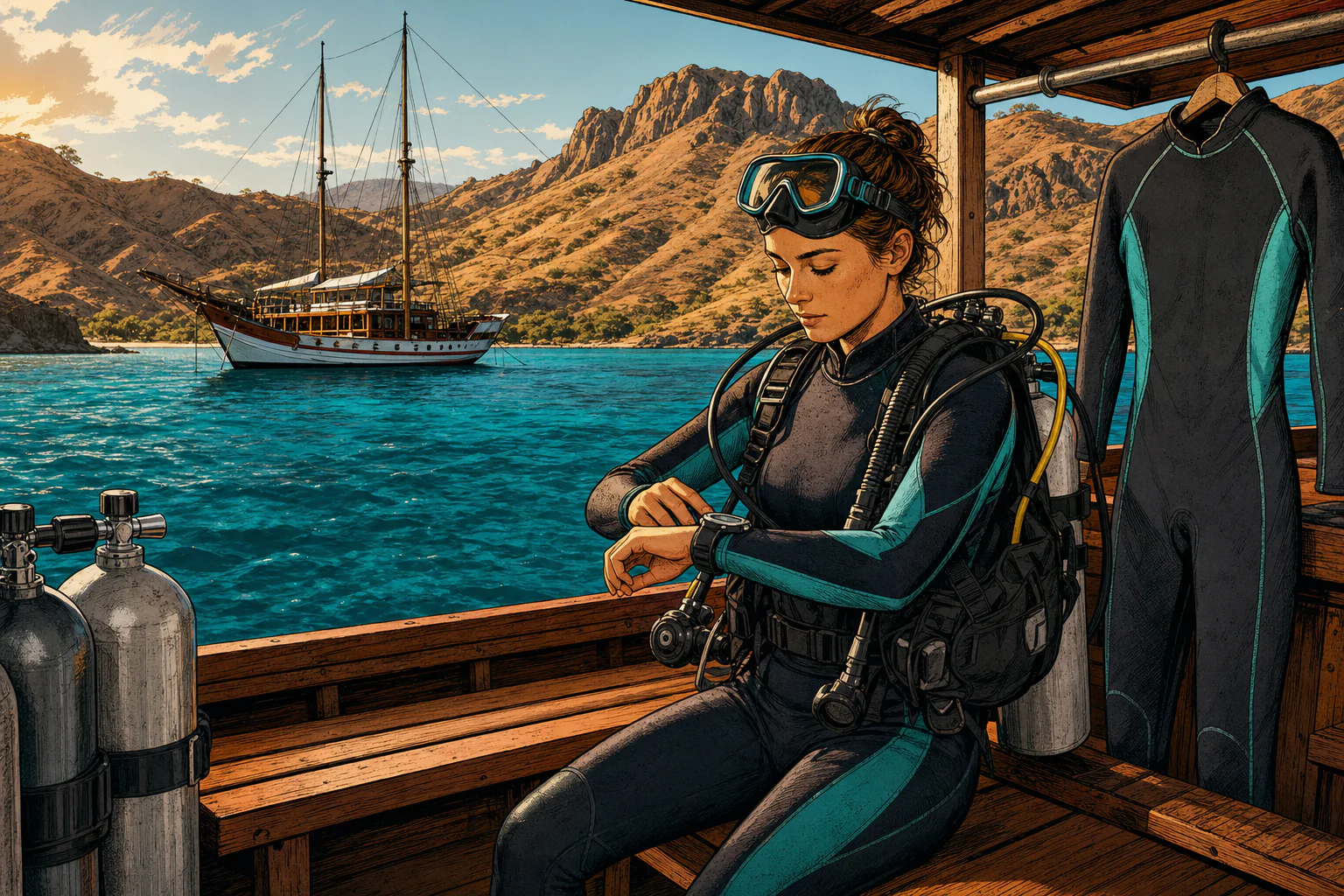
Ask a Komodo dive guide what actually worries them and they will not say dragons, and they will not say current. They will say the diver who notices a dull ache in one shoulder on the ride home, decides it is where the tank harness was digging in, and mentions it for the first time the following evening. Decompression sickness is uncommon in recreational diving and it is very treatable, and the overwhelming majority of divers will never meet it. What decides how a case ends is rarely the chamber itself. It is the number of hours between the first symptom and somebody saying it out loud. If you are diving with our Komodo dive centre, the plan below is already in place and briefed. If you are diving with somebody else, these are the questions worth asking them before you get on the boat.
One fact up front, because it contradicts most of what is written about diving in this part of Indonesia, including some of what we wrote ourselves before the facility existed. The nearest recompression chamber to Komodo National Park is not in Bali. It is in Labuan Bajo, and it has been since 2018. For guests at the resort that is about thirty minutes of boat ride plus a short drive. That single detail reshapes a Komodo dive emergency, and it is the main reason a Komodo liveaboard itinerary that spends nights in the far south of the park carries a genuinely different risk profile from a week of diving the central sites from a fixed base. Same water, same computers, very different distance to a doctor.
The Short Version
- The chamber is in Labuan Bajo. Siloam Hospitals Labuan Bajo holds the only hyperbaric chamber in town, and it was the first in East Nusa Tenggara when it opened in October 2018.
- Symptoms are usually early and usually vague. Roughly half of cases show themselves within an hour of surfacing and about nine in ten within six hours. The classic first sign is not agony, it is a deep ache or unexplained exhaustion.
- Oxygen first, then the phone. High-flow oxygen is the single most useful thing anyone on a boat can do, and it can be started within a minute.
- Call DAN. The 24-hour hotline is +1-919-684-9111 in English, or 021-5085-8719 inside Indonesia. DAN medics will advise whether or not you are a member.
- Never go back in the water. In-water recompression is not first aid, it is a second accident.
- Feeling better on oxygen is not the same as being better. Symptoms that fade can come back, so the evaluation still happens.
- Do not fly. Not to Bali, not home, not until a doctor who understands diving says so.
Where the Chamber Actually Is
Siloam Hospitals Labuan Bajo sits on Jl. Gabriel Gampur in Desa Gorontalo, a few minutes inland from the harbour. It is the largest hospital in the town, with around a hundred beds and a 24-hour emergency department, and it is the only hospital in Labuan Bajo with a hyperbaric chamber. The chamber went in during October 2018 and was the first anywhere in East Nusa Tenggara, which is worth pausing on: for the whole of the province, this is it. In June 2022 Siloam added a second facility in the town, the Labuan Bajo International Medical Centre, built around the tourism boom and running its own 24-hour emergency response, and the chamber was still being presented as a current, working facility during a parliamentary review of the hospital in June 2026.
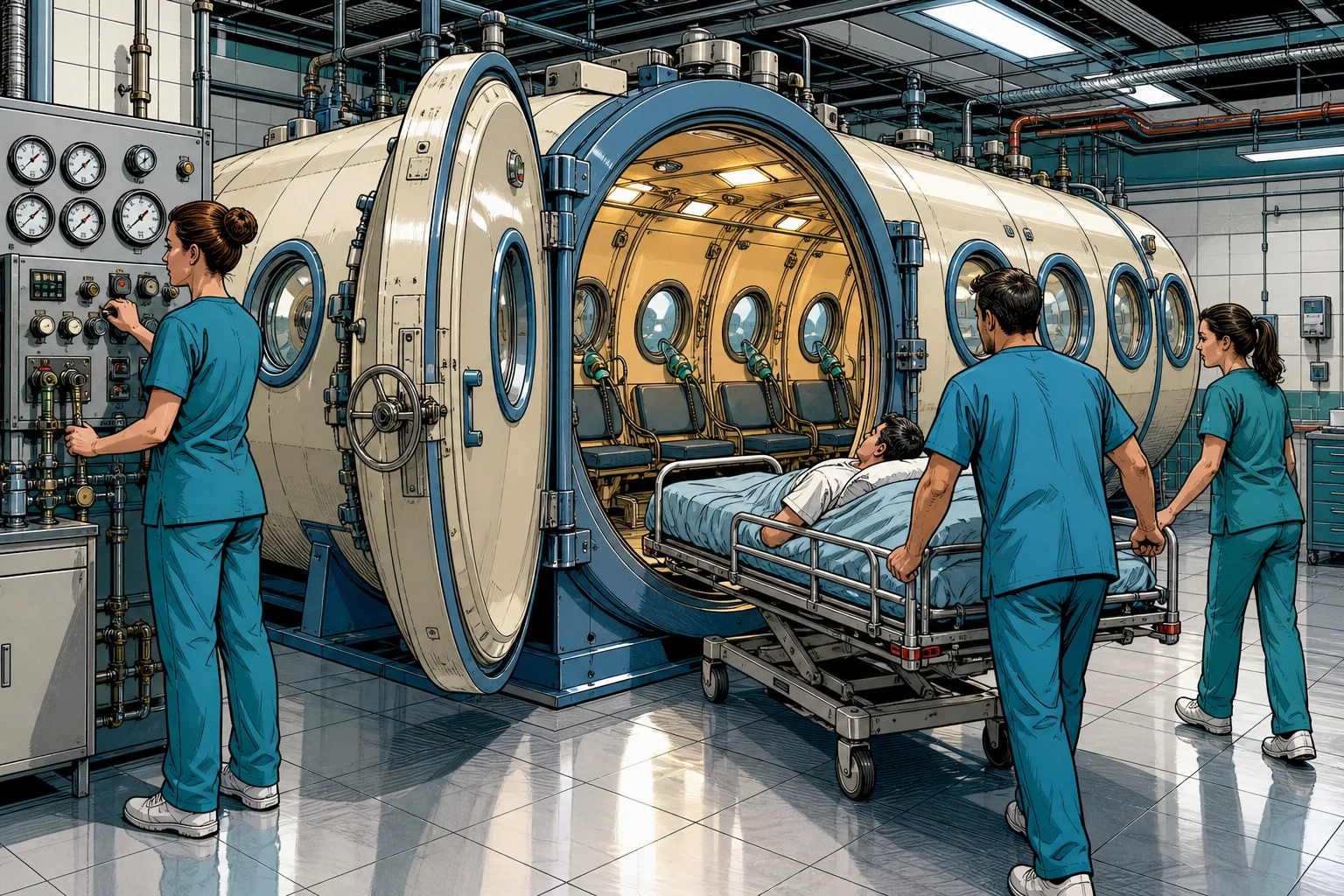
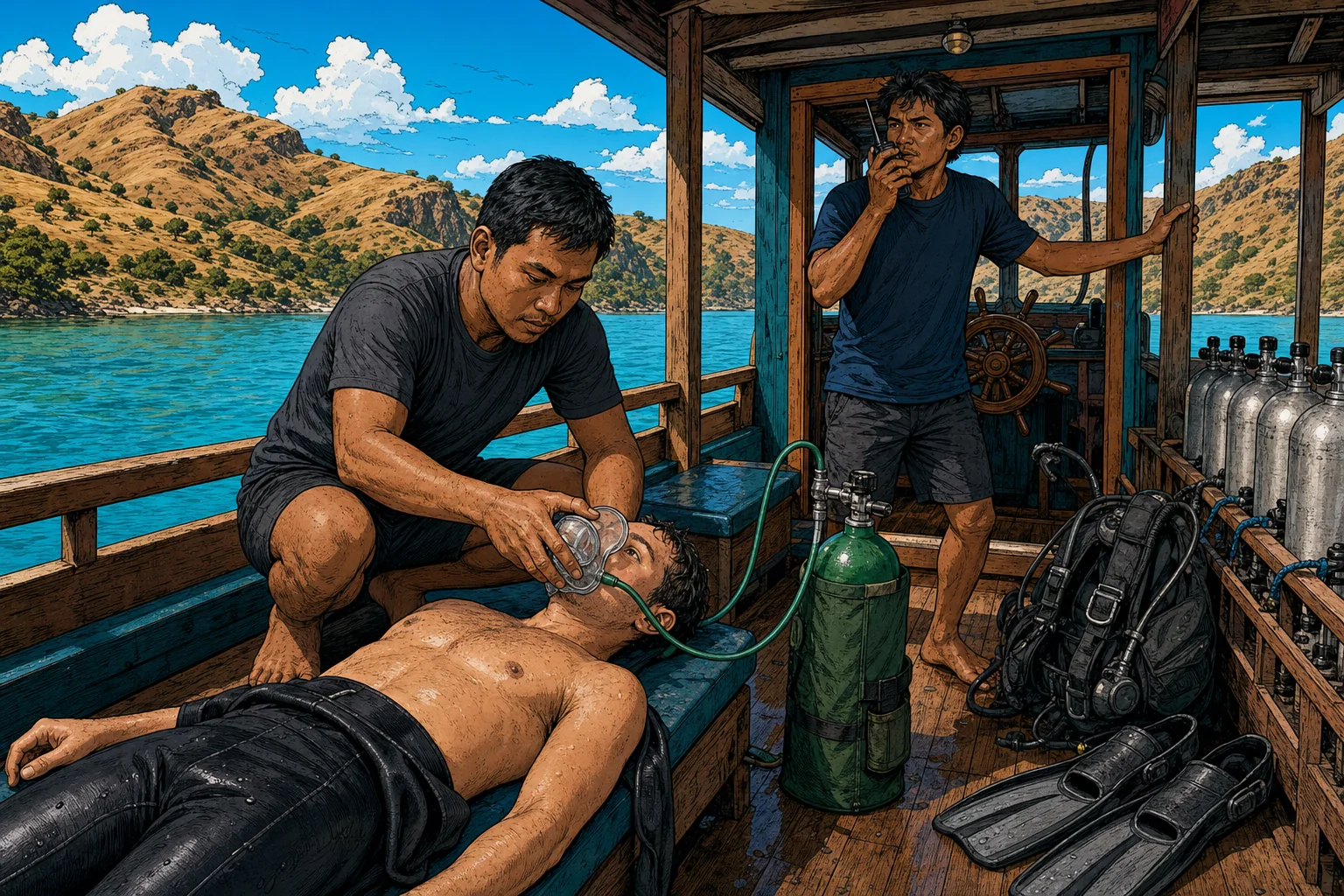
It is a multi-place chamber rather than the coffin-shaped single-patient tube people picture. Siloam put its capacity at up to eight patients when it opened, and it is built to take a hospital bed inside, which matters for a patient who cannot sit up and matters again because an attendant can go in with you. Most people find that last part more reassuring than any of the engineering.
What no source states plainly, and what we will therefore not claim, is that the chamber is staffed and available twenty-four hours a day for walk-in emergencies. The hospital's emergency department is. A chamber is a different thing: it needs a trained team, and it can be down for maintenance or already occupied. This is why every sensible version of this plan starts with a phone call rather than a taxi. Assume it is available, verify that it is, and let somebody with a medical background make the routing decision.
The Numbers Worth Saving Before You Dive
Put these in your phone now, at home, while you have signal and patience. Somebody scrolling a hospital's Facebook page on a rocking boat with one bar of reception is not a plan. Our guide to the Indonesia SIM card and eSIM options covers where signal exists in the park, and the short answer is that a lot of the park has none, which is exactly why the boat's radio and satellite phone matter more than your handset.
- DAN emergency hotline, international English: +1-919-684-9111. Staffed 24 hours a day, every day of the year. DAN medics help divers whether or not they are members, and collect calls are accepted.
- DAN emergency hotline, inside Indonesia: 021-5085-8719. DAN added a Bahasa Indonesia team precisely because language was costing people time in an emergency.
- Siloam Hospitals Labuan Bajo: listed on (0385) 238 1900, with the emergency line listed as (0385) 238 1911 and the Siloam group emergency number as 1-500-911. Hospital numbers do change, so treat these as a starting point and let DAN or your operator confirm.
- Your dive centre or boat. If you dived with us, call us. We know the harbour, the drivers, the hospital and the language, and we have made this call before.
What Decompression Sickness Actually Feels Like
The mental picture most divers carry is wrong, and the wrongness is dangerous. Nobody screams and clutches a joint. The common presentation is a deep, dull ache inside a shoulder or an elbow, with no sharp point you can press and no bruise to look at, arriving an hour or two after the last dive of the day. The second most common is fatigue that does not match the day you had, the kind where somebody goes quiet on the way back and blames the sun.
| What you notice | What it might be | Typical timing |
|---|---|---|
| Deep ache in a shoulder, elbow, knee or hip | Joint or "type 1" DCS, the most common form | Often one to six hours after surfacing |
| Heavy fatigue out of proportion to the diving | Frequently the earliest sign, and the most ignored | Within a few hours |
| Blotchy, marbled or itchy skin, usually on the torso | Cutaneous DCS, sometimes a warning of more | Minutes to hours |
| Pins and needles, numbness or weakness in a limb | Neurological involvement, urgent | Minutes to hours |
| Dizziness, confusion, trouble walking or speaking | Serious neurological DCS, an emergency | Often rapid |
| Breathlessness or chest pain after a fast ascent | Possible lung overexpansion injury, an emergency | Usually within minutes |
On timing, the medical literature is consistent and useful: about half of cases declare themselves within an hour of surfacing and around ninety per cent within six hours, and DAN's guidance is to suspect decompression illness for symptoms appearing within twenty-four hours of a dive. That window is the reason we ask guests to tell us about anything odd on the same day rather than at breakfast tomorrow.
It Does Not Only Happen to People Who Broke a Rule
This is the part that keeps divers quiet, and it is worth saying clearly. Most cases of decompression sickness happen inside the limits, on profiles a computer signed off, to divers who did nothing obviously stupid. Dehydration, a long flight two days earlier, poor sleep, a heavy cold-water dive, a hangover, being older or heavier or simply unlucky on the day: the risk factors are physiological, not moral. Deep or long dives, cold water, hard work at depth and rapid ascents all raise the odds, and so does flying too soon, but plenty of cases have none of those. Nobody is going to tell you off. The only genuinely embarrassing outcome is the diver who sat on a symptom for a day to avoid a fuss and turned a straightforward treatment into a complicated one.
The Komodo Problem: The Park Is Bigger Than It Looks
Here is what a map does not tell you. Komodo National Park is not a single site you can be "at". It is a spread of islands and channels across tens of kilometres of open water, and your distance from Labuan Bajo on any given afternoon depends entirely on the itinerary somebody sold you. From the harbour, Rinca is roughly forty-five minutes to an hour by speedboat. Komodo Island and Padar are more like an hour and a half to two hours or more. Operators generally reckon the park as about two hours out from town on a normal dive boat, less if a speedboat can be scrambled. Anchor in the far south, off the sites people cross the park for, and you are half a day from that hospital rather than a couple of hours.
None of this is an argument against the south of the park. The southern sites are extraordinary and the cold, plankton-heavy water is exactly why. It is an argument for knowing which category of trip you are on, and for diving accordingly. Our guide to the Komodo dive sites lays out where the good stuff sits and what the water does at each; the honest safety reading of that map is that conservatism should scale with distance. A profile that is fine at Sebayur Kecil, thirty minutes from a boat that can run to town, deserves more margin at the far end of the park in the middle of a six-day trip.
Where You Sleep Changes Your Evacuation Time
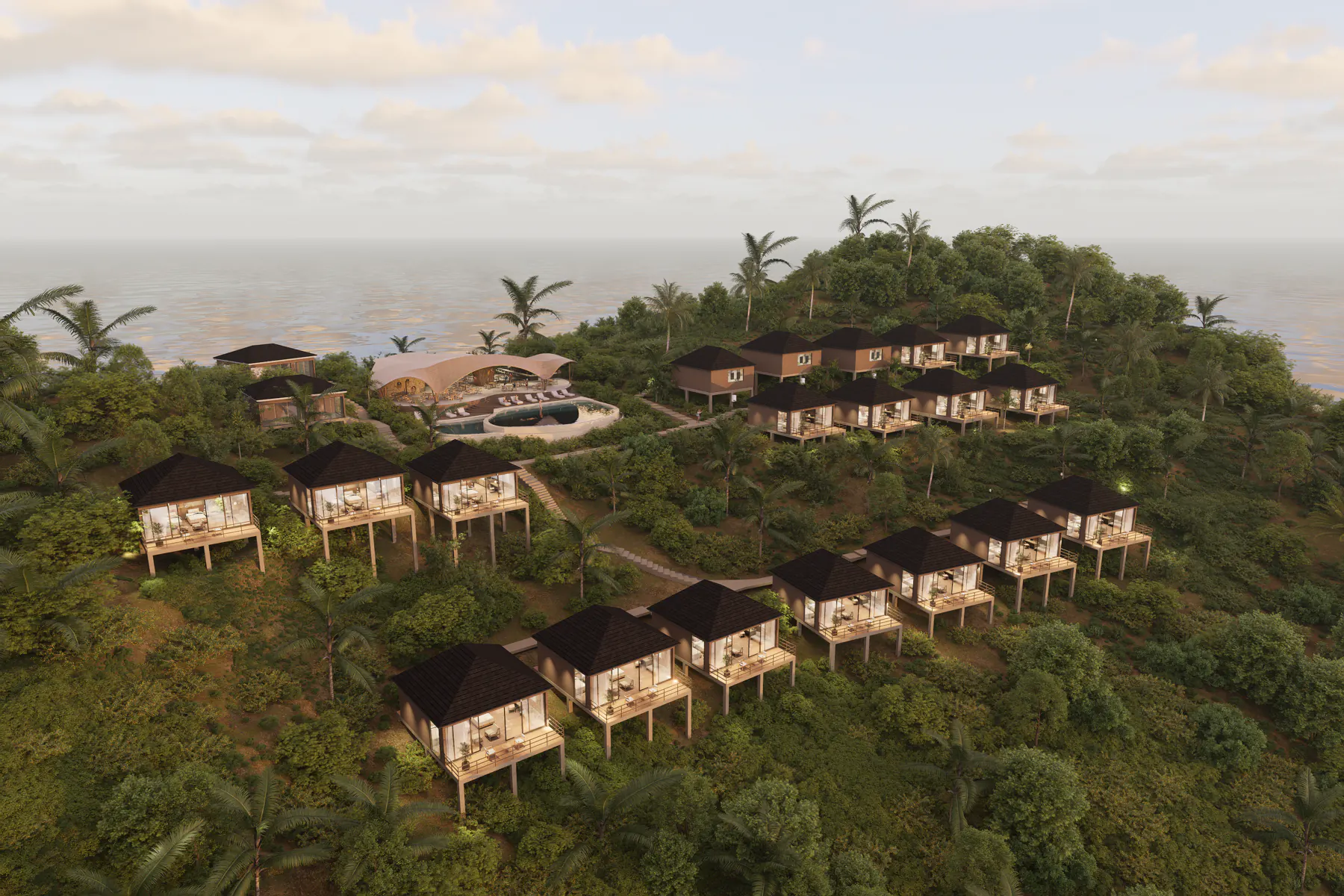
The resort is on Sebayur Besar, about eighteen kilometres from Labuan Bajo, which is roughly a thirty-minute speedboat run and a short drive at the other end. The central dive sites are around half an hour from our jetty in the other direction. That geometry is why we can dive the good sites without a three-hour commute, and it is also, less romantically, why a suspected case of decompression sickness at our rooms at Komodo Resort is closer to a chamber than the same case on most boats. It is not something we advertise on the front page, and it is worth understanding when you choose the shape of your trip.
For liveaboards the calculus is different and manageable, provided somebody has actually done the maths. A well-run boat carries oxygen in quantity, has a tender that can move faster than the mothership, knows how to raise help by radio and satellite, and has a written plan for each anchorage rather than a general intention to head for town. Those are the questions our guide to choosing the best Komodo liveaboard tells you to ask, and the answers tend to separate operators quickly. A boat that has thought about it will answer in specifics: how much oxygen, in how many cylinders, and what the plan is from the southern anchorages. If the answer is a shrug, that tells you something about everything else on board too.
The First Hour Matters More Than the Chamber
Divers fixate on the chamber because it is the dramatic object in the story. In practice the first hour on the boat does more for the outcome than anything else, and every part of it is achievable by people with no medical training.
- Get them out of the water and lying down. Flat, comfortable, out of the sun. On their side if they are nauseous.
- Start oxygen, at the highest flow the kit can give, and keep it running. One hundred per cent oxygen speeds nitrogen out of the tissues and is the reason mild cases sometimes resolve before the boat reaches the harbour. This is the single highest-value action available. Our own boats carry emergency oxygen alongside the VHF radio, GPS, first aid kit and life jackets, and the crew run drills that include acting as emergency oxygen provider — the point of a drill is that nobody stands there wondering where the key is.
- Give fluids if they are alert and able to swallow. Water, not beer, and not coffee if there is a choice.
- Call. DAN, then the hospital, then a diver-savvy doctor, in whatever order the situation allows. Write down the dive profiles, depths, times, ascent rates and surface intervals for every dive that day and the days before, because that is the first thing any hyperbaric doctor will ask.
- Do not put them back in the water. In-water recompression sounds intuitive and is a recipe for a hypothermic, low-on-gas patient with a worse problem than they started with.
- Do not let them talk you out of it. "It has gone now" is common, and symptoms that resolve on oxygen frequently return once the oxygen stops. The evaluation happens anyway.
What a Chamber Run Is Actually Like
The internationally standard first treatment for decompression sickness is a protocol usually called US Navy Treatment Table 6. The chamber is pressurised to the equivalent of about eighteen metres of seawater, you breathe pure oxygen in timed periods with scheduled air breaks so your body does not take on too much oxygen at once, and the run takes somewhere close to five hours before the chamber comes back to surface pressure. It is boring, which is the best thing that can be said about any medical procedure. Patients read, doze, and talk to the attendant.
Siloam described its own hyperbaric protocol at the Labuan Bajo launch in slightly different terms — pressurising to the equivalent of roughly fourteen to twenty metres, two to three atmospheres absolute, with pure oxygen delivered in thirty-minute periods separated by fifteen-minute breaks, around two hours to a cycle. Both descriptions can be true: hyperbaric medicine uses different tables for different indications, and which table a patient gets is a doctor's decision made on presentation, not something to be predicted from a blog. What you can take from it is that the facility describes a real, standard-shaped protocol, and that treatment usually means more than one session.
Recovery is usually good, and it is dramatically better when treatment is early. The poor outcomes in the statistics belong overwhelmingly to divers who spent a day or two insisting they were fine.
What It Costs, and Why Insurance Is Not Optional
We are not going to invent a price. Hyperbaric treatment costs are quoted per session and vary by facility, protocol and how many runs a patient needs, and any figure we published today would be wrong by the time you read it. What is reliably true is the shape of the bill: a chamber run is expensive, several runs are several times as expensive, and the transport and hospital admission around them are their own line items. A boat charter pulled off its schedule to bring one diver to town is not free either.
So carry dive-specific cover, and read the mechanism rather than the marketing. Our own advice on the resort's FAQ has been the same for years: a diver's policy has to include dive accidents specifically, with hyperbaric treatment and emergency evacuation named, and providers like DAN, PADI and Indepth all offer it. DAN membership costs less than a single dive day.
Two details in the small print matter more than the premium. First, DAN arranges and covers emergency evacuation for members up to a substantial per-person limit, but you have to contact DAN so they can authorise and coordinate it — transport you organise yourself, in a panic, may simply not be reimbursed. Second, most travel policies exclude diving entirely, or cover it only to a depth you passed on day one. Check the depth clause and the words "hyperbaric" and "recompression" specifically.
Worth knowing if you book directly with us: we partnered with DiveAssure to provide free diving accident insurance for the entirety of a liveaboard trip, on direct bookings. It does not replace an annual policy for the flights and the rest of the holiday, and we would still rather you had DAN, but the boat is covered.
The Komodo Risk Factors Nobody Puts on a Poster
Currents and the Ascent You Did Not Plan
Komodo's defining feature is water movement, and the specific risk it introduces is the unplanned ascent. An upwelling or a badly timed exit can carry a diver up faster than they intend, and rapid ascent is one of the few risk factors for decompression sickness that is genuinely within a diver's control. This is why the skills in our guide to diving Komodo currents are safety skills rather than style points: reading the water before you drop, hooking in rather than fighting, staying with the guide, and keeping something in reserve so the ascent is yours to control. Slow down. Nine or ten metres a minute, not eighteen, and do the safety stop even when the current makes it awkward.
Four Dives a Day, Six Days Running
Nitrogen accumulates across a week in a way a single dive never shows. Repetitive multi-day diving is the normal Komodo pattern and it is the reason the no-fly guidance for a liveaboard week is longer than for one afternoon's diving. It is also an argument for taking a day off in the middle of a long trip, which almost nobody does and which costs you nothing but one dive. If you are working out what depths your certification actually permits across a week like that, our guide to how deep you can scuba dive covers the limits and the reasoning behind them.
Heat, Dehydration and the Two Drinks on the Sun Deck
Equatorial heat, dry air from a regulator, a long day on a boat and an evening beer add up to a diver who is more dehydrated than they feel, and dehydration is a well-established contributor to bubble formation. Alcohol makes it worse on both counts, and it also blurs the picture the following day, because a hangover and mild DCS look uncomfortably similar. That overlap is the real reason we go on about it, and our article on drinking and diving makes the case in more detail. Drink water like it is part of the equipment.
The Flight Home
Labuan Bajo to Denpasar is about seventy-five minutes in the air, and it is the last hurdle of a Komodo dive trip. Cabin pressure at altitude is lower than at the beach you just left, which is precisely the pressure drop that turns dissolved nitrogen into bubbles. The full reasoning, the DAN waiting periods and how to schedule the last dive of the trip are in our guide to flying after diving. If a diver has any symptom at all, the flight does not happen — and that is one of the strongest arguments for treating in Labuan Bajo rather than trying to get to Bali.
Bali Is the Second Tier Now, Not the First
Bali still matters, because a complex case may need a referral and because divers on Flores outside Labuan Bajo have a longer journey. The island has two facilities divers rely on: the Hyperbaric and Diving Medicine Centre at Kasih Ibu Hospital in Saba, Gianyar, founded in July 2019, a DAN preferred provider running a multi-place chamber with emergency cover around the clock; and the hyperbaric facility at RSUP Prof. dr. I.G.N.G. Ngoerah in Denpasar, the big public referral hospital most guidebooks still call Sanglah, whose hyperbaric clinic keeps weekday hours by its own published schedule.
The change worth internalising is the order. For a diver in Komodo National Park, Labuan Bajo comes first and Bali is the escalation, not the destination. If you dive elsewhere on Flores, do the geography before you go: divers around Maumere diving sites on the north coast are at the far end of a long island, and the chamber in Labuan Bajo is a flight or a very long drive away.
How We Try Never to Need Any of This
The dull answer is the honest one. Conservative profiles, computers on every diver, guides who call the dive on water conditions rather than on the schedule, safety stops treated as compulsory, and a briefing that tells guests to report anything strange the same day. Our boats carry the oxygen and the radio, the crew rehearse the drills, and the resort is thirty minutes from the only chamber in the province. That combination is not a selling point so much as the reason we sleep at night.
The one habit we ask of guests is the one nobody enjoys: say it out loud. Tell a guide about the shoulder, the tiredness, the odd patch of skin, the tingling fingers, on the day it happens. Nine times in ten it is the harness, the sun, or a wetsuit seam. The tenth time, telling somebody early is the difference between a boring afternoon on oxygen and something far worse. If you want to know what our safety plan looks like in detail before you book, or which shape of trip suits a diver who wants more margin, get in touch — it is a conversation we would much rather have in advance.