Guests ask us the same thing in two very different tones of voice. Divers want to know whether they will have signal on the boat, usually hoping the answer is no. Parents, and anyone whose employer has not quite accepted that they are going away, want to know whether they can be reached. Both questions have the same answer, and it is a strange one: Indonesia has some of the cheapest and fastest mobile data in Asia, and Komodo National Park has almost none of it. Those two facts sit about forty kilometres apart. This guide is about buying the right connection before you fly, knowing exactly where it stops working, and what you can realistically expect from the internet on a Komodo island vacation.
The practical part matters more than it sounds. Your e-visa, your boarding pass, your ride from the airport, your bank's approval message and the WhatsApp thread with whoever is meeting you all live on the same phone, and in Labuan Bajo they all work fine. Six hours later, at anchor in the south of the park, none of them do. If your trip includes a Komodo liveaboard, the difference between a workable week and a stressful one is decided before you board, by a handful of choices that cost about ten dollars.
The short version
If you read nothing else: buy data that runs on Telkomsel, register it at an official counter with your passport, and assume you are offline the moment the boat clears the near islands.
- Network beats brand. Telkomsel is the only Indonesian carrier with dependable reach east of Bali. An eSIM that rides on a different network can be perfect in Seminyak and useless in Flores.
- Buy official. Airport operator counters and GraPARI stores register the SIM to your passport and clear your phone properly. A cheap kiosk SIM is how phones end up dark.
- Expect nothing inside the park. Not weak signal — none, for hours at a time.
- Download before you sail. Maps, tickets, insurance details, entertainment, translation packs.
- Keep your home SIM reachable. Your bank and WhatsApp still send codes to that number.
- The WiFi you will actually use is the resort's or the boat's, not your phone's.
One network matters more than the others
Indonesia has four networks worth knowing. Telkomsel is the giant, a Telkom Indonesia subsidiary that claims coverage of about 98 per cent of populated areas and has repeatedly taken Opensignal's Indonesian award for 5G availability. Indosat Ooredoo Hutchison runs IM3 and Tri. XL Axiata merged with Smartfren in 2025 to become XLSmart, which is why you still see all three names on product pages that nobody has updated.
In Labuan Bajo town, any of them will do. The town has been wired properly over the last few years — the airport, the harbour, the hotel strip along the hill — and you can book a boat, order a coffee and upload a video from a warung table without thinking about it. 5G exists there in patches and is a town phenomenon; nobody in the park has ever needed it.
Everywhere else in this part of Indonesia, the gap opens up. Cross to Flores proper, drive inland towards Ruteng or Bajawa, take a ferry, walk up a hill, and Telkomsel is frequently the only network showing anything at all. That is not marketing. It is the practical experience of every guide, boat captain and dive instructor working out here, and it is the reason the choice of network is the one decision in this article that actually changes your week. If you are planning the overland route as well, our Flores road trip guide is honest about the long stretches between towns where the bars simply go.
Buying a physical tourist SIM
The classic approach still works and is still the cheapest per gigabyte. You land, you queue for five minutes at an operator counter, you walk out with an Indonesian number and more data than you will use.
What it costs is where things get faintly comic. Telkomsel's own website currently quotes two different prices for what looks like the same product. Its foreigner registration page advertises a pre-order SIMPATI card at Rp100,000 with 25GB, 25 minutes of local calls and 25 minutes of international calls over 30 days, noting that pickup is available only in Bali and Mandalika Lombok. Its support FAQ says the tourist prepaid card is Rp150,000 for 25GB and 25 minutes. Both pages are Telkomsel's. Third-party sellers describe larger bundles climbing towards Rp250,000 for around 50GB, which we would treat as indicative rather than fixed. Indosat's IM3 "Travel On" range advertises from about Rp100,000 for 30GB. Check the live page or the counter price before you plan around any of these numbers, and expect airport kiosks to sit at the top of the range.
Either way, the sums are small. Twenty-five gigabytes for the price of two cocktails is the deal that makes international roaming look absurd, and it is worth remembering when a vendor in a beach town offers you a "tourist package" at four times the price.
Where to buy it

Buy from an official operator counter at the airport, or from a GraPARI store in town. Ngurah Rai in Bali and Soekarno-Hatta in Jakarta both have staffed operator booths in arrivals, which is the easiest moment to do this, because the alternative is standing outside the terminal trying to order a car on airport WiFi that does not reach the pickup zone. Komodo Airport in Labuan Bajo is a small terminal with far less choice, so if you are connecting through Bali, sort it there.
What you need in your hand: the passport you entered on, your entry stamp or e-VOA, and your phone's IMEI number, which you get by dialling *#06#. Registration takes a few minutes at the counter. One passport can generally register up to three numbers. Keep the packaging and the receipt, because if the number is ever blocked, that paperwork is what unblocks it.
Registration rules tightened again in 2026, and the direction of travel is consistent: cards are distributed inactive and only switch on after a verified identity check, with biometric verification for Indonesian citizens and a passport or residence permit for everyone else. In practice this makes buying from a random phone shop worse than it used to be, and buying from an official counter no harder than it ever was.
eSIM: the brand on the app is not the network on the tower
An eSIM is the better choice for a lot of travellers, and there is one trap in it that matters far more here than it does in Bali.
Travel eSIM companies do not own towers. They resell capacity on local networks, and which local network varies by brand, by plan, and by month. As of August 2026, independent comparisons put Airalo's Indonesian plans on Tri and Indosat, while Nomad, Holafly and Travelsim connect through Telkomsel or Telkomsel plus XL. A plan on Indosat or Tri is genuinely fine for Bali, Java and the cities. Bring it to Flores and you have paid for a phone that works in the airport and nowhere after it.
So the durable rule is not a brand recommendation, because these partnerships change without notice and any article that names a winner is wrong within a year. It is this: before you pay, find the line on the product page that names the Indonesian carrier, and buy the one that says Telkomsel. If a provider will not tell you which network its plan uses, that is an answer too.
Expect to pay somewhere around ten to fourteen US dollars for 5GB over 30 days, or roughly nineteen to twenty-five for 10GB to 20GB. Unlimited plans start around twenty-seven dollars a week and come with fair-use throttling that providers describe vaguely, sometimes with a separate cap on hotspot use — worth reading if you plan to tether a laptop.
You can also get a local Telkomsel eSIM without queuing. Several Bali-based resellers handle the passport and IMEI registration for you before you arrive, email or WhatsApp you a QR code, and let you install the profile over home WiFi; the plan then activates itself when your phone finds an Indonesian tower. Buying an eSIM directly from Telkomsel tends to push you back into an in-person or in-app verification flow, so the resellers exist for a reason. Whichever route you take, install the profile before you fly. Scanning a QR code is much less fun in an arrivals hall with no data.
One more thing, and it catches experienced travellers: leave your home SIM in the phone and turn its data roaming off. You want that number alive for text messages, for reasons we will come back to.
The IMEI rule, which is where people actually get caught
Indonesia has required imported handsets to be known to its networks since 2020, and the enforcement is real: an unregistered phone can accept a local SIM, work for a while, and then quietly stop connecting. It is one of the most common "my phone died in Indonesia" stories, and it has nothing to do with the phone.
For visitors, the good news is that the short-stay path is designed to be painless. Customs guidance separates travellers staying up to 90 days, who can be given network access through the operators' own service channels, from longer stays, which go through formal customs registration. That first path is exactly what the official counter is doing when it asks for your IMEI alongside your passport: it takes an extra two to five minutes and you never see the machinery. This is the single strongest argument for buying from an operator counter rather than a shop that just hands you a card.
If you are staying longer than 90 days and want to keep using an Indonesian SIM, you need to register the handset with Bea Cukai, the customs authority, either at the airport on arrival or through their website. Import duties apply above a declared-value threshold of around USD 500, and the allowance covers a limited number of devices per person. If you are only using your home SIM on international roaming, none of this applies to you at all.
Regulations in this area get adjusted more often than travel articles get updated, ours included. Treat the shape above as reliable and the details as something to confirm at the counter while you are standing there.
What the signal is actually like inside Komodo National Park
Here is the part no eSIM comparison page can tell you, because it requires being out here. The park has minimal infrastructure by design — it is a protected area, and there are no towers on the uninhabited islands. Coverage therefore follows people: the town, the ranger stations, the occasional inhabited village.
Roughly, and with the honest caveat that a phone's mood on any given afternoon is its own business:
- Labuan Bajo town, the airport and the harbour: solid 4G on all networks.
- The first stretch out of the harbour: fine. This is where everyone posts their departure photo.
- Past Kelor and the near islands: fading to one flickering bar.
- Rinca, at the Loh Buaya ranger station: weak and intermittent, Telkomsel only in practice.
- Komodo island, at the Loh Liang ranger station: weak 3G or a thin 4G signal, Telkomsel only. Do not count on it for anything that matters.
- Padar: operators report unexpectedly workable reception at the top of the viewpoint climb, which has led to at least one sunrise work call taken at 05:45 in the wind.
- Pink Beach: intermittent at best.
- The south of the park, Manta Alley, the western bays and open water between islands: nothing. Hours of nothing.
North Komodo, where the current-swept sites sit, is a grey zone in which a message may eventually escape if you hold the phone up and believe. If you want to know what the diving out there involves, that is a separate and more interesting subject: our guide to Komodo dive sites covers the north, central and southern zones, and the one on Komodo currents and drift diving explains why nobody on the boat is looking at a phone anyway.
Most guests decide within a day that this is the best feature of the trip. A few need it not to be, which is what the rest of this article is for.
On a liveaboard: satellite or cellular, and how to tell before you book
Onboard internet in Indonesia split into two completely different products over the last couple of years, and listings have not caught up. Satellite systems — Starlink, in practice — work anywhere the boat goes, including underway and in the far south of the park, and are fast enough for a video call from the saloon. Cellular systems are a router with a local SIM in it, which means the boat's WiFi has exactly the coverage your phone does, and dies in the same places.
Both appear on a booking page as "WiFi on board".
By early 2026 most premium and mid-range boats on the Komodo circuit carry satellite internet, while many budget vessels still run the cellular router or offer nothing. Some operators include it; others sell it as a pass for the cruise. So ask three questions before you book, and ask them plainly:
- Is the internet satellite-based or mobile-based?
- Is it available all day, or only in scheduled windows?
- Is it included, or charged — and if charged, per day or per gigabyte?
An operator who cannot answer those three questions has told you something useful about the boat. For everything else worth asking before your first trip, our guide to your first liveaboard goes through the cabin, the dive deck and the daily rhythm.
We will be straight about our own boats: they offer onboard WiFi with limited speeds. It carries messages, email and the occasional photo. It is not a satellite link, and we would rather you knew that from us than discovered it on day two while trying to join a meeting.
What the WiFi is like at the resort
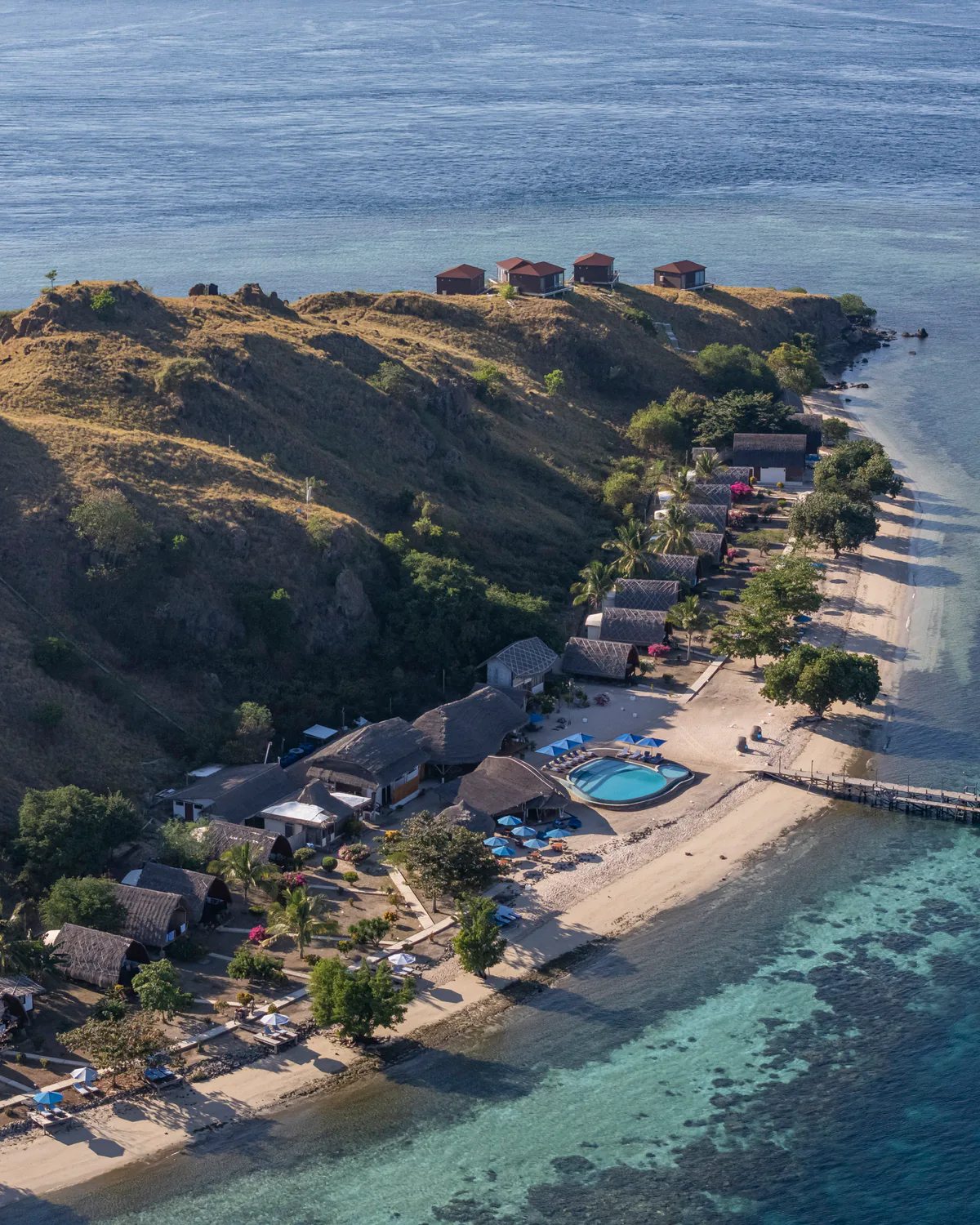
The resort has free WiFi throughout, in every room and in the communal areas, including the Beach Bar where most people end up at sunset. Speeds are modest and we describe them that way on purpose. It handles WhatsApp, email, a browser, a few photos to a group chat and a video call that you keep short. It will not swallow a day's worth of RAW files or a 4K edit, and if your job depends on uploading either of those every evening, plan around it rather than hoping.

Charging is straightforward: 24-hour power at 220 volts. The Seafront Deluxe bungalows have two round-pin type C sockets, and the Grand View and Grand Beach rooms add international sockets with USB chargers. Bring a small multi-plug anyway, because divers travel with cameras, torches, computers and phones, and the maths never works out. The full list of what is in each room is on the Komodo Resort rooms page.
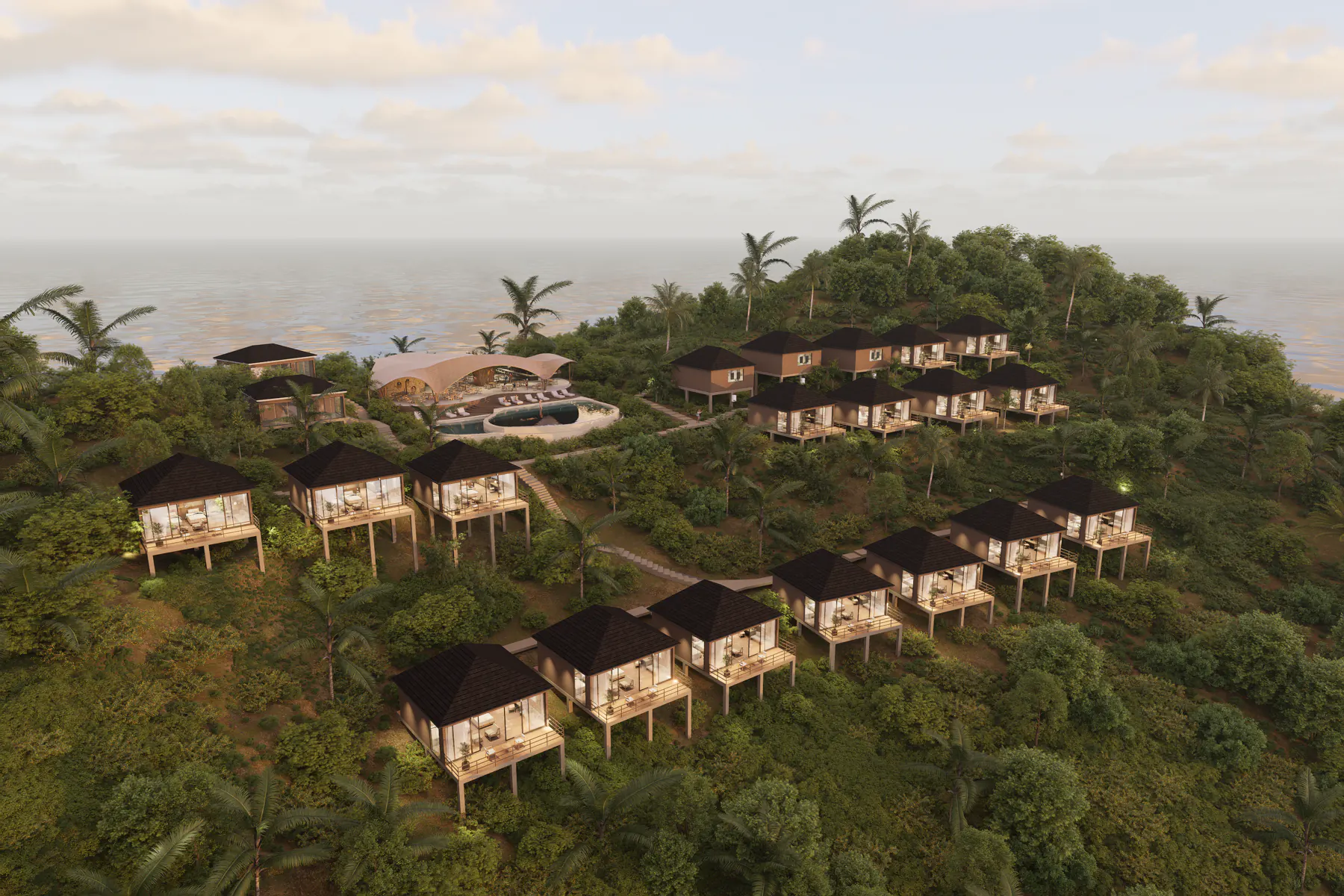
Worth knowing for the future: Hilltop Komodo Resort, which opens on the ridge above us in April 2027, has free WiFi in the rooms as well, along with the writing desk and coffee machine that suggest somebody there expects to answer emails.
We are about 30 minutes by speedboat from Labuan Bajo, on Sebayur Island. Close enough that a genuine emergency can reach us in either direction; far enough that the day's diving is not interrupted by anyone's inbox.
If you genuinely have to work
Some people do. Divers with businesses, parents co-ordinating with home, journalists on deadline. It is workable if you are realistic about three things.
The time zone. This corner of Indonesia runs on WITA, UTC+8. That makes European mornings your late afternoon and puts most of the American working day squarely in the middle of your night, which is either a gift or a problem depending on your colleagues. Our guide to Indonesia time zones sets out how the country's three zones line up if your itinerary crosses them.
The dive schedule. Boats leave early. A day of diving means two or three long stretches with no signal and a genuinely tired human between them. If you must take a call, put it in the evening, on the resort or boat WiFi, after the dive briefing is done.
The expectation you set. "I will reply twice a day" is a promise you can keep here. "I will be reachable" is not, and the honest version buys you more goodwill than the optimistic one. Guests travelling alone often find this the easiest part of the trip to explain and the best part to experience, something we cover in our guide to solo travel in Komodo.
Download this before you leave the harbour
The single habit that separates relaxed travellers from stressed ones out here is a ten-minute download session in town. On the list:
- Offline maps of Flores and Labuan Bajo. Google Maps will do it; do it while you still have data.
- Every ticket and confirmation as a screenshot or PDF: flights, hotel, liveaboard, park permits.
- Your insurance documents and emergency contacts, somewhere that is not your email inbox.
- An offline Indonesian language pack in your translation app, which is more useful in a village than in town.
- Entertainment. Books, podcasts, a couple of films for the crossing. There is a reason experienced boat guests do this.
- Your visa paperwork. If you are still sorting the e-VOA, our Indonesia visa guide covers the process and what to have saved.
Cash belongs on the same list, in spirit. Card payments need data, and data runs out before cash does — the practical detail is in our guide to money in Labuan Bajo, which covers the ATMs, the tipping norms and the "50k" price convention. And if you are still assembling the bag itself, what to pack for Komodo Island has the power bank and dry bag argument.
Two-factor authentication is the real trap
This is the one that ruins afternoons, and almost nobody thinks about it before leaving home.
Your bank sends its confirmation codes by SMS, to your home number. Your airline may do the same. WhatsApp verifies a new device the same way. Take your home SIM out to make room for an Indonesian one, and you have quietly disconnected yourself from every one of those systems, usually discovering it at the exact moment you need to approve a payment.
The fixes are easy and all of them need doing before you fly:
- Use an eSIM for data and leave your home SIM in the phone with data roaming switched off. Texts still arrive; the roaming bill does not.
- Move your bank to app-based authentication rather than SMS, if it offers it.
- Save your recovery codes somewhere offline.
- Tell your bank you are travelling, which still prevents more blocked cards than any other single action.
If you are budgeting the whole trip rather than just the phone, the data plan is a rounding error next to the park fees and the boat — our breakdown of Komodo trip cost puts the numbers side by side.
Beyond the park: Flores, the ferries and the villages
The same rules apply across the region, with sharper edges.
Inland Flores is patchy between towns and reliable in them. Wae Rebo village, up in the mountains above Denge, has no mobile signal at all and limited charging, which is part of why an evening there feels the way it does. Rangko Cave has none inside, and since there is no lifeguard either, that is a safety point rather than a comfort one. The overnight ferry route covered in our Lombok to Komodo guide runs dark for long stretches between Sumbawa and Komodo, where the boat's own radio matters and the captain's phone does not.
In town, the base for all of it, you will be fine — Labuan Bajo travel guide covers where to stay and eat while you are still connected enough to care.
What we would do
Buy a Telkomsel-backed eSIM before flying, install it at home, and keep the home SIM in the phone with roaming off. Land in Bali, confirm it works before leaving the airport, and if it does not, walk to an operator counter with your passport and buy the physical card instead. Download the maps and the tickets in Labuan Bajo. Then get on the boat and let the signal go.
The people who enjoy Komodo most are usually the ones who arranged their connectivity properly and then did not need it. If you want to check anything about the resort's WiFi, the boats or a specific work requirement before you book, get in touch — we would rather answer honestly in advance than have you find out at anchor. And if the diving is the reason you are coming, our Komodo dive centre team will happily tell you which dives are worth being unreachable for.