Every guide to diving in Komodo, including ours, tells you the same thing: the currents are strong, the currents are why the marine life is here, and some sites are for experienced divers only. All of that is true. Almost none of it tells you what to actually do when you are in the water and the reef starts moving past you faster than you can swim.
That gap matters, because the single most useful idea in Komodo diving is also the least intuitive. A fit diver in full kit sustains somewhere around one knot. The tidal streams running through these channels regularly exceed five knots and can touch eight on a spring tide. You are not going to win. Every technique in this article exists to make that fact irrelevant rather than frightening, and divers who internalise it early tend to describe Komodo as the best diving of their lives. Divers who do not tend to describe it as the most stressful.
We run a dive resort inside the national park, and our guides brief these currents several times a day, every day, through every phase of the moon. This is a practical guide to the mechanics behind them, how to read water before and during a dive, the specific techniques that work, what to do when a current turns vertical, and how to judge honestly whether you are ready. It is a companion to our guide to the dive sites themselves, which tells you where the current is; this one is about what to do about it.
Why Komodo Has Currents Like Almost Nowhere Else
The park sits on one of the planet's great plumbing joints. The Indonesian Throughflow is the only major low-latitude exchange of water between the Pacific and Indian Oceans, and it moves something on the order of fifteen million cubic metres of seawater per second through the archipelago.
The engine driving it is a difference in sea level. Trade winds and ocean circulation pile water up on the Pacific side, leaving it roughly twenty centimetres above global mean, while the Indian Ocean side sits around ten centimetres below. That thirty-centimetre head is enough to push an ocean sideways through every gap it can find.
Komodo, Rinca and Padar sit directly in one of those gaps. The Sape and Linta Straits squeeze the exchange between the Flores Sea and the waters to the south through channels that are narrow and, in places, shallow. Constrict a flow and it accelerates, exactly like putting your thumb over a hose. That is the whole explanation for both the diving and the anxiety: tidal streams through these straits regularly exceed five knots and peak around eight on the biggest spring tides.
It is also why the reefs are extraordinary. All that moving water carries plankton and nutrients past stationary animals, which is why the soft corals are dense enough to hide the rock, why the fish schools are the size of buildings, and why manta rays line up at predictable cleaning stations. Take the current away and you take Komodo away with it. The relevant background on the wider ecosystem sits in our Coral Triangle guide.
The Moon Runs Your Dive Schedule
Komodo's currents are tidal, not seasonal, and the tides here are dominated by a regular twice-daily cycle. That has one enormously useful consequence: they are predictable. Guides are not guessing.
Strength tracks the lunar cycle. Around new and full moon, when the sun and moon pull in alignment, spring tides produce the largest water movements and the fastest streams. Around the first and third quarters, neap tides move far less water and conditions are correspondingly gentler. The same site on the same day of the year can be a lazy coral cruise or a genuine handful depending on where the moon is.
This is why a good operator will not promise you a specific site on a specific day. The plan is built backwards from slack windows and tide direction, then reshuffled as conditions reveal themselves. A typical morning might open at a sheltered site while the flow is still running, move to a channel as it eases toward slack, then finish somewhere protected as it builds again the other way. Our dive site pages set out which sites sit where in that rotation.
The practical advice for guests is uncomfortable but simple: do not push your guide to dive a famous site at the wrong hour. The site will still be famous tomorrow at the right one. Our overview of the Komodo diving seasons covers the broader annual pattern that sits on top of this daily one.
The Four Kinds of Current You Will Meet
Lumping all of it together as "current" is the mistake that gets divers rattled. They behave differently and they call for different responses.
Lateral Drift
The ordinary kind, and the good kind. Water moves horizontally along a reef and you go with it, covering ground effortlessly while the reef scrolls past. This is what most Komodo diving actually is, and it requires no technique beyond staying with your group and not trying to stop.
Up-currents
Water deflected upward by a wall or pinnacle. The hazard is not the current itself but what it does to your ascent rate: an uncontrolled trip toward the surface is a decompression and barotrauma problem, and it is a far more serious outcome than being pushed around horizontally.
Down-currents
The same deflection running the other way, pushing water and everything in it down the face of a wall. These are the ones experienced Komodo divers actually respect, they can appear with very little warning, and they get their own section below.
Washing Machines and Eddies
Where opposing flows meet, or where water wraps around an obstruction, you get rotation and turbulence rather than clean direction. It is disorienting and it can tumble you. It is rarely dangerous in itself at recreational depths, provided you stay calm, keep your regulator in and hold a stable position until you pop out the other side.
How to Read Water Before You Are In It
Current assessment starts on the boat, and on a well-run operation it starts before you even kit up. Guides scan for standing waves, boils, slicks and small whirlpools on the surface, and at exposed sites a guide will often go out in the tender first, put their face in the water, and come back to brief on what they found rather than what the tide table predicted.
Underwater, the reef tells you everything if you look. Fish orient into the current, so a wall of fusiliers all pointing one way is a direction indicator. Soft corals and crinoids lean downstream. Sea fans grow perpendicular to the prevailing flow, which tells you the long-run pattern even on a slack day. Your own bubbles show you what the water is doing right now.
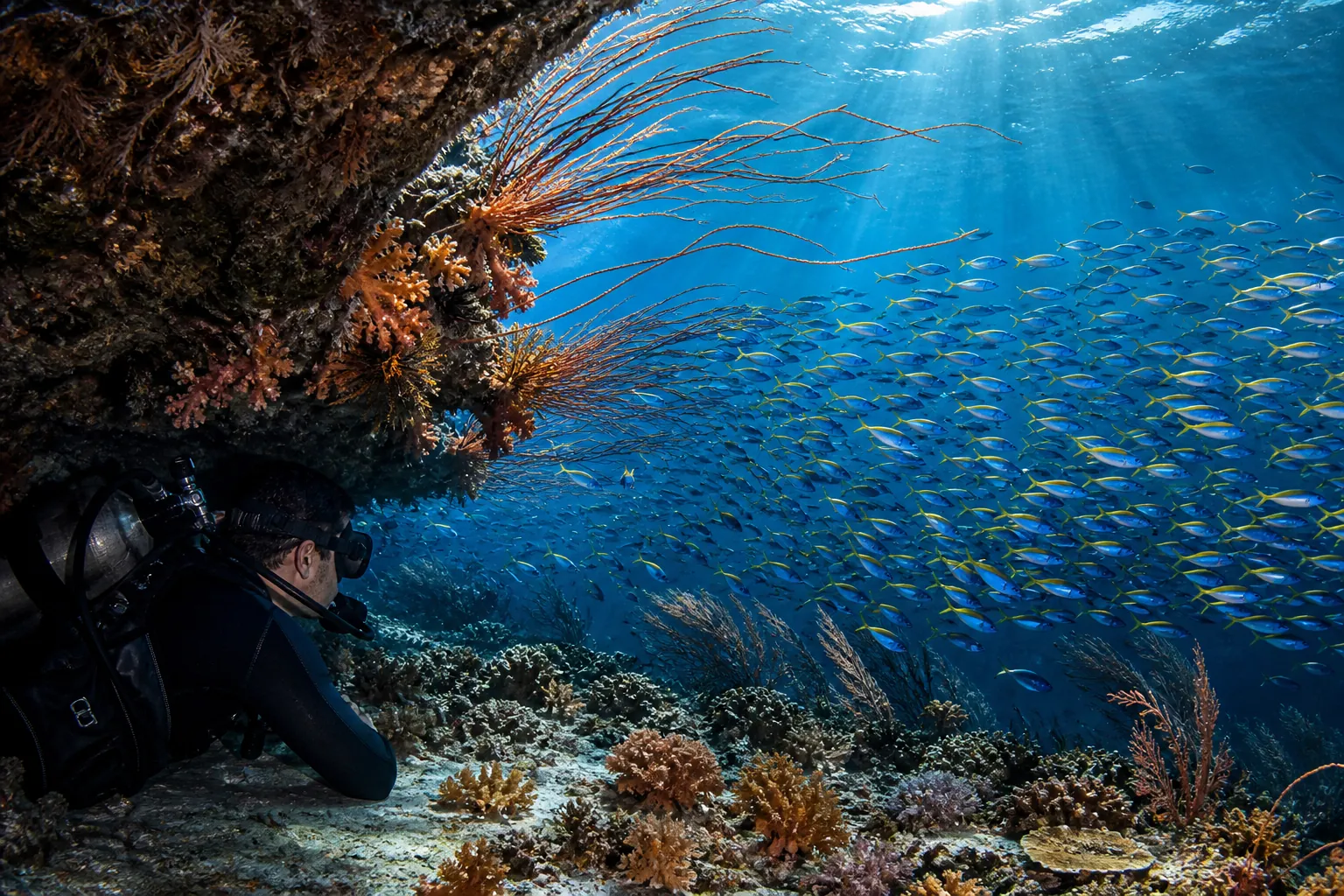
The single most valuable habit is looking ten metres ahead rather than at the coral in front of your mask. If the fish in the distance are suddenly all swimming downward, or the water shimmers where an upwelling meets warmer water, you have advance notice of a vertical current and several seconds to change your plan. Those seconds are the whole game.
Your body is a sensor too. The pressure of water on your fins, the tug on your hair or hood, the way your mask loads slightly to one side, all register before you consciously notice you are moving.
The Negative Entry
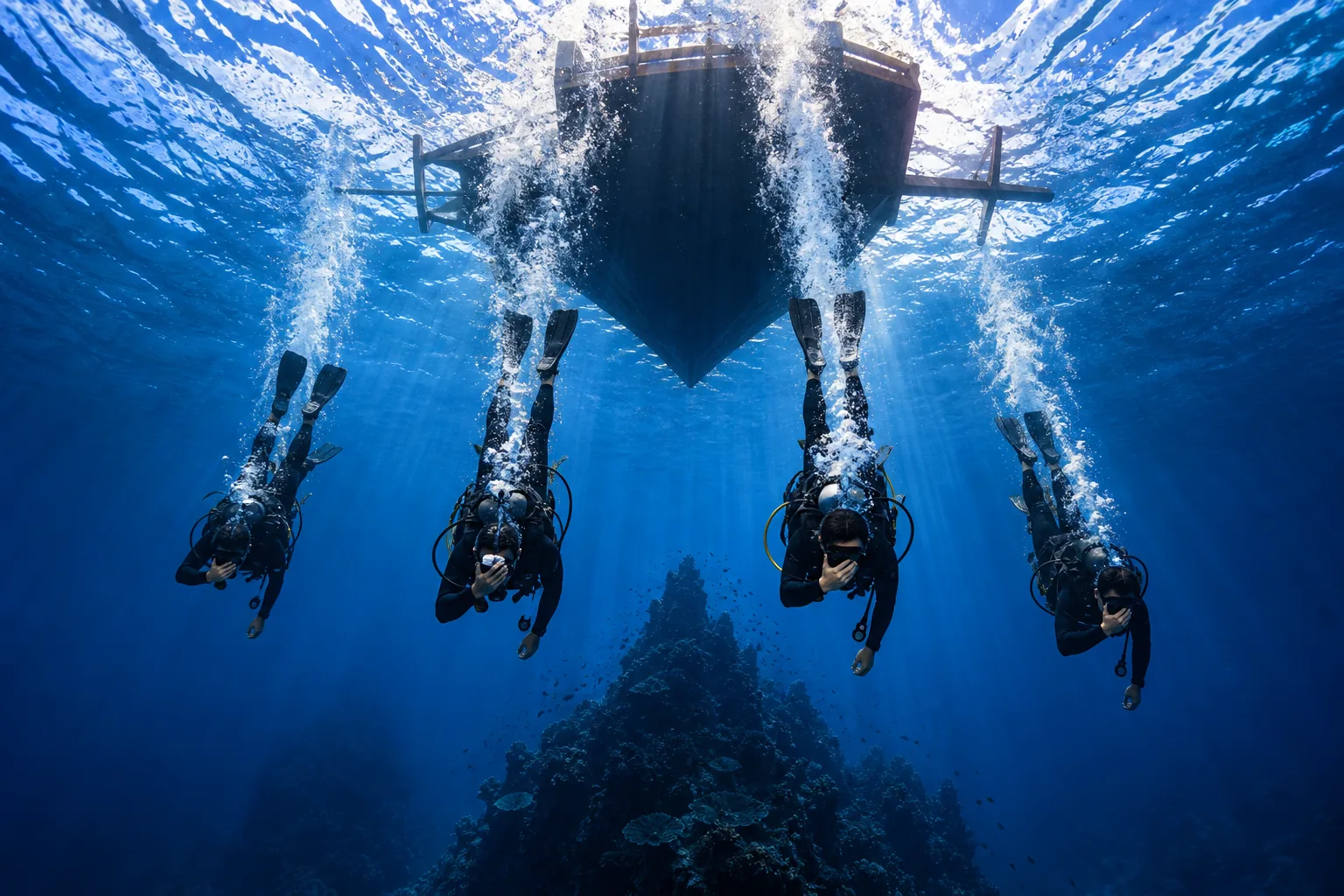
At exposed pinnacles the surface is frequently the worst place to be, because that is where the flow is fastest and where it can sweep a group off the site before anyone has descended. The answer is the negative entry: you deflate completely, roll off the boat, and go straight down without regrouping on the surface.
It is a simple skill that goes wrong in predictable ways. Divers who are not fully ready when the guide calls it end up entering late and alone. Masks flood because people forget to hold them. Over-weighted divers plummet and cannot equalise fast enough. Under-weighted divers hang at the surface and get carried off.
Prepare for it properly: be fully kitted with your computer on, your air on, your BCD completely empty and your mask held firmly before the call comes, and go on the signal, not five seconds after it. Descend positively, get down to the reef, and only then sort yourself out. If you have never done one, say so in the briefing rather than discovering the problem in the water.
Diving the Drift Itself
Once you are down, most of the technique reduces to a handful of principles.
Go with it. The reflex to swim against a current is the thing that turns a good dive bad. It burns gas at a spectacular rate, achieves nothing against anything above about a knot, and leaves you tired and breathing hard with a long dive still to go.
Use the terrain. Current flows around obstructions, and the sheltered pocket behind a boulder, ledge or reef spur can be almost still while the water a metre above rips past. Experienced Komodo divers move between these lees rather than swimming in open water, staying low and using the reef contour as cover.
Swim across, never into. If you need to get somewhere, ferry across the flow at an angle rather than fighting up it, exactly as you would swim out of a rip.
Trim and buoyancy do the heavy lifting. A horizontal, streamlined diver presents a fraction of the drag of one hanging at forty-five degrees with knees down. Nothing improves current diving as much as being properly weighted and flat in the water, which is also why we suggest a checkout dive before the demanding sites.
Streamline everything. Loose octopus hoses, dangling gauges and unclipped torches snag on reef and increase drag. Clip it all in.
Watch your gas. Working in current, in cooler upwelled water, at depth, you will use noticeably more air than you expect. Call the dive on your own numbers and do not assume your usual profile applies.
Reef Hooks, and How to Use One Without Damaging the Reef
A reef hook is a stainless hook on a short line that clips to your BCD, letting you park in a strong flow and watch the show instead of being swept past it. At sites where reef sharks and trevally hold position in the current, it turns a thirty-second glimpse into a ten-minute encounter.
Used carelessly, it is also a very efficient way to break coral. The technique matters.
Clip the line to a D-ring at your hip or chest so you hang facing the flow rather than sideways. Approach low and in the lee of the reef, where you can work without fighting. Choose your anchor point on bare rock, dead substrate or stable rubble, never on live coral, sponges or sea fans, and at established sites the scoured bare ledges are usually obvious. Set the hook gently and test it rather than ramming it in.
Then add a small amount of air so you hover clear of the reef, horizontal, fins up and off the coral. Keep the hook-in short, a few minutes rather than the whole dive. To leave, dump your air first, because unhooking while positively buoyant launches you upward, then release the hook by lifting the line rather than dragging it sideways, and stow it before you drift on.
Two honest caveats. A reef hook does not substitute for buoyancy control, and if your trim is poor it will make things worse rather than better. And some sites and operators restrict their use, so ask in the briefing rather than assuming.
If You Are Caught in a Down-current
This is the scenario worth rehearsing in your head before you ever need it, because the instinctive response is the wrong one.
The instinct is to inflate and swim up. Divers Alert Network is explicit that increasing buoyancy is the highest-risk option available to you, because the moment you exit the flow all that gas becomes an uncontrolled ascent, which is a considerably worse emergency than the one you started with.
The recommended approach is a graded response, escalating only as far as the situation demands.
A mild downdraft can simply be ignored. Something stronger calls for swimming horizontally, perpendicular to the flow, with little or no air added to your BCD. Down-currents behave like rip currents: powerful but usually narrow, so a short swim across gets you out of the column. If the flow is stronger still, or the affected zone is too wide to cross, get negative, get onto the wall and climb out hand over hand along the rock. This feels undignified and it is by far the most controlled option, because it keeps your depth and the gas in your ears and lungs stable. Only at that point, holding the wall, is a small amount of air into the BCD reasonable.
Throughout, keep equalising continuously, watch your depth, and be ready to vent the instant you break free. Ditching weights is a genuine last resort for a diver being taken dangerously deep, not an early move. And the thing that makes all of it work is staying calm; panic is what converts a manageable situation into an accident.
Up-currents invert the problem. Get negative, flare your body and fins to increase drag, and swim down and horizontally out of the column, then re-establish neutral buoyancy once clear.
What Happened at Tatawa Besar
In June 2008 five divers, three British, one French and one Swedish, were swept away during a dive at Tatawa Besar inside the national park. It is worth sitting with that detail: Tatawa Besar is a mainstream site known for orange soft coral, not some extreme technical objective.
They surfaced far from the boat and could not be found. The group tied themselves together with their BCDs, clung to a floating log, and spent roughly nine hours in the water before making a deliberate push for land, aware that the alternative was being carried out of the island chain into open ocean. They came ashore on Rinca, around forty kilometres from where they had entered the water, lived on scavenged shellfish for a day and a half, drove off a persistent Komodo dragon with rocks, and were eventually found by local fishermen and park rangers and taken to Labuan Bajo. Everyone survived.
Two details from the reporting are the useful ones. The dive leader was running one group while her husband ran another, and the disappearance was only noticed when the second group surfaced about an hour after entering the water. And the five did the most important thing right once they were on the surface: they stayed together, stayed buoyant and conserved energy rather than exhausting themselves swimming against water that was always going to win.
Modern practice in the park has moved on considerably since then, with surface marker buoys treated as mandatory rather than optional, tenders that follow bubbles rather than waiting at anchor, and headcounts in and out of the water. But the underlying physics has not changed at all, which is why the kit and the protocol below are not paranoia.
The Kit That Earns Its Place
A delayed surface marker buoy and a spool are the two most important pieces of safety equipment you will carry in Komodo, and the buoy should be tall. In choppy water a short sausage disappears between swells. Practise deploying it somewhere calm before you need it somewhere that matters.
Beyond that, carry a whistle or air horn, and something visual for distance, whether a signalling mirror or a small strobe. A personal locator beacon or satellite messenger in a dive housing is increasingly common on serious Komodo trips and is the single biggest upgrade to your odds if you end up genuinely adrift. A spare mask is cheap insurance, because a hard current can genuinely take one off your face. Stiffer fins help. So does a dive computer you can read at a glance.
Our Komodo packing guide covers the broader kit list, and the first liveaboard guide is worth a look if this is your first multi-day dive trip.
Agree Your Separation Plan Before You Get Wet
The standard protocol is to search for about a minute, then ascend, deploying your buoy on the way up so the boat can see where you are going to appear. The critical part is that this gets agreed in the briefing rather than assumed, along with where the tender will be and what the recall signal is.
If you do surface away from the boat, the lessons from every drift incident are consistent. Stay with anyone you are with. Get positively buoyant and stay that way. Do not swim against the current, because you will not beat it and you will need that energy later. Deploy everything you have that is visible or audible, and wait to be collected. Our article on safety in the Komodo region covers the wider emergency and medical picture, including where the nearest hyperbaric chamber is.
Are You Experienced Enough?
An honest answer, because the marketing answer helps nobody.
Our full guide to scuba diving in the park covers conditions site by site, but the short version is this. Plenty of Komodo is genuinely suitable for newly certified divers. There are sheltered bays and gentle reefs where the flow is negligible, and people learn to dive here perfectly successfully. What is not suitable for a fresh Open Water diver is the set of exposed pinnacles and channels the park is famous for.
For those, the realistic bar is an Advanced qualification, somewhere upward of fifty logged dives, genuinely reliable buoyancy, and ideally prior drift experience. Our breakdown of certification levels is a fair place to work out where you sit. If you are short of that, the answer is not to skip Komodo, it is to sequence it: dive the gentler sites first, let a guide watch your trim and gas consumption on a checkout dive, and earn your way onto the harder ones across the week. Guides are not gatekeeping for fun when they suggest this. A diver who is out of their depth in a five-knot channel is a risk to the whole group.
Be honest in the briefing about your dive count and your recent experience. Nobody thinks less of it, and it directly changes how a guide positions themselves relative to you in the water.
Why Being Inside the Park Helps
Slack windows are not negotiable and they do not care about your schedule. Some of the best of them fall early in the morning or late in the afternoon, at exactly the hours a boat coming out from town cannot reach.
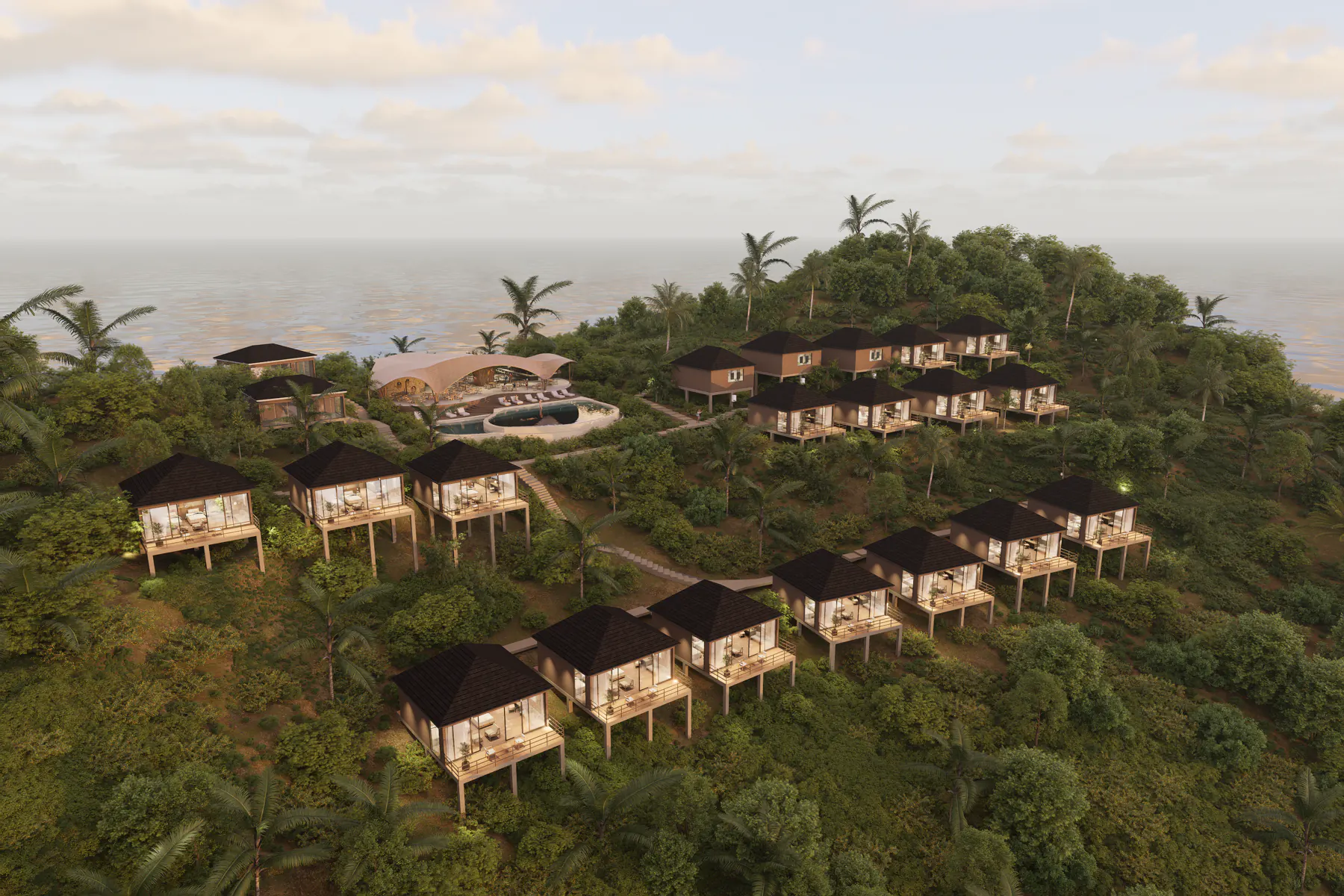
That is the practical argument for staying in the park rather than commuting to it. From our resort on Sebayur the central sites are around half an hour away instead of three hours, which means the dive plan can be built around the water rather than around the travel. Our dive centre pages explain how the daily schedule works, and the wider case for sleeping inside the park is in our guide to where to stay in and around the national park. A liveaboard solves the same timing problem a different way, by simply being moored where you want to dive.
The Short Version
Komodo's currents are strong, predictable and the entire reason the diving is world class. You cannot out-swim them and you are not supposed to try. What you can do is dive at the right hour, read the water, stay low and streamlined, use the terrain, hook in properly when it is appropriate, and have a rehearsed response ready for the day a wall starts pulling you downward.
Do those things and the current stops being an obstacle between you and the diving. It becomes the thing that carries you along a reef at walking pace while sharks hold station in the blue beside you, which is an experience that very few places on earth can offer, and the reason people come back.