For a while in the 1980s, Maumere Bay had a claim that Raja Ampat now holds. It was described as the most species-rich stretch of water anyone had catalogued, and the numbers behind that reputation are still remarkable: the underwater photographer Rudie Kuiter recorded more than 1,200 species of fish in this one bay, several of them new to science. Dive boats came from across the world for it.
Then, on 12 December 1992, a magnitude 7.8 earthquake struck a few kilometres off the island of Pulau Babi, and the tsunami that followed killed roughly 1,690 people, flattened most of Maumere town, and tore the shallow reefs apart. The bay dropped off the international dive map almost overnight and, unlike the town, it never really got its name back.
That is the part of the story most divers know, if they know Maumere at all. What far fewer people know is that the reefs came back. Government monitoring work carried out between 2006 and 2012 put reef recovery in the bay at around 90 per cent, and divers who visit today generally find healthy coral, absurd macro life and almost nobody else in the water. We run a dive resort in the Komodo National Park, and Maumere is far and away the most common second stop our guests ask about, because it sits at the other end of the same island and it offers exactly the diving Komodo does not. This guide covers what the diving is really like, how it compares with Komodo, how to physically combine the two, what it costs in 2026, and the safety detail that catches people out on the way home.
Where Maumere Is, and Why Divers Bother
Maumere is the largest town on Flores, home to around 90,000 people, and it sits on the north coast at the eastern end of the island, roughly 260 kilometres from Labuan Bajo as the plane flies and considerably further by road. Our wider guide to Flores covers the island as a whole; this article is about the water.
The diving happens in Maumere Bay, protected since 21 April 1987 as the Gugus Pulau Teluk Maumere marine nature tourism park, a little under 60,000 hectares of water studded with ten islands. The names worth remembering are Pulau Besar, the largest, along with Pangabatang, Dambilah, Pulau Pemana and Pulau Babi.
Those islands do something useful. Strung across the mouth of the bay, they act as a barrier against the open Flores Sea, which is why the inner bay stays calm for most of the year while Komodo's channels are ripping. It is also why big animals like it in here: dolphins and pilot whales are seen year-round when the sea is flat, sperm whales turn up in the November to December rains, and whale sharks are most reliably reported in April and May.
The bay sits inside the Coral Triangle, which explains the biodiversity, and the human pressure on it has always been light. There is no mass tourism here. On a normal day you will share a dive site with your own boat and nothing else.
The 1992 Earthquake, and the Honest State of the Reefs
You cannot write about Maumere without this, and you should not read glossy operator copy that skips it either.
The quake struck at 15 kilometres depth, close enough to Pulau Babi that the island took the worst of it. Waves topped 5.6 metres there, the two villages on the flat southern shore were erased, and 263 of the island's 1,093 residents died. Rebuilding was never permitted, so what you see on Babi today is a handful of seasonal fishing huts. Across Flores the tsunami destroyed roughly 18,000 homes, and something close to 90 per cent of Maumere's buildings came down. Aftershocks continued for months and the town was cut off from the rest of the country.
Underwater, the shallow coral communities were smashed, and they got unlucky twice: a severe storm swept the same coastline within two months of the earthquake, and marine scientists working in the bay afterwards could not always separate which disturbance had done which damage. In places the storm may have been the more destructive of the two.
Three decades on, the picture is genuinely good. The long-running national reef monitoring programme assessed recovery in the bay at about 90 per cent, and independent divers reporting from the site describe walls and slopes with dense hard coral, big gorgonians and heavy fish life, with damage visible only in patches of shallow water at a small number of sites. You should still go in with calibrated expectations. This is a recovered reef system, not a pristine one, and if you swim over a rubble field in the shallows somewhere, now you know why.
One site turns the history into something you can actually look at. The Crack is a fissure roughly 70 centimetres wide that the earthquake opened in the reef around 18 to 20 metres down, running some 30 metres back into the coral. You cannot swim inside it, but you can hang above it and look down into the internal structure of a reef, which is not a view you get anywhere else. Corals are slowly closing it over.
What the Diving Is Actually Like
Maumere is a macro destination with good reefs attached, and if you arrive expecting a second Komodo you will be disappointed for the wrong reasons.
Muck and Macro, Which Is the Real Reason to Come
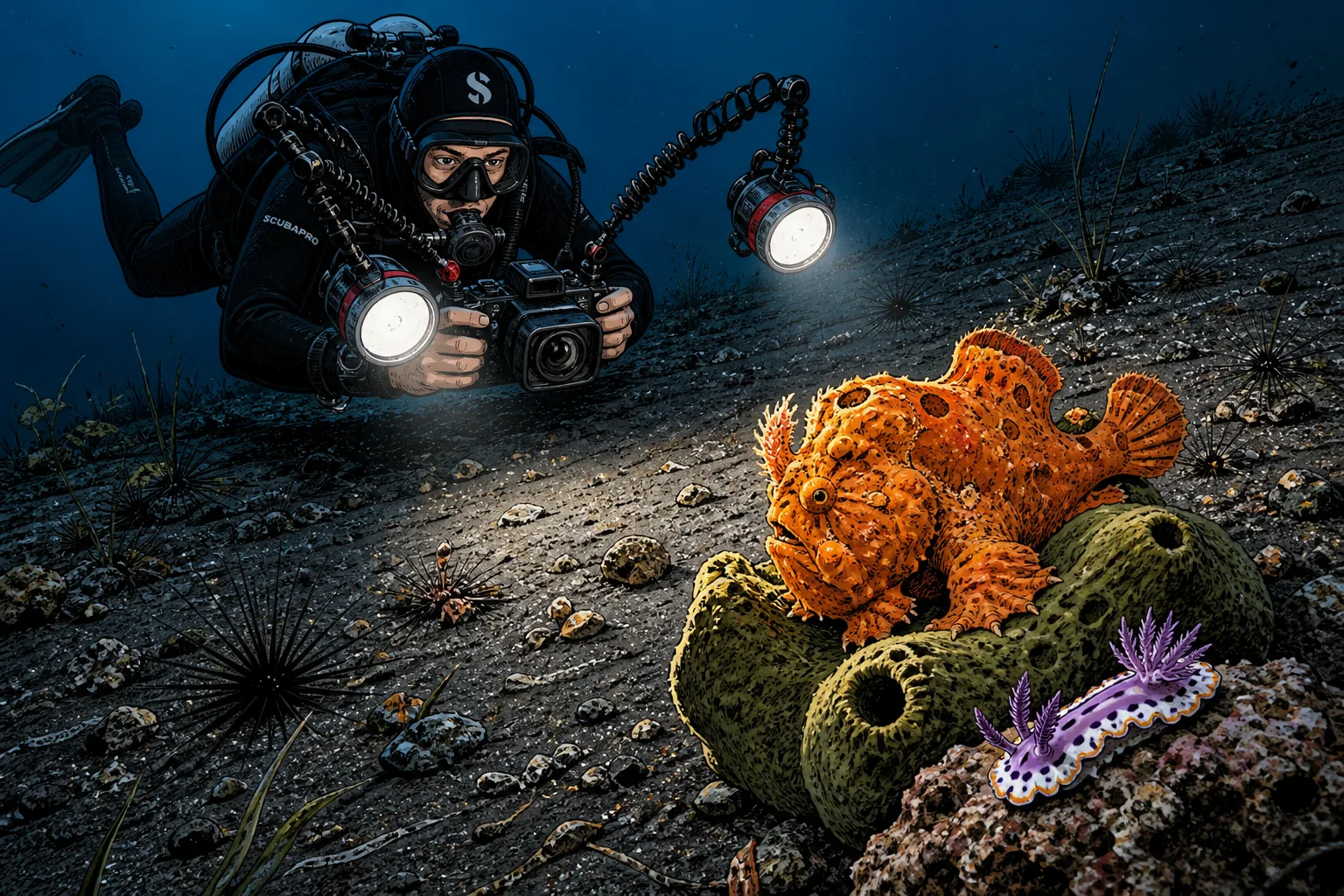
The black volcanic sand slopes along the mainland shore are the heart of it. Frogfish in several species, mimic and blue-ringed octopus, ghost pipefish, whiskered pipefish, nudibranchs in quantities that embarrass most photographers' memory cards, orangutan crabs, and resident mandarinfish that come out to spawn at dusk on particular patches of rubble. Sites like New Ankermi Slope are graded easy, sit in shallow water, and will hold a macro shooter for an hour without ever going below 15 metres.
If this is your thing, bring the right lens and plan on night dives. Our guide to underwater photography in this region covers the kit and settings, and almost all of it applies here with the added luxury of no current to fight.
Walls, Slopes and Currents
The outer islands are a different kind of diving. Pangabatang and Pulau Besar have steep walls hung with sea fans the size of car doors, plate coral terraces and clouds of anthias. The Channel, which runs between Pulau Besar, Dambilah and Pangabatang, is the one place in the bay that behaves like Komodo: real current, eagle rays, marbled rays and whitetips, and an advanced rating that it deserves.
Visibility across the bay commonly runs 20 to 30 metres in the dry season. Water sits between 26 and 29 degrees, and crucially it stays there, because Maumere has none of the cold upwellings that can drop a Komodo dive into the low twenties without warning. A 3mm suit is plenty.
The Wairterang Wreck
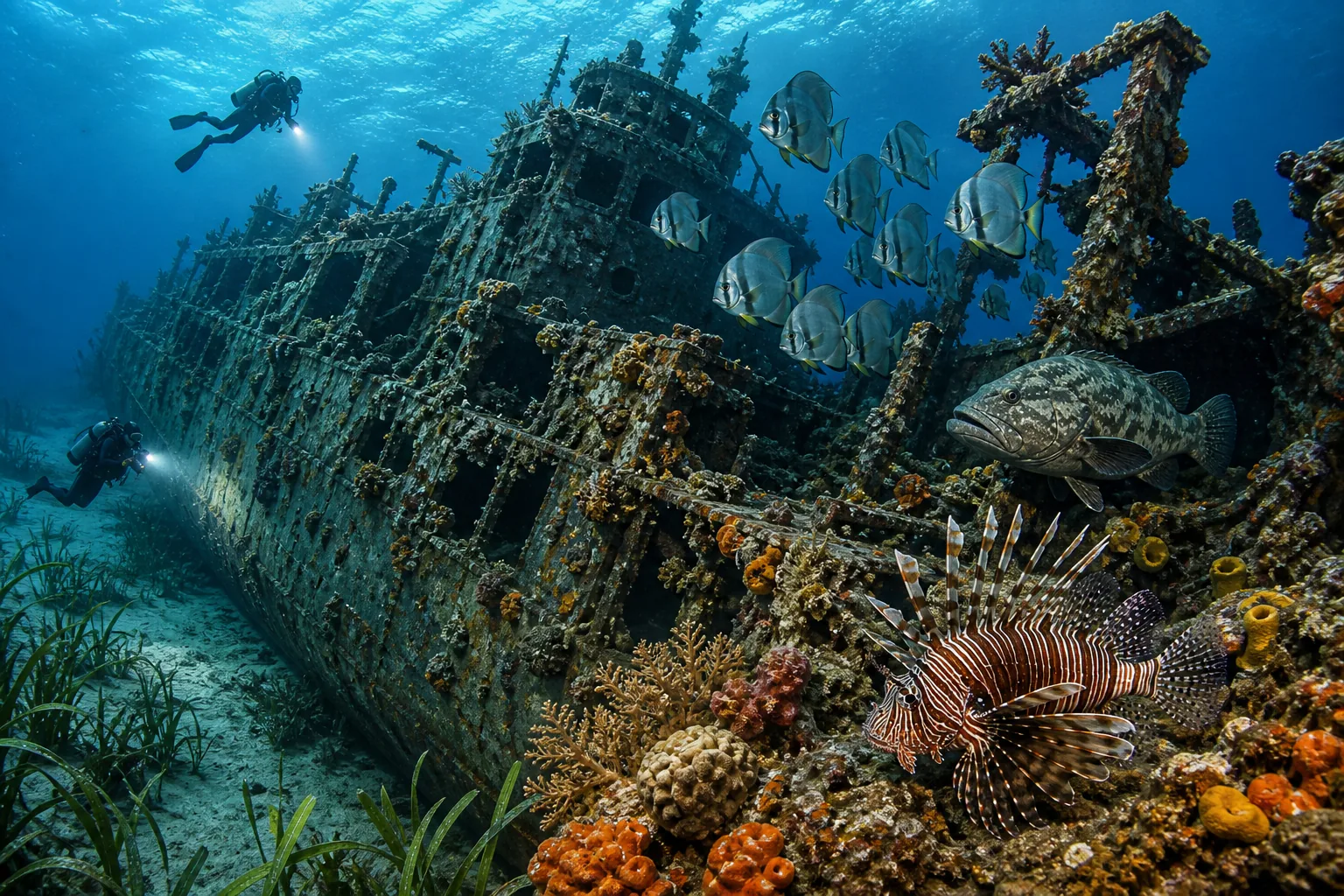
About 29 kilometres east of Maumere, off Wairterang beach in Sikka Regency, lies the bay's one wreck: a Japanese vessel that was anchored there loading charcoal and timber when an Allied bomb sank it in 1943. It is around 50 to 62 metres long and lies between 12 and 33 metres, close enough to shore that most operators run it as a shore dive.
It is thoroughly overgrown now, which is the appeal. Groupers and trevally patrol the structure, lionfish and scorpionfish sit on it, and the sand and seagrass either side of the hull is prime critter ground, with seahorses at the end of the dive if your guide knows where to look. It is not a technical wreck and you do not penetrate it. Treat it as a reef dive with excellent bones.
The Big Stuff
Manta rays are seen in the bay, reef sharks are around, and the cetacean list is unusually long for a dive destination. Do not, however, build a trip around megafauna here. Komodo's manta cleaning stations are far more reliable; Maumere's big-animal encounters are a bonus rather than a schedule.
How Maumere Compares With Komodo
This is the comparison our guests actually want, so here it is without diplomacy.
| Factor | Komodo National Park | Maumere Bay |
|---|---|---|
| Defining feature | Current-driven big-animal diving | Macro, muck and quiet reefs |
| Currents | Strong, tidal, occasionally serious | Mostly negligible, one advanced channel |
| Water temperature | 20 to 29C, cold upwellings possible | 26 to 29C, stable |
| Manta rays | Reliable at cleaning stations in season | Occasional |
| Macro life | Very good | Exceptional |
| Skill floor | Some sites demand experience | Suits beginners and courses |
| Other divers | Busy at the famous sites | Usually nobody |
| Cost per dive | Higher | Roughly 25 to 40 USD |
| Getting there | Direct flights from Bali, Jakarta, Singapore | Small airport, limited routes |
The honest summary is that these are complementary rather than competing destinations. Komodo delivers adrenaline, scale and near-guaranteed encounters with large animals; our overview of the dive sites in the park gives a sense of what that means in practice. Maumere delivers slow, warm, uncrowded diving where the interest is measured in centimetres. Divers who love both usually find the pairing more satisfying than two weeks of either one, in much the same way that our Komodo and Raja Ampat comparison ends up recommending both for different reasons.
Who Maumere Suits, and Who Should Skip It
Go if you are a macro photographer, if crowds bother you more than logistics do, if you want warm easy water after a hard week of drift diving, if you are learning to dive or building confidence, or if you like the idea of a place that used to be famous and now is not.
Skip it if you have a single week in Indonesia, because that week belongs in Komodo. Skip it if you need pelagics on a schedule, if you want polished resorts and a choice of restaurants in the evening, or if unpredictable regional flights will ruin your mood. Maumere town is a working Indonesian port, not a resort strip, and the diving is genuinely the reason to be there.
The Season, and How It Lines Up With Komodo
Maumere dives best from April to October, when the seas are calmest and visibility is at its peak. The broader dry season runs to about December. January to March is the wet season, which brings less predictable weather and rougher water on the crossings, though the sheltered inner bay still dives.
That maps neatly onto the Komodo calendar. As our guide to the Komodo diving seasons explains, the park is at its best from April through to around July, with manta aggregations peaking in that window before the southeast winds strengthen in August. April to July is therefore the sweet spot where both destinations are performing.
There is a second, quieter reason the calendars align. Indonesian liveaboards use Maumere as a staging port between the Komodo and Raja Ampat seasons, roughly April to May and September to November, when they reposition the fleet across the archipelago.
How to Combine Komodo and Maumere
Three ways, in descending order of practicality.
Fly, Which Is What Almost Everyone Should Do
Wings Air operates the only direct service between Komodo Airport in Labuan Bajo and Frans Xavier Seda Airport in Maumere. It is a short hop, about 257 kilometres and roughly an hour in the air, and it runs three times a week in each direction with a late-morning departure. Fares are cheap, frequently under 60 USD.
Three flights a week is the constraint that shapes the whole trip. You cannot treat this as a daily shuttle, so build your itinerary around the specific departure days and give yourself a buffer, because regional turboprop schedules in eastern Indonesia change with little notice and volcanic activity elsewhere on the island occasionally disrupts the airport. The fallback if the direct flight fails you is a connection through Denpasar or Kupang, which costs a day.
Drive Across Flores, If the Journey Is the Point
The Trans-Flores highway links the two ends of the island over roughly 650 kilometres of relentless mountain switchbacks. Driving time alone is twelve hours or more, and nobody sensible does it in one go. Broken into four to six days it becomes one of the best road trips in Indonesia, taking in Ruteng, the Ngada highlands around Bajawa, and the three coloured crater lakes at Kelimutu before dropping down to the north coast.
This is the option for people who came for Flores rather than just for the diving. It is also the only way to see the interior properly, and it removes the flight schedule from the equation entirely.
Take a Liveaboard
Because Maumere is a repositioning port, it appears as an endpoint on crossings heading east. Boats running the Banda Sea itineraries commonly start or finish here, typically over 10 to 12 nights via the remote volcanic islands. If your ambitions extend past Flores, this is the elegant way to leave. Our own liveaboard operation is focused on Komodo itself, so a Banda crossing is a separate booking, but it is worth knowing the geography makes it possible.
Which Order to Do Them In
Komodo first, Maumere second, for three reasons.
The first is arrival logistics. Labuan Bajo has frequent direct flights from Bali, Jakarta and Singapore, so it is the easy way in; Maumere is not. The second is diving load. Komodo is the more demanding destination, and it is better attempted with fresh legs at the start of a trip than at the end of one. The third is that finishing in Maumere gives you a soft landing: easy warm dives, no current, and the option of Kelimutu on the way out.
The counter-argument is worth acknowledging. If you are certifying, or you have not dived in a couple of years, doing your first days in Maumere's flat water before moving to Komodo's channels is a much gentler progression, and our breakdown of certification levels is a reasonable place to work out where you sit.
What It Costs in 2026
Maumere is cheap by Indonesian dive standards, which is part of the attraction.
Expect around 400,000 rupiah, roughly 25 USD, for a single shore dive including equipment and a guide, rising to about 500,000 rupiah for a night dive. Two boat dives run to roughly 1,200,000 rupiah, around 75 USD, and three boat dives to about 1,650,000 rupiah, close to 100 USD, generally with snacks, water and coffee thrown in. A full Open Water course sits near 5,900,000 rupiah, in the region of 360 USD.
Most operators prefer to sell stay-and-dive packages, and those are usually where the value is. Full-board multi-day packages combining accommodation, meals, equipment and daily diving have historically been advertised from a few hundred US dollars per person for a week, which is a fraction of the equivalent in Komodo. Add the flight, the park and site fees, and a modest budget for the drive to Kelimutu if you are adding it. Treat every figure here as indicative and confirm before booking, because rupiah pricing moves.
Where to Stay and Dive
The dive operations are not in Maumere town. They are strung along the coast road running east, which is where the reefs and the black sand slopes are, and they are mostly modest beachfront bungalow resorts with a dive centre attached rather than hotels in any conventional sense.
Sea World Club at Waiara is the oldest of them, a long-standing operation on a grey sand beach close to town. Ankermi Happy Dive at Watumita has been diving the bay for more than two decades and sits within 50 metres of its own house reef. Santai Divers on Nangatobong beach at Waigete is about 40 minutes out, was the first SSI centre in the area, and takes solo divers without the usual penalty. Coconut Garden and Budi Sun round out the main choices.
Two things to check before you commit. First, the quality of the house reef, because a good one transforms the trip: shore diving here is cheap and unlimited enough that you can dive far more than a boat schedule allows. Second, how far you are from town, since the road journey matters at the end of a long travel day. If you want to see how a purpose-built dive resort operates for comparison, our own dive centre and rooms pages set out the alternative model inside the national park.
Safety, Chambers and Getting Home
This section matters more in Maumere than it does in most places, because you are a long way from help.
There is no hyperbaric chamber in Maumere. The nearest one on Flores is at Siloam Hospitals in Labuan Bajo, at the opposite end of the island, which in a genuine emergency means an evacuation flight or a very long drive. That is not a reason to avoid the destination, but it is a reason to dive conservatively, pad your safety stops, stay well inside no-decompression limits, and carry proper diving insurance with evacuation cover. Our article on safety in the Komodo region goes through the medical infrastructure in more detail.
The more common mistake is the flight. The Wings Air hop to Labuan Bajo is short and feels trivial, but it is still a flight, and the standard guidance of 12 hours after a single dive and at least 18 to 24 hours after repetitive or multi-day diving applies exactly as it would to a long-haul departure. Because the service runs only three days a week, people compress their last diving day to make the plane. Do not. Plan your final dive day around the flight, not the other way round, and read our guide to flying after diving if you want the reasoning.
The same logic catches people going the other way, toward Kelimutu.
Adding Kelimutu on the Way Out
Maumere is the natural airport for Kelimutu, the volcano whose three crater lakes sit in different colours and periodically change them. Moni, the village at the trailhead, is three to four hours by road from Maumere, and the classic plan is to drive over in the afternoon, climb for sunrise, and continue or return the following day.
The catch is altitude. The Kelimutu summit area sits at about 1,639 metres, and ascending to altitude after diving carries the same decompression risk as flying. Diver safety guidance treats an ascent above roughly 600 metres the same way it treats a flight, which means a 12 to 24 hour surface interval before you start driving up. Our full guide to Kelimutu covers the climb, the fees and the current state of the lakes, and it makes the same point at greater length. Get the sequencing right and the two fit together beautifully: dive the bay, take a day off, drive up, and fly home from Maumere or Ende.
So Is It Worth It?
If you have one week, no. Spend it in the national park, where the diving is world class and everything is easier. Our guide to staying inside the park explains why proximity to the sites matters so much on a short trip.
If you have two weeks or more, and especially if you shoot macro, Maumere is one of the best-value additions available to you anywhere in Indonesia. You get a bay that was once considered the most diverse on the planet, reefs that have quietly rebuilt themselves over thirty years, a wreck, world-class muck diving, water that never gets cold, and a near-total absence of other divers, all for a fraction of what the equivalent costs further west. It is a one-hour flight from the park, and the two destinations have almost nothing in common underwater, which is precisely the argument for doing both.
Go with the right expectations. Maumere is not glossy and it is not convenient. What it is, still, is one of the most interesting stretches of water in the Coral Triangle, and one of the very few where you are likely to have it to yourself.