There is no ferry from Lombok to Komodo. That single fact is behind most of the confusion about this route, because it is the thing people assume exists and then plan around. What does exist is better than a ferry in one direction and considerably worse in another: a 75-minute flight, a four-day boat trip that is one of the best journeys in Indonesia, and a chain of public buses and car ferries that will get you there for about the price of two cocktails in Senggigi. Which one is right depends on whether the crossing is a chore to be minimised or the holiday itself. If it is the holiday, a Komodo boat tour from the Lombok side covers roughly 400 kilometres of islands that almost nobody visits.
Lombok is a genuinely good place to start a Komodo trip, and not many people work that out. You are already 400 kilometres closer than Bali, already on Indonesia time in the same zone as Labuan Bajo, and already in the habit of boats. Divers in particular tend to arrive with the wrong mental model, expecting to fly out and back through Bali when the direct hop exists and the sea route sails through Saleh Bay. If you are coming to dive rather than to sightsee, the crossing you pick determines what shape your first week takes, and a Komodo liveaboard from Labuan Bajo is a different trip from a budget open boat that ends there.
This guide covers all four routes with real 2026 numbers: what the flight actually costs once you add baggage, what the four-day boat includes and where it will disappoint you, how the public ferry chain fits together and where its published schedules stop being trustworthy, and the honest version of the whale shark question, which is not the answer the tour listings imply. I have tried to be straight about which route suits which traveller instead of recommending the most expensive one.
The Four Routes at a Glance
| Route | Time | 2026 cost per person | Best for |
|---|---|---|---|
| Fly Lombok (LOP) to Labuan Bajo (LBJ) | 1h 15m in the air | Roughly IDR 900,000 to 1,800,000 plus baggage | Short holidays, divers on a schedule |
| Open-trip boat, Lombok to Labuan Bajo | 4 days, 3 nights | IDR 3,600,000 to 6,500,000 | Travellers who want the journey to be the trip |
| Public ferry and bus chain | 2 days or more | Under IDR 500,000 all in | Tight budgets, time to spare, patience |
| Expedition liveaboard along the same chain | 10 days, 9 nights | From USD 3,550 | Divers who want the whole archipelago |
One thing to get out of the way, because it saves a lot of confused reading: Komodo is not a town you can fly to. The airport is at Labuan Bajo, on the western tip of Flores, and the national park is the water and islands to its west. Every route below ends at Labuan Bajo, and the park starts after that. Our guide to where Flores Island is untangles the Flores, Komodo and Labuan Bajo naming mess if that is what brought you here.
Option 1: The Flight Nobody Realises Exists
There is a direct flight, it runs most days, and a surprising number of travel agents in Lombok will still route you through Bali. Wings Air flies Lombok International (LOP) to Komodo Airport (LBJ) on an ATR 72 turboprop. The flight is 1 hour 15 minutes for 398 kilometres, and it is the only nonstop service on the route.
Frequency is the part to check rather than trust. Depending on the season and the source you look at, the route runs anywhere from eight to fourteen times a week, which at the top end is two or three departures a day and at the bottom end is not quite daily. In August 2026 the listed pattern was a late-morning departure around 11:05 every day, an early-afternoon one on some days, and a mid-afternoon departure around 14:30 daily. Wings Air re-cuts regional schedules seasonally and one aggregator had the route scheduled only as far as late October, which is normal and not a sign the route is disappearing. Look it up for your dates rather than trusting any guide, including this one.
A small mercy: Lombok and Labuan Bajo are both on WITA, Indonesia Central Time, so there is no time change and no arithmetic. Our note on Indonesia time zones matters more if you are connecting from Jakarta, which is an hour behind.
The baggage trap, and it is a real one
Here is the thing that catches divers, and it is the most useful paragraph in this article. Wings Air economy tickets carry no free checked baggage as standard. Lion Group's own allowance table lists Wings Air at 0 kg, against 20 kg for Lion Air and Batik Air. Some fares bundle 10 kg, so check your specific itinerary receipt, but do not assume.
Cabin baggage is one piece, 7 kg maximum, and the size limit is a genuinely small 35 x 30 x 20 cm. Not a bag plus a laptop bag. One bag.
Prepaid baggage bought in advance through the airline runs roughly IDR 125,000 for 5 kg up to about IDR 750,000 for 30 kg. Buying it at the check-in desk costs materially more. So the arithmetic that matters for a diver carrying 25 kg of gear is not the fare, it is the fare plus something like IDR 600,000 of baggage, each way. That can close the gap with the boat entirely.
Two more ATR-specific points. Cargo hatches are small, so oversized items are capped by space on the day and charged separately, in the region of IDR 500,000 per bulky piece. And if you are carrying a tank, it must be empty with the valve open. Most people rent tanks at the destination for exactly this reason, and our Komodo dive centre has them, so there is no good argument for flying one across the Flores Sea.
Build in a buffer day
One airline, one aircraft type, a small regional airport, and afternoon weather in the wet season. Cancellations happen, and when they happen your options are tomorrow's flight or a two-day overland retreat. If you have an international flight home out of Bali or Jakarta, do not connect to it on the same day you leave Labuan Bajo. That advice holds double for divers, because flying after diving needs a surface interval you cannot compress just because a rebooked flight left earlier.
Option 2: The Four-Day Boat, Which Is the Real Answer for Most People
This is what most people searching "boat trip to Komodo from Lombok" actually want, and the first correction is the duration. The standard is four days and three nights, not the three days people expect. Boats leave Lombok, work east through Sumbawa, spend a full day inside Komodo National Park and finish at Labuan Bajo in the early afternoon of day four.
Departure is not from Mataram or the Gilis. You are collected from Senggigi, Bangsal or Mataram and driven roughly two hours east to Kayangan harbour, at the far end of Lombok, where the boat is waiting. Some operators use Labuhan Lombok, which is the same corner of the island. Departure days vary by operator and cluster around Monday, Wednesday, Thursday, Saturday and Sunday, with two passengers as the usual minimum booking.
What the route actually is
The itinerary is remarkably consistent between operators, because it follows the only sensible line east through the islands.
- Day one, Kenawa Island. A tiny uninhabited island off western Sumbawa, all golden savannah hill and shallow turquoise water. You walk up the hill for sunset, swim, and sleep on the boat.
- Day two, Saleh Bay and Satonda or Moyo. An early start for the whale sharks at Saleh Bay, then on to Satonda, a volcanic island with a saltwater crater lake in its middle, or Moyo for its waterfalls.
- Day three, Komodo National Park. The long day. Usually the sunrise trek on Padar Island, a ranger-guided dragon walk on Komodo or Rinca, snorkelling at Pink Beach in Komodo, and a drift over the manta aggregation at Karang Makassar.
- Day four, the run into Labuan Bajo. Snorkelling at Manjarite and a last stop at Kelor Island with its steep little hill, then into the harbour around lunchtime.

Run in reverse, Labuan Bajo to Lombok, the itinerary usually swaps the whale sharks for the flying fox exodus at Kalong Island and more time at Moyo, and it is sometimes a few hundred thousand rupiah cheaper. If you are ending in Lombok or Bali, that direction is worth pricing.
What it costs in 2026
Prices are set by where you sleep, and the spread is wide.
| Sleeping arrangement | Price per person | Reality |
|---|---|---|
| Open deck, mattress | IDR 3,600,000 to 4,000,000 | Mattresses in a row under a canopy. Sociable, hot, and you wake with the sun. |
| Shared cabin, fan | Around IDR 4,200,000 | A basic bunk cabin below deck. Airless but private-ish. |
| Private cabin, air conditioning | Around IDR 4,600,000 | The sweet spot on a standard boat. |
| Upgraded phinisi cabins | IDR 5,000,000 to 6,500,000 | Better boat, better food, fewer people, proper bathrooms. |
Meals, drinking water, coffee and tea, an English-speaking guide and the transfers are normally included. Park entrance fees sometimes are and sometimes are not, and they are not trivial, so ask before you book rather than at the park gate. Our breakdown of Komodo National Park entrance fees explains what is charged per person, per activity and per boat, and why Sundays and public holidays cost more. For a fuller picture of what a week here costs once flights, park fees and diving are stacked up, we have a Komodo Island trip cost breakdown.
The honest version of what these boats are like
This is where most write-ups go soft, so plainly: these are budget boats, and the cheap tier is basic in ways that matter over three nights. Bathrooms are shared, small and wet. Fresh water is limited and showers may be salt water or a bucket. There is often no functioning air conditioning on the open-deck tier because there is no cabin. Phone signal disappears for long stretches between Sumbawa and Komodo. The engine is directly below you and it is loud.
None of that is a reason not to go. Three nights of sleeping on deck under an absurd number of stars, in a place with no other boats in sight, is the sort of thing people remember for twenty years. But it is worth knowing before you commit, especially if you were picturing a cruise. If you want that experience with proper cabins and a chef, the phinisi tier or an expedition liveaboard is the version to book, and our guide to your first liveaboard covers what changes when you step up.
The crossings themselves are open water. The stretch across the Sumbawa Sea and the run through the Sape Strait can be genuinely rough, particularly in the northwest monsoon between December and March. If you know you are susceptible, deal with it before you board rather than on day two, because there is no getting off. Our guide to seasickness on Komodo boat trips covers what works and when to take it.
It is not a diving trip. Do not book it as one.
This is the single most important thing to understand about the Lombok boats. They are snorkelling and sightseeing boats. There is no compressor, no tanks, no dive guides and no insurance for diving. Some listings use the word "liveaboard", which in this segment means "you sleep aboard", not "you dive from it".
If you are a diver, the sensible shape is to treat the boat as the arrival and do your diving properly afterwards from inside the park. That is the whole argument for the crossing: you see Kenawa, Saleh Bay and Satonda, which no dive itinerary from Labuan Bajo will ever show you, and then you dive Komodo with people who dive it every day. What you should not do is spend four days passing over some of the best reefs in Indonesia with a snorkel, then fly home.
Choosing a boat safely
Small-boat standards in Indonesia vary, and price is the main thing that varies with them. A few checks are worth making, and they are the same checks any honest operator will be happy to answer.
- Enough life jackets for everyone aboard, stowed where you can reach them rather than locked away.
- A working VHF radio and GPS, not just the captain's phone, which has no signal for most of the route.
- A tender or dinghy that runs, since it is what gets you ashore and what gets you off in trouble.
- A passenger count that matches the boat. Overloading is the common factor in most incidents.
- Departures cleared by the harbour master. In bad weather, sailings are held, and an operator willing to sail anyway is telling you something.
Resist the urge to book the absolute cheapest seat you can find on a Facebook group. The gap between the cheapest boat and a reputable one is a few hundred thousand rupiah across four days. Our wider look at whether Komodo Island is safe covers the same ground for the park itself, and the open trip Komodo guide explains how shared-boat bookings work.
The Whale Sharks: What Is Actually True
Whale sharks are the headline on nearly every Lombok-to-Komodo listing, and the way they are advertised leaves people with two wrong impressions. Both are worth correcting before you book.
First, whale sharks are not a Komodo animal. They are not resident in Komodo National Park and no honest operator will promise you one there. What the boats visit is Saleh Bay, on the north coast of Sumbawa, which is a completely different place several hundred kilometres west of the park. Saleh Bay is genuinely one of the most reliable whale shark sites in the world, because the sharks feed on bycatch around the bagans, the floating fishing platforms, and have done for generations. They are there year round, with the strongest run from roughly May to October, typically one to four animals at a time in shallow, calm water.

Second, this is a snorkel, not a dive. Encounters happen at the surface beside the platforms, usually at dawn, and they are open to anyone who can swim. That is a feature rather than a limitation: you are in five metres of flat water with a seven-metre fish, which is a better way to see one than from 20 metres below.
So the accurate framing is that the Lombok route is a whale shark trip and a Komodo trip stitched together, which is exactly what makes it good value. Just do not arrive in the park expecting more of them. What Komodo does have in reliable numbers is mantas at Karang Makassar and a genuinely dense shark population on the northern pinnacles: our guides to swimming with manta rays in Komodo and the sharks of Komodo cover what you will actually see once you are there.
Option 3: The Public Ferry and Bus Chain
The cheapest way across is a chain of public transport, and it is genuinely cheap: under IDR 500,000 for the whole crossing if you are careful. It also takes two days or more and involves a great deal of road time. There is no single boat, and this is the source of the "is there a ferry from Lombok to Komodo" confusion. There is no direct ferry, and multi-day tour boats are the only vessels that sail the whole way.
The chain has three legs.
- Lombok to Sumbawa. A car ferry from Kayangan in East Lombok to Poto Tano in West Sumbawa, running roughly hourly and taking one to two hours.
- Across Sumbawa. The long one. Bus or minivan from West Sumbawa through Bima to the eastern port town of Sape, around eight to ten hours, frequently overnight.
- Sape to Labuan Bajo. The ASDP car ferry across the Sape Strait, operated by KMP Cakalang and KMP Cucut on alternating days, about seven to eight hours. Economy tickets are in the IDR 84,000 to 120,000 range.
The efficient way to do it is to buy a single executive bus ticket from Mataram straight through to Sape, which includes the Poto Tano ferry crossing. Tiara Mas and Safari Dharma Raya are the two established operators, the run takes twelve to fifteen hours, and it costs somewhere around IDR 275,000 to 350,000. Then you buy the Sape ferry separately.
A warning about times. Published departure times for the Sape ferry genuinely conflict between sources: English-language guides list a morning departure around 08:00, while Indonesian listings of the ASDP schedule show 21:00 from Sape with 10:00 in the Labuan Bajo direction. Both may be right at different points in the vessel rotation, and both change for weather and maintenance. Do not build a connection on a time you read anywhere, including here. Check the Ferizy app or the port a day ahead, and if you are relying on this route, give yourself a spare day at the Flores end.
There is also a fortnightly-ish option worth knowing: Pelni's inter-island ships, notably KM Tilongkabila, call at Lembar in Lombok and Bima in Sumbawa on their circuits. Schedules are published only a few weeks out in voyage batches, so it is a route for people whose dates are flexible rather than a plan.
Who is this for? Travellers on a real budget with time, and people who like the transport to be part of the story. If you are trying to save money on a two-week holiday, the honest answer is that the flight plus the days you get back is better value than the bus. For a broader look at the ways into the region, including the Bali options, see how to get to Komodo National Park.
Option 4: Sail the Whole Chain Properly
There is a version of this crossing that is neither a budget open boat nor a flight, and it is the one to look at if the islands between Lombok and Komodo are the reason you are interested in the first place.
Neptune Liveaboards, part of the same Neptune World family as Komodo Resort, runs Neptune One on a ten-day, nine-night expedition that goes Bali, Lombok, Moyo Island, Satonda, Sumbawa, Gili Banta, Komodo National Park and into Labuan Bajo, with diving and snorkelling at the stops along the way and prices from USD 3,550 per person. It runs in reverse too, which is useful if you want to finish in Bali. That is the same island chain the budget boats follow, sailed by a boat set up for diving, with cabins, a chef and dive guides. If you are coming to dive, this covers ground no day boat from Labuan Bajo reaches, and it arrives at Komodo from the west.
Between those two extremes sits the option most divers actually take: get to Labuan Bajo however suits you, then dive from a boat or from inside the park. Our Komodo Island itinerary plans show how three, five and seven-day trips fit together once you have arrived.
When to Make the Crossing
The crossing is more weather-dependent than the destination, because you are spending hours in open water rather than in the sheltered channels of the park.
From April to November the southeast trades blow and the sea is generally kinder. This is the main season for the Lombok boats, and it overlaps neatly with the Saleh Bay whale shark peak from May to October. July and August are the busiest, and the boats fill.
From December to March the northwest monsoon arrives. Boats still run, but crossings get bouncier, sailings are held more often, and an open-deck berth in the rain is a long night. Some operators pause the Lombok route entirely in January and February. The park itself is a good deal better in the wet season than its reputation suggests, which we go into in Komodo in January, but the long open crossings are the weak point of a wet-season plan. If your dates are fixed in that window, fly and dive rather than sail. For the month-by-month picture, see the best time to visit Komodo Island.
Arriving in Labuan Bajo
However you come in, the town is small and the airport is a ten-minute drive from the harbour, which makes onward logistics easy. If you have arrived on the boat, you are already at the harbour.
Two practical notes. Park fees are charged separately from your transport and vary by activity and day, so budget for them as a line of their own. And Labuan Bajo has become a real town rather than a fishing village, with decent coffee, dive shops and hotels at every level: our Labuan Bajo travel guide covers where to eat and what to sort out before you head into the park.
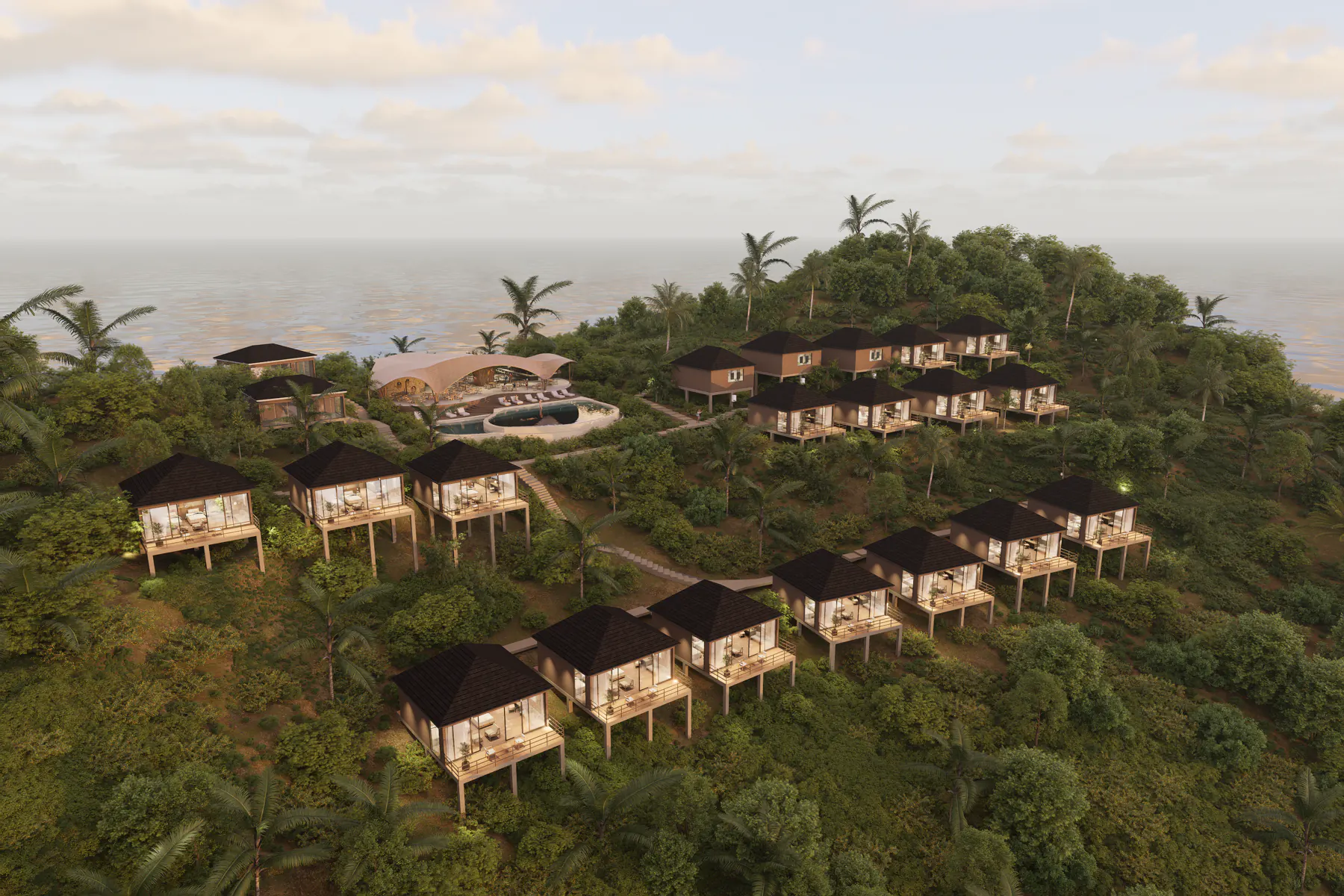
If you would rather not stay in town at all, the alternative is to sleep inside the park. Komodo Resort sits on its own island in the middle of it, which means the dive sites are a short boat ride away instead of a two-hour transit each morning, and you wake up on the reef. You can see the Komodo Resort rooms for what that looks like. For a diver who has just spent four days getting here, cutting the daily commute is worth more than it sounds.
One last packing note specific to this route: if you are taking the boat, pack for a boat. A dry bag, reef-safe sunscreen, motion sickness tablets taken before you sail, a head torch, and far less clothing than you think. Everything gets damp. Our what to pack for Komodo Island list covers the rest, and it is worth reading before you buy anything.
So Which One Should You Take?
If your holiday is two weeks or less and you want to dive, fly. Add the prepaid baggage when you book, leave a buffer day before your international flight, and spend the time you saved underwater instead of in transit.
If the journey is the point, take the four-day boat, pay the extra for a cabin, and go in the dry season. It is the best value of the four and the only one that shows you Kenawa, Saleh Bay and Satonda.
If you are on a tight budget with time to spare, the bus and ferry chain works and thousands of people do it every year. Give yourself a spare day and do not trust a published schedule.
And if you are a diver who wants the whole archipelago rather than one park, sail the chain properly on an expedition itinerary and arrive at Komodo from the west, the way the first divers here did.
Whichever you pick, the diving starts after Labuan Bajo, not before it. Plan the crossing around that and you will not get it wrong. If you want a hand fitting the pieces together, get in touch and tell us your dates.