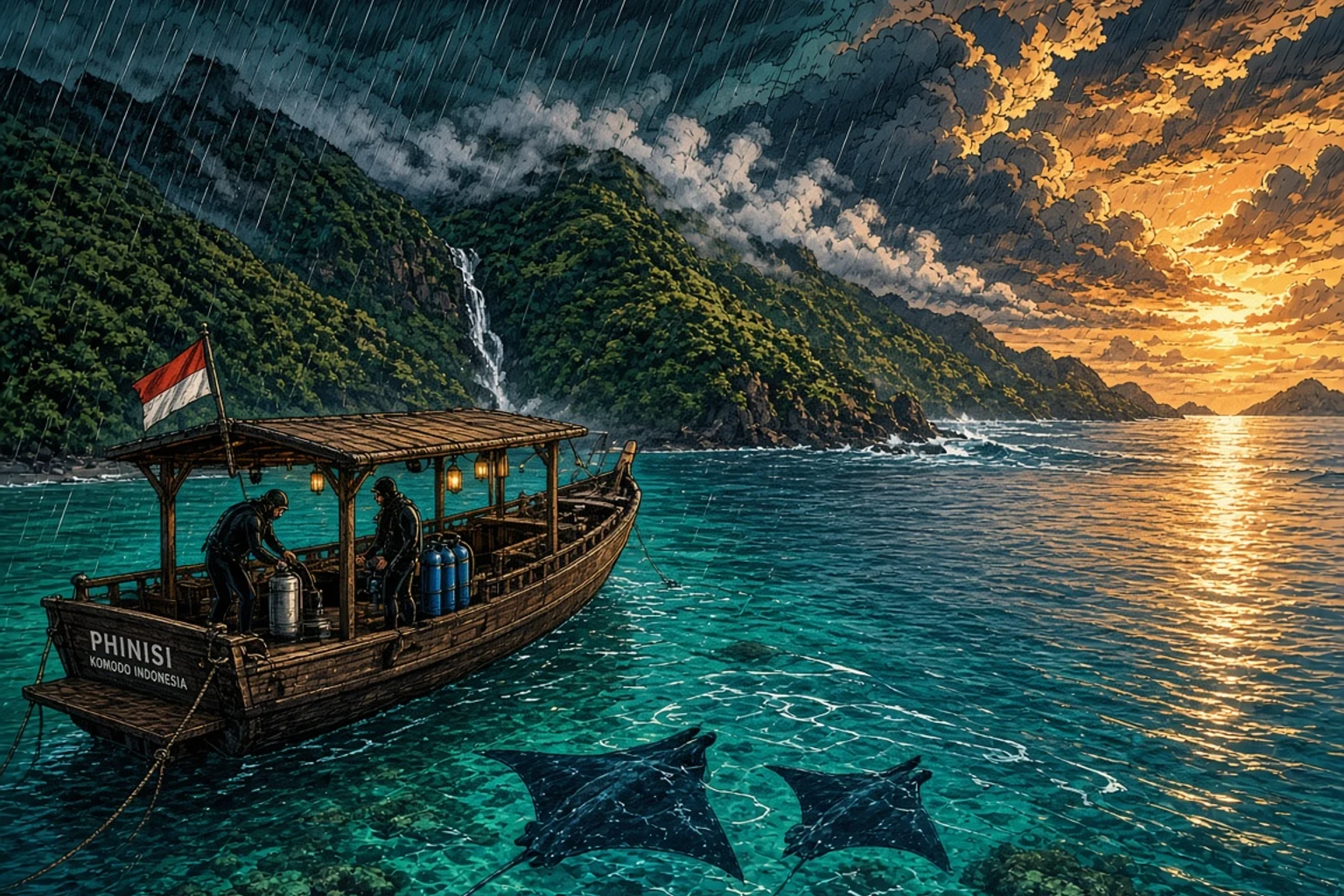
Ask ten divers what brought them to Komodo and you will hear the same three answers: mantas at Karang Makassar, sharks holding station in the blue at Castle Rock, and soft coral bent flat by a drift nobody can swim against. Almost nobody arrives with a night dive on the list. Then they do one, usually because a guide mentioned it over dinner, and it becomes the dive they describe first when they get home. Our PADI five-star dive centre runs them on request, and that pattern repeats all season.
The reason is biology rather than novelty. A tropical reef works two shifts, and every photograph you have ever seen of Komodo is the day shift. After sunset the daytime fish wedge themselves into cracks and hand the reef over to animals that have been hiding since dawn: octopus out hunting in the open, morays free-swimming across the sand, shrimp whose eyes throw back your torch beam like road studs. It is the same site you dived that morning and you will not recognise it. Guests staying in our rooms on Sebayur are showered and eating within an hour of surfacing, which is a large part of why night diving from a resort is less of an undertaking than it sounds.
This guide covers what actually comes out after dark here, which sites work at night and which are a genuinely bad idea, the dusk dive that everyone calls a night dive but isn't, the park rules that apply after sunset, torch technique and light etiquette, and an honest answer on how much experience you need. It sits alongside our guide to diving Komodo's currents, which is the daytime half of the same story.
What Changes on the Reef After Sunset
The handover happens fast. In the tropics there is barely any dusk, so the light goes from usable to gone in about twenty minutes, and the reef reorganises itself in roughly the same window.
Day-active fish need somewhere to be. Parrotfish, wrasse and surgeonfish look for a hole that fits, back into it, and stay put until dawn. Many of them change colour while they sleep, and the bright green parrotfish you photographed at Batu Bolong in the morning turns a blotchy grey-brown that is genuinely hard to identify. Torch them gently and they usually do not stir at all.
Parrotfish do something stranger still. Several species secrete a transparent mucus envelope around themselves before sleeping, a cocoon that takes up to an hour to produce and that they abandon each morning. The best-supported explanation is that it works as a mosquito net: it blocks the scent trail that blood-feeding gnathiid isopods follow, and experiments have shown fish without a cocoon get bitten far more. Finding one is a matter of looking under ledges rather than out in the open, and it is the single most reliable "you had to be there" sighting on a Komodo night dive.
Meanwhile the reef itself comes alive in a way it never does in daylight. Hard corals extend their polyps after dark to feed on zooplankton rising through the water column, so a boulder coral that looked like grey rock at noon turns furry and mobile under a torch. Basket stars unfold from tight knots into metre-wide filigree nets. Crinoids climb up onto the highest point they can find and open into the current. It is worth spending two minutes of any night dive with your beam on a single coral head, doing nothing else.
The Animals You Came For
Cephalopods, Which Are the Main Event
Octopus are the reason many divers become night-dive people. In daylight they are a suspicion in a hole. At night they hunt in the open, flowing over coral with their arms spread into a web, changing colour and texture continuously while they work. Watch one long enough and you will see it flush white, then pebbled brown, then throw a false eye spot, all in a couple of seconds.
Komodo also holds the small, strange end of the cephalopod family. Bobtail squid the size of a thumbnail hover just off the sand and bury themselves with a flick when the beam finds them. Flamboyant cuttlefish walk rather than swim, pulsing purple and yellow across the rubble. Blue-ringed octopus turn up on the sandy sites and are worth knowing about for two reasons: they are beautiful, and their venom is genuinely dangerous, so the rule is look, photograph, and keep your hands to yourself. That is not a night-diving rule so much as a Komodo rule, and it applies to the rest of the reef too.
Hunters
Moray eels leave their holes after dark and swim the reef fully extended, which is startling the first time one passes a metre below you. Lionfish work the edges of your torch beam, and this is real behaviour rather than a story: they learn that a diver's light concentrates prey and will shadow you for the whole dive, ambushing anything your beam picks out. It is a good reason not to hold your light on a small fish for too long, unless you want to watch it get eaten.
Crustaceans dominate the substrate. Sweep the sand at a low angle and the eyeshine gives them away, hundreds of tiny orange-green points looking back at you from a reflective layer behind the retina. Get closer and they resolve into shrimp, hermit crabs, slipper lobsters and swimming crabs, most of which never emerge in daylight. Spanish dancers, big red nudibranchs the length of your forearm, occasionally launch off the reef and swim with a rippling motion that looks nothing like anything else underwater.
Bioluminescence
This is the part guests remember longest, and it costs nothing. Find a spot with no current and reasonable depth, signal your buddy, and switch every torch off. Give your eyes thirty seconds. Then wave a hand slowly through the water: the dinoflagellates in the plankton respond to the disturbance and your arm leaves a trail of cold blue-green sparks behind it.
It works better on dark nights than under a full moon, better in the plankton-rich water that also feeds the manta rays, and it never fails to turn a group of adults into children. Brief it beforehand, though. Switching your light off unannounced next to a diver who was not expecting it is a poor way to make friends.
Mandarinfish at Dusk, Which Is Not a Night Dive
The dive people most often mean when they say "night dive in Komodo" is technically a dusk dive, and the distinction matters because the timing is unforgiving.
Mandarinfish are small, absurdly patterned dragonets that live deep in coral rubble and are almost impossible to see during the day. For roughly twenty minutes around sunset, pairs rise a foot or two off the rubble, press together and release eggs and sperm into the water, then drop back into cover. Then it is over until tomorrow. Miss the window by half an hour and you have done a dive on a rubble slope in the dark.
In Komodo the site for this is Wainilu, a shallow black-sand slope near Rinca, across from the ranger station. It is the park's answer to Lembeh and it looks like nothing at all on first inspection: sand, rubble, a few coral patches, no drama. Operators arrive around thirty minutes before sunset and drop in while there is still light, which gives you time to find the right patch of rubble and settle before the show starts.
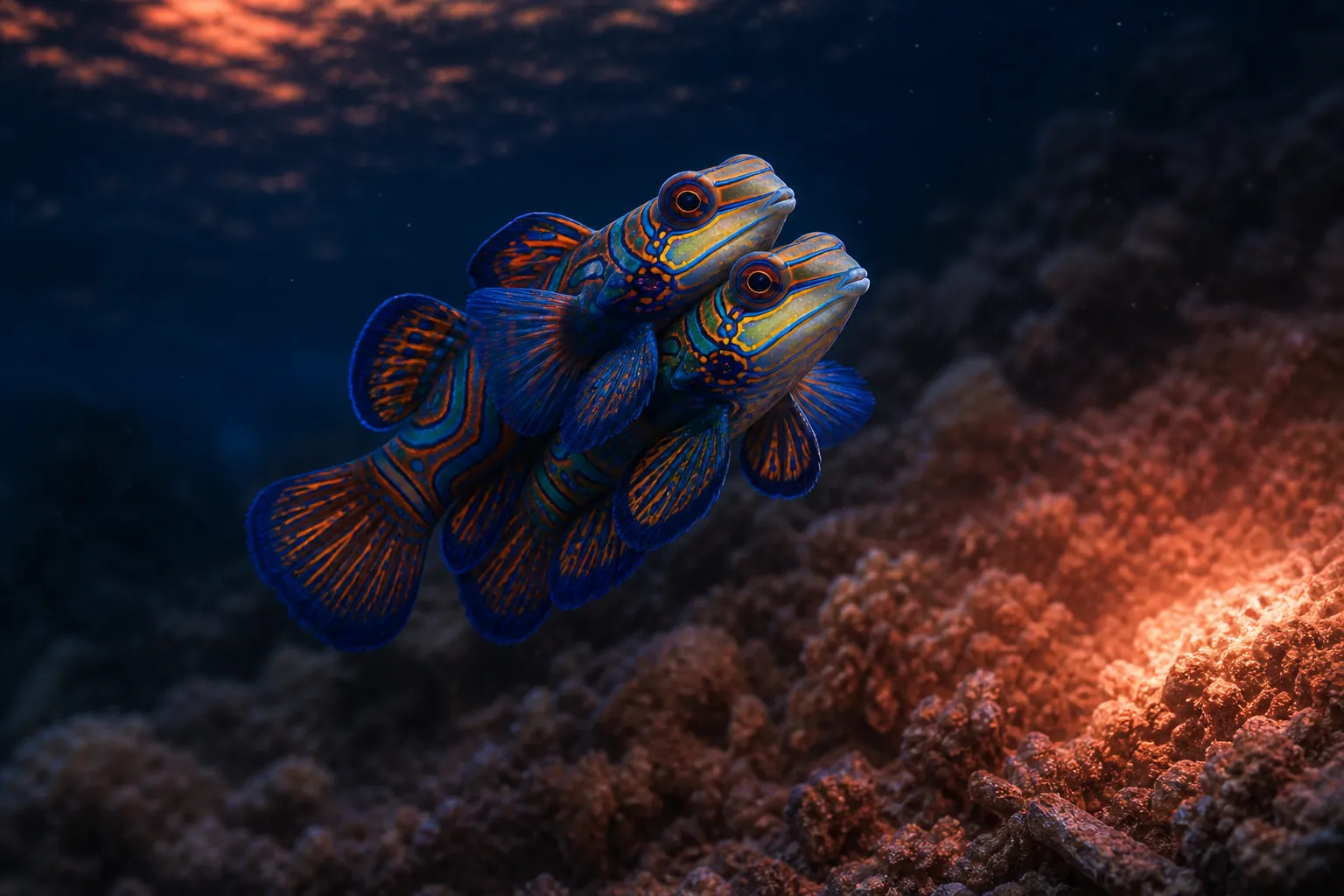
Light discipline is the whole game. White light interrupts the ritual and can shut it down completely, so use a red filter or the dimmest setting you have, keep the beam off the pair themselves and light them with the edge of it, and stay still. Divers who hover motionless at a respectful distance see the full sequence several times. Divers who chase see nothing.
Wainilu is worth the trip on its own merits regardless of the timing. It is the best muck site in the park, with ribbon eels, frogfish, ghost pipefish, mantis shrimp, mimic and wonderpus octopus and a nudibranch list that keeps macro photographers busy for a week. The current is mild, the depth is shallow, and it is often used as a check dive for exactly those reasons. Our underwater photography guide goes into the lens and lighting choices in more detail.
Where Night Diving Actually Happens, and Where It Absolutely Does Not
Two things shape the answer, and neither is obvious from the brochures.
The famous sites are the worst possible choice after dark
Batu Bolong, Castle Rock, Crystal Rock, Shotgun, Tatawa Kecil and the Karang Makassar drift are exposed pinnacles and channels running serious tidal flow. Their entire character is current, and current is precisely what you cannot read at night.
Tatawa Kecil is the clearest example of why. It is an advanced site notorious for split currents, downcurrents and whirlpools, and it has to be timed against the slack tide to be manageable in broad daylight with a guide reading the surface. Castle Rock and Crystal Rock are submerged seamounts where the group descends fast on a negative entry into flow that can exceed anything you have dived before. Batu Bolong drops vertically on both sides of a rock in mid-channel, and drifting off the sheltered face into the moving water is the standing hazard there in full sun.
In daylight a guide judges these sites by watching the surface for boils and standing waves, by checking which way the fusiliers are pointing before committing anyone to the water, and by keeping the whole group in sight through the dive. None of that is possible in the dark. Nobody night dives them. No reputable operator in Komodo will offer to, and if one offers, book with somebody else.
Night diving happens in sheltered water, mostly just outside the park
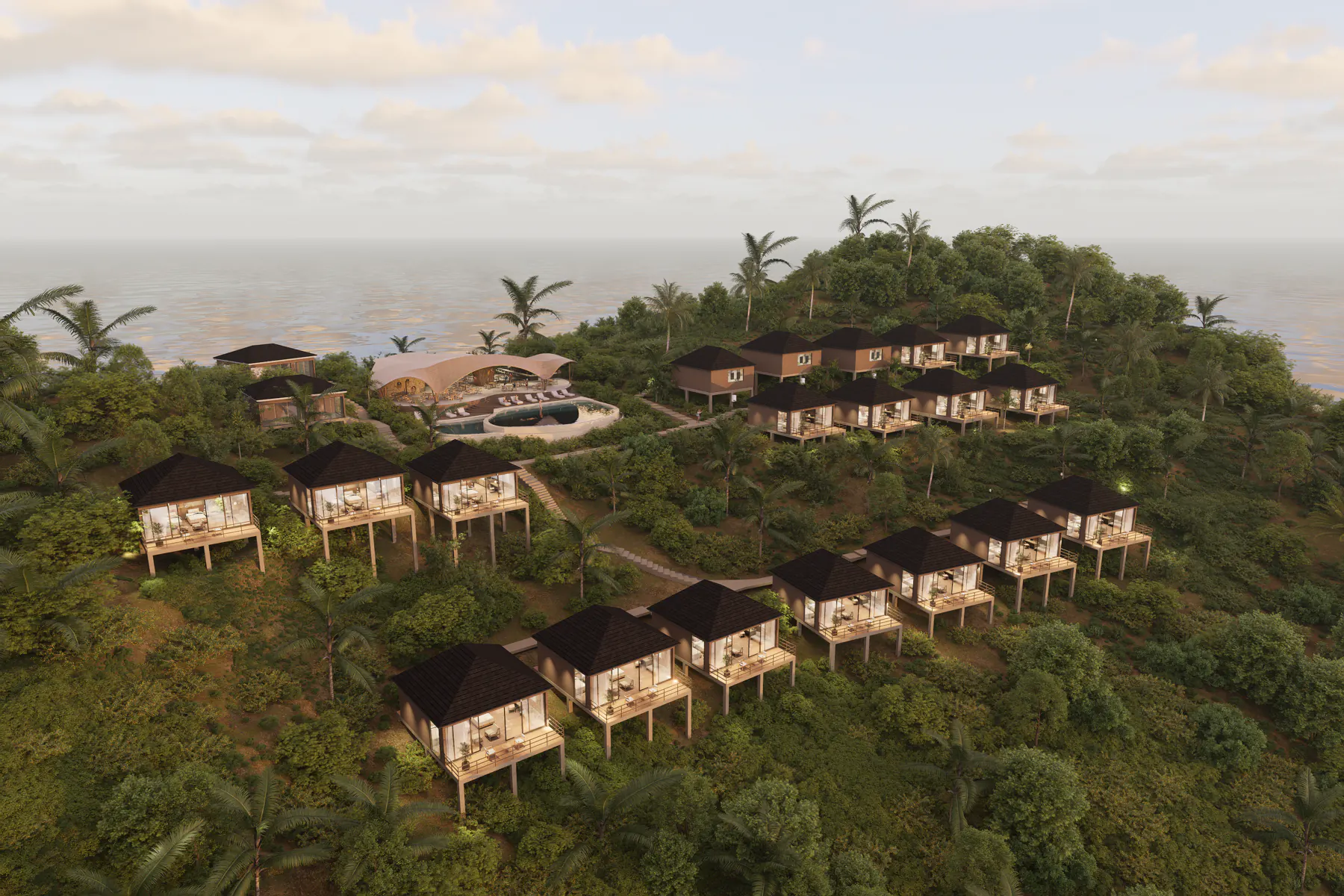
The second thing is a boundary that most visitors never notice. Sebayur, where our resort sits, lies just outside the northern edge of the national park, close enough that our boats reach the park's signature sites in minutes but far enough that the park's access rules do not govern a dive off our own jetty. That is the practical reason a night dive here is a simple thing to arrange, while inside the park proper night diving is limited and is mostly the preserve of liveaboards that are already moored at a sheltered site for the evening.
The best of them for most guests is the one directly in front of the resort. Our house reef runs about a kilometre along Sebayur Island, with turtles, reef sharks and healthy hard and soft coral, and the nearby Sebayur reef sites are a few minutes away by boat: gentle slopes with sleeping parrotfish, crustaceans, hunting morays and reliable bioluminescence. It is the water our guides know better than any other, because they dive it in every condition, year round. Knowing a site in daylight is what makes it safe and productive at night, and there is no substitute for that.
Inside the park, the one night-time site worth planning around is Wainilu, the shallow muck slope near Rinca described above, and that is a dusk dive rather than a true night dive. Our guide to the dive sites covers the daytime picture across the park.
The Park Rules That Apply After Dark
Komodo National Park is a managed marine protected area, not open water, and a few rules bear directly on night diving.
Night diving inside the park is limited rather than freely available, and where it happens it is at sheltered sites arranged in advance by an operator who handles the access side of it. This is the reason a night dive in the park is planned rather than decided on a whim at four in the afternoon, and the reason the answer is sometimes no. Dives from Sebayur sit outside the park boundary and are simpler, which is why most guests here do their night dive on the house reef.
Diving with a guide is mandatory throughout the park and solo diving is prohibited outright, with the currents given by the park authority as the stated reason. Every visitor entering the park is registered in advance through the park's online system, and diving carries a permit fee on top of the entrance fee; your operator normally handles both. Beyond that, the standard protections apply and matter more at night when your buoyancy is harder to judge: do not touch or stand on coral, do not collect anything, and do not feed fish. Park entrance fees are covered in our guide to park fees and regulations.
Rules here do get revised, sometimes with little notice, so treat any list you read online, including this one, as a starting point and confirm the current position with your operator when you book.
Torches, and the Rest of the Kit
Your primary torch does not need to be enormous. A wide, even beam of moderate power beats a narrow searchlight for actually seeing a reef, and a hard hotspot makes photography harder and blinds everyone around you. Something in the region of a thousand lumens with a decent beam angle is plenty.
The backup torch is not optional, and it should be clipped somewhere you can find without looking. Diving without one means a flooded primary ends the dive for you and, because you cannot be left alone, for at least one other person as well. Small and cheap is fine. Working is the requirement.
Add a marker light on your tank valve, a chemical stick or a small LED, so the guide can count the group at a glance and you can find each other without waving primary beams around. Take a delayed surface marker buoy with a light stick inside it. Take a compass and know how to use it. A spare mask costs little and saves a dive.
We rent torches at the dive centre along with the rest of the kit, so there is no need to fly with one if you are not sure you will use it more than once. Our Komodo packing list covers the broader question of what to bring.
Light Etiquette and Signals
Everything social underwater changes at night, because your torch becomes your voice and your face is invisible.
The core courtesy is simple: never shine your beam into anyone's mask. If you need to signal a buddy, point your light at your own hand and make the signal in the pool of light, or aim the beam at the sand near them to get their attention. A torch in the eyes destroys the night vision they have spent twenty minutes building.
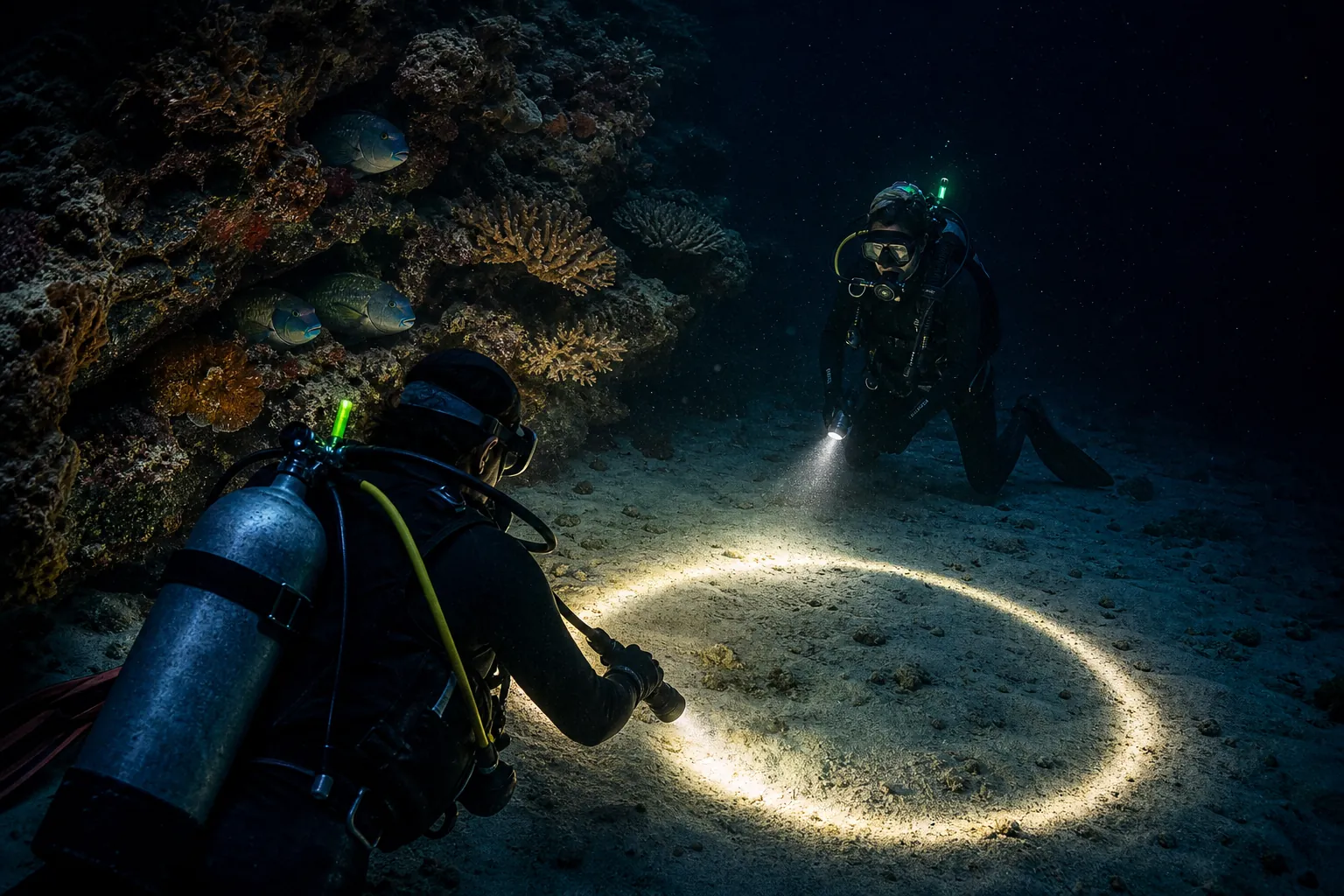
The light signals themselves are standard and worth rehearsing on the boat. A slow circle traced on the reef or sand means OK, and it is answered with the same. A beam moved rapidly side to side means attention, look at me, or there is a problem. A wide, exaggerated up-and-down sweep means emergency. Our guide to underwater hand signals covers the daytime vocabulary that still applies whenever your buddy can see your hands.
Two more habits separate comfortable night divers from twitchy ones. Keep your buddy in your peripheral vision by tracking their beam rather than their body, since the light is what you can actually see. And resist the urge to spotlight every animal continuously: light the edge of the subject, give it a few seconds, and move on. Some of the best behaviour you will witness only happens when the animal does not feel hunted.
Buoyancy, Navigation and Not Getting Disoriented
Night diving punishes sloppy buoyancy more than daylight does, because your visual references shrink to whatever your torch is pointing at. On a sandy site like Wainilu, one careless fin kick raises a cloud that ruins the next ten minutes for everyone behind you and buries the critter everyone came to see. Hover, keep your fins up and behind you, and move slowly.
Depth control needs conscious attention too. Without the surface glow to orient by, divers routinely drift a few metres up or down without noticing, so check your computer more often than you would in daylight. If you get genuinely disoriented, the fix is to stop, breathe, and look at your bubbles, which will always go up.
Navigation is easier than most people expect provided you keep it simple. Nearly every Komodo night dive is a there-and-back along a slope: reef on your left going out, reef on your right coming back. Note your depth and heading at the start, keep an eye on the contour, and you will not get lost. The boat will show a light, and on shore dives the jetty is lit, which makes finding the exit straightforward.
Do You Need to Be an Experienced Diver?
Less experienced than people assume, and more comfortable than people admit.
There is no certification that gates a night dive; a guide can take an Open Water diver on one, and the sheltered sites here are shallow and slow. What genuinely matters is your buoyancy, your comfort with the mask on your face when you cannot see much beyond your beam, and whether small surprises make you breathe faster. If you have twenty relaxed dives and stable buoyancy, you will enjoy it. If you are still working out your weighting, do that in daylight first.
The sensible sequence, and the one we suggest to guests, is to dive the site in daylight and then dive it again after dark. Recognising the ledge you saw that morning is what turns the dark from disorienting into interesting. If you want it formalised, the night dive is one of the adventure dives inside the PADI Advanced course and there is a dedicated night specialty; our overview of certification levels explains how those fit together, and complete beginners can start with an Open Water course here.
One honest caveat. If you are prone to anxiety in confined or dark spaces, a night dive can bring that on in a way daylight diving does not, and there is no shame in deciding it is not for you. Tell the guide beforehand rather than discovering it at fifteen metres. Guides here work to a maximum of four guests each, so there is room to keep someone close if that helps.
Why a Resort Makes Night Diving Easy
Night dives are the clearest practical argument for sleeping inside the park rather than commuting from Labuan Bajo.
A day boat from town has to leave in time to get home, which means the last dive finishes in the afternoon and sunset is spent on the crossing. From our jetty the equation is different: the afternoon dive runs at half past two, dinner is at the resort, and a night dive is a short boat ride or a walk down the jetty. Kit is rinsed and hung by the dive centre, the compressor is fifty metres away, and nobody is driving anywhere afterwards. A single night dive is IDR 1,700,000 at the time of writing, and a torch rents for IDR 80,000 if you would rather not fly with one.
A liveaboard solves the timing the other way, by being moored at the site already, and most itineraries include at least one night dive. Both work. The difference is that from a resort you can decide at lunchtime, and if you would rather sit with a drink and watch the flying foxes instead, nothing is wasted. The broader comparison is in our guide to staying inside the national park.
When to Go
Night diving here is possible year round, and the limiting factor is sea state rather than season. The calm, clear months from April to November suit it best, and the sheltered bays used for night dives stay diveable even when the exposed sites are being knocked about.
Moon phase is worth a thought for two opposite reasons. A dark, moonless night gives you the best bioluminescence and the most active hunting. A bright full moon lights the shallows beautifully and makes the whole dive feel less enclosed, which is easier for a first-timer. Neither is wrong. Our month-by-month guide covers the seasonal picture for the trip as a whole.
Book the night dive when you arrive rather than on your last evening. Conditions get a vote, guide availability gets a vote, and leaving a spare day means a postponement is not a cancellation. And do not fly the next morning; the usual surface interval before altitude applies exactly as it would after any other dive, which we cover in our article on flying after diving.
The Short Version
Komodo's reputation is built on current, big animals and blue water, and all of that happens between breakfast and mid-afternoon. The night shift is a quieter, closer, stranger kind of diving: octopus hunting in the open, a parrotfish asleep in a bag of its own mucus, shrimp eyes glittering back at you off black sand, and a handful of blue sparks when you turn the torch off and move your hand through the water.
It asks for a sheltered site, a guide who knows that site in daylight, two working torches, decent buoyancy and a bit of light discipline. Get those right and you will spend the rest of the trip telling people about the dive you never planned to do. Our dive centre arranges them on request; the safety picture for the region more broadly is in our guide to whether Komodo is safe.