Short answer: Bajawa is a cool highland town at about 1,100 metres in central Flores, and the base for the Ngada villages, where thatched clan houses face each other across yards full of megalithic stones and ancestor shrines. Bena is the best known and sits 19 km south of town under Mount Inerie, with a ticket of about IDR 20,000 to 25,000. Most people arrive on the long drive across Flores, but Wings Air flies Labuan Bajo to Bajawa daily in roughly 45 minutes, which makes it a realistic two-night add-on rather than a road trip.
Most guests come to us for the water. They fly into Labuan Bajo, spend a week with the guides at our Komodo dive centre, and go home having seen an extraordinary amount of Indonesia below the surface and almost none of it above. That is a fair trade and nobody regrets it. But there is a version of Flores about 130 km east that has nothing to do with reefs, and the reason hardly anyone sees it is a piece of received wisdom that is simply out of date.
The wisdom says Bajawa is a two-day drive away, which is why it only shows up in itineraries built around the Trans-Flores highway. Check the timetable, though, and there is a daily ATR 72 doing Labuan Bajo to Bajawa in about 45 minutes. That single fact changes what the Ngada highlands are: not a commitment to a week in a car, but two nights you can bolt onto the end of a diving trip or the front of a Komodo island tour. This is what is up there, what it costs in 2026, and the one piece of planning that divers in particular need to get right.
What Bajawa Actually Is
Bajawa is the capital of Ngada Regency, a town of roughly 40,000 people sitting in a bowl of volcanic hills at around 1,100 metres. It is not a pretty town. The centre is concrete shopfronts, motorbike repair places, a market, a lot of churches and a surprising number of good coffee stalls. Nobody comes for the town.
What Bajawa is, is a base. Within an hour of it, in several directions, are the villages of the Ngada people, who kept their ancestral architecture and their ceremonial life more intact than almost anyone else on Flores. Behind the villages stands Mount Inerie, a near-perfect 2,245 metre cone that dominates every view south. North of town the ground steams. The whole district is volcanic, and the hot springs are the reason your legs recover from whatever you did the previous day.
The first thing you notice on arrival is the temperature. Labuan Bajo in the dry season is 30 to 33C. Bajawa's average daily high sits between about 24 and 26C depending on the month, and the overnight low drops to somewhere around 13 to 16C, with July and August the coldest. After a week at sea level that feels genuinely cold. Guesthouse rooms up here rarely have heating and the hot water is a lottery. Bring a fleece, which is the single most common piece of advice from anyone who has been, and the single most commonly ignored.
The 45 Minute Flight Nobody Mentions
Here is the practical heart of this article. There are two ways to reach Bajawa from Labuan Bajo, and every English-language guide describes only the slow one.
By road, it is about 265 km and seven and a half to nine hours of driving, in two legs: Labuan Bajo to Ruteng is roughly 135 km of steady sealed climbing in three and a half to four hours, then Ruteng to Bajawa is about 130 km of mountain hairpins that takes four to five. Almost nobody does that in one push, and you should not try. Split it with a night in Ruteng. Our Flores road trip guide breaks the whole route down leg by leg if you want to keep going east afterwards to Ende, Moni and Maumere.
By air, Wings Air runs a daily ATR 72 between Komodo Airport in Labuan Bajo and Turelelo Soa Airport, which serves Bajawa. Scheduled time in the air is about 45 minutes. The same aircraft continues to Kupang, which is worth knowing if you are heading onward rather than looping back. Be aware of two things. The airport is not in Bajawa: it is out near Soa, roughly 25 km north of town, so budget 40 minutes and a transfer at each end. And regional Indonesian timetables change with very little notice, so confirm the specific day you want rather than trusting a schedule you read in an article. Sell-outs happen too, because an ATR 72 is 72 seats and locals use this route.
The overland middle ground, if you are travelling between towns on Flores rather than out of Labuan Bajo, is the Gunung Mas shared minibus. It runs Ruteng to Bajawa twice a day, about five hours for around IDR 120,000, and Bajawa to Ende for around IDR 200,000. Ask your guesthouse to reserve a seat the day before.
Bena Village, and What You Are Looking At
Bena is the village everyone means when they say they went to the Ngada villages. It sits in Desa Tiworiwu, in Jerebu'u district, about 19 km south of Bajawa, which is 30 to 40 minutes on a road that deteriorates politely rather than alarmingly. Inerie stands directly behind it.
The layout is the point. Around 45 houses are arranged in two long rows facing each other down a central avenue, stepped in terraces that follow the natural contour of the ridge rather than cutting into it. The houses are bamboo and timber under thatch, and the motifs on each roof identify the clan that owns it. Nine clans live here: Bena, Ago, Dizi, Dizi Azi, Deru Lalulewa, Deru Solamae, Khopa, Wahto and Ngada. At the far end, where the ridge drops away, there is a small rise with a statue of the Virgin Mary set among the stones.
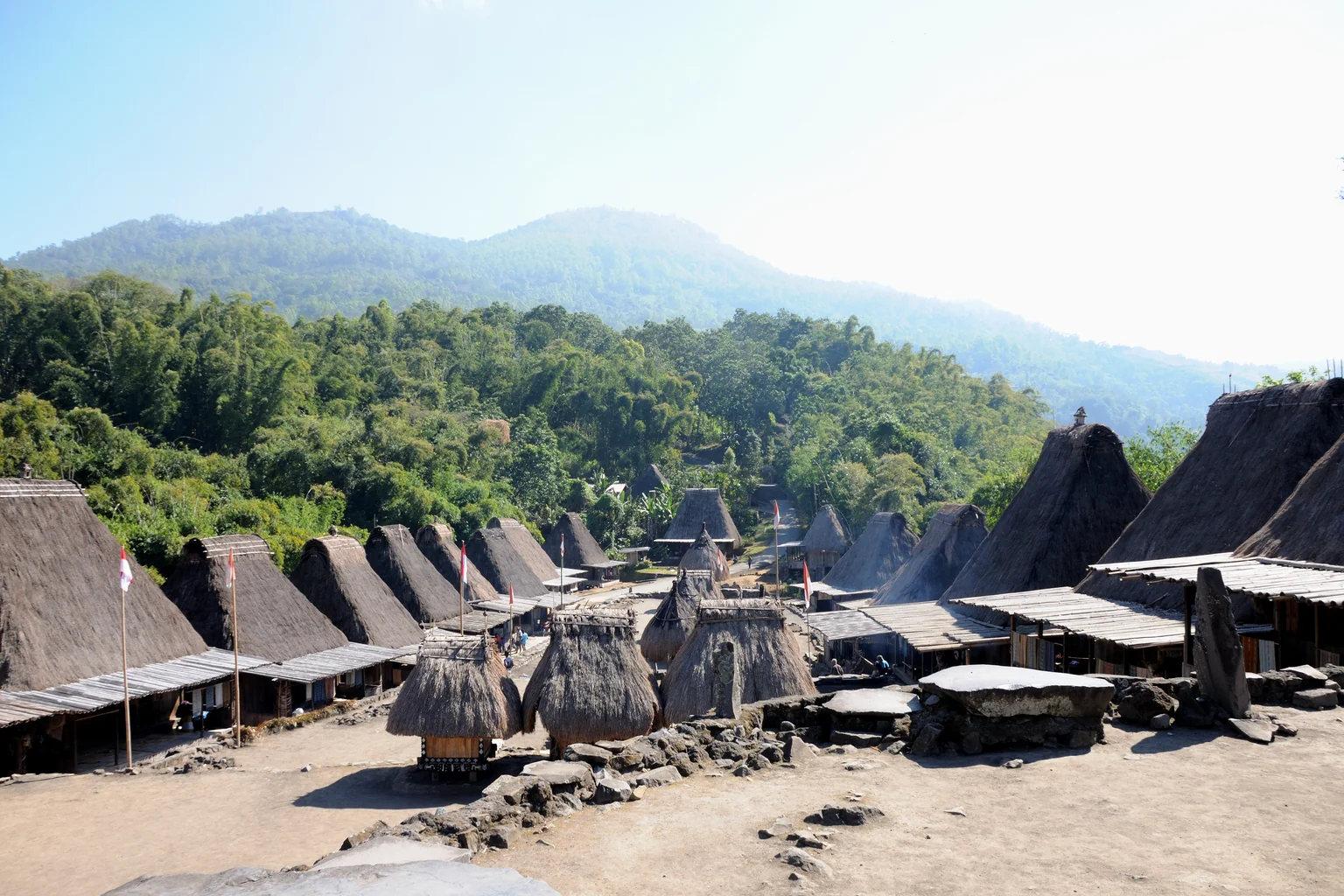
That last detail tells you more about Ngada than anything else in the village. This is a place where a megalithic ancestral religion and Catholicism did not fight to the death. They layered. People here will take an offering to the ancestors and go to Mass, and see no contradiction worth discussing with a visitor.
Bena has been on Indonesia's UNESCO tentative list since 1995, in the cultural category. Worth being precise about that, because a lot of pages describe it as a World Heritage Site and it is not one. The tentative list is the queue.
Ngadhu and Bhaga: The Two Shrines in Every Yard
In the central avenue of Bena, and of every Ngada village, you will find pairs of structures that look like nothing else in Indonesia. They are the reason the architecture reads as strange even to visitors who have seen a lot of traditional Indonesian building.
The ngadhu is the male ancestor. It is a single thick post of hard wood, carved, standing under a conical roof of thatch or palm fibre so that the whole thing resembles a figure wearing a hat, or a small parasol, depending on who is describing it. The choice of hardwood is practical as well as symbolic: at ceremonies, sacrificial animals are tethered to that post.
The bhaga is the female ancestor, and it is built as a miniature house, roofed and walled, small enough that no one lives in it. Offerings are made there.
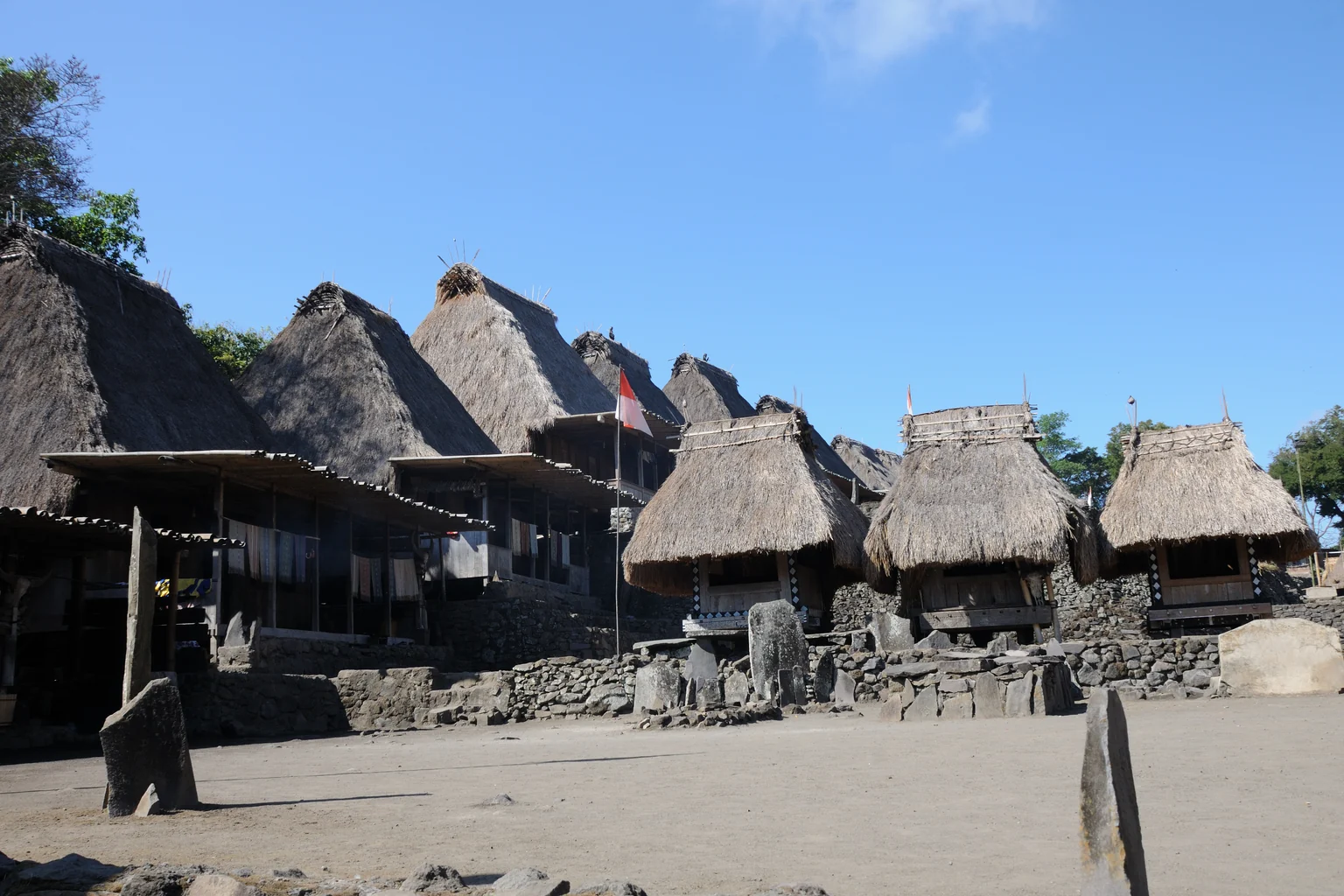
They come in pairs, one ngadhu to one bhaga, each pair belonging to a descent group, which is why counting them tells you how the village is organised. Ngada society is usually described as matrilineal, with descent and house rights running through the mother's line, and this is unusual enough in Indonesia that it is worth mentioning to anyone who assumes eastern Indonesia is uniformly patrilineal.
The stones scattered around them are not decorative either. They are ceremonial platforms and graves, and the flat ones are where ritual takes place.
What It Costs to Visit Bena in 2026
The East Nusa Tenggara provincial tourism office lists the Bena ticket at IDR 20,000 per person for domestic visitors and IDR 25,000 for foreign visitors, with parking at IDR 5,000 for a car or motorbike.
In practice, reported amounts scatter. Some sources say IDR 10,000, some say 25,000 flat, some report up to 35,000, and at least one says there is no ticket at all and you simply give what you think is right. The likeliest explanation is that collection is handled by whoever is at the welcome hut and has changed over the years. The number is small either way. Bring cash in small notes, expect something in the IDR 20,000 to 35,000 range per person, and do not haggle over it.
What happens next is consistent everywhere. You sign the village guest book, and you are lent a woven ikat scarf or headcloth to wear for the duration of your visit. Wear it. It is not a souvenir upsell, it is the marker that you have been received.
The women of Bena weave, and they will lay textiles out as you walk through. Scarves start around IDR 75,000 to 100,000. A full cloth runs from about IDR 300,000 into the hundreds of thousands, and the good ones are worth it, because you are looking at months of work in natural dye. There is no ATM anywhere near, and nothing here takes cards. Our guide to money and ATMs in Labuan Bajo is worth reading before you leave the coast, because the highlands are where people run out of cash.
The Rules That Matter in a Living Village
Bena is not a museum and not a reconstruction. People live in those houses, and the single most useful mental adjustment is to behave as though you are walking down someone's hallway, because you are.
- Cover your shoulders and knees. Long trousers or a long skirt is right; beachwear is not.
- Ask before photographing a person, and take no for an answer. Photographing the architecture is fine.
- Do not climb on, lean against or touch the ngadhu, the bhaga, the graves or the ceremonial stones.
- Do not walk into a house uninvited. If you are invited, remove your hat, and a small gift or contribution is the right response.
- If a ceremony is happening, you are a guest at it, not an audience for it. Follow whatever the custodians tell you and put the camera away unless you are told otherwise.
- A local guide is not compulsory but it changes the visit completely, because almost nothing here is labelled and the meaning is the entire attraction.
Gurusina, and What a Fire Takes
About 21 km from Bajawa, also in the Jerebu'u valley under Inerie, is Gurusina. It is less visited than Bena and it carries a story worth knowing before you arrive.
On 13 August 2018, fire went through the village. Of 33 traditional houses, 27 burned, along with three ngadhu and three bhaga. The central government put Rp2.2 billion into reconstruction, and the community rebuilt using traditional forms and materials, which in Ngada is not merely a building project but a ritual re-establishment of the link to the ancestors. The village functions again today, with 32 clan houses standing, and the Labuan Bajo Flores tourism authority now promotes it as a cultural heritage destination.
The part that does not appear in the promotional version is what could not be rebuilt. Researchers documenting the village afterwards recorded that while the houses and many symbols could be remade, some things could not: buffalo horns held for generations, the jaws of sacrificial animals, gold chains. A house can be re-thatched. Four hundred years of accumulated heirlooms inside it cannot.
Go to Bena for the spectacle and Gurusina for the perspective. It is also markedly quieter, which for some visitors is the whole argument.
Tololela, Luba and Wogo: The Quieter Villages
Bena absorbs almost all the traffic, which leaves several other Ngada villages nearly to yourself.
Tololela sits higher, split into an upper and a lower village by the steep ground, with seven clans between them and seven pairs of ngadhu and bhaga in the yards. It is the one most often mentioned by people who want to stay overnight in a Ngada village rather than photograph one.
Luba is a short walk from Bena and gets a fraction of its visitors despite being close enough to add on in an hour.
Wogo lies on the other side of Bajawa and has an older abandoned site nearby with the megaliths still standing where the village used to be.
The best way to see this properly is on foot. There is a walking route linking Bena, Tololela and Gurusina through bamboo stands and smallholdings, with the southern flank of Inerie above you the whole way. Half a day, a local guide, and you will have seen three villages and the countryside that connects them instead of three car parks. If you like that style of visit, the same logic applies to Wae Rebo village further west, which is the other great Flores village experience and is reached only on foot.
Mount Inerie: An Honest Assessment of the Climb
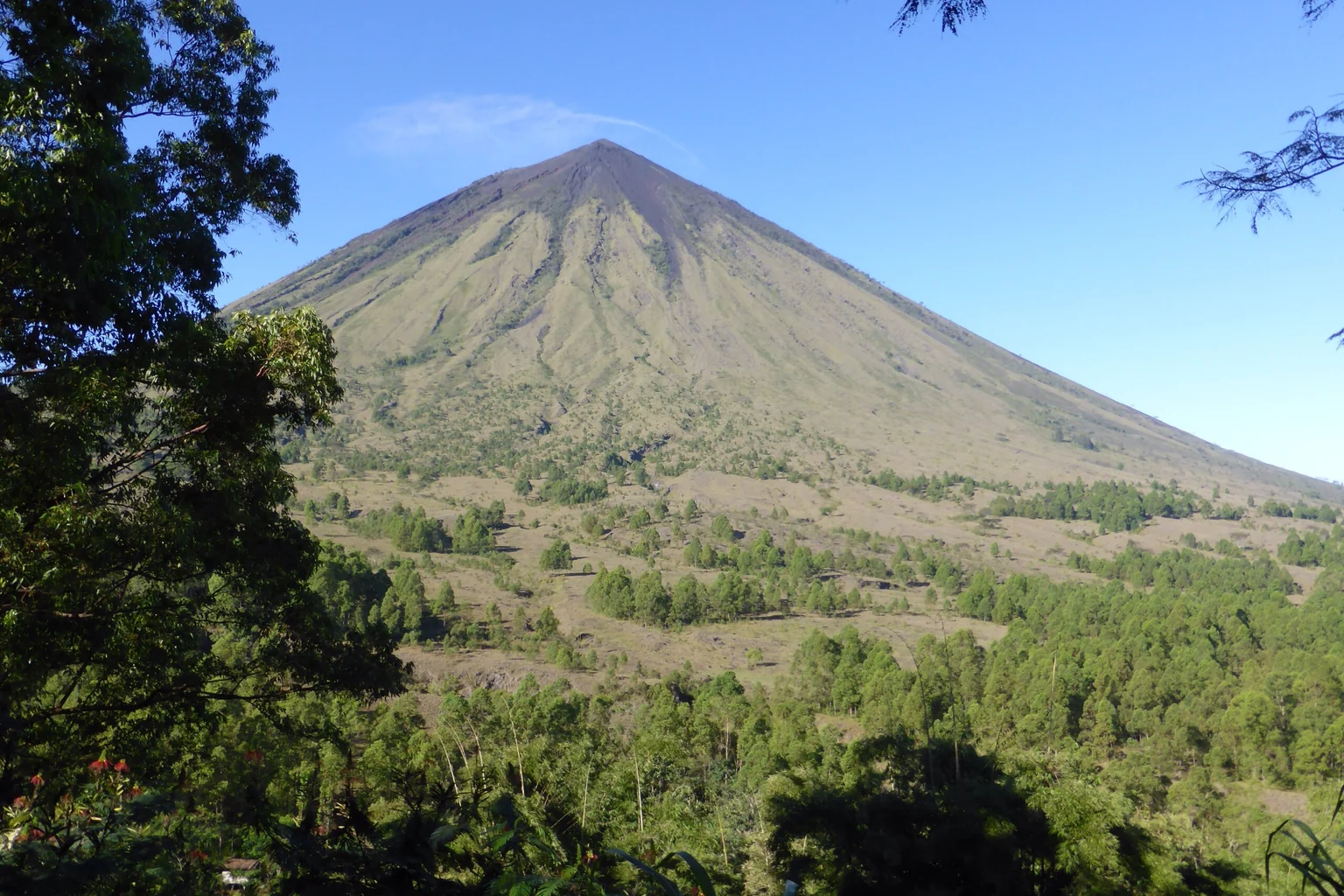
Inerie is 2,245 metres and it is the reason photographs of Bena look the way they do. Locally the name is usually explained from ine, mother, and you will hear it glossed as something like the beautiful mother.
Climbing it is a serious undertaking and it is regularly undersold. Here is the shape of it. The trailhead is at Watumeze, around 1,100 metres, 15 to 20 minutes by car from Bajawa. That leaves you roughly 1,100 metres of ascent. Reckon on two and a half to four hours up and two to three and a half hours down, so five to eight hours in total depending on fitness and how long you sit at the top.
The first hour is gentle, through savanna and scattered trees. Then it changes. The upper mountain is loose volcanic scree and sharp rock on a slope steep enough that people describe climbing it on all fours, with deep ravines flanking the route on both sides. There is no signage and, above a certain point, no obvious path.
The descent is the dangerous half, which is the opposite of what most people expect. Going down, it is easy to slip on scree, and it is easy to take the wrong line into one of the ravines, at which point the only fix is to climb back up to rejoin the correct route. In poor visibility that is a genuinely bad situation.
Take a guide. Villagers at Watumeze have told visiting operators that unguided tourists have got lost and been injured falling on the rock. Guides charge in the region of IDR 200,000 to 300,000 in 2026, which is nothing set against the alternative, and they know the correct descent line. You will also want a headlamp if you are starting in the dark, gloves because the rock cuts, poles or a stick for the way down, grippy footwear, a warm layer for the summit wind, and all your own water, because there is none on the mountain.
Two schools of thought on timing. Start around 2:00 to 2:30am and you get sunrise from the summit, plus the mountain's pyramid shadow thrown across the landscape, and you avoid the heat. Start at first light instead and you lose the sunrise but do the technical descent in full daylight, which is the safer option and the right one if anyone in the group is a hesitant scrambler. Do not go up in rain or immediately after it, and do not go in the wet season. The dry months from roughly April to October are the season for this.
If you want the image without the ordeal, there are roadside viewpoints on the way to the villages where the cone rises straight out of farmland, and honestly they are where the best photographs of Inerie come from anyway. For more of this kind of walking at sea level, our guide to hiking in Komodo covers the trails inside the park.
Two Hot Springs, and Which One to Choose
Ngada sits on a lot of geothermal activity, and there are two hot springs in the visitor rotation. Most articles treat them as interchangeable. They are not, and the difference is geography.
Mengeruda, also called Soa hot spring, is in Kecamatan Soa about 25 km north of Bajawa, roughly 4 km from the airport. Water emerges between 35 and 45C, sulphurous, and the site is developed: built pools as well as stretches of natural river, gazebos to rent, warungs selling instant noodles, boiled eggs and cold drinks, parking and toilets. Open roughly 08:00 to 18:00. The published foreigner ticket has been IDR 12,000, though a January 2026 listing puts it at IDR 20,000 to 25,000, with parking IDR 3,000 to 5,000. Some visitors find parts of it too hot to sit in.
Malanage is south of Bajawa, near the Ngada villages, and it is the wilder of the two: hot water running into a jungle river so you can sit where the hot and cold streams meet and pick your temperature. Around IDR 20,000.
The practical upshot: if you are spending the day at Bena and the southern villages, Malanage is on your way back and Mengeruda is not. If you are flying out of Turelelo Soa, Mengeruda is essentially at the airport and makes a very good last two hours on Flores. Our Flores road trip guide calls Soa the standard afternoon, and for someone driving through that is right. Coming from Bena, take Malanage.
Bajawa Coffee, and Why It Has Its Own Certificate
If you know one thing about Bajawa before arriving, it is probably the coffee, and for once the reputation is documented rather than marketing. Kopi Arabika Flores Bajawa holds a registered Indonesian geographical indication, number IG.00.2011.000005, with the certificate issued by the Ministry of Law and Human Rights in 2012. That is the same class of protection that governs where a cheese or a wine can claim a place name, and it means the origin is legally defined rather than asserted on a bag.
The growing area covers something in the order of 6,500 hectares producing roughly a tonne of green bean per hectare, on the volcanic slopes around Inerie. Sources disagree on the altitude band, with the producer cooperative citing 900 to 1,200 metres and other accounts 1,200 to 1,800, so treat any precise figure on a café blackboard with mild suspicion. The character people describe is a heavier, chocolatey, low-acid arabica, which is a fair description of what you get in town.
Ngada weaving holds a geographical indication too, which is useful context when you are looking at cloth in Bena and wondering whether the price is real.
The town's own festival, the Wolobobo Ngada Festival, is built around exactly these things. Recent editions ran over four days in late July with coffee, weaving and bamboo as the themes, and it is on the national curated events list. Dates move year to year, so check before building a trip around it.
Reba: The Ceremony You Cannot Quite Plan Around
Reba is the big one in the Ngada year, and it is the reason some visitors come in what is otherwise the worst month to travel on Flores.
It is a thanksgiving, given to God and to the ancestors, marking the end of the harvest and the turn of the customary year. The central symbol is the uwi, the yam, and the ceremony turns on the Su'i Uwi, the cutting of the yam, and the O Uwi, the chanted verses and dance around it. It runs across several days, with feasting, gongs and drums, traditional dress and a great deal of collective singing. Three groups within Ngada Regency hold it: the Bajawa, Soa and Riung communities. Since Catholicism reached the area around 1919 it has been woven into the Eucharist as well, which is that same layering you see in the Marian statue at Bena, expressed as a calendar instead of a statue.
Here is the honest planning problem. Reba runs from December through February, village by village, on the customary calendar, with the peak commonly falling in early to mid January. Which village celebrates on which date is decided locally and is not published in a form you can book flights against. It is also the height of the wet season, when Bajawa gets around 376mm of rain in January.
So: if you happen to be on Flores between December and February, ask locally, because there is a reasonable chance something is happening within an hour of town and visitors are genuinely welcomed rather than tolerated. Do not fly from Europe in January on the assumption that you can schedule it. And if January is on your mind for the diving side of the trip too, our guide to Komodo in January explains what the monsoon does to the park.
If You Are Diving in Komodo, Read This Before You Book
This is the section no travel guide to Bajawa contains, and for our guests it is the most important one on the page.
Bajawa is at altitude. Going to altitude after diving carries the same decompression risk as flying, because the mechanism is identical: ambient pressure falls, and nitrogen still dissolved in your tissues can come out of solution as bubbles. The DAN and UHMS guidelines that everyone knows as the flying-after-diving rules are written for the altitude band from 610 to 2,438 metres, and DAN is explicit that they apply to any post-dive ascent, including by road and on foot, not only to aircraft.
Run the numbers on this trip and it is not marginal:
- Bajawa town, about 1,100 metres. Inside the band.
- The Inerie trailhead at Watumeze, about 1,100 metres. Inside the band.
- Ruteng, if you drive and break the journey there, about 1,200 metres. Inside the band.
- The summit of Inerie, 2,245 metres. Inside the band, but close to the 2,438 metre ceiling above which DAN advises against going after diving until excess inert gas has cleared.
The recommended minimum surface intervals are 12 hours after a single no-decompression dive, 18 hours after multiple dives in a day or multiple consecutive days of diving, and substantially longer than 18 hours after any dive requiring decompression stops, where 24 hours is the common working figure. If you have been doing three dives a day for a week, which is what a stay with us normally looks like, you are in the 18 hour category at minimum, and more conservative is better.
What this means in practice is simple. Put the highlands at the end of the trip, not in the middle, and leave a clear day between your last dive and your ascent. The 45 minute flight is convenient enough that it is tempting to slot Bajawa between two blocks of diving, and that is exactly the wrong shape. Going the other way is fine: arriving at altitude and then coming down to sea level to dive poses no decompression problem at all.
Our guide to flying after diving goes through the full guidance and the reasoning, including why the Trans-Flores highway counts. And if the worst happens, it is worth knowing before you travel where the nearest hyperbaric chamber in Labuan Bajo is, because there is nothing in the highlands and you would be looking at a long journey back down.
When to Go, and What to Pack
The dry season, roughly May to October, is the straightforward answer, and it is emphatic here. Bajawa's rainfall goes from about 20mm in September and 26mm in August to 376mm in January, on an annual total of roughly 1,835mm. Village paths turn to mud in the wet, Inerie becomes a bad idea, and the cone spends most of its time in cloud, which removes the main visual reason to come.
September and October are the sweet spot: dry, clear, the cone visible most mornings, and the coffee harvest done. That also lines up neatly with the best diving window in the park, which we go through in Komodo in October.
For packing, the highland list differs from the coastal one in exactly one respect, and it is the one everyone gets wrong:
- A fleece or light down layer, plus long trousers. Nights in the low-to-mid teens after a week at 30C feel much colder than the number suggests.
- A rain shell, in any month.
- Shoes with real grip. Village terraces are uneven stone and Inerie is scree.
- Cash in small notes, more than you think. No ATMs outside town, no card payments in the villages.
- Modest clothing for the villages, which is not the same as your dive-boat wardrobe.
- A swimsuit and a quick-dry towel for the hot springs.
- A headlamp if Inerie is on the list.
Our full packing list for Komodo Island covers the marine half of the trip. Add the fleece.
Where to Stay, and What It Costs
Bajawa is guesthouse territory and it is cheap. Small family-run places run in the region of IDR 150,000 to 180,000 a night in 2026. Quality varies a lot, and the one thing genuinely worth paying up for is hot water that works, because of the altitude. Ask specifically, and ask whether it is hot water or a tank that is warm at 7am and cold by 8.
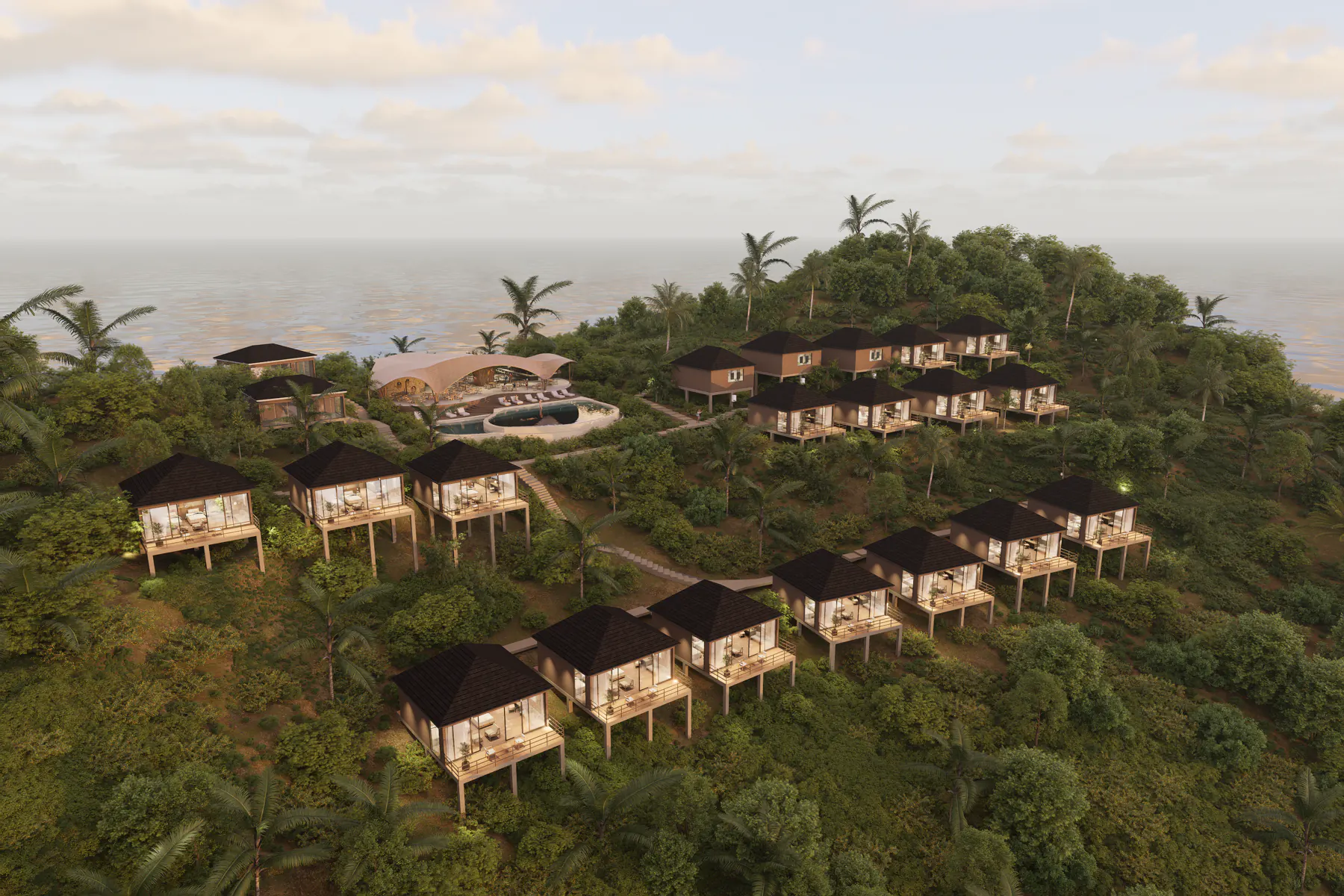
An alternative some visitors prefer is staying out in the Jerebu'u valley south of town, closer to Inerie and the villages, where a couple of small places have views straight at the cone. That also shortens the pre-dawn transfer if you are climbing.
Two nights is the right length for a first visit. Day one for Bena, Luba and Malanage, day two for either Inerie or the Tololela and Gurusina walk, and Mengeruda on the way to the airport. Three nights if you want both the climb and the walking, or if you want any chance of being around when something is happening in a village.
Practical notes. Mobile coverage in Bajawa town is fine and patchy in the valleys, and it is worth sorting a local Indonesia SIM card or eSIM before you leave the coast. Bajawa has ATMs; the villages do not. And check your visa situation covers the whole trip, which our Indonesia visa guide walks through.
Who Should Skip Bajawa
Plenty of people should, and it is more useful to say so than to pretend a destination suits everyone.
Skip it if you have fewer than ten days in Indonesia, because the days this costs come straight out of your diving. Skip it if the idea of a village visit makes you uncomfortable, since being uncomfortable while doing it is worse for everyone than not going. Skip it if you need reliable comfort, because up here that does not exist at any price. Skip it if you are travelling in January or February and the diving is the priority. And skip the Inerie climb specifically, while still enjoying the rest, if you have knee problems or no scrambling experience, because the descent is unforgiving and you will be a long way from help.
Go if the thing you remember from trips is the hour you spent not understanding something. That is what Bajawa is good at.
How Bajawa Fits a Komodo Trip
The shape that works is diving first, highlands second, and a clear day between them.
Spend your week in the park, get the dives in, then take the flight up after a proper surface interval. Two or three nights in the Ngada highlands, then fly back to Labuan Bajo, or carry on to Kupang and out from there. If the drive appeals more than the flight, you are really planning the Flores road trip, and Bajawa becomes the second stop rather than the destination, with Kelimutu crater lakes and eventually Maumere diving further east.
If Bajawa is too much but the idea appeals, there are shorter versions of the same instinct closer to base. Rangko Cave is a half day from Labuan Bajo. Liang Bua, where Homo floresiensis was found, sits near Ruteng and can be reached on a long day. And if you are still working out how Flores, Komodo and Labuan Bajo relate to each other at all, our explainer on where Flores Island is sorts that out, while our Komodo Island itinerary shows where a highland block fits in a whole trip.
So Is Bajawa Worth It?
If you measure a trip in comfort, no. The rooms are basic, the road in is long unless you fly, and the town itself is unremarkable.
If you measure it in the number of times you see something you have no existing category for, Bajawa is the best value on Flores. Two rows of thatched houses facing each other across a yard of standing stones, with a perfect volcano behind them and a Virgin Mary among the megaliths at the far end, is not a sight you can approximate somewhere else. And the flight makes it cost two nights instead of a week, which is the change that makes it a reasonable thing to ask of a diving holiday.
Go dry season, take a guide in the villages, wear the scarf they lend you, leave a clear day after your last dive, and bring the fleece.